
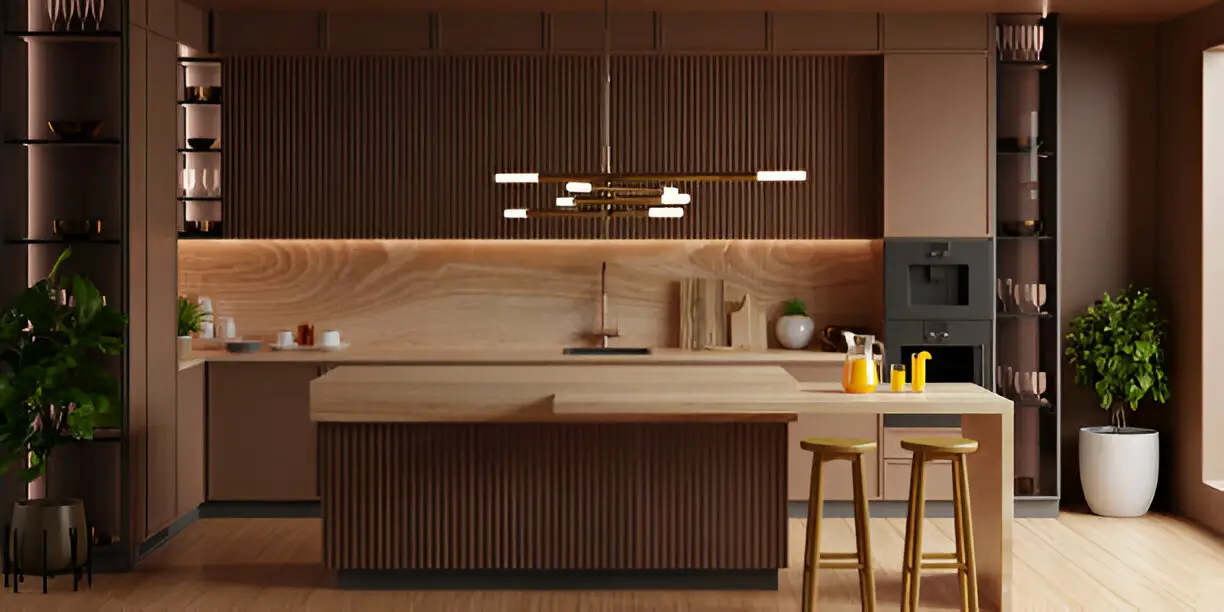

For nearly a decade, the modern kitchen island was code for one thing: a long white box, quartz on top, three pendants overhead. That look has officially aged out. According to the 2026 Houzz Kitchen Trends Study (a survey of 1,780 U.S. homeowners who recently renovated), wood-toned cabinetry overtook white as the most-specified cabinet color for the first time in years. For the island countertop specifically, wood is now the leading choice. Islands themselves are getting bigger, more functional, and far more central to how the kitchen actually works.
At USA Cabinet Express, we see this shift play out every week across our showrooms in Austin, Dallas, Houston, Chesapeake, Fairfax, Fredericksburg, and St. Louis. Dealers are pulling fewer all-white slab samples and more mid-tone oak and walnut. Contractors are quoting longer islands. Homeowners are asking about waterfall edges, integrated dishwashers, and handleless fronts they saw on Houzz. This guide is built for all three audiences. It covers what defines a modern kitchen island in 2026, the eight design directions worth specifying right now, the dimensions and clearances that pass code and feel right in the room, the materials that earn their cost, and the cabinet brands at USA Cabinet Express that actually fit a modern brief.
Modern Kitchen Island Trends 2026
Top Trends
| Kitchen | Length |
|---|---|
| Compact | 36–48″ |
| Medium | 60–84″ |
Schedule Consultation
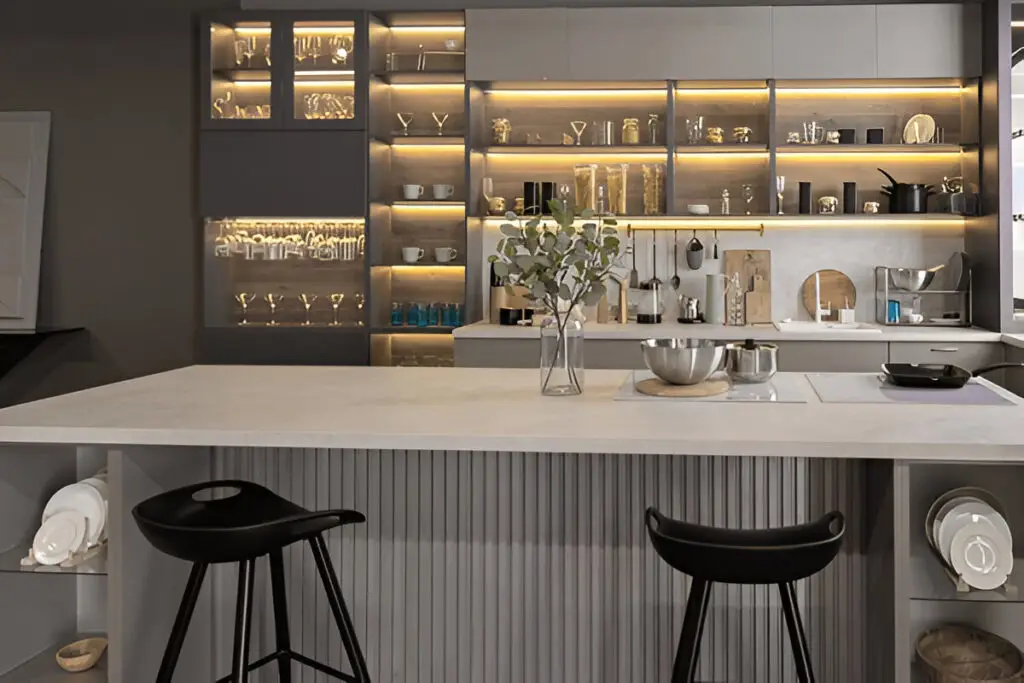
Key Takeaways
- Wood became the #1 island countertop choice in 2026, overtaking white and quartz for the first time (Houzz 2026)
- Roughly half of renovated islands now exceed 7 feet in length, with rectangular shapes outpacing L-shaped layouts 4 to 1
- More than half of homeowners integrate at least one appliance (dishwasher, microwave drawer, or beverage center) into the island itself
- Two-tone islands, where the island carries a contrasting color from the perimeter cabinets, are now specified in 24% of renovations
- Bar pulls have replaced knobs as the dominant island hardware, most often in brushed nickel, matte black, or brushed gold
- Industry pros expect kitchen footprints to grow over the next three years (NKBA 2026 forecast: 76% of professionals), and the island is what most of that new square footage feeds
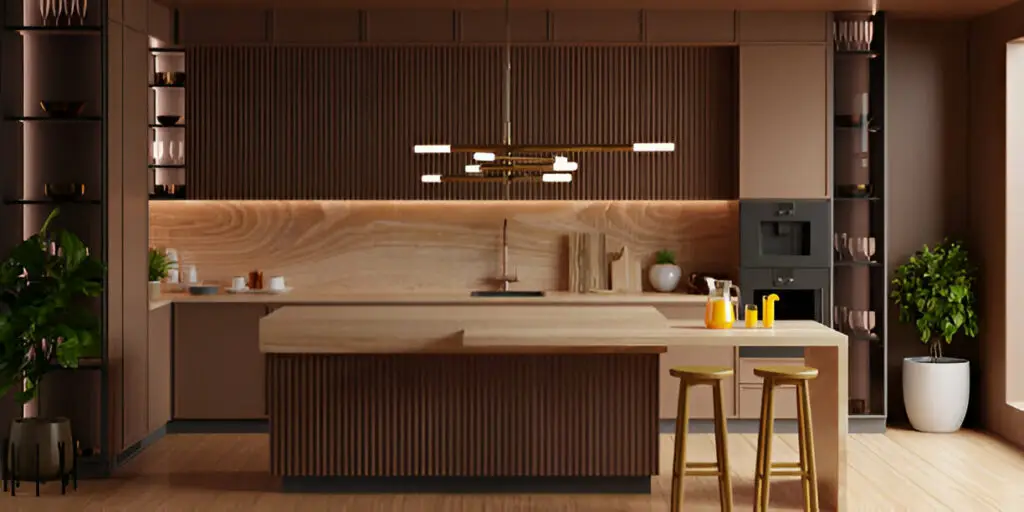
What Defines a Modern Kitchen Island in 2026
A modern kitchen island in 2026 is a freestanding cabinet run, sized between 36 and 96+ inches long, that anchors an open-plan kitchen and absorbs at least three jobs the perimeter used to handle: prep, storage, and casual dining. What separates it from a transitional or farmhouse island is the visual language. Modern islands favor flat-panel or slim-Shaker doors, integrated or minimal hardware, clean horizontal lines, and either tonal restraint or one decisive contrast moment.
The all-white era ran from roughly 2014 through 2023. What replaced it is more nuanced than “wood is back.” Industry forecasters group the 2026 shift under two themes: Organic Grounding (warm woods, natural stone, layered texture) and Tactile Luxury (mixed species, refined proportions, hand-feel finishes). Three threads run through both: warm, grounded materials (natural oak, walnut, ash, often mixed within a single project); refined proportions (slimmer rails, larger cabinet boxes, taller toe kicks); and integrated function (appliances disappearing into the casework instead of stacking on the perimeter). For dealers and contractors, this means the kitchen island is now the deepest revenue point in the project. It carries more linear feet, more drawer hardware, and more spec decisions than the perimeter run on most jobs.
One quiet rule is doing most of the work in well-designed modern islands: drawers outperform cupboards. Pull-outs put the contents at eye level, eliminate the bend-and-rummage problem, and make zoned storage (pans near the cooktop, utensils near the prep zone, recycling near the prep sink) trivial. The other rule is restraint: choose one primary role and one secondary role for the island, no more. Prep plus seating, or prep plus storage, will outperform “prep plus cooktop plus sink plus dishwasher plus breakfast bar” on any footprint short of a great room.
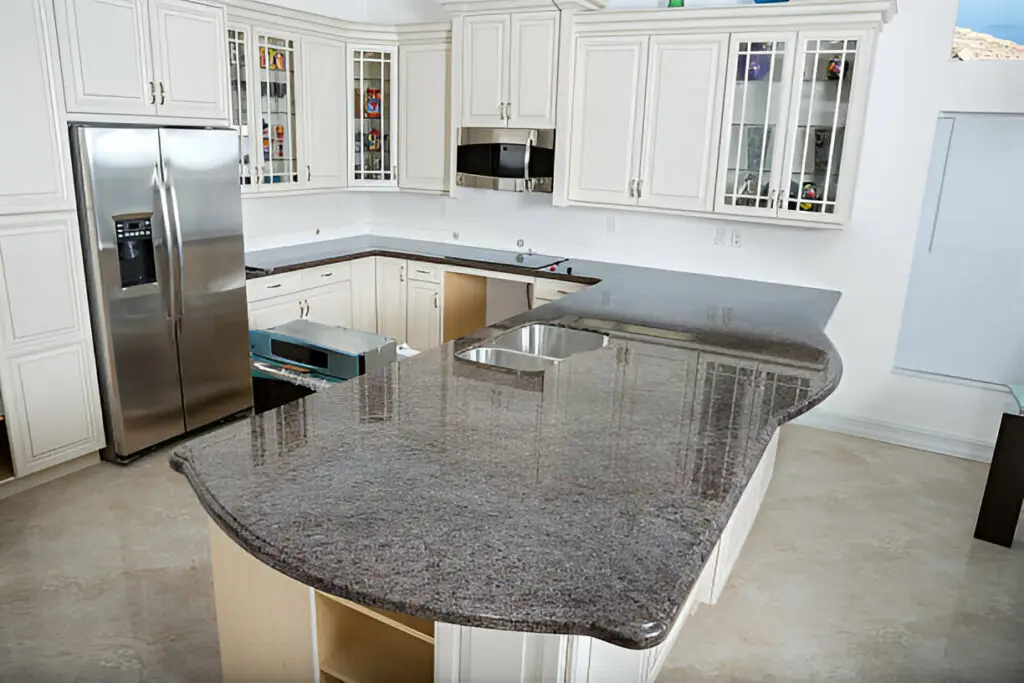
Eight Modern Kitchen Island Design Directions for 2026
Below are the eight directions shaping modern island design this year, each tied to a Houzz or NKBA data point and to an actual product line we stock. The right move depends on the project budget, the perimeter cabinet selection, and whether the island is the room’s quiet anchor or its loudest moment.
1. Warm Wood Tones: The Defining Move
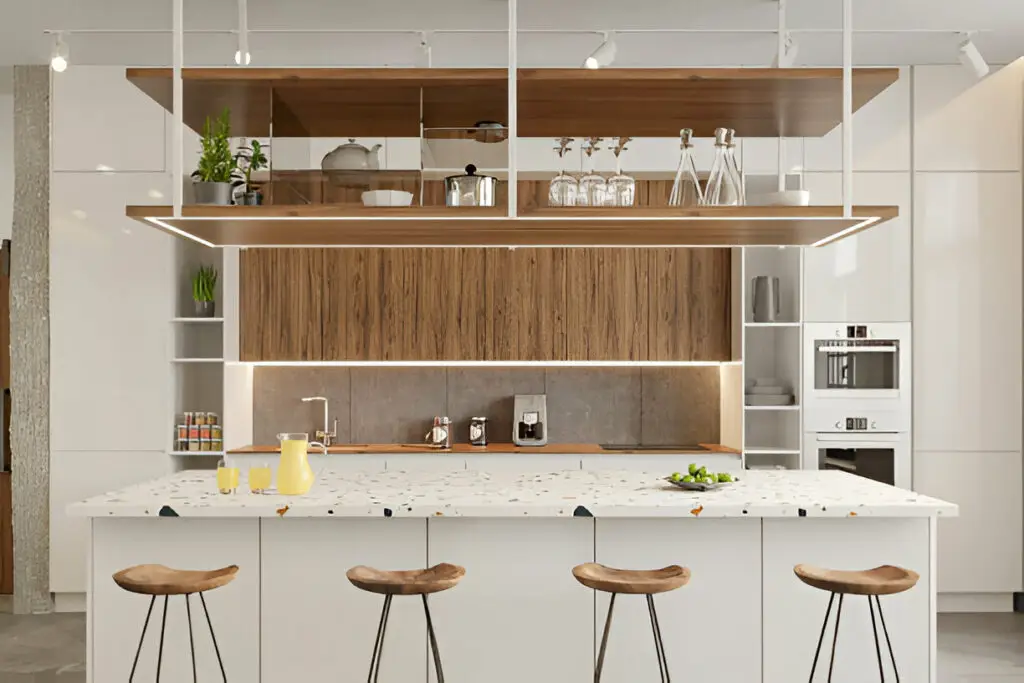
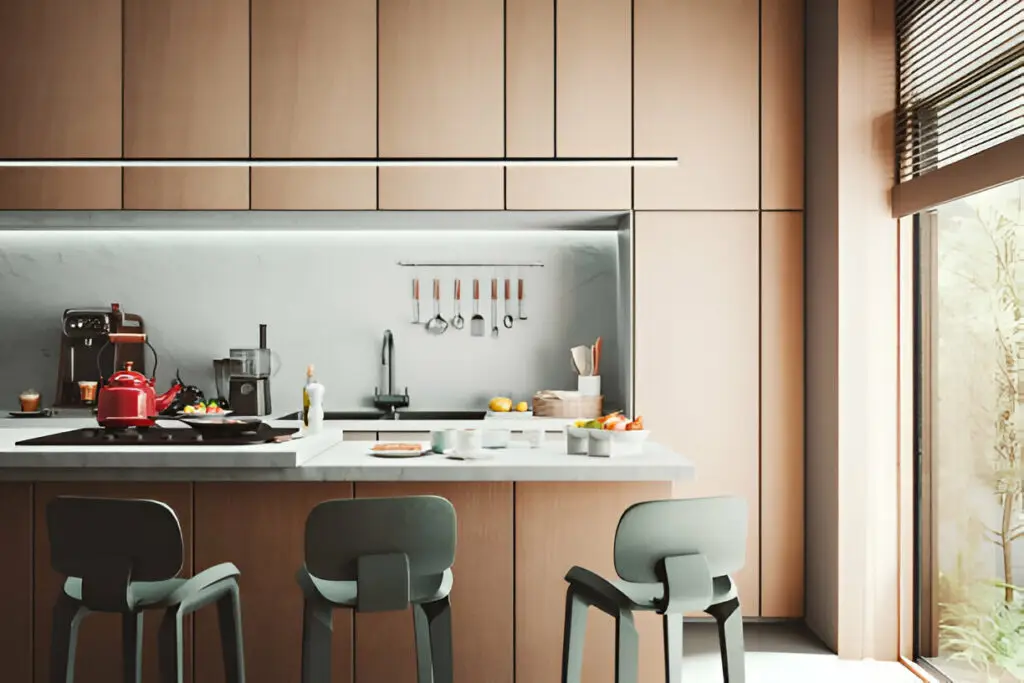
The single biggest shift in 2026: wood replaced white as the most-specified island countertop, and medium-toned woods lead the comeback. Oak (especially white oak), walnut, and ash dominate the spec sheets. The look reads as warmer and more lived-in without slipping into farmhouse territory. For a modern read, the grain stays clean and rift-cut, the finish stays matte or satin, and the hardware leans dark or brushed gold. Fabuwood Allure Galaxy in Horizon and the Luna Desert Oak stain both serve this brief well at the budget-to-mid range.
2. Two-Tone Islands
A two-tone scheme (perimeter in one color, island in another) is now the default for 24% of remodels (Houzz 2026). The island most often takes the darker or warmer of the two. Common 2026 pairings include white perimeter with walnut island, light oak perimeter with deep navy or forest green island, or matte black island against soft white perimeter. The trick is using paint or stain on the island only, which keeps perimeter cabinet costs predictable while letting the island do the design work.
3. Waterfall Edges, Now Paired with Wood
Waterfall countertops, where the stone slab folds vertically down the side of the island, are still in heavy rotation in modern remodels. What changed: the dominant pairing is no longer veined white quartz against a white base. It’s veined stone or warm-leaning quartz running over a wood island. The visual contrast, cold stone meeting warm wood, is the defining 2026 moment. Engineered quartz remains the most popular choice for the slab itself because it survives spills better than natural marble.
4. Curved and Soft-Edge Islands
Designers are trading sharp 90-degree corners for rounded ends or full sweeping arcs. Curved islands cost more (custom radius cabinet boxes plus stone fabrication that follows the curve) but they soften an open-plan kitchen and improve traffic flow on the seating side. They show up most often in higher-end remodels where the island is the architectural centerpiece. For dealers selling against pre-built RTA at the lower end of the market, curved islands are where the upcharge story justifies itself.
5. Integrated Appliances and Specialty Zones
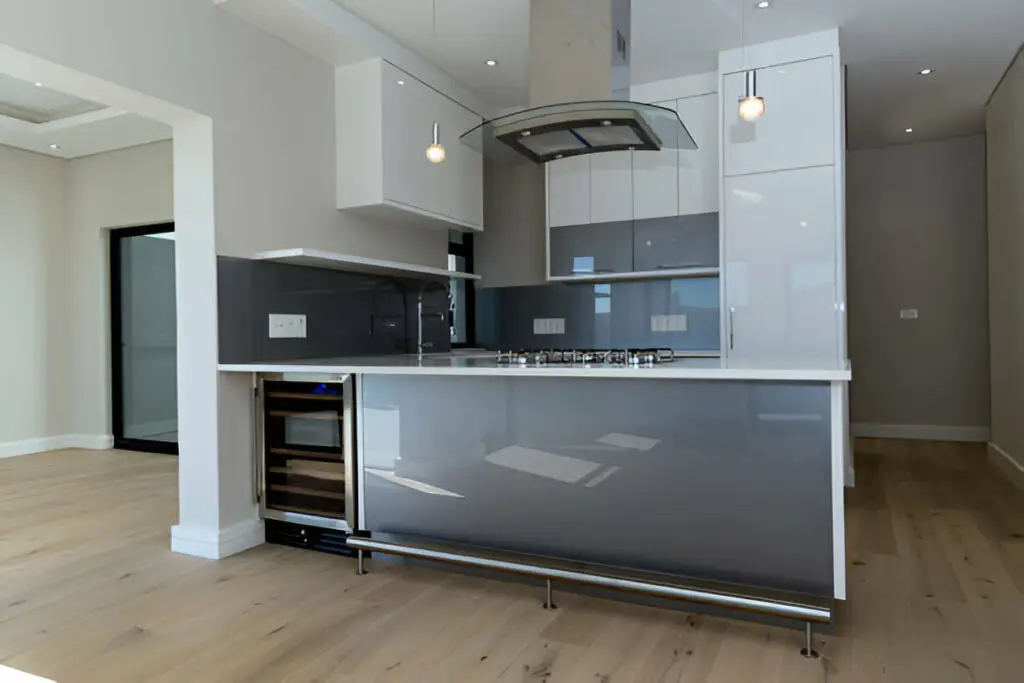
Before deciding which appliances to integrate, decide how far you want to go. The most reliable way to plan an island is in three tiers, ordered by service complexity: prep-only first, sink island second, cooktop island third. Prep-only is the cheapest, most flexible, and preserves the most drawer space. A sink island adds entertaining and multi-cook flexibility but means routing plumbing and waste through the floor. A cooktop island is the most ambitious, because it forces an extraction plan (downdraft or ceiling-mounted hood), takes drawer space for ducting, and changes how everyone moves through the room.
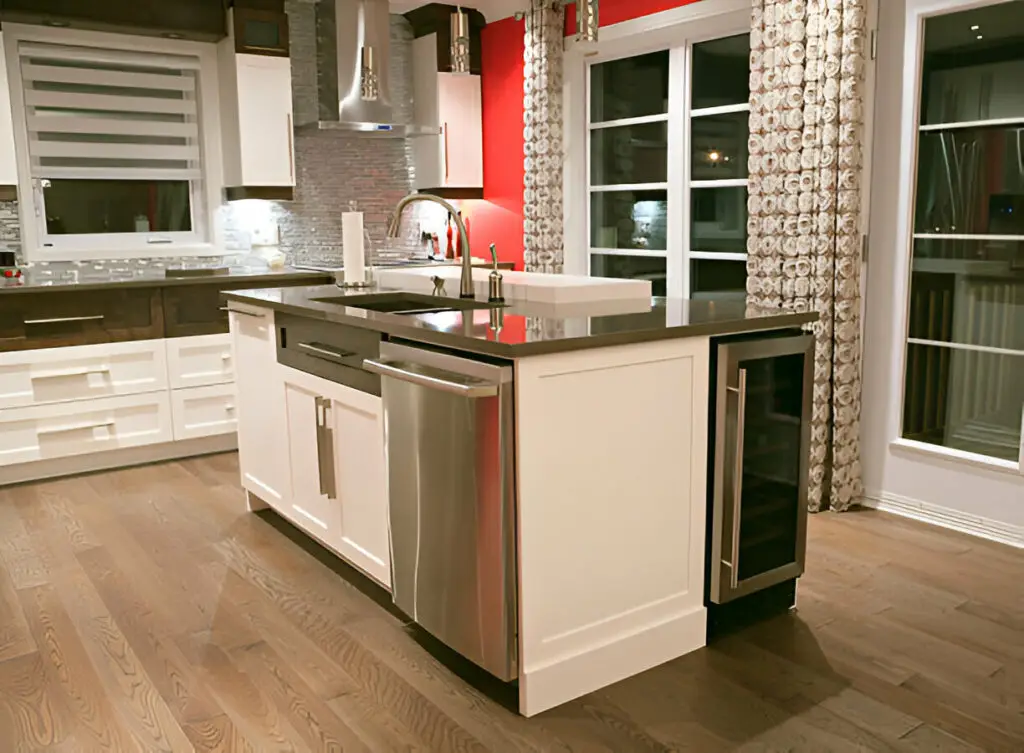
More than half of renovated islands in 2026 hide at least one appliance inside the casework (Houzz). The most common integrations: a dishwasher tucked next to the prep sink, a microwave drawer below the counter, a beverage cooler at the seating end, or a warming drawer for entertaining. The benefit is a perimeter that finally has room to breathe. The constraint is plumbing and electrical that has to land before the cabinets do, which raises the importance of a designer’s role early in the project.
Beyond appliances, the island is increasingly hosting dedicated zones. The most common in 2026 specs: a beverage station at the seating end, a coffee bar with a built-in espresso machine and cup storage, a baking zone with a marble or quartzite insert and pull-out scale drawer, or a snack station for households with kids. These zones get carved out at the seating side of the island so the cook stays in the prep zone uninterrupted.
6. Handleless and Slim-Shaker Fronts
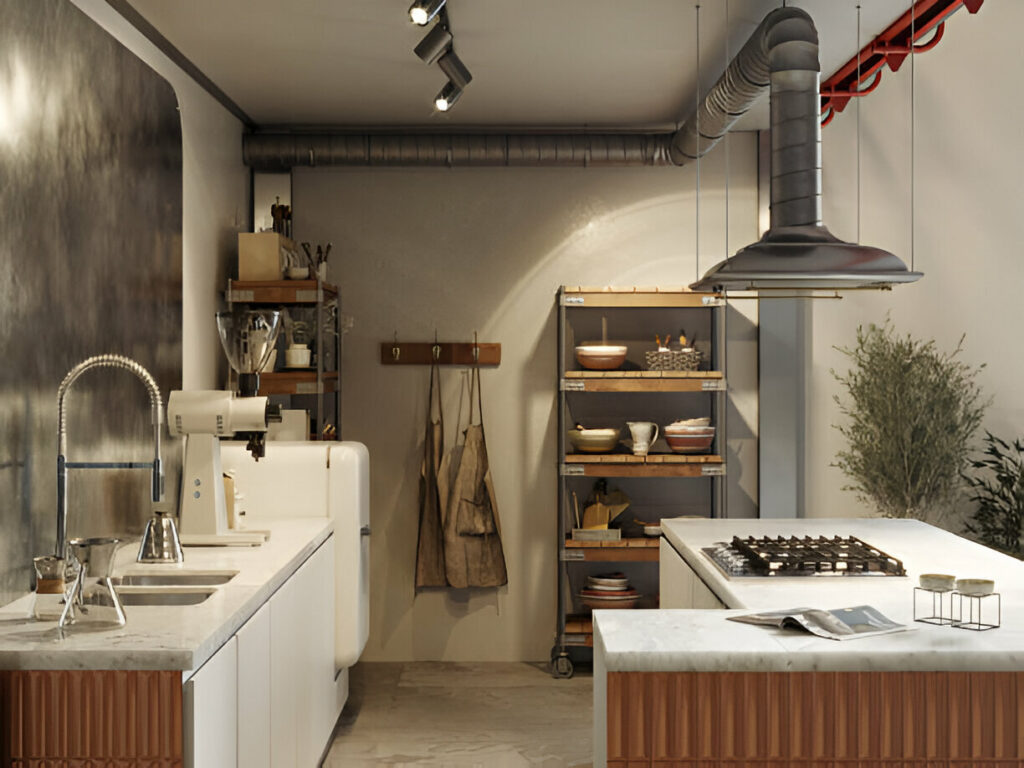
Two door styles are doing most of the work in modern islands. Flat-panel slab fronts with push-to-open mechanisms or recessed finger pulls deliver the cleanest look. Slim-Shaker fronts (with 2-inch rails instead of the traditional 2.5-inch) split the difference for buyers who want a hint of detail without the weight of full Shaker. Both are widely available in stocked white-oak veneer, painted finishes, and the standard RTA cabinet Shaker White, Blue, and Gray we keep in inventory across all seven showrooms.
7. Slab Backsplashes Behind the Cooktop Wall
When the island runs across from a cooktop wall, designers in 2026 are increasingly specifying a full slab of quartz or porcelain as the backsplash on that wall, using the same stone as the island countertop or a deliberate contrast. The result is a continuous material story that plays off the island. This swap is gaining ground specifically in engineered quartz because the slab format eliminates grout lines and reads as more architectural than tile.

8. Smart Tech and Layered Lighting
According to NKBA’s 2026 forecast, 82% of designers now specify under-cabinet LED lighting as standard. The reason: a well-lit island wants three layers, not just decorative pendants. Ambient light fills the room (recessed downlights, ceiling fixtures). Task light hits the worktop directly where you prep, usually pendants 30 to 36 inches above the counter, or angled downlights placed in front of the cook so light falls onto the surface and not behind. Accent light builds atmosphere: recessed LED toe-kick strips, internal drawer lighting, under-cabinet washes. Switch the island lighting on its own circuit so work mode and entertaining mode tune independently.
On modern islands, that translates into recessed LED toe-kick lighting, integrated USB-C charging spots in seating-side overhangs, and pendant lighting on dimmable smart-home circuits. Induction cooktops are increasingly specified directly into the island when the layout allows, giving the cook a sightline into the room while keeping the heat element flush with the counter.
The same NKBA forecast notes a parallel shift toward wellness-focused, adaptable kitchens, with more than half of renovating homeowners specifying islands and layouts that can accommodate aging in place or shifting household needs over the next decade. A walk-through of our broader 2026 kitchen trends covers the lighting, color, and storage shifts that go beyond the island itself.
Modern Island Trends at a Glance
| Trend | Best For | Cost Impact | USA Cabinet Express Match |
|---|---|---|---|
| Warm wood tone | Buyers wanting warmth without farmhouse | Neutral | Fabuwood Galaxy Horizon, Luna Desert Oak |
| Two-tone | Designers wanting island as focal point | +5–10% | Mantra Modern + RTA Shaker pairing |
| Waterfall edge | Mid-to-high-end remodels | +15–25% | Engineered quartz pairing with any base |
| Curved island | Architectural / luxury projects | +30–50% | Custom order via showroom design team |
| Integrated appliances | Open-plan kitchens, entertainers | +10–20% | Any line, depth and door selection key |
| Slim-Shaker / handleless | Modern minimalists | Neutral | Fabuwood Luna, Mantra Modern |
| Slab backsplash | Premium open-plan kitchens | +20–40% on backsplash | Spec coordinated with island stone |
| Smart tech / LED | All builds (now baseline) | +$300–1,500 | Cabinet accessories + electrician |
Sizing a Modern Kitchen Island: The Numbers That Matter
Modern islands have grown. Half of all new islands in 2026 are over 7 feet long (Houzz), and the growth feeds broader storage shifts: 47% of remodeling homeowners now add pantry cabinets and 16% include walk-in pantries, both of which let the island take on more prep and serving roles instead of bulk storage. The island has to feel proportional to the room, leave enough clearance for safe traffic flow, and support whatever functions you’re loading into it. The four numbers that drive every island spec are length, width, height, and clearance.
Length and Width by Kitchen Size
| Kitchen Size | Recommended Island Length | Recommended Island Width | Seating Capacity |
|---|---|---|---|
| Compact (under 150 sq ft) | 36–48 inches | 24–30 inches | 1–2 seats |
| Medium (150–250 sq ft) | 60–84 inches | 36–42 inches | 2–4 seats |
| Large (250–400 sq ft) | 84–108 inches | 42–48 inches | 4–6 seats |
| Open-plan (400+ sq ft) | 108+ inches | 48–60 inches | 6–8+ seats |
Standard Heights
Standard counter height is 36 inches. Bar height, used for raised seating sections or prep counters where the cook stays standing, is 42 inches. Counter-height seating uses 24- to 26-inch stools; bar-height uses 28- to 30-inch stools. Most modern islands in 2026 keep a single 36-inch height for the entire run because two-tier islands have fallen out of favor in cleaner contemporary designs.
Clearance Around the Island
The non-negotiable rule: 42 inches minimum clearance on all sides between the island and the perimeter cabinets. Bump that to 48 inches on the appliance side (where you need door swing room) and on any side with seating. Anything less than 42 inches makes two cooks at the island uncomfortable and turns appliance doors into traffic hazards.
Seating Overhang
Plan for 12 inches of countertop overhang on the seating side, with a corbel or hidden steel bracket if the overhang exceeds 14 inches. Each seat needs 24 inches of linear width minimum. A 96-inch island with seating on one side fits four stools comfortably; a 72-inch island fits three.
Materials That Earn Their Place in 2026
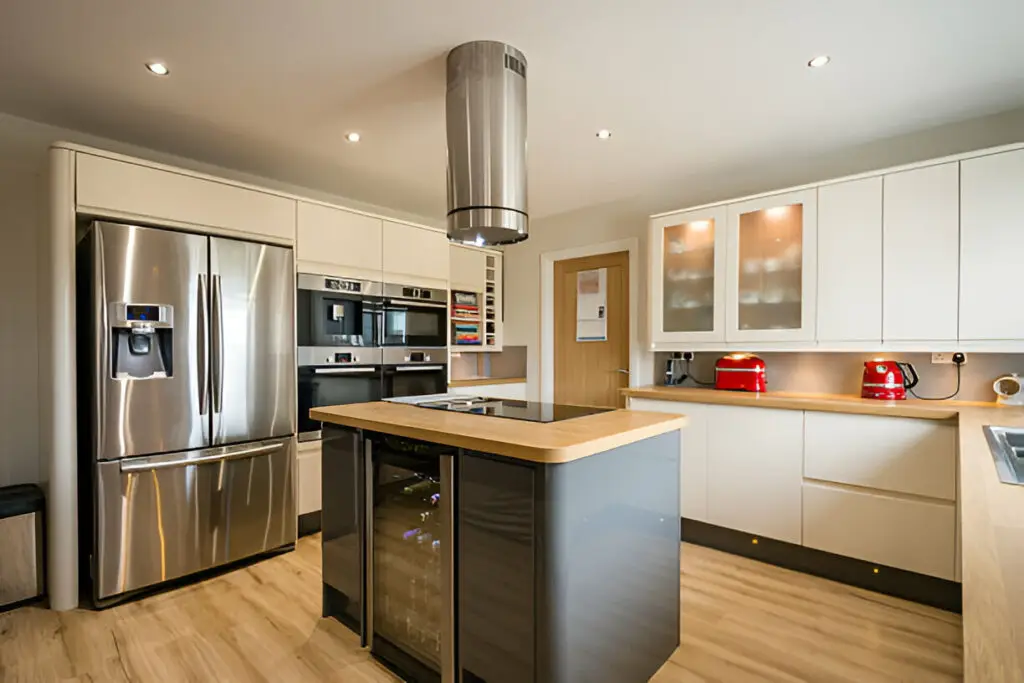
The materials story for modern islands has split into two layers: the cabinet base (what you see at eye level and lower) and the countertop (the work surface and the visual stop). Each does different work in the design and pulls from different price tiers.
Sustainability moved from niche preference to baseline buyer expectation in 2026. FSC-certified wood, low-VOC finishes, and recycled-content quartz are now standard asks during the spec phase. On the countertop side, sintered stone (engineered from natural minerals at high heat and pressure) and recycled-glass surfaces are the two emerging materials gaining the most ground in eco-conscious modern remodels. Most reputable cabinet lines, including the Fabuwood and Mantra collections we stock, meet or exceed CARB Phase 2 emissions standards by default. If sustainability is a dealbreaker for your buyers, ask the showroom team for spec sheets up front.
Cabinet Base Materials
| Material | Look | Durability | Price Tier |
|---|---|---|---|
| Painted MDF | Crisp, matte, minimalist | Stable, doesn’t expand with humidity | $ |
| White oak veneer | Warm, natural grain, on-trend | Strong; finish-dependent | $$ |
| Solid walnut | Rich, deep, luxury feel | Hardwood, durable | $$$ |
| High-gloss lacquer | Reflective, ultra-modern | Shows fingerprints; durable finish | $$$ |
| Plywood box construction | Hidden, structural | Best long-term performance | Standard at most quality lines |
Countertop Materials
| Surface | Best Use | Maintenance | Cost per sq ft (installed) |
|---|---|---|---|
| Engineered quartz | Highest-traffic islands; waterfall edges | Wipe clean; no sealing | $60–$140 |
| Natural quartzite | Marble look without the staining | Annual sealing | $80–$200 |
| Walnut butcher block | Warm wood-on-wood island | Oil 2–4x per year | $70–$180 |
| Soapstone | Matte modern, develops patina | Mineral oil monthly first year | $70–$130 |
| Sintered stone (Dekton-class) | Heat / scratch / UV resistant | Wipe clean; no sealing | $80–$180 |
| Porcelain slab | Heat / stain / UV resistant | Wipe clean; no sealing | $70–$160 |
For a modern island in 2026, engineered quartz is still the workhorse. It survives kids, dinner parties, and red wine without complaint, and it fabricates cleanly into a waterfall edge. Walnut butcher block is the rising challenger when the island is the warm anchor of a cooler perimeter. Sintered stone and porcelain slab are gaining ground in luxury remodels because they handle direct heat and outdoor-light exposure better than quartz.
What a Modern Kitchen Island Costs in 2026
Cost ranges depend on three things: cabinet line (RTA vs. semi-custom vs. custom), countertop material, and integrated features (sink, dishwasher, beverage cooler, pop-up outlets). The numbers below assume a 7-foot island with one base cabinet stack of drawers and one stack of doors, no integrated appliances unless noted.
| Tier | Cabinet Spec | Countertop | Total Range |
|---|---|---|---|
| Budget | RTA Shaker White / Gray | Standard quartz | $2,800–$5,500 |
| Mid-range | Fabuwood Galaxy or Allure | Premium quartz | $5,500–$12,000 |
| Mid-range with integration | Mid-range cabs + dishwasher + sink | Quartz with waterfall edge | $9,000–$18,000 |
| Semi-custom | Mantra Modern, two-tone | Natural quartzite | $12,000–$25,000 |
| High-end / curved | Custom radius, walnut, integrated appliances | Porcelain or quartzite | $25,000–$60,000+ |
For comparison, the median spend on an entire major kitchen remodel sits at $55,000 in 2026 (Houzz). The island typically captures 25 to 45 percent of total cabinet cost on a remodel, and a higher share when integration features and stone fabrication are added.
Matching the Island to Your Cabinet Line
Modern islands work across most cabinet lines we stock, but each line has a sweet spot. The pairings below match each USA Cabinet Express brand to the modern brief best suited to it.
- RTA Cabinets (Shaker White, Blue, Gray): Budget-conscious modern. The Shaker Gray and Shaker White work especially well as island bases for two-tone schemes; pair Shaker Gray with white or oak perimeters for the most-specified 2026 contrast.
- Fabuwood Allure & Galaxy: The middle of the line. Galaxy Horizon and Indigo deliver the cool-modern read; Allure Onyx anchors a black-island scheme; Luna Desert Oak hits the warm-wood trend at mid-range pricing.
- Fabuwood Illume: Their highest-tier line. Cleanest fronts, slim Shaker proportions, the closest match to handleless modernism without going full custom.
- Mantra: Frameless construction, full-overlay doors, modern-leaning out of the box. Best fit when the brief is clean lines, larger cabinet boxes, and a contemporary aesthetic across both perimeter and island.
All four lines are available for same-week pickup at our showrooms across Austin, Houston, St. Louis, Chesapeake, Fairfax, and Fredericksburg. Our design teams will spec the island base, drawer hardware, and overhang detail before you commit, and we keep core door styles in stock to keep project timelines tight.
Common Modern Kitchen Island Mistakes
A few errors come up repeatedly in projects that arrive at our showrooms mid-stream. Knowing them in advance saves cost and rework.
- Undersizing the island. If the perimeter run is 18+ linear feet, a 4-foot island will look stranded. Match island length to roughly 30–40% of the perimeter cabinet length on a typical open-plan layout.
- Mixing too many materials. Modern islands work best with one cabinet finish, one countertop material, and one hardware finish. Adding a fourth visual moment turns clean modern into busy contemporary.
- Forgetting electrical. Pop-up outlets or recessed plug strips have to be specified during cabinet ordering, not after install. Code requires outlets on islands over a certain size in most jurisdictions.
- Overspeccing seating. Six bar stools sounds nice on paper. In a typical four-person household, three are used; two collect mail. Plan seating to your real entertaining frequency.
- Choosing cupboards instead of drawers. Cupboards on island bases force you to crouch and dig. Drawers put everything at eye level and let you zone storage by task. The cost difference is small; the daily-use difference is large.
- Treating lighting as decoration only. Pendants alone leave shadows on the worktop and glare at seated guests. Plan ambient, task, and accent layers from the start, on switched or dimmed circuits, before the electrician’s first fix.
- Skipping the design consultation. Plumbing, electrical, and the appliance integration spec all have to land before the cabinets do. Our showroom design teams do this for free at every USA Cabinet Express location.
Frequently Asked Questions
What size kitchen island works best in 2026?
For most renovations, a 7-foot island (84 inches) is the new standard, with a 36 to 42-inch width and 36-inch height. About half of newly renovated kitchens in 2026 specify islands at this length or longer. Compact kitchens still go shorter (48 to 60 inches is normal), but anything under 36 inches stops being useful as a prep surface.
Should the kitchen island match the perimeter cabinets?
No, and increasingly they don’t. Two-tone kitchens, where the island carries a different finish from the perimeter, are now the move in 24% of renovated kitchens (Houzz 2026). The most common 2026 pairing pairs a lighter perimeter with a darker or warmer island.
Are waterfall kitchen islands still in style?
Yes, waterfall edges remain in heavy rotation in modern and high-end remodels in 2026. The pairing has shifted: instead of stark white quartz on white cabinets, designers now run warmer veined stone or quartz over wood-fronted islands, which keeps the architectural moment but warms it up.
How much clearance do I need around a modern kitchen island?
Plan 42 inches minimum on every side, and 48 inches on the appliance side and any side with seating. Less than 42 inches makes the kitchen feel cramped and turns appliance doors into traffic obstacles.
Should I put a sink or cooktop in the island?
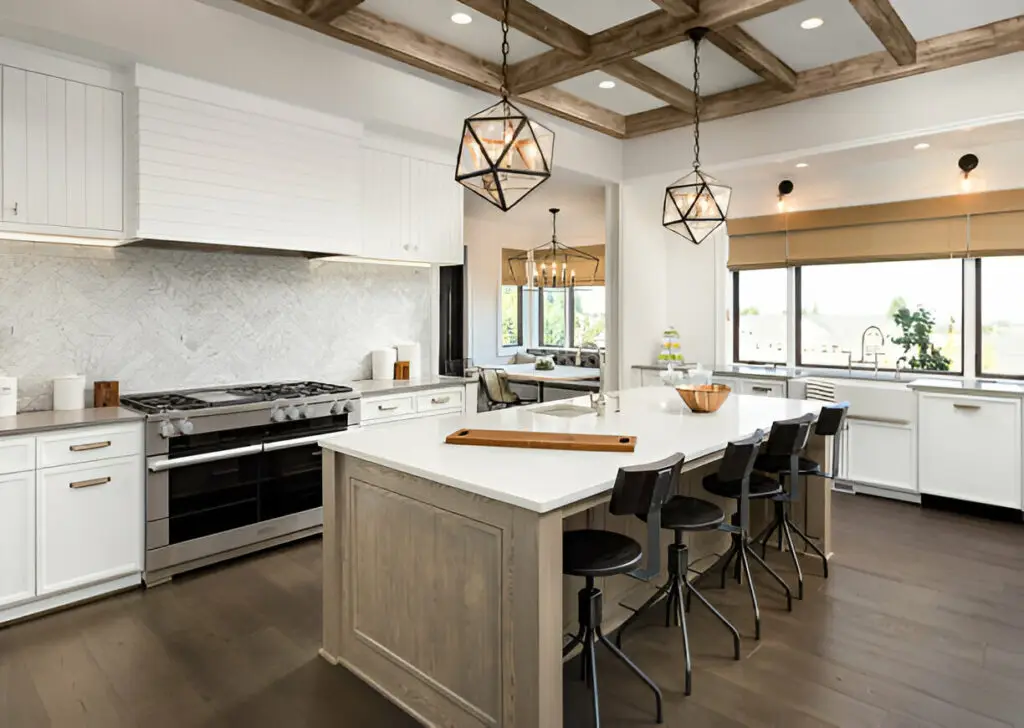
Plan it in tiers: prep-only is the simplest, a sink island is more demanding (plumbing through the floor), and a cooktop island is the most complex (extraction routing). A prep sink in the island makes sense for households that cook with multiple people. A cooktop in the island works only with proper ventilation, either a downdraft system or a ceiling-mounted hood, both of which add cost and design constraints. The most common 2026 integration is a dishwasher next to a prep sink, which is simpler and cheaper than venting a cooktop.
What’s the most popular countertop for modern kitchen islands in 2026?
Wood took the top spot for the first time in 2026 for island countertops specifically (Houzz). Engineered quartz is still the most-specified material across all surfaces, but for the island alone, a wood top (usually walnut or white oak butcher block) is now leading. Quartz is the right choice when the island gets heavy daily use.
How much does a modern kitchen island cost?
A budget-tier RTA island runs $2,800 to $5,500 installed. Mid-range Fabuwood with premium quartz lands at $5,500 to $12,000. Adding integrated appliances pushes the total to $9,000 to $18,000. Semi-custom and curved high-end islands range from $12,000 to $60,000+ depending on materials and complexity.
What’s the difference between modern and contemporary kitchen islands?
In design language, “modern” usually refers to mid-century-rooted minimalism: clean lines, restrained palette, reduced ornament. “Contemporary” means current-moment aesthetics, which in 2026 includes warm wood, curved shapes, and integrated tech. Most homeowners use the terms interchangeably, and most current 2026 islands actually blend both: modern bones with contemporary materials and details.
Ready Visit any USA Cabinet Express showrooms for a free design consultation. Our team will walk you through Fabuwood, Mantra, and RTA options, run sizing for your specific kitchen footprint, and quote both base and countertop in one visit.