
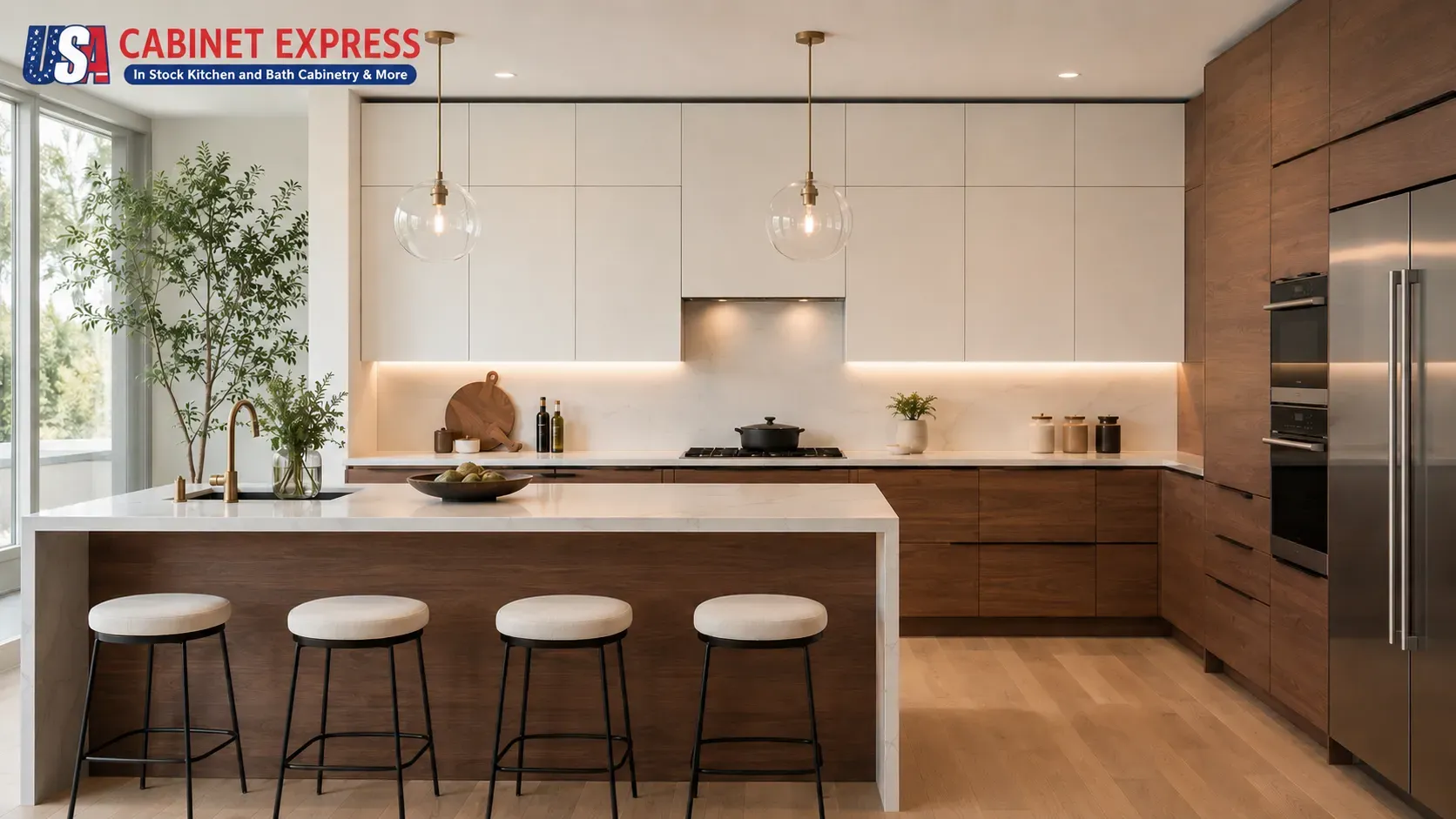

Frameless kitchen cabinets, also called full-access or European-style cabinets, leave the wood face frame off the front of the cabinet box. The doors mount straight to the box instead. That one change does three useful things: it widens the opening, adds storage you can actually reach, and gives the kitchen the clean, continuous front that reads as modern. For homeowners trying to get more out of a tight kitchen, and for dealers and contractors speccing a build, it’s one of the bigger calls on the board.
Here’s what frameless construction actually is, how it stacks up against traditional framed cabinets, how much storage you really gain, what it costs, and which frameless lines we stock at USA Cabinet Express.
What Are Frameless Kitchen Cabinets?
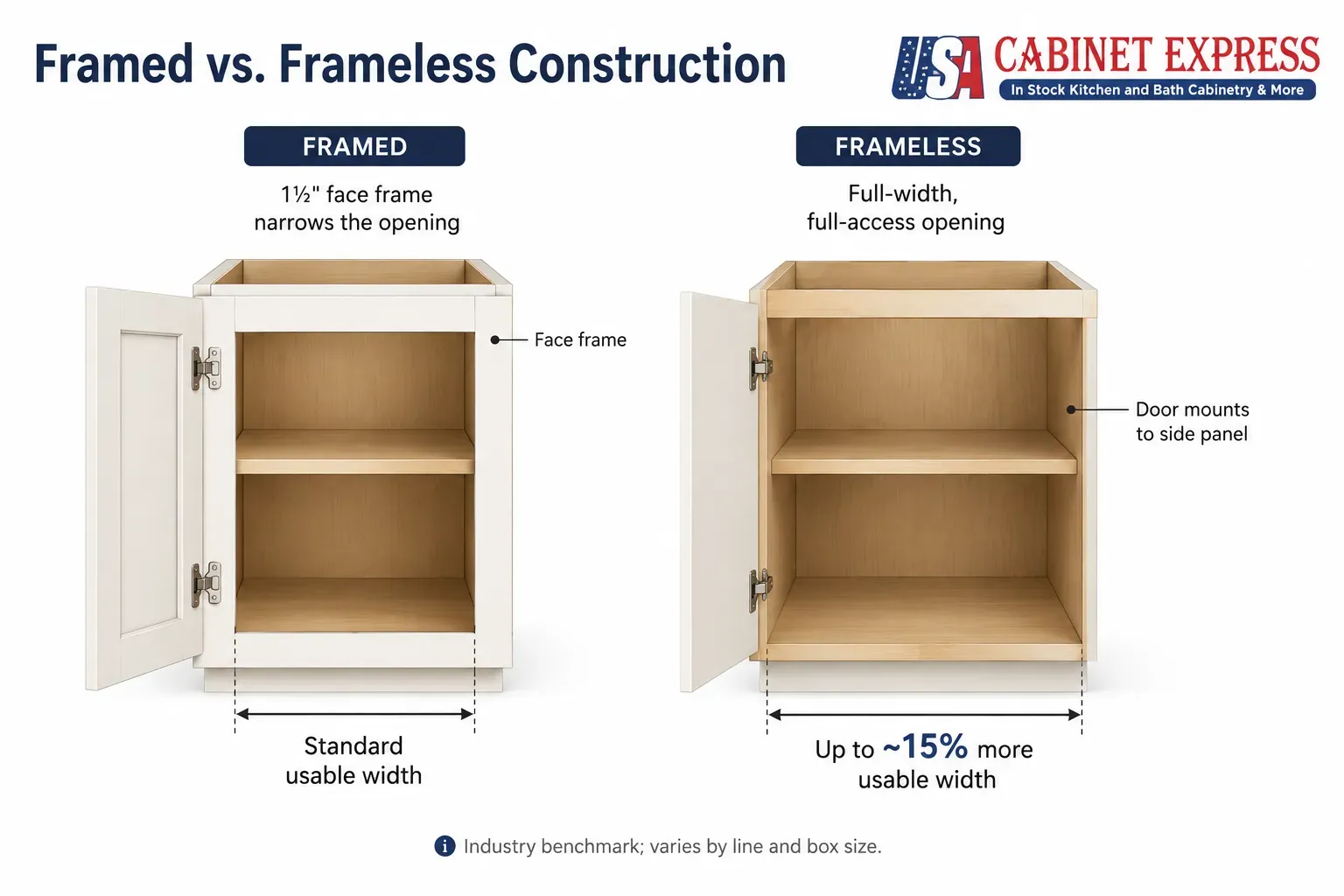
A traditional cabinet has a face frame: a flat wood frame, usually about 1½ inches wide, fixed to the front edge of the box. Doors and hinges attach to that frame. A frameless cabinet leaves it off, and the doors mount directly to the side panels. Open the door and the full interior is right there, with no frame lip to reach around.
Because nothing narrows the opening, the industry calls this full-access cabinetry. You’ll also see it called European or frameless construction; it has been the European standard for decades.
A well-built frameless box doesn’t need a frame to stay rigid. It earns its strength from the box itself:
- ¾-inch panels for the sides, top, bottom, and shelves. Plywood is the preferred material; MDF and particleboard show up on lower-priced lines.
- A set-in back panel that squares and stiffens the cabinet.
- Full-overlay doors that cover almost the whole box face, leaving only a thin, even reveal between doors.
- Concealed European hinges that clip onto the side panel and adjust in three directions.
The result is a cabinet with a wider opening, a cleaner front, and a look that suits most contemporary kitchens, including the styles in our 2026 cabinet door trends.
Framed vs. Frameless Cabinets
Both are good, durable choices. They just optimize for different things.
| Factor | Framed (Face-Frame) | Frameless (Full-Access) |
|---|---|---|
| Front of Box | ~1½″ wood face frame | No frame; door mounts to the box |
| Interior Access | Frame lip narrows the opening | Full-width, unobstructed |
| Usable Storage | Standard | Up to ~15% more |
| Look | Traditional / Transitional | Modern (European) |
| Door Overlay | Partial, full, or true inset | Full overlay (inset is rare) |
| Hinges | Mounted to the frame | European clip-on, mounted to the side panel |
| Installation | More forgiving of out-of-square walls | Needs precise, skilled installation |
| Cost | Lower entry point | Often 10–20% higher |
Want a classic, furniture-style kitchen with true inset doors? Framed still has the edge. Want to squeeze out every usable inch behind a modern face? Frameless wins, which is why it keeps taking market share. For how the box style plays out in daily use, see our guide on drawers vs. doors.
How Frameless Construction Maximizes Storage
This is the real reason frameless keeps gaining ground. Dropping the face frame doesn’t just change the look. It changes what fits inside.
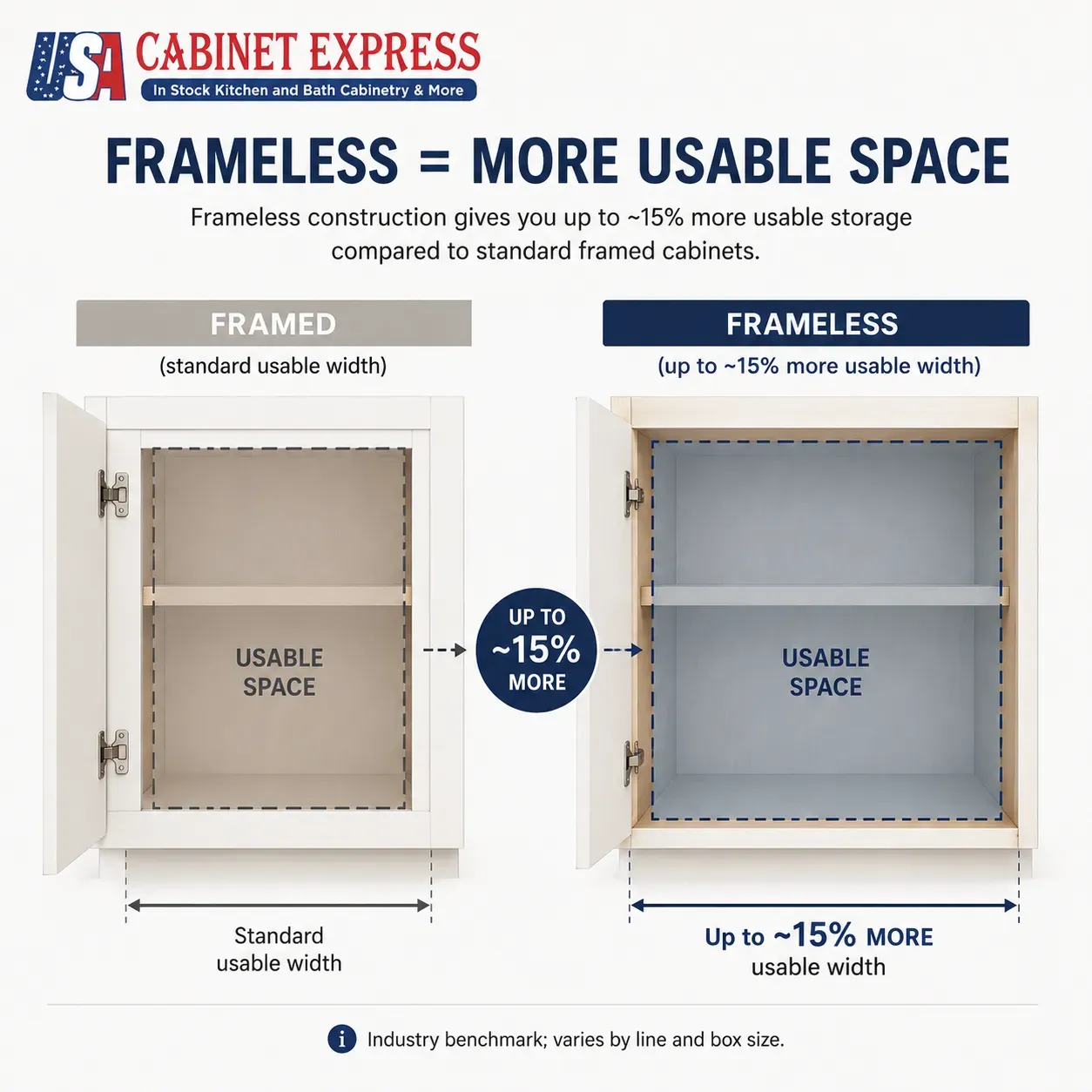
- Up to ~15% more usable interior space. That 1½-inch frame, repeated around every opening across a whole kitchen, adds up fast. Take it away and you get the width back.
- Boxes run at least an inch deeper. Frameless boxes are typically about an inch deeper than comparable framed boxes, so every shelf gains area.
- Wider drawer boxes. With no frame lip cutting into the opening, drawers can be built closer to the full interior width.
- Full-height, unobstructed access. No center stile splitting a double-door cabinet, and nothing to reach around. Sheet pans, stand mixers, and tall bottles slide straight in.
In a small kitchen, that reclaimed width is often the difference between a layout that fights you and one that works. The ~15% figure is an industry benchmark and varies by line and box size.
Frameless Benefits Checklist
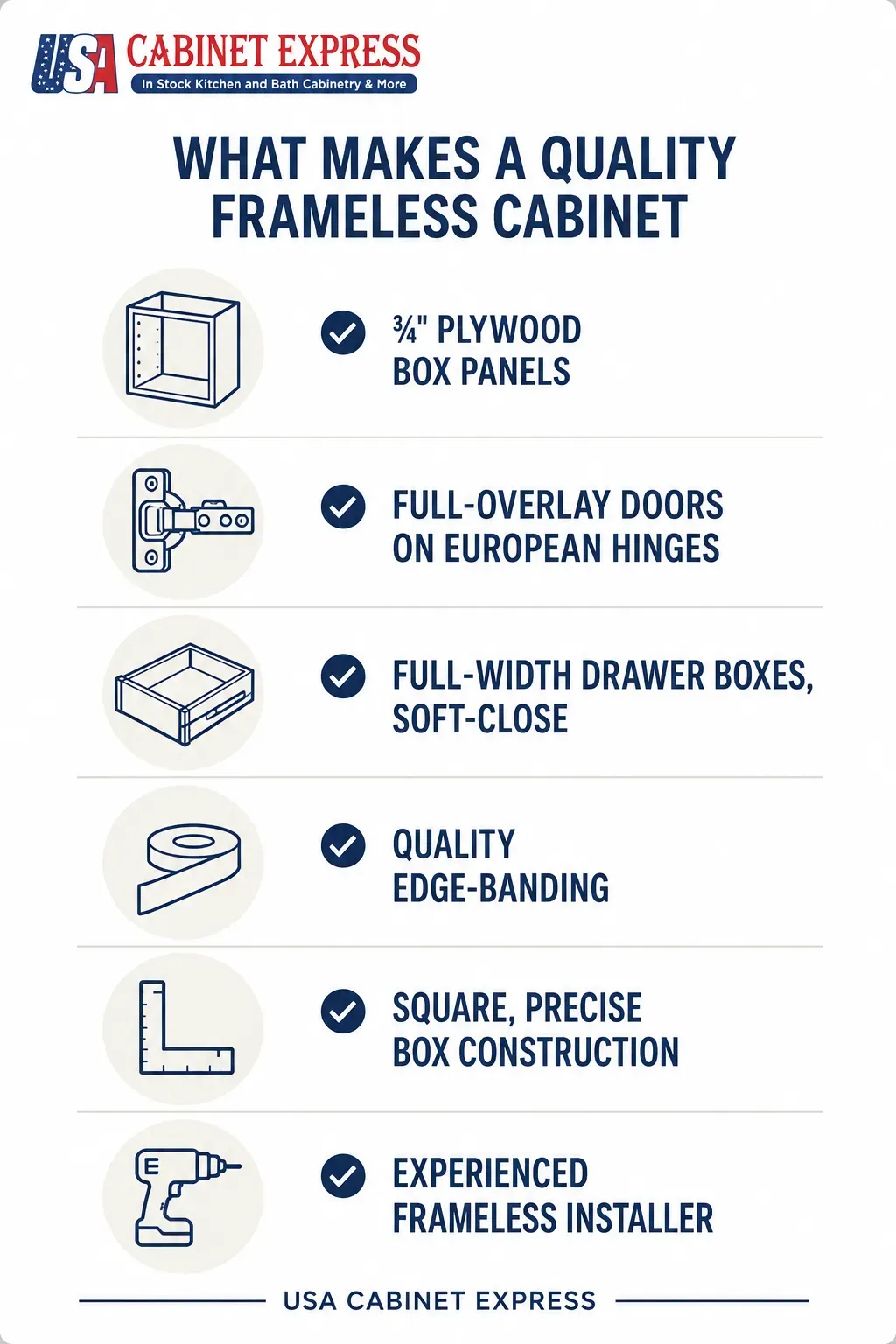
Run any frameless cabinet against this before you buy:
- ¾-inch box panels (sides, top, bottom, shelves), plywood preferred
- Full-overlay doors on adjustable European clip-on hinges
- Drawer boxes sized close to the full opening, full-extension and soft-close
- Quality edge-banding on exposed panel edges
- A square, precisely built box (frameless is less forgiving, so tolerances matter)
- An installer with real frameless / European experience
Pros and Cons of Frameless Cabinets
What you gain
- More storage and easier access, the headline benefit above.
- A modern, low-reveal look from full-overlay doors.
- Design flexibility for contemporary, minimalist, and transitional kitchens.
- Easier cleaning, with no frame edges to trap crumbs and grease.
The trade-offs
- Installation has to be precise. With no frame to absorb error, the walls need to be square and the installer needs to know the system.
- Fewer traditional looks. Frameless is built for full overlay, so true inset, furniture-style detailing is uncommon.
- It usually costs a bit more (see below).
Are Frameless Cabinets Less Sturdy?
Not when they’re built right. A frameless box made from ¾-inch plywood with a set-in back is plenty rigid, and it’s the European standard for good reason. The catch is that frameless leans entirely on box quality, because there’s no frame to fall back on. Two things to watch: thin, all-particleboard boxes can sag on wide spans under heavy loads, and the hinges screw into the side panel rather than a solid frame, so panel material matters. Spec a quality box and neither is a problem. For more on what separates a well-built cabinet from a weak one, see common pitfalls in cabinet door design.
Frameless Cabinet Door Styles and Finishes
Frameless pairs with most of today’s popular looks, as long as the door is a full-overlay design:
- Slab / flat-panel doors, the cleanest, most modern option and a natural fit.
- Shaker doors. Yes, you can get a shaker look on frameless cabinets; the door simply sits as a full overlay instead of inset.
- Glass and specialty fronts for upper accent cabinets.
The one style frameless generally can’t do is true inset, since there’s no frame to set the door into. That’s the design trade-off noted earlier. For the full range of contemporary looks, browse our modern kitchen cabinets.
Hinges and Hardware for Frameless Cabinets
Frameless cabinets use concealed European hinges that clip onto the inside face of the side panel. No frame required. They adjust in three directions (height, depth, and side to side), which is what keeps the tight, even gaps of a full-overlay front looking right over the years. Soft-close is standard on quality lines.
The hinge system is the main hardware difference between framed and frameless, so it’s worth getting right. For a full breakdown of hinge types and motion systems, see our guide on choosing cabinet door opening mechanisms, and find handles and pulls in our cabinet hardware collection.
Cost: Are Frameless Cabinets More Expensive?
Frameless usually runs a little higher than comparable framed cabinets, often in the 10–20% range. The reason isn’t the missing frame; it’s the box. To stay rigid without a frame, frameless cabinets use thicker, better panels, and that’s where the money goes. Two things worth knowing:
- A fully custom framed kitchen with true inset doors can cost more than a quality frameless line, so “framed = cheaper” isn’t a hard rule.
- Frameless rewards a skilled installer. Budget for precise installation, especially in older homes with out-of-square walls.
In short, don’t expect a huge premium. Expect to pay for build quality, which is what gives you the durability and the storage.
Best Frameless Cabinet Lines at USA Cabinet Express
We carry frameless and full-access lines built to the standards above:
- Fabuwood Illume, a true frameless line using Threespine® construction for maximum interior access and a clean modern front. See the full Fabuwood collection.
- Mantra, contemporary frameless-friendly cabinetry with full-overlay doors and soft-close hardware. Browse Mantra cabinets.
- Frameless RTA options, ready-to-assemble frameless cabinets that ship flat and install fast, a strong fit for budget-conscious remodels and dealers. See our RTA kitchen cabinets.
Not sure which fits your kitchen, budget, or timeline? Explore our kitchen cabinets or reach out to your nearest USA Cabinet Express showroom for a free quote.
Frequently Asked Questions for Frameless Kitchen Cabinets
What is a frameless cabinet?
A frameless (full-access) cabinet has no face frame. The door mounts straight to a ¾-inch box, which gives you a wider, unobstructed opening and a clean modern front.
What are frameless cabinets called?
Full-access or European-style cabinets. All three names describe the same thing: a cabinet box with no front face frame.
What’s the difference between framed and frameless cabinets?
Framed cabinets have a ~1½-inch wood face frame on the front of the box; frameless cabinets leave it off. Frameless gives you more opening width, more usable storage, and a modern look, while framed construction supports traditional inset styling and has a lower entry price.
Do frameless cabinets give you more storage?
Yes. Removing the face frame opens up roughly 15% more usable interior space and allows wider drawer boxes, which adds up across a full kitchen and matters most in small ones.
What’s the best material for frameless cabinets?
¾-inch plywood. It’s strong, holds screws and hinges well, and resists sagging better than the alternatives. MDF and particleboard cost less and are fine for painted doors and lighter loads, but for the box itself, plywood is the safer call.
Are frameless cabinets more expensive?
Usually a little, often 10–20% more than comparable framed cabinets, because the box uses thicker, better panels. A fully custom framed kitchen with inset doors can still cost more than a quality frameless line.
Are frameless cabinets less sturdy?
No, as long as the box is built from ¾-inch plywood with a proper back. Frameless depends entirely on box quality, so the “less sturdy” reputation traces back to cheap, thin-panel cabinets, not to frameless construction itself.
Why are frameless cabinets harder to install?
There’s no face frame to absorb error, so the boxes and doors all have to land on the same plane. Out-of-square walls and floors show up fast as uneven gaps, which is why frameless rewards an experienced installer.
Can you get a shaker or inset look on frameless cabinets?
Shaker, yes, as a full-overlay door. True inset is uncommon on frameless because there’s no frame to set the door into.
Are frameless cabinets good for small kitchens?
Very. The full-access opening and extra usable width make every inch count, which is exactly what a small kitchen needs.
Ready to plan a frameless kitchen? Browse our kitchen cabinets or contact your nearest USA Cabinet Express location for a free design consultation and quote.