


Short answer. The best RTA cabinets share three specs: a plywood cabinet box, dovetail drawer boxes, and soft-close hinges with full-extension drawer slides. If a seller will not confirm all three in writing, keep shopping. Brand names matter far less than those three details.
Every product spec on this page comes from our own published product pages.
Your kitchen budget just got tighter, and the cabinet aisle at the big-box store is not helping. Between markups and long lead times, more homeowners and contractors are choosing RTA cabinets (ready to assemble cabinets) instead of custom cabinetry. The hard part is telling a well-built RTA cabinet from a cheap one when every seller calls theirs “premium.”
We sell RTA kitchen cabinets from our showrooms in Texas, Virginia and Missouri. This guide covers what to check before you buy, what a 10×10 kitchen really costs, and the in-stock RTA Shaker line we carry.
3
Specs that decide quality
3
In-stock Shaker colors
4–6 hrs
Pro crew, 10×10 kitchen assembly
$128/hr
Contractor breakeven for RTA
Always in stock
Our RTA Shaker Collection
Bright and timeless. Pairs with any countertop and backsplash.
A bold color for an accent island or a full kitchen.
A middle ground that works with quartz and brass hardware.
All three include, per our product pages:
- Flat-pack (unassembled), finished on both sides
- Full overlay Shaker birch doors with a 5-piece drawer front
- UV plywood construction
- 5/8″ fully adjustable plywood shelves
- Soft-close doors and drawers
- Full-extension dovetailed drawer boxes in 5/8″ birch UV plywood
We keep Shaker White, Shaker Blue and Shaker Gray cabinets in stock, so most orders are ready for pickup without the weeks-long wait of made-to-order cabinetry.

What Are RTA Cabinets, Exactly?
RTA stands for ready-to-assemble. Instead of arriving fully built, these cabinets ship flat-packed with the panels, hardware and instructions included. You put them together at home or on the job site with basic tools: a drill, a screwdriver, wood glue and a rubber mallet cover most jobs.
Flat-pack shipping is the main reason RTA cabinets cost less. Smaller boxes mean smaller freight bills, and no factory assembly labor is built into the price. That does not have to mean a lesser cabinet. The best RTA cabinets use the same plywood boxes, dovetailed drawer boxes and soft-close hardware found in mid-range assembled lines.
For contractors, the math is simple. On a typical 12-cabinet kitchen, RTA saves about $513 in materials, and an experienced crew assembles it in about 4 hours. That works out to $128 per hour. If your fully loaded crew rate is below that, RTA earns more per kitchen. Above it, pre-assembled is the better call.

Why Shaker Cabinets Still Lead in 2026
A question we hear constantly: are Shaker cabinets going out of style? No. Shaker’s strength is that it is not a trend. The five-piece door with a flat center panel predates modern kitchen fashion, which is why it works in farmhouse, transitional, contemporary and even industrial spaces. Our kitchen cabinet door styles guide compares it with the other profiles.
Our three in-stock colors cover the most requested looks:
- Shaker White: the default for a reason. Bright and open, it pairs with every countertop and backsplash material.
- Shaker Blue: a bold but grounded tone for an accent island or a full kitchen.
- Shaker Gray: sits between warm and cool, and works well with quartz countertops and brass hardware. If you are weighing gray, read whether gray kitchen cabinets are out of style first.
Are RTA Cabinets Good Quality? What to Check Before You Buy
This is where cheap RTA cabinets and quality RTA cabinets part ways. Buyers who have been through it say the same thing again and again. As one r/cabinetry commenter put it in August 2026, “the specs are what matter.” Here is what to check.
1. Box material
The cabinet box matters most for long-term durability.
| Material | Strength | Moisture | What to know |
|---|---|---|---|
| Plywood | Very good | Good | Holds screws and hinge plates well. The standard to ask for. |
| Solid wood | Excellent | Moderate | Common for doors and frames rather than whole boxes. |
| MDF | Good | Low | Smooth for painted panels. Swells if water gets in. |
| Particleboard | Fair | Low | Screws loosen over time. Weakest near sinks and dishwashers. |
Our recommendation is a plywood box, and that is what our RTA Shaker line uses. Watch the wording on product pages: “engineered wood” or “wood composite” without the word plywood usually means particleboard, and “all wood” can describe the doors and frames while the box is something else.
2. Drawers and joinery
Dovetail drawer boxes are the benchmark. Stapled butt joints are the cost cut that shows up as sagging, loose drawers within a few years. On doors, mortise-and-tenon frames signal a manufacturer that did not skimp on engineering. How the box goes together matters too: cam-locks alone loosen over time, while glue plus screws or clips makes a permanent joint. Many experienced installers add wood glue during assembly even when the kit does not require it.
3. Hardware
Soft-close hinges and full-extension drawer slides should be standard, not an upgrade. Hardware is also where RTA cabinets most often let owners down in daily use. A Southern California homeowner described old RTA cabinets where the soft-close trays “started to just slam closed” and hinge screws kept working loose. Ask which hinge and slide brand is used before you buy.
4. Certification
Formaldehyde limits for composite wood are federal law under the EPA’s TSCA Title VI rule, which matches California’s CARB Phase 2 standard. Every legal cabinet sold in the U.S. has to meet them, so treat compliance as the minimum, not a selling point. The quality signal to look for is KCMA A161.1 certification, the Kitchen Cabinet Manufacturers Association’s voluntary performance standard covering structure, drawer durability and finish resistance.
Signs of quality
- Plywood box construction
- Dovetail drawer boxes
- Soft-close hinges and full-extension slides included
- Mortise-and-tenon door frames
- KCMA A161.1 certification
- Published spec sheet you can keep
Red flags
- “Engineered wood” box with no mention of plywood
- Stapled butt-joint drawers
- Soft-close sold as an add-on
- Unbranded hinges with no rating
- Shipping fees that appear after checkout
- No written damage or return policy
Best RTA Cabinets in 2026: Our RTA Shaker Line
We are a distributor of the RTA Shaker line in White, Blue and Gray, with UV plywood construction, full overlay birch Shaker doors, 5/8″ adjustable plywood shelves, soft-close doors and drawers, and full-extension dovetailed drawer boxes. Most of our RTA stock is in stock and ready for pickup, and our Price Match Guarantee means that if you find a lower price, we will match or beat it.
We offer scheduled delivery or showroom pickup, with a pre-delivery inspection and loading help at pickup, and we can take a project from design consultation through to final installation.
Best RTA Kitchen Cabinets: How Our Spec Sheet Measures Up
| What to check | What to look for | Our RTA Shaker line |
|---|---|---|
| Box material | Plywood | UV plywood construction |
| Drawer boxes | Dovetail joints | Full-extension dovetailed drawer boxes, 5/8″ birch UV plywood |
| Hardware | Soft-close and full-extension included | Soft-close doors and drawers, standard |
| Doors | Solid, well-joined frames | Full overlay Shaker birch doors, 5-piece drawer front |
| Shelves | Adjustable plywood | 5/8″ fully adjustable plywood |
| Finish | Finished inside and out | Finished on both sides |
Specs as published on our Shaker White, Blue and Gray product pages, September 2026. Ask for a written spec sheet with any quote.
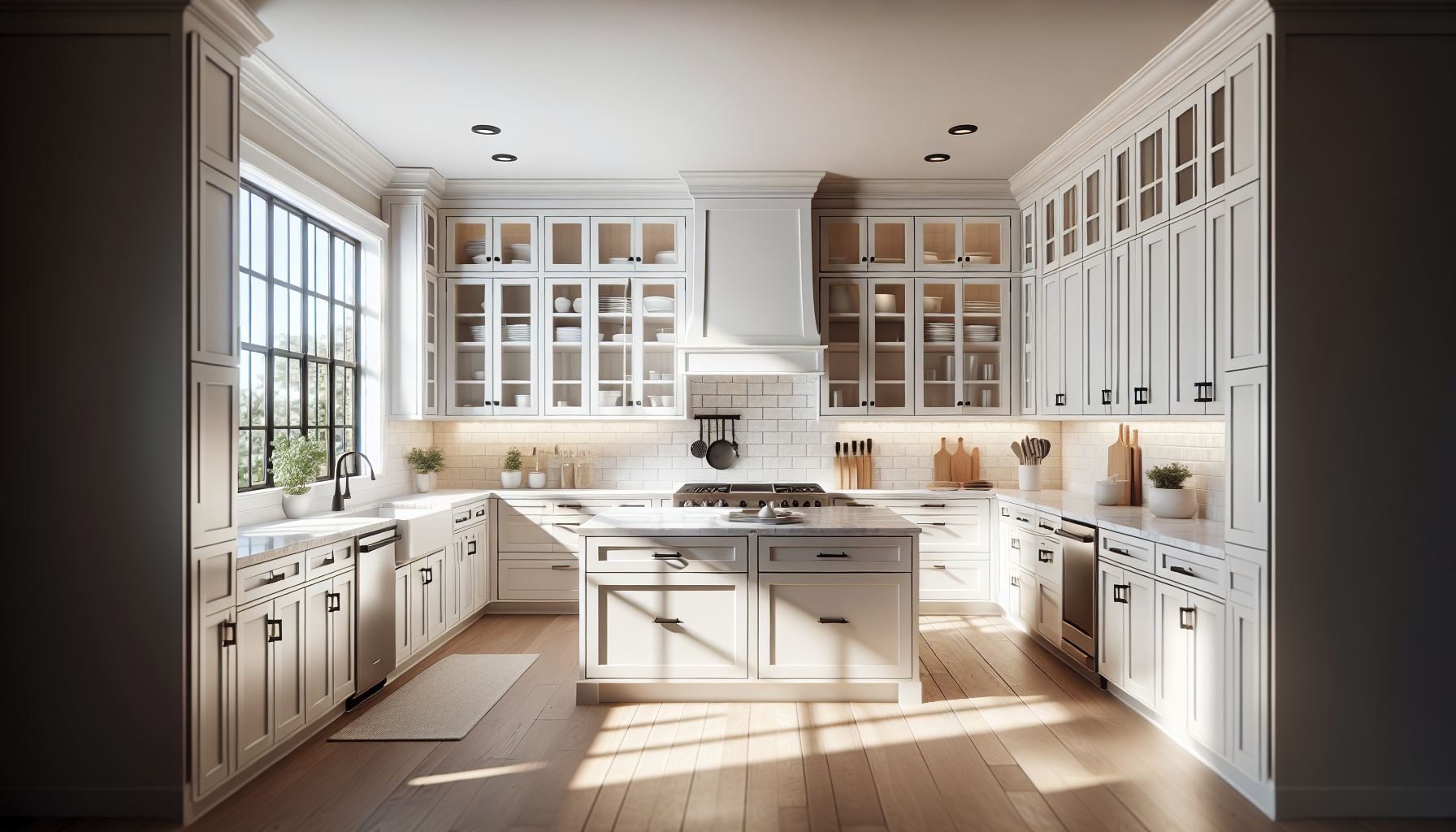
RTA Cabinets vs. Pre-Assembled and Custom Cabinets
The biggest difference is not quality. It is the delivery model. Pre-assembled cabinets arrive built, and you pay for that labor and the freight of shipping bulky boxes. RTA shifts assembly to you or your crew.
There is also a middle ground. We carry pre-assembled lines alongside RTA, so you can use RTA for simple base and wall cabinets and buy tricky pieces such as lazy Susans and blind corners already assembled.
- Choose RTA if you are comfortable with basic DIY, need cabinets fast, or are working to a tight budget. Contractors running several kitchens a month usually prefer it for cost and logistics.
- Choose pre-assembled if your crew rate is above the $128-per-hour breakeven, or you have little space to assemble on site.
- Choose semi-custom or custom if you need unusual sizes, rare wood species or a fully managed remodel.
Are There American-Made RTA Cabinets? What the Labels Mean
It is one of the most common questions buyers ask, and the labels are easy to misread. Under Federal Trade Commission rules, a product sold as “Made in USA” has to be all or virtually all made in the United States. A product can be labeled “Assembled in USA” when its main assembly happens here and that work is substantial, even if many of the parts are imported. Plenty of cabinets on the market combine U.S. and imported components, so ask for the country of origin in writing before you buy.
Where the cabinet brands we carry come from
Alongside our in-stock RTA Shaker line, we sell cabinets from several manufacturers. Here is what each one publishes about where its cabinets are made, and how long they take to reach you.
| Brand | Manufacturer | Where it is made | Lead time |
|---|---|---|---|
| RTA Shaker | Flat-pack line we distribute | Ask us for the spec sheet | In stock, same-day pickup |
| Fabuwood | Fabuwood Cabinetry, Newark, NJ | U.S. and globally sourced components, assembled in the USA | 1–2 weeks |
| Mantra | MasterBrand Cabinets, Jasper, IN | Shipped from U.S. facilities in Jackson, GA; Carlisle, PA; and North Las Vegas, NV | Reaches the dealer in 15 days or less |
| Wolf Classic | Wolf Home Products | Not published by the manufacturer; ask us | 1–8 weeks |
Sources: FTC, Complying with the Made in USA Standard; Fabuwood FAQ; Mantra FAQ; our own lead times. Checked September 2026.
All three assembled lines share the specs that matter most: Fabuwood builds to its Q12 standard with dovetail drawers and Blum soft-close hinges and glides, Mantra lists plywood construction, soft-close doors and drawers and dovetail drawers as standard, and Wolf Classic uses plywood sides, solid wood dovetail drawers and 3/4″ adjustable plywood shelves. That makes it easy to mix formats in one kitchen: RTA for simple base and wall cabinets, and an assembled line for corners, drawer stacks or a different color on the island.
RTA Cabinet Reviews: What Buyers Actually Say
We read the long Reddit threads where homeowners and contractors compare RTA purchases (r/cabinetry, r/DIY and r/kitchenremodel, 2025 to 2026). The same points come up in nearly every one.
What owners praise
- Real savings compared with custom and big-box assembled quotes
- Plywood RTA cabinets that feel close to much pricier lines once installed
- Assembly that gets quick after the first one or two cabinets
- Good results when owners glue the joints in addition to the included fasteners
What owners complain about
- Soft-close hardware wearing out before the boxes do
- Painted or laminate finishes chipping within a couple of years on some lines
- Damage or wrong parts found after the seller’s inspection window closed
- Quotes for the same kitchen varying by hundreds of dollars, with shipping as the hidden cost
The practical takeaway: buy plywood, check the hardware spec, inspect every carton the day it arrives, and compare delivered prices, not sticker prices. One r/DIY commenter summed up the shipping point: “look for a warehouse/seller near you.” That is exactly why we keep our Shaker line in stock for local pickup.

How Much Do RTA Cabinets Cost in 2026?
Price depends on material, door style and how many cabinets your layout needs. For a standard 10×10 kitchen, materials only, typical 2026 ranges look like this:
| Cabinet type | Per linear foot | 10×10 kitchen (materials) |
|---|---|---|
| Economy RTA (particleboard) | $100 – $150 | $1,200 – $2,500 |
| High-end RTA (plywood) | $200 – $350 | $2,800 – $5,000 |
| Stock pre-assembled | $150 – $400 | $3,500 – $6,500 |
| Semi-custom assembled | $350 – $800 | $8,000 – $15,000 |
| Custom assembled | $700 – $1,200+ | $25,000+ |
Typical market ranges, materials only. Countertops, installation and accessories are extra.
For a like-for-like line in a 10×10 layout, RTA typically runs about $2,169 versus $2,682 pre-assembled, roughly $513 less per kitchen before labor. Always compare quotes in the same grade: plywood RTA against plywood assembled, not plywood against particleboard.
Hidden costs to watch for
- Shipping: a low cabinet price can hide a large freight charge. Always get a delivered quote, or buy from a seller with local pickup.
- Trim and fillers: fillers, toe kicks, crown molding and panels are rarely in the base price, and long pieces are expensive to ship. Order more trim than you think you need.
- Tools: budget for a drill, clamps and a good level if you are starting from scratch.
- Assembly labor: if you hire it out, use the $128-per-hour breakeven to decide whether RTA still saves you money.
Installation Tips for RTA Cabinets
Tools you will need
- Power drill with a range of bits
- Level (a 4-foot level is ideal for wall cabinets)
- Measuring tape and pencil
- Clamps to hold cabinets together during installation
- Stud finder. Never hang wall cabinets on drywall anchors alone.
- Wood glue and a rubber mallet for assembly
Step-by-step overview
- Inspect and count every carton against your order the day it arrives, and photograph any damage before you move it. Report problems inside the seller’s window.
- Assemble all cabinet boxes first. Work in batches, base cabinets together and wall cabinets together.
- Check each box for square by measuring the diagonals before the glue sets.
- Install wall cabinets before base cabinets for clear access to the wall.
- Shim and level everything. Floors and walls are rarely straight, so check with your level after each cabinet.
- Clamp and screw neighboring cabinets through the face frames for a tight, aligned run.
- Install doors, drawers and hardware last, and adjust hinges until every door sits flush.
How long does it take? Typical times for an experienced crew are 7 to 10 minutes per standard wall cabinet, 10 to 15 minutes per base cabinet, 20 to 30 minutes for a base with drawers, and 4 to 6 hours for a full 10×10 kitchen of about 12 units. First-timers should plan on considerably longer and budget a full weekend.
Maintenance and Long-Term Care
Plywood RTA cabinets that are assembled and installed properly need very little upkeep. The routine that keeps them looking new:
- Wipe surfaces weekly with a damp cloth and mild dish soap. Skip anything abrasive.
- Dry water splashes around the sink and dishwasher right away. Moisture is the enemy of all cabinetry.
- Tighten hinges and check drawer slides once a year. Most soft-close hinges have adjustment screws.
- Touch up scratches with a matching furniture marker before they collect grime.
- Avoid hanging heavy organizers on doors. They pull hinges out of alignment over time.
Are RTA Cabinets Eco-Friendly?
More than most people realize. Flat-pack boxes use far less truck space. A 53-foot trailer holds roughly 150 to 200 RTA kitchens versus 50 to 60 pre-assembled ones, which means fewer trucks and less fuel per kitchen delivered.
On materials, every composite wood cabinet sold in the U.S. must meet the EPA’s TSCA Title VI formaldehyde limits. For a step beyond that, ask about low-VOC finishes and third-party certifications such as GREENGUARD Gold.

Frequently Asked Questions About RTA Cabinets
What are RTA cabinets?
RTA cabinets are kitchen and bathroom cabinets that ship flat-packed and unassembled. You or your contractor put them together on site with the included hardware and basic tools. RTA stands for ready-to-assemble. They come in the same styles, materials and finishes as pre-assembled cabinets, at a lower price because you handle the assembly.
Are RTA cabinets good quality?
The best ones are. Quality varies by line, not by format. Look for a plywood box, dovetail drawer boxes, and soft-close hinges with full-extension slides included as standard. Lines built from particleboard throughout will feel and perform like a budget product. Check the box material before anything else.
Are RTA cabinets worth it?
For most homeowners and many contractors, yes. For a like-for-like plywood line, RTA typically comes in about $513 below pre-assembled for a 10×10 kitchen before labor. If you are comfortable with a drill and instructions, assembly adds hours to the project in exchange for that saving. Contractors should check the $128-per-hour breakeven first.
What are RTA cabinets made of?
It ranges across the market: solid wood, plywood, MDF and particleboard. The box, face frame, door and drawer box can each use a different material. Better lines use plywood for the box and solid wood or birch for the doors. Our Shaker line uses UV plywood construction with birch doors and 5/8″ birch UV plywood dovetail drawer boxes.
Can’t see the video? Watch it on YouTube.
Are RTA cabinets real wood?
Many are. “All wood” RTA cabinets usually have solid wood door frames with plywood boxes and shelves. Some sellers use the “all wood” label loosely, so confirm the material of the box, doors and drawers in writing before you buy.
Who makes the best quality RTA cabinets?
Judge the specs, not the brand name. Many sellers source from the same factories, so a plywood box, dovetail drawers and named-brand hardware tell you more than the label. Ask for those details in writing. Our RTA Shaker line lists all of them on its product pages: UV plywood construction, dovetailed drawer boxes and soft-close hardware as standard.
Which RTA cabinets are best for a modern kitchen?
Shaker is the most flexible choice. A five-piece Shaker door in a solid color with slim bar pulls reads clean and current, which is why our Shaker White, Blue and Gray work in transitional and modern kitchens. If you want a true flat-slab look, that usually means stepping up to an assembled line: Fabuwood’s Illume series, for example, is frameless with full-overlay slab doors.
Which RTA cabinets work best in a small kitchen?
Light colors such as Shaker White keep a small room feeling open, and full-overlay doors give you the widest possible opening into each cabinet. Put drawers where you can, since full-extension drawers let you reach everything at the back, and use a tall pantry cabinet to replace several small wall cabinets. Measure twice for fillers: small rooms rarely have perfectly square corners.
What are the best RTA cabinets for a DIY homeowner?
Choose a plywood line with clear instructions and pre-drilled panels, and build your first few boxes before you commit to the whole order if you can. Start with wall cabinets, which are the quickest to assemble, and leave drawer bases for last because they take the longest. Add wood glue to every joint, and consider buying corner units or large drawer stacks already assembled.
How do I check the quality of RTA cabinets before I order?
See a real door and cabinet box in person if you can, and ask for a written spec sheet that names the box material, the drawer joinery and the hinge and slide brand. If a seller cannot tell you those three things, keep looking. You can also visit one of our showrooms to see the doors in person before you buy.
Can someone help me check my measurements and fillers before I order?
Yes. Bring your measurements to one of our showrooms and our team will help you plan the layout, including fillers, panels and trim. We also offer 3D design services, so you can see the kitchen before any cabinets are ordered.
How long does it take to assemble RTA cabinets?
An experienced crew needs about 7 to 30 minutes per cabinet depending on type, and 4 to 6 hours for a full 10×10 kitchen of about 12 units. First-timers should plan on a full weekend.
Are RTA cabinets cheaper than big-box store cabinets?
Often, but compare like for like. Big-box stores may charge extra for plywood boxes, soft-close hardware or delivery. Get a delivered quote in the same grade from each seller. We match or beat a lower price on the same product under our Price Match Guarantee.
Where can I buy RTA cabinets near me?
USA Cabinet Express has showrooms in Houston, TX; St. Louis, MO; and Chesapeake, Fairfax and Fredericksburg, VA. See our locations page for addresses.
Are Shaker cabinets going out of style?
No. Shaker has been the go-to door style in American kitchens for years, and its clean, unfussy design adapts to modern, transitional, farmhouse and traditional kitchens. The broader move toward simpler profiles plays directly into Shaker’s strengths.

Choosing the Right RTA Cabinets for Your Project
The RTA market in 2026 offers more quality at lower prices than it did a decade ago, but the gap between good and bad lines is still wide. Whether you are a first-time homeowner or a contractor on your fifth flip this year, the formula is the same: a plywood box, dovetail drawers, soft-close hardware you can name, and a seller who puts the specs in writing.
Our Shaker White, Shaker Blue and Shaker Gray RTA cabinets are built to that standard and kept in stock for pickup or delivery. Visit one of our showrooms to see the doors in person, or request a project quote online.
Ready to Start Your Kitchen Project?
Shaker White, Blue and Gray in stock · Design consultation · Price Match Guarantee
Sources. Product specs from usacabinetexpress.com (Shaker White, Blue and Gray door pages; RTA Cabinets; Delivery and Pickup), read September 2026. Brand origin and lead times from fabuwood.com (FAQ), mantracabinets.com (FAQ) and our own cabinet page; labeling rules from the FTC. Buyer comments from public r/cabinetry, r/DIY and r/kitchenremodel discussions, 2025 to 2026. Formaldehyde standard: U.S. EPA, TSCA Title VI.