

White kitchens had a long run. A very long one. But according to the 2026 Houzz Kitchen Trends Study (surveying 1,780 U.S. homeowners), wood-toned cabinetry has officially overtaken white for the first time, claiming 29% of renovating homeowners versus white’s 28%. That six-point jump for wood year over year is not a blip. It’s a real shift in how people think about the heart of their home.
The National Kitchen & Bath Association’s 2026 report confirms the same direction: kitchens are moving toward warmer materials, smarter storage, and spaces that feel more like living rooms than work stations. At USA Cabinet Express, we see this daily in our showrooms across Austin, Dallas, Houston, Chesapeake, Fairfax, Fredericksburg, and St. Louis. This guide pulls together 21 of the most important trends for 2026 . Every recommendation here is grounded in data, not just aesthetics.
Key Takeaways
- Wood cabinets overtook white for the first time (29% vs. 28%) of renovating homeowners (Houzz 2026)
- Shaker-style doors still dominate at 58%; flat-panel is the rising runner-up at 22%
- 24% of homeowners now choose two-tone cabinetry with contrasting upper and lower finishes
- Green overtook gray as the top non-neutral cabinet color (6% vs. 5%)
- Pantry cabinets are the #1 storage upgrade at 47%; beverage stations follow at 24%
- 76% of industry professionals expect kitchen footprints to grow over the next three years (NKBA 2026)
Data-Backed Design Report · 2026 Kitchen Trends 2026: What the Numbers SayBased on 1,780 U.S. homeowners — Houzz Kitchen Trends Study & NKBA 2026 Forecast | USA Cabinet Express Houzz 2026 · NKBA 2026 |
| 76% of industry pros expect kitchen footprints to grow over the next 3 years NKBA 2026 | $55k median spend on a major kitchen remodel in 2026 Houzz 2026 | 82% of designers now specify under-cabinet lighting as standard NKBA 2026 |
Cabinet Color Market Share — For the First Time Ever
| 👑 VS |
|
Door Style Market Share
| Top Storage Upgrades Added
|
| 🪓 Warm Wood Comeback Oak, walnut & ash overtake white for the first time | 🎨 Bold Colors Green overtakes gray as top non-neutral at 6% vs 5% | ☕ Beverage Stations Dedicated coffee & bar zones now in 24% of kitchens | ||
| 💡 Smart Lighting Under-cabinet LED specified as standard in 82% of designs | 🧱 Slab Backsplashes Full quartz slabs replacing individual tile in premium builds | 🤖 AI Pantry Systems Barcode-scanning shelving & app-connected pantry storage | ||
Economy / RTA $60–$200 per linear ft Stock & RTA cabinets. Same-day pickup at USA Cabinet Express. | Semi-Custom $100–$650 per linear ft Fabuwood, Wolf & Mantra. Best value for quality and speed. | Custom / Luxury $500–$1,500+ per linear ft Fully custom builds. 8–16 week lead times typical. |
| Ready to upgrade your kitchen? In-stock cabinets — same-day pickup at 7 locations across TX, VA & MO. | Get a Free Estimate |
| USA Cabinet Express | Sources: Houzz 2026 Kitchen Trends Study (n=1,780 U.S. homeowners) · NKBA 2026 Kitchen & Bath Industry Forecast |
How Kitchen Design Has Changed Coming Into 2026
A kitchen used to be about function first, everything else second. Then came the era of the showcase kitchen : all-white, high-gloss, photographed more than cooked in. That chapter is closing. The 2026 direction is a kitchen that actually works for the way people live: warmer, more layered, built around activity zones rather than the old work triangle.
Three forces are driving this.
- First, people are staying in their homes longer . Aging housing stock and a tight market mean more homeowners are investing in the spaces they already have instead of moving.
- Second, the pandemic permanently shifted how kitchens get used, adding coffee corners, homework stations, and informal dining to the mix.
- Third, sustainability moved from marketing language to a baseline requirement . Buyers now check for low-VOC finishes and responsible sourcing the way they check for drawer quality.
The trends below reflect all three of those forces.
1. The Warm Wood Comeback
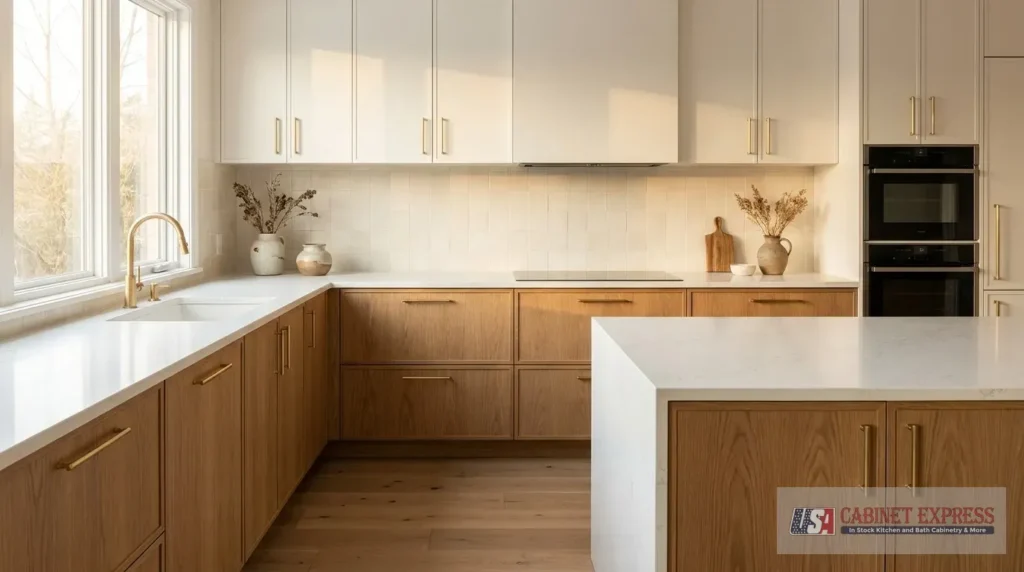
This is the biggest story of 2026 kitchen design. Wood-toned cabinetry at 29% market share vs. white at 28% might look like a narrow gap, but the trajectory is sharp . Wood grew six points year over year while white dropped five. Designers describe it as a move away from “clinical” toward “grounded,” and the grain preference backs that up: homeowners are gravitating toward plain-sliced varieties that show natural variation rather than rift-cut wood that hides the grain.
Medium wood tones lead the category at 15% of the market, with lighter finishes at 11%. Species driving the trend include white oak, maple, ash, and walnut. White oak in particular offers a clean, architectural look that photographs well and wears even better over time.
One thing worth noting: this doesn’t mean all-white is dead. Off-white and cream tones still hold 15% of the market, and they pair beautifully with wood in two-tone layouts. The shift is away from the all-white-everything approach, not away from white as one part of the kitchen.
Our Fabuwood cabinet lines at USA Cabinet Express include warm wood finishes in several door styles . All are in stock and available for same-day pickup across our locations.
2. Bold Color Statements
Beyond wood, the color story for 2026 kitchens is about what the industry calls “earthy vibrancy” : nature-pulled hues that feel rich without being aggressive. Green is the standout: sage, olive, and forest tones overtook gray as the top non-neutral cabinet color this year, moving from 5% to 6% of homeowners’ choices. That sounds small but represents real momentum in a category where neutrals have dominated for decades.
Dramatic Black
Matte black cabinetry remains a strong choice for kitchens that want a serious, sophisticated edge. Benjamin Moore’s Baby Seal Black (2119-30) is a reference point for the right depth . It reads differently under different lighting conditions throughout the day: not flat, not glossy, but a distinctly suede quality.
Deep Reds and Navy Blues
Rich jewel tones are showing up more frequently as island and accent colors. Deep reds and saturated navy blues work well on a single run or island where the rest of the kitchen stays neutral. They add personality without committing the entire room. Benjamin Moore’s Symphony Blue (2060-10) and Deep Rose (2004-10) are the paint references showing up most in 2026 design coverage.
Natural Green Palettes
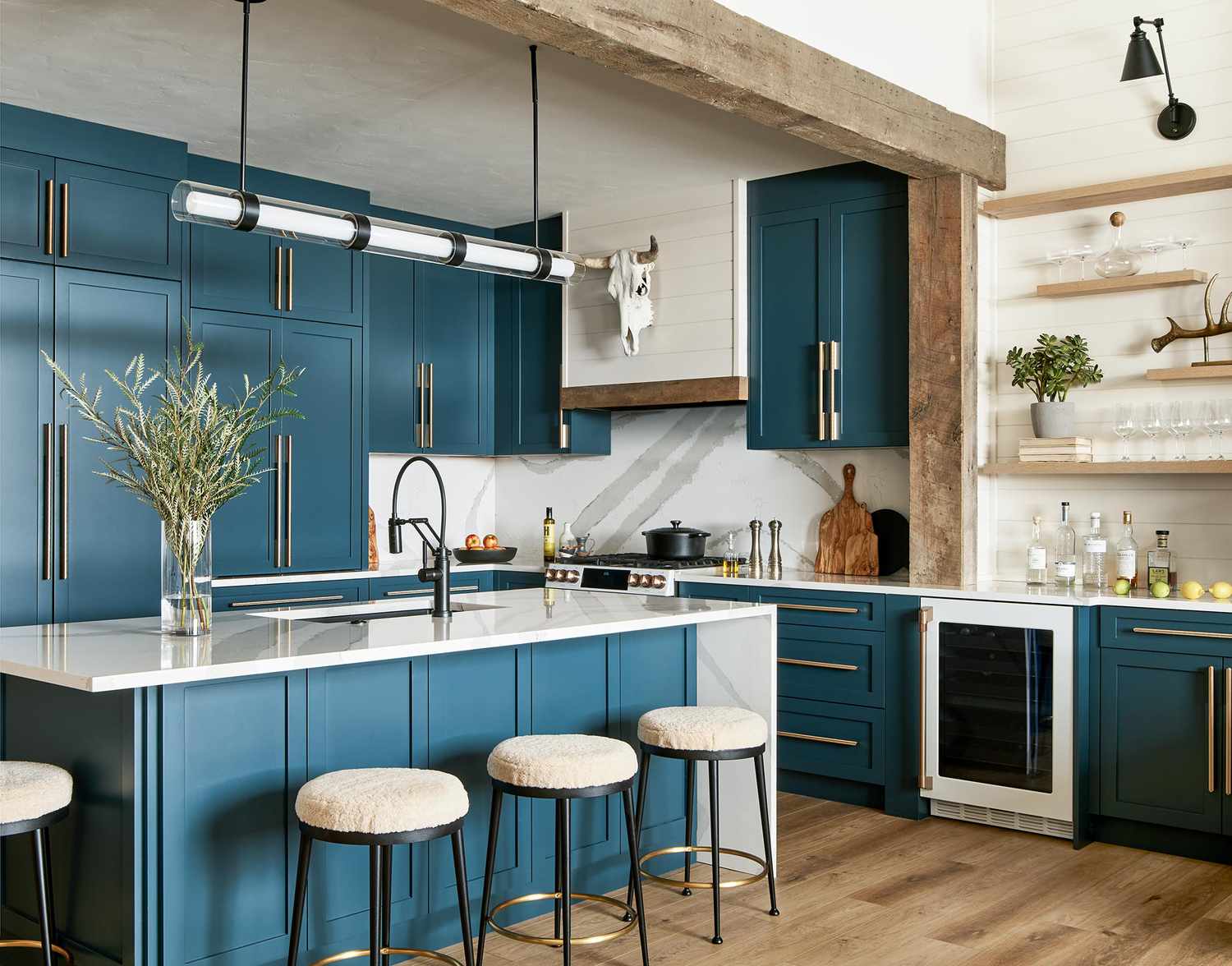
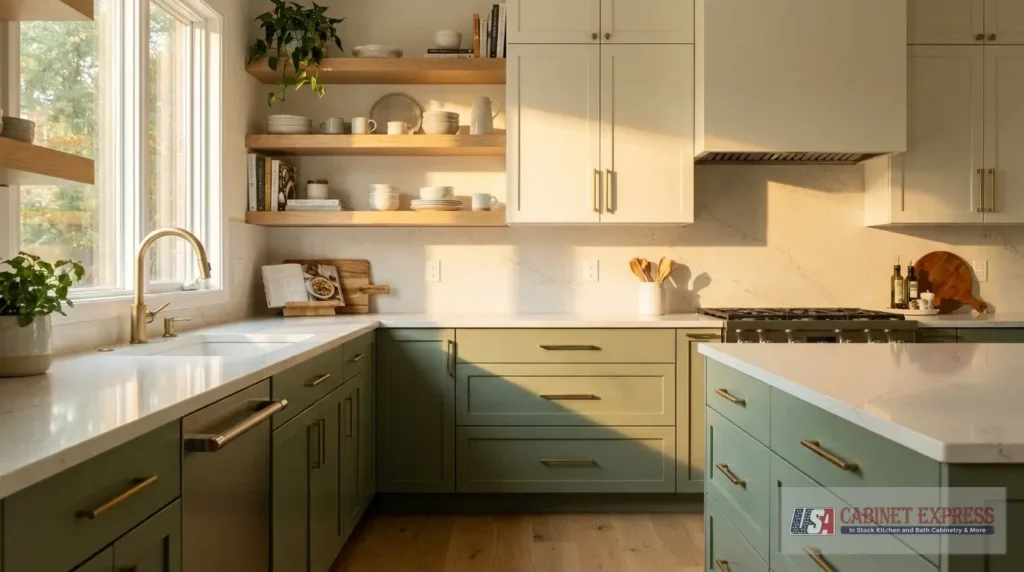
Green works at two extremes: very muted sage (close to a neutral) or a deeper forest tone used on lower cabinets or an island. Behr’s Hidden Gem, a smoky jade green, was the brand’s 2025 Color of the Year and continues to influence 2026 specifications. Pair it with light oak open shelving and warm brass pulls and you get a combination that’s showing up in nearly every high-end kitchen publication right now.
3. Two-Tone Cabinet Combinations
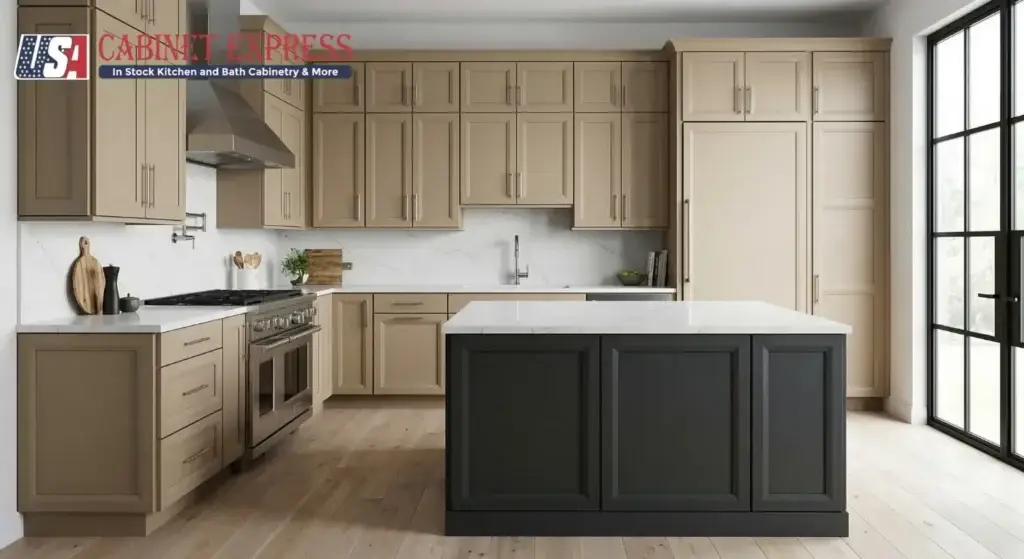
About 24% of renovating homeowners now choose contrasting colors for their upper and lower cabinets, according to Houzz’s 2026 study. The most common pattern: lighter tones on top (whites, off-whites, or light wood) with deeper, grounding colors below : natural wood, sage green, navy, or charcoal.
The way this is being executed in 2026 is more refined than earlier attempts. Instead of stark contrast, the best two-tone kitchens use tones that share an undertone. Warm white uppers paired with honey oak lowers. Pale sage above with walnut below. The island becomes the accent piece . The island is the one spot where you can take a color risk; changing a single finish later is far easier than repainting the entire kitchen.
From a practical standpoint, two-tone layouts give smaller kitchens a visual lift. Lighter uppers keep the eye moving toward the ceiling while darker lowers anchor the room without making it feel heavy.
4. Sustainable Kitchen Design
Sustainability in 2026 kitchens has moved from aspirational to expected. Buyers and contractors now ask about formaldehyde emissions standards, chain-of-custody wood certification, and finish chemistry the same way they ask about construction quality.
In practice that means: low-VOC and water-based finishes (TSCA Title VI and UL GREENGUARD certification are the benchmarks to look for), FSC or PEFC chain-of-custody certification on wood components, and energy-efficient appliances that cut operating costs over time. The most sustainable kitchen, though, is one built to last . That means solid plywood boxes, solid hardwood doors that can be refinished, and Blum soft-close hardware that won’t fail after 50,000 cycles.
Energy-efficient refrigerators, induction cooktops, and dishwashers all contribute to reduced household operating costs while meeting the environmental priorities most 2026 homeowners rate as a top-three renovation criterion.
5. Smart Technology That Stays Out of the Way
The NKBA’s 2026 outlook puts it well: technology should feel invisible. The smart features gaining real traction in 2026 aren’t flashy gadgets . They’re quality-of-life upgrades that disappear into the cabinetry.
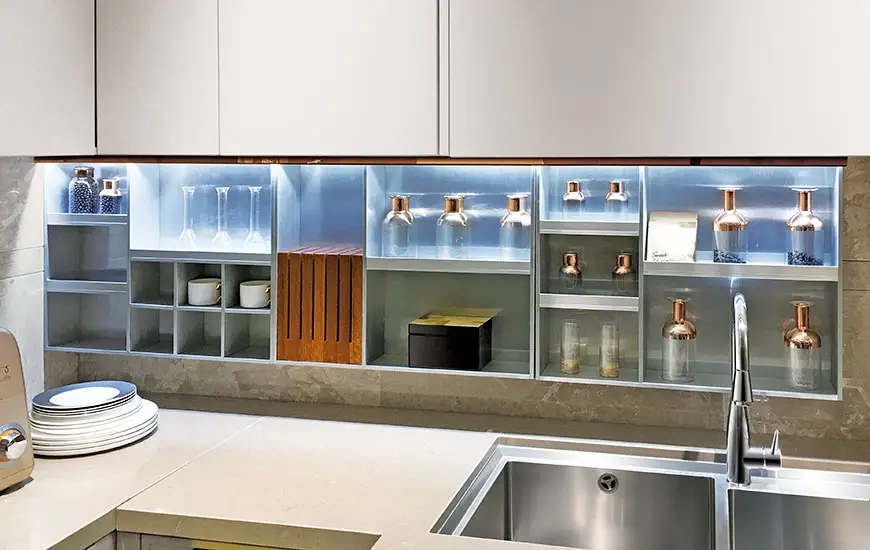
Under-cabinet and in-drawer LED lighting that turns on when you open a drawer or approach the counter. Charging drawers with hidden USB-C and wireless pads, keeping devices off the counter. Motion-activated waste and recycling pull-outs. WiFi-enabled appliances and app-controlled lighting (82% of designers expect under-cabinet lighting to be standard in new projects, per NKBA). These are features people actually use every day.
The higher-end tier includes app-controlled lighting scenes, cameras inside refrigeration drawers that integrate with recipe management, and voice-controlled cabinet lifts. But for most homeowners, the LED lighting and charging drawers deliver the majority of the value at a fraction of the cost.
One area moving fast: AI-powered pantry management. Systems now built into shelving can track expiration dates via barcode scanning, flag when staples run low, and sync with grocery apps so you can check pantry stock from the store. It’s not mainstream yet, but it represents where smart storage is heading, and the cabinet infrastructure (deep shelving, dedicated pantry walls, built-in outlets) needs to be planned now for these systems to work later.
6. Natural Elements and Materials
Natural stone countertops have been trending for several years, but the 2026 version looks different. The focus has shifted from standard granite and marble to materials with more visual character:
Quartzite with bold veining
Book-matched slabs where adjacent pieces flow symmetrically across a central seam
Green-toned natural stone that brings color into the countertop itself rather than the cabinetry.
Green stone countertops specifically are getting serious attention from designers. Choosing a colorful stone is a bigger commitment than a cabinet color . Stone is not returnable, but tonal greens are more versatile than they appear, working well with wood, white, and warm metal finishes. For homeowners who want a distinctive kitchen that doesn’t feel trendy in five years, it’s a strong choice.
Reclaimed wood, bamboo, and living walls continue to add texture and organic warmth to kitchens designed with the biophilic connection in mind : the idea that spaces feel better when they reference the natural world.
7. Cabinet Door Styles and Hardware in 2026
We’re excited to explore the world of smart kitchens. Here, innovative kitchen concepts meet cutting-edge technology. Today, smart technology in kitchens is a must, not a luxury. It brings convenience, safety, and fun to your home.
Shaker-style doors remain the most popular cabinet door in the U.S. at 58%, according to the Houzz data. They’re not going anywhere. But flat-panel (slab) doors have grown to 22% and represent real momentum toward cleaner, more architectural lines. The sweet spot getting the most attention right now is the slim or micro-Shaker profile . It keeps familiar recessed-panel proportions with thinner rails and stiles, reading contemporary without the coldness of a pure flat panel.
Hardware tells a similarly clear story. Bar pulls now dominate over knobs, with brushed nickel as the top finish, followed by matte black and brushed gold. The 2026 direction is mixed metals . Brass with matte black, or nickel with gold. The single-finish-throughout approach that defined the previous decade is fading fast. Some homeowners are going the opposite direction entirely with handleless cabinetry, where push-to-open mechanisms (Blum’s TIP-ON system) or J-pull grooves eliminate hardware completely for a flush, architectural look.
For a thorough breakdown of door styles by market share, Shaker vs. flat-panel performance data, and cabinet line comparisons, the team at IST Cabinets published a detailed 2026 data-backed guide that covers specifications, construction standards, and cost ranges by budget tier . It’s worth your time before finalizing selections.
At USA Cabinet Express, our Fabuwood, Wolf, and Mantra lines cover Shaker and flat-panel options in multiple finishes, all in stock and available for same-day pickup.
8. Beverage Stations and Coffee Bars
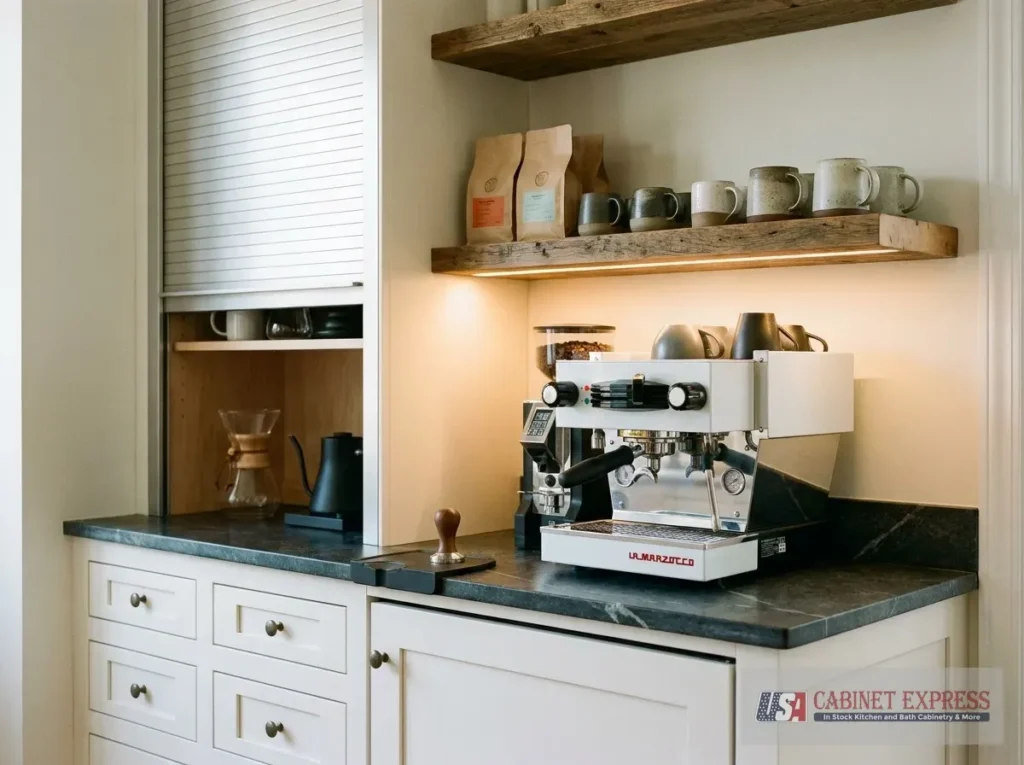
This is the storage trend that caught the most attention in the 2026 Houzz study. Beverage stations , dedicated cabinet zones for coffee makers, espresso machines, wine storage, and related accessories, are now incorporated by 24% of renovating homeowners. Walk-in pantries are growing too, but the beverage station specifically reflects a shift toward task-specific zones in the kitchen.
The idea behind zone thinking is straightforward: instead of planning a kitchen around the old work triangle (sink, stove, fridge), you plan around activity zones : prep, cooking, cleaning, beverages, baking, a drop zone near the entry. Each zone gets purpose-built storage. The result is a kitchen that functions better for the way households actually use the space, not the way home economics textbooks said they should.
Appliance garages with retractable doors are the cabinet solution that makes beverage zones work . Blenders, toasters, and coffee makers disappear behind consistent doors when not in use, keeping counters clear. Our accessories catalog includes pull-out pantry inserts, spice racks, and tray dividers that retrofit into standard cabinet boxes for this exact purpose.
9. Kitchen Islands: Bigger, Smarter, More Intentional
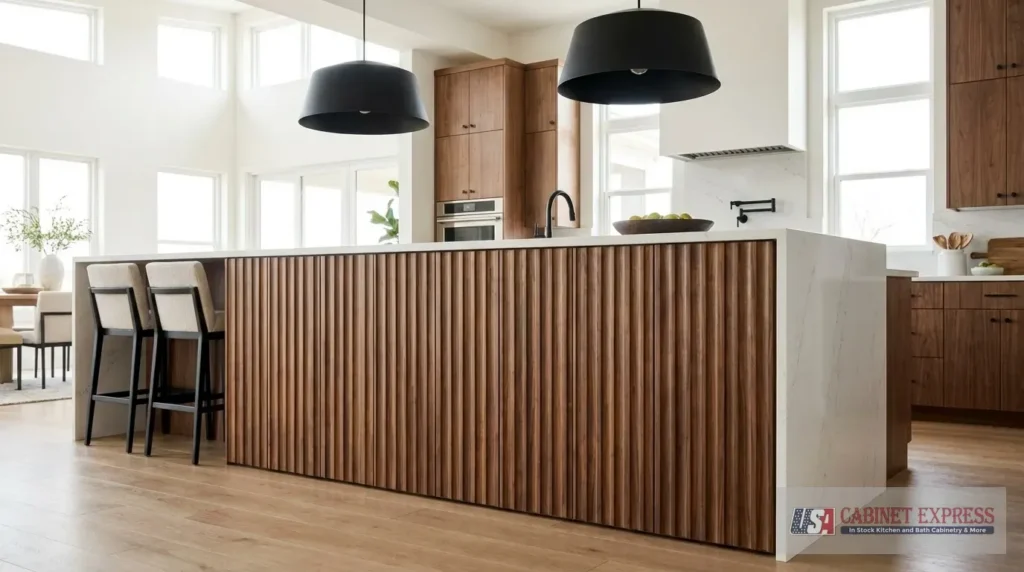
Kitchen islands have shifted from prep surface to the architectural anchor of the room. In 2026 they’re larger (about half of renovated islands now exceed seven feet in length, per Houzz), more multi-functional, and often the spot where homeowners take a design risk they’d be too cautious to take across the whole kitchen.
Waterfall-edge countertops that extend vertically down island sides are one of the most visually striking choices in 2026 kitchens. Fluted paneling on island faces (a vertically grooved detail that reads like furniture) adds depth and texture that a flat panel cabinet can’t match. Curved island forms, while less common, are showing up in high-end projects where the island is specifically meant to look nothing like a box.
Functionally, islands are becoming appliance hubs. Dishwashers, beverage fridges, and secondary sinks are moving to the island to keep the perimeter runs clean. More than half of renovating homeowners are integrating appliances into the island, turning it into a central hub for prep, cleanup, and casual dining in a single zone.
10. Lighting Innovations and Natural Light
Lighting is where the NKBA data gets specific. Among 2026 kitchen projects, under-cabinet lights are specified in 82% of designs, interior cabinet lights in 72%, and pendant lights in 63%. Those numbers reflect a move away from single overhead fixtures toward layered lighting that serves different times of day and different activities in the kitchen.
Pendant lights over the island have become a design focal point : a way to introduce a material, finish, or color that ties the room together without the commitment of full cabinetry. Backlit features (floating shelves with integrated LED strips, glass-front cabinets lit from within) add ambient depth without additional floor lamps or table lighting.
For natural light, the 2026 direction is strategic: larger windows positioned to wash countertop work surfaces, skylights over islands or cooking areas, and in open-plan layouts, a careful relationship between the kitchen and whatever faces south or west. Energy efficiency connects here too . More natural light means less artificial lighting load during daylight hours.
11. Modern Countertop Trends
Quartz remains the practical workhorse. Durable, low-maintenance, and resistant to staining and heat, it still dominates mid-range renovations. But the 2026 version is less uniform than the solid-color engineered quartz that dominated the last decade. Veined quartz that mimics natural stone at a fraction of the cost is now the most specified option in mid-range kitchen renovations.
At the higher end, natural quartzite is gaining ground for its combination of luxurious veining, natural strength, and the fact that every slab is genuinely unique. Book-matched installations, where adjacent slabs orient so veining flows symmetrically across a seam, create countertop surfaces that function as focal points without any additional decorative effort.
Slab backsplashes are one of 2026’s clearest statements. Instead of individual tiles, a full slab of engineered quartz or natural stone runs from countertop to upper cabinets, creating an uninterrupted surface that’s easier to clean and architecturally striking. Rectangular tile still leads overall, but slab backsplashes are gaining fast in projects with larger budgets.
12. Innovative Storage Solutions
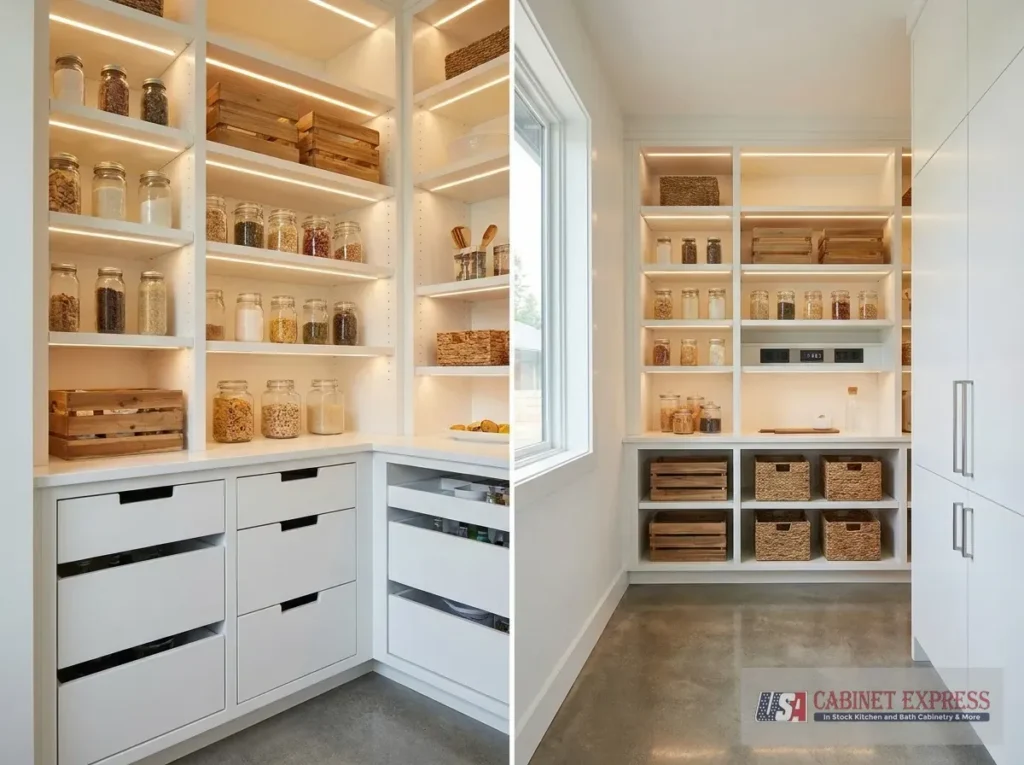
The biggest change in how modern kitchens are planned isn’t the cabinet door you pick . It’s how storage is organized across the whole room. Pantry cabinets are the #1 built-in feature addition in 2026 at 47%, according to Houzz. Walk-in pantries at 16% and butler’s pantries at 7% round out a consistent pattern: homeowners want more storage that hides more stuff.
Floor-to-ceiling cabinet runs are the architectural move that delivers on this. Eliminating the gap between wall cabinet tops and the ceiling adds cubic storage without expanding the footprint, and the built-in, seamless look makes the room feel taller and more finished. Pull-out shelving makes those upper sections useful . Today, 59% of renovating homeowners specify pull-out shelving as a standard feature, not an upgrade.
The scullery or back kitchen is an idea gaining momentum in larger renovation projects. The walk-in pantry, instead of functioning purely as storage, becomes a secondary kitchen space: a sink, small appliances, prep surfaces, and in some cases a social seating area. It keeps the main kitchen clear during entertaining while giving the household a private, functional workhorse zone just behind it.
Our RTA cabinet lines are available in Shaker White, Shaker Blue, and Shaker Gray for same-day pickup, making them an efficient choice for adding pantry columns or storage runs without long lead times.
13. Wellness-Focused Kitchen Features
The NKBA’s 2026 report highlights wellness as one of the growth-phase trends with real staying power. In practice that means appliance and ventilation choices that affect indoor air quality and cooking health. Steam cooking is specified in 66% of high-end 2026 kitchen projects. Powerful vent hoods are a priority for 85% of designers surveyed. Both choices directly affect the air quality in one of the most frequently used spaces in the home.
Smart refrigerators with adjustable temperature zones, water filter alerts, and remote monitoring are described in the Houzz data as “less about flash and more about function.” Precise oven controls that support low-and-slow or specific temperature requirements matter more to buyers in 2026 than the number of modes on the display.
Outdoor kitchen connections are growing too: 71% of NKBA respondents see this as a meaningful trend. Whether that means a pass-through window, a connected grill area, or a full outdoor kitchen, the idea of the kitchen extending to where people actually spend time in warmer months is driving design decisions in markets across the South and Southwest, including our Austin, and Houston locations.
14. Textural Elements and Finishes
The finish story for 2026 is matte over gloss. Matte and suede textures hide fingerprints, diffuse light more naturally, and photograph well in real-world conditions without glare. New anti-fingerprint surface technologies from manufacturers like FENIX and EGGER have largely addressed the earlier concern that matte finishes showed grease and water marks. This matters most in handleless kitchens where cabinet fronts are touched constantly.
Mixed metal applications continue from 2025 into 2026 with more confidence. Copper, brass, and brushed nickel in the same kitchen (once considered a mistake) now reads as intentional layering. The key is sharing an undertone: warm metals together, cool metals together, with one finish as the dominant and the others as accents.
Tactile surface treatments on cabinetry (wood, fluted panels, linen-textured laminates, brushed oak) add depth that a smooth painted cabinet can’t provide. The kitchen is a high-touch space; materials that engage the hand as well as the eye hold their appeal over time in ways that purely visual finishes don’t.
15. Eco-Friendly Appliance Integration
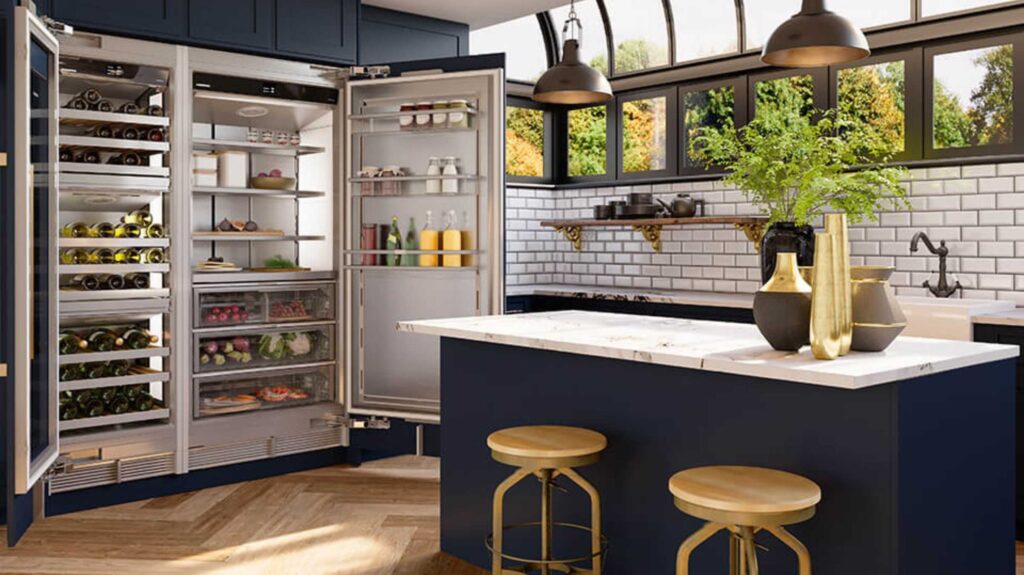
Energy-efficient appliances deliver two kinds of value in 2026: lower operating costs and better indoor air quality. Induction cooktops eliminate combustion and the associated pollutants, run on electricity from an increasingly clean grid, and heat faster with more precise control than gas. Energy Star-certified refrigerators and dishwashers use 10-50% less energy than older models, which translates to several hundred dollars in utility savings over a ten-year period.
Recycled and responsibly sourced materials like reclaimed wood, bamboo, and recycled glass countertops continue to attract buyers who want provenance and responsibility in their material choices, not just style. These aren’t fringe preferences anymore. They’re showing up in spec sheets alongside Shaker door profiles and countertop thickness.
16. Space Optimization for Every Kitchen Size
The NKBA reports that 76% of industry professionals expect kitchen footprints to increase over the next three years . But that growth isn’t universal. Smaller kitchens in urban apartments and older homes still need to work harder for every square foot. The strategies that work at both ends of the size spectrum are similar: vertical storage, zone planning, and choosing drawer-over-door configurations wherever possible (drawers use 100% of their interior depth; door cabinets typically use 60-70%).
For kitchen layouts, the work triangle has largely given way to zone-based planning. Activity zones (prep, cooking, cleaning, beverages, casual dining) each get its own storage and workflow logic. The kitchen that results from zone thinking is more functional for households that have multiple people using the space simultaneously, which is now the norm rather than the exception.
USA Cabinet Express carries RTA cabinet lines across our seven locations, available in Shaker White, Shaker Blue, and Shaker Gray for same-day pickup. Whether you’re adding a pantry column, a beverage station, or a full kitchen renovation, schedule a free consultation at the location nearest you.
17. Floor-to-Ceiling and Frameless Cabinetry
Eliminating the gap between wall cabinet tops and the ceiling is one of the highest-impact moves in a kitchen renovation. It adds storage, makes the room feel taller and more finished, and creates a built-in look that raised-panel or framed cabinetry can’t match in a contemporary context.
Frameless (European-style) construction is the structural choice that makes this look work cleanly. Without a face frame, the cabinet front is flush and continuous. Drawers and pull-outs can be wider, and there’s no center stile blocking a base cabinet’s opening. For families or contractors who want maximum interior space without maximizing exterior dimensions, frameless is the right spec.
18. Freestanding Cabinetry: The Furniture-Like Kitchen
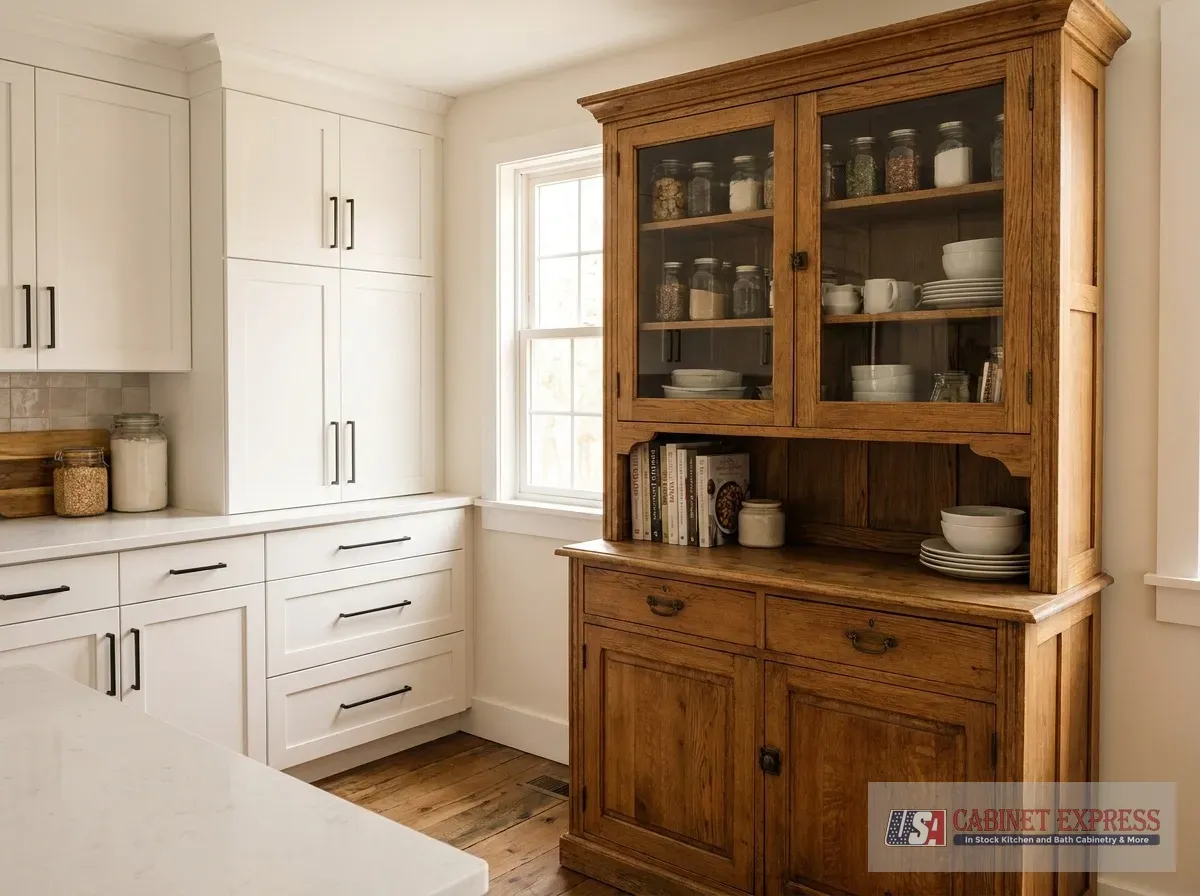
Not every 2026 kitchen trend points toward built-in and seamless. A growing counter-movement is specifically designed to look un-built-in: freestanding cabinet pieces that read like furniture rather than architecture. Think an antique armoire used as a pantry, a sideboard standing in for a lower cabinet run, or a freestanding island that could theoretically move to a different position in the room.
The appeal is warmth and individuality. A kitchen with one or two freestanding pieces among built-in cabinetry feels curated rather than installed. It also offers flexibility in rentals or for homeowners who want to take pieces with them if they move. Designers at Homes and Gardens named this the standout trend that separates 2026 kitchen design from the previous decade’s all-built-in uniformity. For practical purposes, freestanding pieces work best as storage accents (a hutch for display, a standalone pantry column) rather than primary cabinet runs, where the built-in approach still wins on space efficiency.
19. Cabinet Colors at a Glance: 2026 Data
Here’s how the color market breaks down for 2026, according to the Houzz Kitchen Trends Study:
| Color | 2026 Market Share | Direction | Best Paired With |
|---|---|---|---|
| Wood tones | 29% | ↑ Up (+6% YoY) | White counters, brass hardware, green accents |
| White | 28% | ↓ Down (-5% YoY) | Wood islands, black hardware, marble |
| Off-white / cream | 15% | → Stable | Wood lowers, warm metals, natural stone |
| Green (sage, olive, forest) | 6% | ↑ Overtaking gray | Light oak, brass, white counters |
| Gray | 5% | ↓ Declining | White uppers, stainless hardware |
20. Universal Design: Building Kitchens That Work for Everyone
Over 50% of renovating homeowners now build in accessibility features, and the reason isn’t always aging-in-place planning. Pull-out shelving, soft-close drawers, and lower-profile fixtures simply make a kitchen more comfortable to use for everyone. These aren’t clinical additions. They’re better design.
Soft-close and servo-assisted systems reduce the physical force needed to operate heavy drawers. Rounded countertop edges improve safety for households with young children. Lower countertop sections or seated prep areas serve a wider range of users without reading as accommodations. When planning a kitchen that needs to serve a family for 10-15 years, building in these features from the start costs almost nothing extra compared to retrofitting later.
20. Universal Design: Building Kitchens That Work for Everyone
Over 50% of renovating homeowners now build in accessibility features, and the reason isn’t always aging-in-place planning. Pull-out shelving, soft-close drawers, and lower-profile fixtures simply make a kitchen more comfortable to use for everyone. These aren’t clinical additions. They’re better design.
Soft-close and servo-assisted systems reduce the physical force needed to operate heavy drawers. Rounded countertop edges improve safety for households with young children. Lower countertop sections or seated prep areas serve a wider range of users without reading as accommodations. When planning a kitchen that needs to serve a family for 10-15 years, building in these features from the start costs almost nothing extra compared to retrofitting later.
21. Refacing vs. Full Replacement: What Homeowners Choose
Full replacement dominates. Houzz reports 68% of homeowners replace all cabinets, 27% partially replace, and 5% skip cabinet upgrades entirely. But among partial upgraders, the strategies are practical: refinishing or repainting existing exteriors (50%), adding new cabinets to the existing layout (32%), or swapping just the doors and drawer fronts (20%).
The key question is whether your existing cabinet boxes are structurally sound. If they are, replacing doors, hardware, and adding organizational accessories delivers a dramatic visual change at roughly 40-60% of full replacement cost. If the boxes are damaged or the layout needs to change, full replacement makes more sense. With USA Cabinet Express’s in-stock inventory, kitchen cabinets are available in 5-7 business days rather than the 6-8 week lead times typical of custom manufacturers.
22. Refacing vs. Full Replacement: What Homeowners Choose
The kitchen of 2026 is warmer, smarter, and more intentional than the kitchens of the previous decade. Wood is back as the dominant finish. Storage is planned around how people actually cook and live, not around the old triangle. Technology is present but quiet. Sustainability is a baseline, not a premium add-on.
Whether you’re planning a minor refresh or a full renovation, these trends point toward the same thing: a kitchen that holds up over time, not just over Instagram. The choices that look right in 2026 (warm materials, quality hardware, zone-based storage) are also the choices that look right in 2031.
Ready to see what’s possible in your kitchen?
Book a free 3D design consultation at any USA Cabinet Express location. Same-day pickup available on our full in-stock cabinet selection.
Conclusion
The 21 trends covered here share a common thread: kitchens are becoming more personal, more purposeful, and more connected to how households actually function. Bold colors, warm wood, dedicated beverage zones, and wellness features aren’t competing aesthetics. They’re parts of the same move toward kitchens designed around the people who use them.
USA Cabinet Express carries in-stock Fabuwood, Wolf, and Mantra cabinet lines at seven locations across Texas, Virginia, and Missouri. No back-orders, no long wait times. Contact your nearest location to get started.
Frequently Asked Questions: Kitchen Trends 2026
The biggest trend of 2026 is the shift from all-white kitchens toward warm wood cabinetry, which overtook white as the #1 cabinet color for the first time according to Houzz's 2026 Kitchen Trends Study (29% vs. 28%). Other major trends include two-tone cabinetry, dedicated beverage stations, bold green accents, mixed metal hardware, slab backsplashes, and wellness features like steam cooking and powerful ventilation.
White cabinets aren't disappearing, but they're no longer the default. Wood-toned cabinetry took the top spot for the first time in 2026, while off-white and cream remain stable at 15% of the market. The trend is away from all-white kitchens, not away from white entirely. White still works well as upper cabinets in two-tone designs paired with wood or colored lowers.
Wood tones lead at 29%. White holds at 28%. Off-white and cream are steady at 15%. Green (sage, olive, forest) overtook gray as the top non-neutral color, now at 6% vs. gray's 5%. For paint colors, Sherwin-Williams Universal Khaki, Benjamin Moore Silhouette (chocolate brown), and Behr Hidden Gem (smoky jade green) are the 2026 Color of the Year references shaping kitchen palettes.
Shaker-style doors remain the most popular in the U.S. at 58% of the market, according to Houzz's 2026 data. Flat-panel (slab) doors are the strongest runner-up at 22%. A growing option is the slim or micro-Shaker profile with familiar proportions but with thinner rails and stiles for a more contemporary look without the coldness of a pure flat panel.
Pantry cabinets are the #1 built-in storage addition, specified by 47% of renovating homeowners. Beverage stations follow at 24%. Walk-in pantries at 16%, butler's pantries at 7%. Pull-out shelving is the most popular accessibility feature at 59%. Floor-to-ceiling cabinet runs are the most impactful way to add storage without changing the kitchen's footprint.
According to Houzz's 2026 data, median spend is $55,000 for a major kitchen remodel (all cabinets and appliances replaced) and $20,000 for a minor remodel. Cabinets typically account for about 28% of total kitchen renovation costs. Semi-custom cabinets like our Fabuwood and Wolf lines at USA Cabinet Express deliver custom-level quality at stock-level speed, which is where most homeowners find the best value.
Countertops in 2025 will focus on durability and low maintenance. Natural stone, quartz, and other sustainable materials are trending. Modern, minimalist designs are also popular.
For 2025, kitchens will feature smart appliances, voice control, and energy management. Advanced storage and sustainable materials will also be key. These innovations aim to reduce environmental impact.