

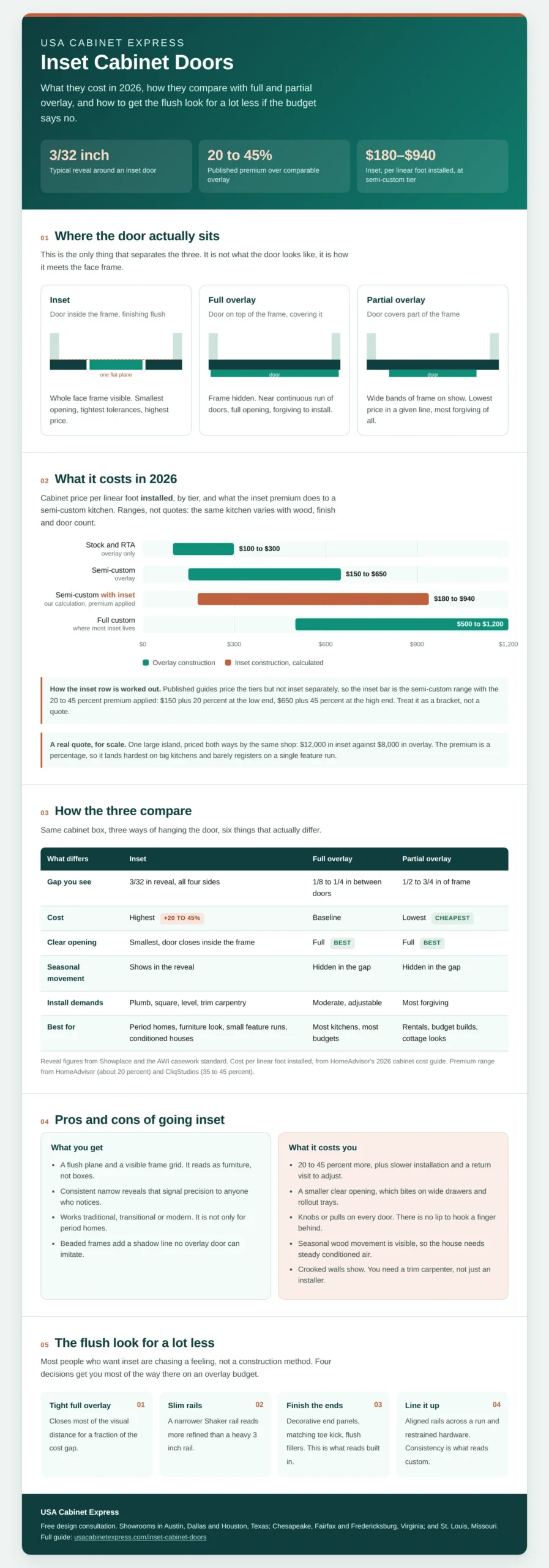
Here is the short answer, because you probably came for it. Inset cabinet doors sit inside the face frame instead of on top of it, they typically add 20 to 45 percent to a cabinet order, and neither Fabuwood nor Mantra builds a true inset kitchen line. If a designer told you otherwise, they were describing a look, not a construction method.
That does not mean you should give up on the look, and it does not mean inset is the right call for every kitchen. This guide covers what inset actually is, what it costs, what owners say after living with it, how humidity in Texas, Virginia and Missouri changes the math, and what gets you most of the same result for a lot less. If you want the wider view first, start with our complete guide to kitchen cabinet door styles.
Which one is right for you?
- You want the furniture look and have room in the budget. True inset, from a line that actually builds it. Expect a premium and a follow-up adjustment visit.
- You want tight, clean lines on a normal budget. Full overlay. Fabuwood Allure or Mantra Omni close the gap on looks for a fraction of the cost difference.
- You like seeing the face frame. Partial overlay, such as Fabuwood Quest or Mantra Classic. Wider reveals, lowest price, traditional feel.
- Your house swings from humid summers to dry winters and nobody runs the AC. Skip inset. Read the humidity section before you spend the money.
Not sure which camp you are in? Book a free design consultation and we will tell you straight.
Want a straight answer on your kitchen? Send us your layout and your budget. We will price the overlay version properly, tell you honestly what inset would take, and put the two side by side before you commit to either.
Get a free consultationWhat inset cabinet doors are
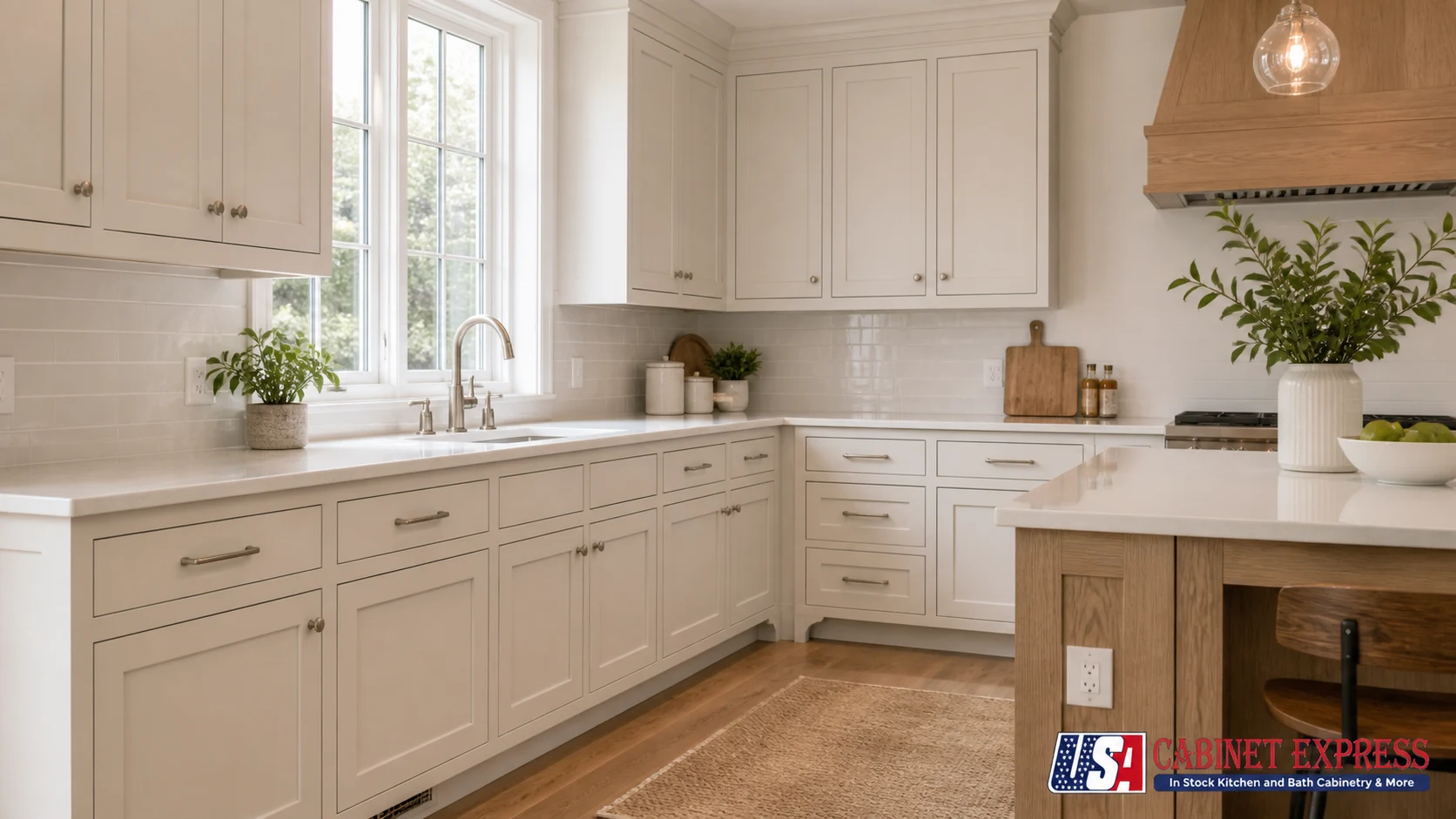
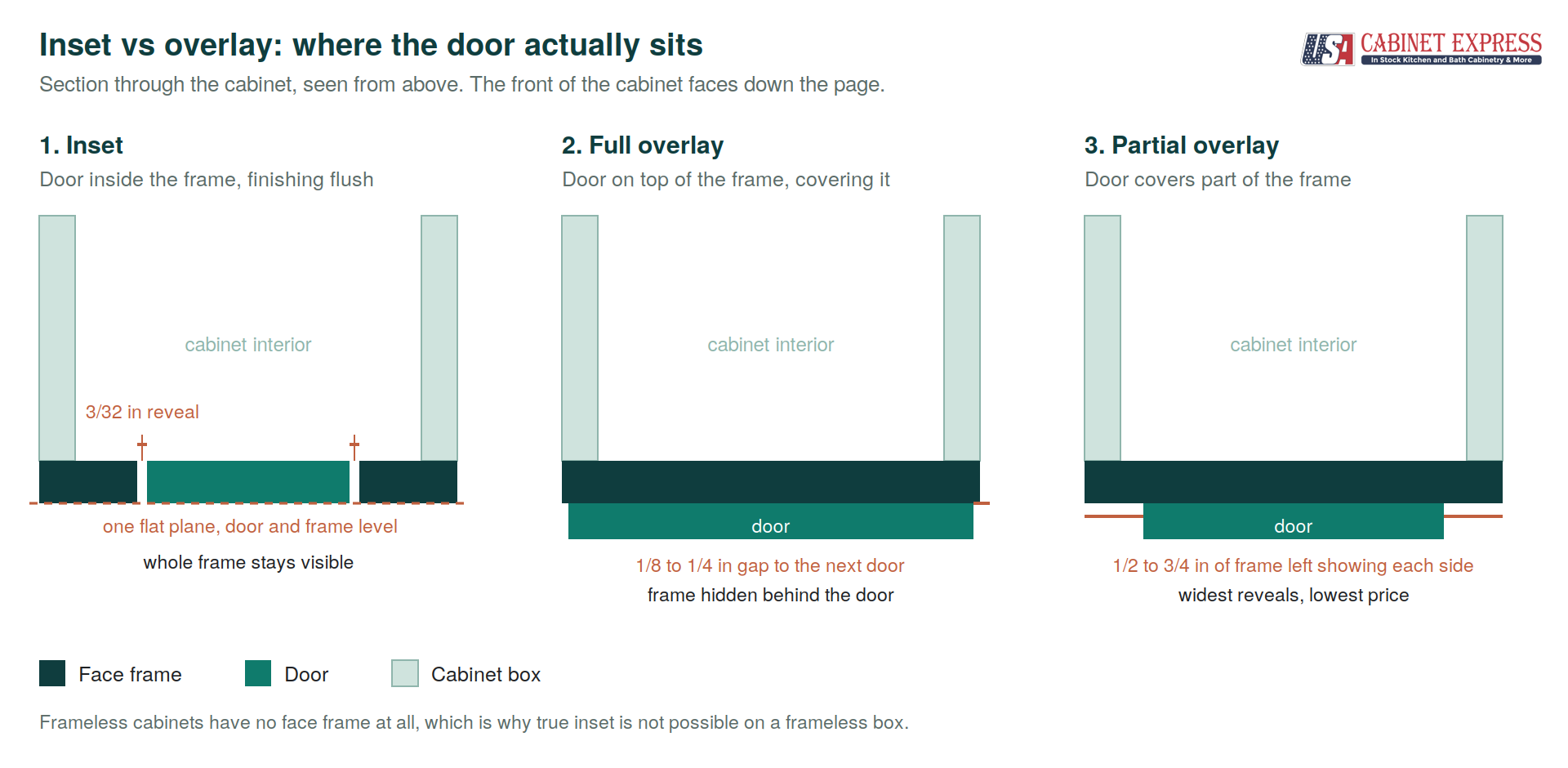
An inset door is fitted inside the opening of the cabinet’s face frame so the closed door sits flush with the front of the frame. Nothing overlaps. The whole face frame stays visible, which is why an inset kitchen reads like a piece of furniture instead of a run of boxes. The Kitchen Cabinet Manufacturers Association defines a full inset cabinet exactly this way, as doors fitted into the face frame and flush with it.
You will see the same construction called flush inset, full inset and true inset. Those all mean one thing: the door sits inside the frame. The gap around the door is called the reveal. Showplace, one of the manufacturers that does build inset, publishes a 3/32 inch gap between the door and the frame. The Architectural Woodwork Institute’s casework standard allows a maximum uniform inset reveal of 1/8 inch, with tighter variation permitted at higher workmanship grades. Those two numbers explain the entire cost story. A full overlay door can be off by a sixteenth and nobody sees it. An inset door cannot.
The part almost everyone gets wrong
Shaker and inset are not the same kind of word. Shaker describes the face of the door. Inset describes where the door sits. You pick one of each, and a Shaker door can be full overlay, partial overlay or inset. It is the reason people walk into showrooms asking for something the brand on the floor does not build.
| Decision | What it describes | Your options |
|---|---|---|
| Door design | The visible profile of the door | Slab, Shaker, slim Shaker, raised panel, fluted, glass front |
| Box construction | Whether the box has a face frame | Framed, or frameless full access |
| Door to frame relationship | Where the closed door sits | Full overlay, partial overlay, or inset |
Why frameless cabinets cannot be truly inset
Frameless cabinets, the European full access style, have no face frame at all. The doors mount straight to the box sides. Without a frame there is nothing for a door to sit inside, so conventional inset construction is off the table. A fabricator can build a secondary inner frame to fake the geometry, and Blum publishes separate inset planning details for its AVENTOS lift systems, which hints at how much extra structure that takes. That is cabinet reconstruction, not a door option. If you love the flush look and you are shopping frameless, you are choosing between two different things.
Inset vs overlay cabinets, compared honestly
Most people arrive at this question from the other direction: they have been quoted overlay and they want to know what inset buys them. Here is the whole trade in one table.
| What differs | Inset | Full overlay | Partial overlay |
|---|---|---|---|
| The look | Door flush in the frame, whole face frame visible, furniture grid | Door covers the frame, near continuous run of doors | Wide bands of frame between every door |
| Gap you see | About 3/32 inch of reveal on every side | Roughly 1/8 to 1/4 inch between adjacent doors | 1/2 to 3/4 inch of exposed frame |
| Cost | About 20 to 45 percent above comparable overlay | Baseline for most framed lines | Usually the lowest price in a given line |
| Clear opening | Smallest. The closed door sits inside the opening | Full opening, door parks outside the frame | Full opening |
| Seasonal movement | Shows. A tight reveal makes swelling and shrinking visible | Hidden. Wider gaps absorb it | Hidden |
| Install demands | High. Needs plumb, square and level, and trim carpentry skill | Moderate. Adjustable and forgiving | Most forgiving of the three |
| Best for | Period homes, furniture-look kitchens, small feature runs, climate-controlled houses | Most kitchens, most budgets, modern and transitional | Rentals, budget builds, traditional and cottage looks |
Put in money terms, on HomeAdvisor’s semi-custom band of $150 to $650 per linear foot installed, the same kitchen in inset works out somewhere around $180 to $940 per linear foot once the premium is applied. That is our arithmetic rather than a published figure, so treat it as a bracket. That spread is why the answer is rarely about taste alone.
So which should you choose
Skipping the hedging, here is how it usually falls out.
- Choose inset if the flush plane is the point of the kitchen, your house holds a steady indoor climate, and your installer is a trim carpenter. It is also the easier call on a small run, an island or a butler’s pantry, where the premium applies to a handful of cabinets rather than forty.
- Choose full overlay for almost every other kitchen. You get tight, clean lines, the full opening, and the money left over goes into better boxes, better hardware and better counters.
- Choose partial overlay if you want the frame to read as part of the design, or the budget is the binding constraint. Just choose it deliberately. Partial overlay applied by accident is what makes a kitchen look builder grade.
How much storage inset actually costs you
Less than the internet suggests, but not nothing. Inset does not shrink the box. It shrinks the clear opening, because the door closes inside the frame rather than over it, so the width and height you can reach through get smaller. That matters most for wide drawers, rollout trays, sheet pans and anything you slide in and out. It matters much less for a cupboard you reach into.
One practical consequence people forget: inset doors need knobs or pulls. There is no door lip to hook a finger behind, so handleless is off the table. Budget for hardware on every door and drawer, and see our cabinet hardware guide for what holds up.
Flush inset vs beaded inset
Two versions of the detail, and they read very differently in a room.
Flush inset
The frame opening has a plain square edge and the door sits inside it, flat with the frame face. Quieter, more transitional, and the version that works in a modern kitchen without looking like a period restoration.
Beaded inset
A bead is machined around the inside edge of the frame opening, framing each door with a shadow line. More traditional, and one more edge to wipe down. It usually costs more, though not everywhere: Shiloh prices its inset styles level with full overlay.
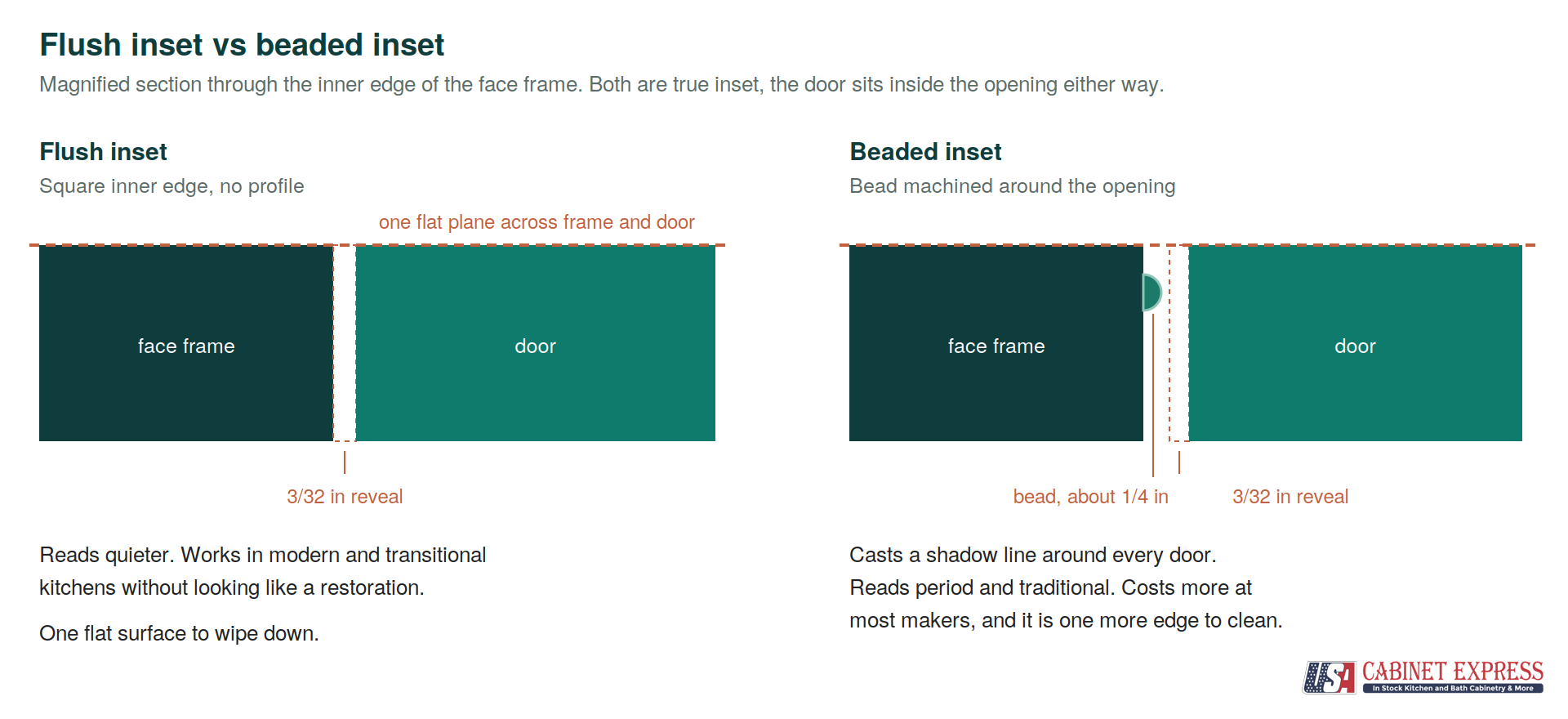
Choose flush if the kitchen leans modern or transitional, or if you want the frame to stay quiet. Choose beaded if the house is period, or if you want the shadow line to do some of the decorative work. There is a third question your cabinetmaker will ask: whether to keep the centre stile, the vertical piece of frame between two adjacent doors. Keeping it is the traditional, furniture-correct answer and it stiffens the frame. Removing it gives a wider unbroken opening and a more modern face, at the cost of some rigidity.
Hinges are a separate choice, not a rule. Inset can run on six-way adjustable concealed soft-close hinges, or on visible butt and finial hinges in finishes like polished nickel, satin nickel, oil rubbed bronze and flat black. Exposed hinges are a design decision. Plenty of people assume inset means visible hardware and it does not. For how hinge type changes what a door can do, see our cabinet door opening mechanisms checklist.
Does Fabuwood make inset cabinet doors?
Not for kitchens. As of August 2026, no Fabuwood kitchen series is built as true inset, and we checked the current door style catalog and every series page to be sure. There is one inset product in the Fabuwood line and it is a bath vanity series, covered below. Here is what the kitchen catalog offers.
| Series | Box | Door relationship | Notes |
|---|---|---|---|
| Allure | Framed plywood | Full overlay | Galaxy, Fusion, Nexus, Luna, Echo, Luxe. Solid wood door frames, MDF center panel, Blum soft-close |
| Illume | Frameless | Full overlay | Catalina and Tuscany. No face frame, so inset is not possible by construction |
| Ovela | Frameless plywood | Full overlay | Full access box with wood veneer interior |
| Quest | Framed plywood | Partial overlay | Metro and Discovery. More face frame stays visible, but the doors still sit on top of it |
| Value Premium | Framed plywood | Full overlay | Hallmark door. Fabuwood’s spec guide notes modified overlay on wall cabinets |
The one exception, and its limit. Fabuwood does build inset, in exactly one place. The Valencia series with the Lavari door is described by Fabuwood as classic inset cabinetry, and it carries the same limited lifetime warranty as their other listed series. Valencia is a bath vanity line. It is not a kitchen series and it will not furnish a kitchen, so it is worth knowing about for a powder room and worth ruling out for everything else.
Fabuwood does publish educational content explaining what inset means, which is where some of the confusion starts. Their own overlay guide and their series pages both put their kitchen lines in the full and partial overlay columns. More on the brand in our Fabuwood overview.
Are Mantra cabinets inset?
Also no. Mantra, built by MasterBrand, keeps its catalog deliberately short so it can ship fast. Two published door profiles, and neither is inset.
| Profile | Door relationship | Rail width | Drawer front |
|---|---|---|---|
| Omni | Full overlay Shaker | 2 1/4 inch | Five piece, matching |
| Classic | Partial overlay Shaker | 2 1/4 inch | Flat slab |
Mantra puts plywood boxes, solid wood dovetail drawer boxes and full extension soft-close hardware in the base price, then limits choice to keep lead times short. That is a good deal if you want a clean full overlay Shaker quickly. It is the wrong shopping list if inset is the requirement. See our Mantra overview for the rest of the specification.
What inset cabinet doors cost in 2026
Two numbers matter. The tier you are buying in, and the premium inset adds inside that tier.
| Tier | Per linear foot installed | Is inset available? |
|---|---|---|
| Stock and RTA | $100 to $300 | Rarely, and not from Fabuwood or Mantra |
| Semi-custom | $150 to $650 | Yes, from lines that build it |
| Full custom | $500 to $1,200 | Yes, and this is where most inset lives |
On top of the tier, published inset premiums run from about 20 percent to about 45 percent over comparable overlay. HomeAdvisor puts flush and inset cabinets in the same $150 to $1,200 per linear foot band as other semi-custom and custom work and estimates about 20 percent more for flush. CliqStudios, which sells inset, puts it higher at 35 to 45 percent over a standard full overlay cabinet. Treat those as ranges, not quotes. Neither Fabuwood nor Mantra sells inset as a factory upgrade, so there is no honest same-brand percentage to give you.
A real number helps. A homeowner in this r/kitchenremodel thread priced one large island both ways and got $12,000 for inset against $8,000 for overlay. On the other end, a poster in an r/cabinetry cost thread was quoted $40,000 for 23 feet of custom inset, about $1,700 a foot. Same construction method, wildly different projects.
The cost line most quotes leave out
Installation. Inset punishes crooked walls and out-of-level floors in a way overlay does not, because every gap is on display. A kitchen designer with ten years in the trade put it plainly in the same thread: you need a good trim carpenter, not just an installer, and you cannot hide install mistakes with inset. Budget for slower installation and a return visit to adjust doors after the first season.
When you compare quotes, compare the same kitchen. Same cabinet count and sizes, same finished ends, moldings, fillers, organizers, hardware, delivery, install, tax and finish. A 10 by 10 kitchen price is too blunt an instrument for an inset decision.
Why inset costs more, and when the premium is worth it
The premium is not a brand markup. It pays for tighter tolerances, more skilled labour, specific hinges and hinge mortising, more installation time, and the follow-up adjustments a 3/32 inch reveal demands. Beading and decorative exposed hinges add more. In a retrofit, custom sizing and colour matching add more again.
Worth it: a period home where overlay would look wrong, a furniture-look kitchen where the flush plane is the whole design, or a small run where the premium applies to six cabinets instead of forty. Hard to justify: a large kitchen on a mid-range budget, where the same money buys plywood boxes, better drawer hardware and a better counter across the whole room. And skip it in a house that sits unconditioned for months at a time, whatever the budget.
What people who live with inset say
These are real comments from a public r/kitchenremodel discussion about inset cabinets, condensed for length and lightly cleaned up. We picked the objections that come up over and over, and answered each one.
“Inset shows every mark, scratch and damage on the frame since there is no overlay of the door.”
Partly fair, and the counter came from the same thread: doors show every mark too. If your family is hard on cabinets, you will find the damage on an overlay door instead of an exposed frame. What actually protects you is a catalyzed finish and a touch-up kit, which is a question to ask the manufacturer, not a reason to rule out inset.
“I cannot unsee the ever so slight imperfect spaces that do not align with one another. My husband thinks I am crazy but it is enough for me to insist on full overlay in my kitchen.”
This is the honest reason to skip inset, and it has nothing to do with quality. A cabinet maker replied with the reframe worth keeping: look at the gap between full overlay doors and you will see it change from day to day. If inset bugs you, full overlay will too. The difference is that a 3/32 inch reveal makes the movement visible and a 3/16 inch gap hides it.
“Everyone, including the people trying to sell them to me, tells me they are a little higher maintenance with the level adjustments. Not sure I have the time or energy to level my cabinets.”
Realistic expectation: a hinge tweak once or twice in the first year as the house and the wood settle, then rarely. Adjustable concealed hinges turn that into a five minute job with a screwdriver. Ask who is responsible for the first-season adjustment and get the answer in writing before you sign.
“I hated them. They never lined up right. They chipped like crazy. Once a month I was touching them up with paint and adjusting the hinges.”
This outcome is real and it is almost always a build and install problem rather than an inset problem. A weak box under an inset face sags and drifts, and once the box moves the reveals go with it. It is the single best argument for checking box construction before you fall in love with a door.
“Seventeen years later all of the cabinets still look pretty good. There is some visible wear in a few areas with the highest use, but nowhere near the point that we would consider refinishing.”
The other side of the ledger, from an owner of custom painted inset Shaker built in 2008. Good inset, built well and installed well, ages fine. The horror stories and the happy stories are both true, and the variable is the shop, not the style.
Inset and humidity, which matters more than anyone tells you
Wood takes on moisture in summer and gives it back in winter. It moves. On an overlay door that movement disappears into a wide gap. On an inset door with a 3/32 inch reveal, it is the whole story: reveals close up in August and open up in January, and in a bad case a door rubs or sticks.
The manufacturers put numbers on this, and they are worth reading before you order anything. Mantra’s warranty treats temperatures outside 50 to 85 degrees Fahrenheit and humidity outside 30 to 55 percent as extreme conditions, which are not covered. Fabuwood’s warranty excludes cabinets in locations that do not maintain year-round environmental controls, or that are exposed to excessive moisture and humidity, and it states that center panels which shrink up to 1/8 inch, and doors warped up to 1/4 inch, are not considered defective.
Those tolerances tell you how much movement a mass-produced door is allowed before anyone calls it a defect. An inset door has to hold a 3/32 inch reveal on top of all of it. That is not an argument against inset, it is an argument for the specific things that manage it.
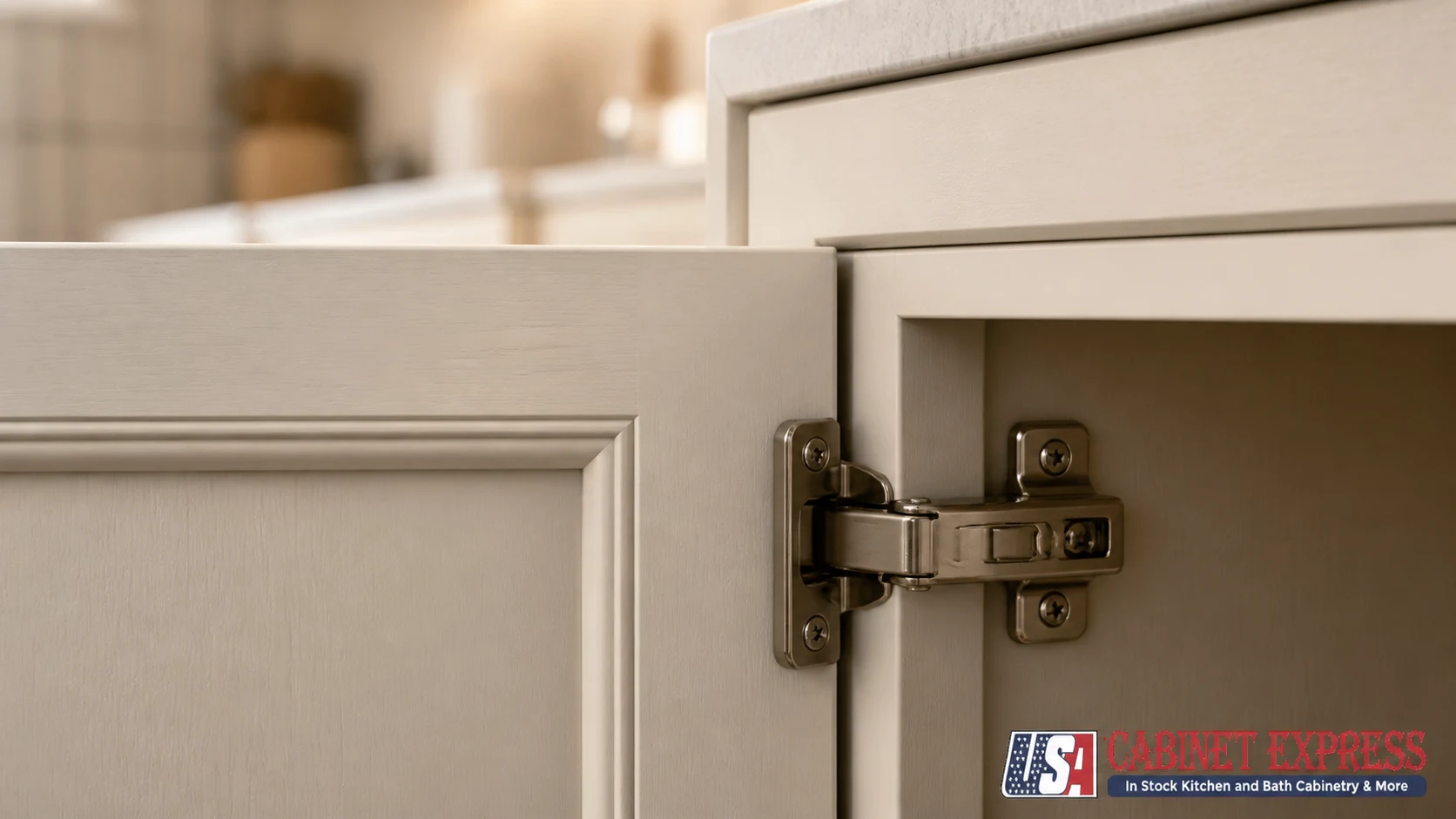
What keeps an inset door working
- Back-bevelled door edges, so a swollen door still clears the frame
- Six-way adjustable concealed hinges, so seasonal correction is a screwdriver job
- Conditioned air year round, including the months the house sits empty
- Stable center panels on painted doors, and a plywood box that will not rack
- A finish system that can be touched up rather than refinished
Practically, this lands differently across our markets. Summers in Houston, Dallas and Austin, and along the coast in Chesapeake, run humid enough that a house without steady air conditioning will move inset doors around. St. Louis, Fairfax and Fredericksburg swing the other way, humid in July and dry in January, which is the seasonal reveal shift people notice most. None of this rules inset out in a house with steady conditioned air. It means the environmental control question belongs in the buying conversation, not in a warranty claim two years later.
Not sure your kitchen can hold a 3/32 inch reveal? That is a fair question and it depends on your house, not your taste. We will walk your layout and tell you whether inset is a good idea here.
Can RTA cabinets do inset well?
Yes, ready-to-assemble inset exists and some of it is good. Whether it holds up comes down to the box, not the door, which is the part most buying guides skip.
A cabinet maker with decades in the trade said the useful version of this in that thread: you need a strong box to do inset style, or you will get cabinet sag or movement that causes issues. He was blunt about why so much of the industry avoids inset, too. Fast assembly methods, hot melt glue and weak joinery produce boxes that cannot carry a tight reveal, and full overlay hides the consequences. That is the real dividing line, and it is not about the letters R, T and A.
Can you get inset from us? Our standard catalog is overlay, and neither Fabuwood nor Mantra builds a true inset kitchen line, so inset is not something we stock. Availability and special-order options do vary by showroom, so ask your local store before you assume either way. If the answer is no, we will say so and point you at who does build it.
Seven things to check before you buy inset at any price
- Plywood box, not particleboard or furniture board
- Real joinery. Dado, dowel or dovetailed panel joints, not staples and hot melt glue
- A face frame thick enough to carry the hinge, typically 3/4 inch solid hardwood
- Six-way adjustable concealed hinges, or properly mortised butt hinges
- Back-bevelled door and drawer front edges
- A catalyzed or equivalent finish, plus a touch-up kit in the box
- A written reveal spec and who is responsible for adjusting it after season one
If a supplier cannot answer those seven questions in writing, the price does not matter. And if you are weighing RTA generally, our RTA cabinet reviews cover what separates the good lines from the rest.
Can you convert existing cabinets to inset?
Sometimes, if the boxes are framed, and it is a custom refacing project rather than a door order. Framed cabinets such as Fabuwood Allure and Quest, or any Mantra line, have the face frame the job requires. Frameless Illume and Ovela do not, so a conversion there means adding structure, which is a rebuild.
What a real conversion involves, and why trimming the old doors is not on the list:
- Every opening measured individually after the cabinets are installed and leveled, because nominal sizes are not actual sizes
- New doors and drawer fronts built to each opening. Cutting down five piece overlay doors wrecks the stile and rail proportions, the joinery and the finished edges
- A reveal specified and held on all four sides
- Inset hinges engineered in, with different arms, plates and boring positions than overlay hardware
- Drawer fronts redesigned to sit inside the opening without hitting the frame, slides or neighbors
- Rollout trays and pullouts checked against the smaller clear opening
- The newly exposed face frame inspected and refinished, since overlay doors were hiding hinge holes and unfinished areas
- Door stops and bumpers added so the door lands flush instead of swinging inward
- Appliance, corner and filler clearances rechecked against the new hinge swing
Warranty warning. Mantra’s warranty excludes products subjected to unauthorized modifications. Fabuwood’s excludes cabinets modified from their original form. A conversion may affect or remove coverage on the modified components. Ask your dealer for a written answer on your specific project before any work starts, not after. Our own position: on a kitchen worth converting, the money is usually better spent on new cabinets from a line that builds inset, because you are paying custom door prices either way and only one of those paths comes with a warranty.
How to get most of the inset look without the inset price
Most people who want inset are not chasing a construction method. They are chasing a feeling: built-in, tailored, furniture rather than boxes. A good chunk of that comes from decisions that have nothing to do with where the door sits.
- Choose a tight full overlay. Fabuwood Allure or Mantra Omni close most of the visual distance for a fraction of the cost gap.
- Go slim rail. A narrower Shaker rail, like Fabuwood’s Luna, reads more refined than a heavy 3 inch rail and photographs closer to inset.
- Finish your ends. Decorative end panels, matching toe kicks and flush fillers do more for a built-in look than the door style does.
- Line things up. Aligned rails across a run, consistent gaps and a considered hardware layout are what read as custom.
- Pick hardware with weight. Solid knobs and pulls in a restrained finish. Light, shiny hardware undoes an expensive kitchen faster than anything else on this list.
One thing we will not do is call this faux inset. It is a well executed overlay kitchen, and if the flush plane is what you want, no amount of detailing substitutes for it. For a look that leans modern instead of traditional, slab doors get you a different kind of clean.
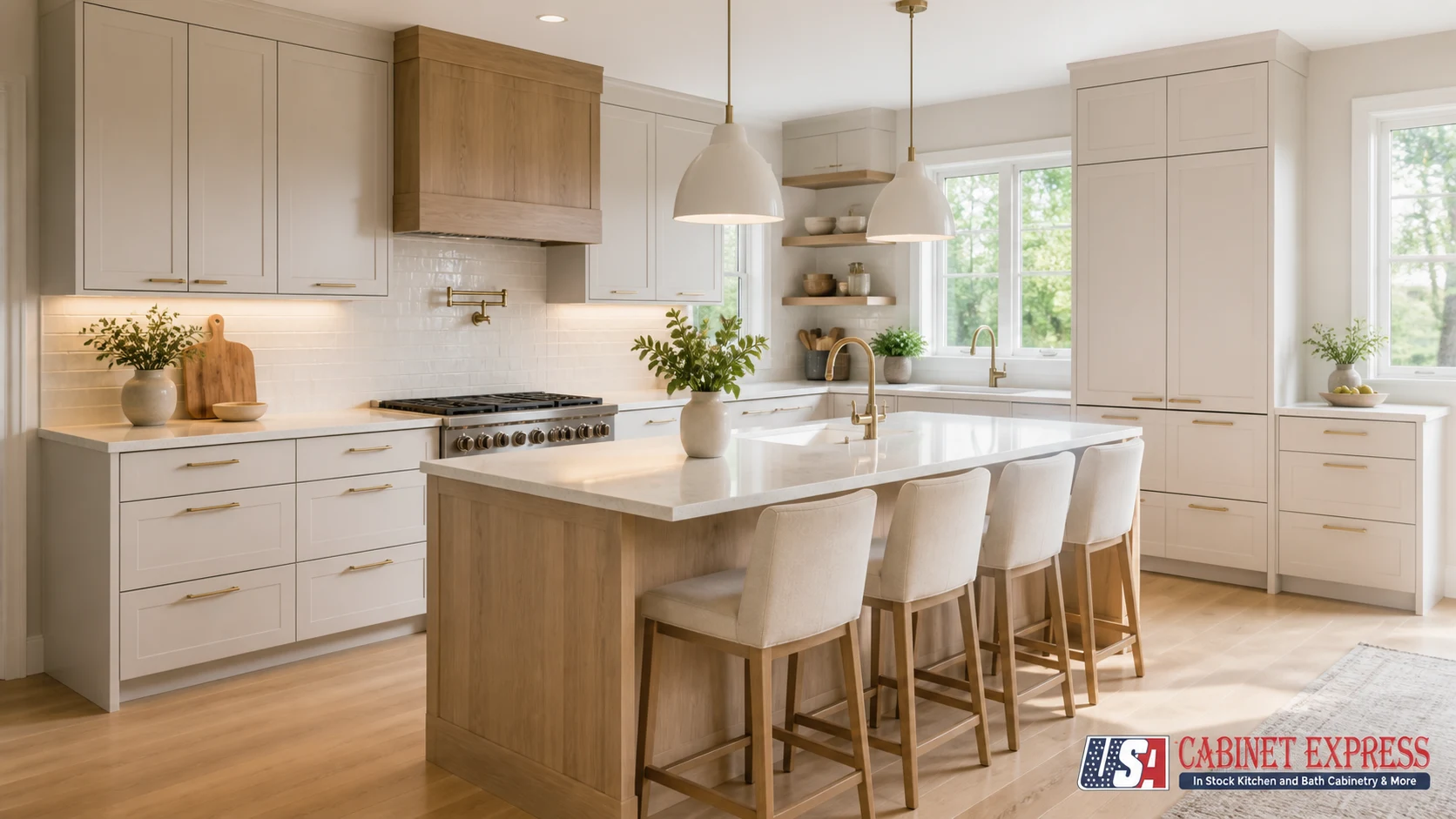
This is the version most people actually buy. The full overlay Shakers we stock, in Fabuwood Allure and Mantra Omni, are the doors that get closest to the inset look without the inset build. Worth seeing in person before you decide.
If true inset is non-negotiable
Then buy from a line that builds it, or commission a local cabinet shop. Manufacturers that publish flush or beaded inset options include Showplace, Decora and Shiloh, and availability shifts by market and dealer, so confirm before you plan around it. Shiloh is worth a look if budget is the obstacle, because it publishes its inset styles at no upcharge over full overlay. A custom shop fits each door to its opening on the bench, which is the most reliable version of this and usually the most expensive.
Whoever builds it, get the reveal, frame detail, hinge type, materials, finish system, humidity expectations and installation responsibility written into the proposal. Get those written into the proposal. They are the difference between an inset kitchen that still looks right in year ten and the one in the forum thread that got repainted every month. And if you want a second opinion before you sign with anyone, bring the quote to us. We will read it with you even though it is not our sale.
Questions to ask before you order
Ask your dealer
- Is the quoted door full overlay, partial overlay or inset? In writing.
- Which exact series and door style is on this quote?
- Are the boxes framed or frameless?
- What are the box, panel, drawer and hardware materials on this line?
- What indoor humidity range does the warranty require?
- Which modifications are factory authorized?
- Can I see a physical door sample, not a render?
Ask anyone proposing a conversion
- Will you measure every opening after install and leveling?
- What reveal will you hold, and what variation do you warrant?
- Are the existing frames square and flat enough to convert?
- New doors or altered doors?
- Which inset hinge and mounting plate?
- How do drawers, slides, pullouts and appliance clearances change?
- Who fixes seasonal binding, and for how long?
Inset cabinet doors: frequently asked questions
What is the difference between inset and overlay cabinets?
An inset door sits inside the face frame opening, flush with the frame, with about a 3/32 inch reveal around it. An overlay door sits on top of the frame and covers it, either most of the way (full overlay) or partly, leaving 1/2 to 3/4 inch of frame showing (partial overlay). Inset shows the whole frame and costs about 20 to 45 percent more. Overlay hides the frame, gives you the full clear opening and handles seasonal wood movement better.
Which is better, inset or overlay cabinets?
Neither is better built by default. Inset is better when the flush furniture look is the point of the kitchen, the house holds a steady indoor climate and the installer is a trim carpenter. Full overlay is the better buy for most kitchens, because it gets close on looks and leaves budget for plywood boxes, better hardware and better counters. Partial overlay wins on price and suits traditional and cottage kitchens.
What is it called when cabinet doors are inset?
Flush inset, full inset and true inset all describe the same construction: the door fitted inside the face frame opening so it finishes level with the frame. Beaded inset is the same thing with a decorative bead machined around the inside edge of the frame. The visible gap around the door is the reveal.
Are inset cabinet doors more expensive?
Yes. Published premiums run from about 20 percent to about 45 percent above comparable overlay cabinets. HomeAdvisor estimates about 20 percent more for flush construction within the same tier, and CliqStudios, which sells inset, puts it at 35 to 45 percent. The premium pays for tighter tolerances, more skilled labor, specific hinges and more installation and adjustment time.
Does Fabuwood offer inset cabinet doors?
Not for kitchens. Fabuwood’s kitchen series are framed full overlay (Allure), frameless full overlay (Illume and Ovela) and framed partial overlay (Quest, including Metro and Discovery). Fabuwood does describe its Valencia series with the Lavari door as classic inset cabinetry, but Valencia is a bath vanity line rather than a kitchen series.
Are Mantra Omni cabinets inset?
No. Omni is a full overlay Shaker with 2 1/4 inch rails. Mantra currently publishes two profiles: Omni is full overlay and Classic is partial overlay. Neither is flush or beaded inset.
What is the difference between Shaker and inset?
Shaker describes the door’s face, a recessed flat panel inside a square frame. Inset describes where the door sits, inside the face frame rather than on top of it. A Shaker door can be inset, full overlay or partial overlay, so the two terms answer different questions.
What are the disadvantages of inset cabinets?
Higher cost, a smaller clear opening because the door closes inside the frame, more sensitivity to humidity swings, more visible consequences from crooked walls, and periodic hinge adjustment. You also need knobs or pulls, since there is no door lip to grab.
Do inset cabinets reduce storage space?
They reduce the clear opening rather than the box volume. The door closes inside the frame opening rather than over it, so the width and height you can reach through shrink, which matters most for wide drawers, rollout trays and anything you slide in and out. Compared with frameless full access construction, the face frame itself is the bigger restriction.
Do inset cabinet doors swell or stick?
They can, in a home without year-round climate control. Fabuwood’s warranty does not treat center panel shrinkage up to 1/8 inch or door warp up to 1/4 inch as defects, and Mantra’s warranty treats humidity outside 30 to 55 percent as extreme. Back-bevelled door edges, adjustable hinges and steady conditioned air are what keep a 3/32 inch reveal working.
Can full overlay cabinets be converted to inset?
Only framed cabinets, and only as a custom refacing project. It needs new doors built to each measured opening, inset hinges, redesigned drawer fronts, refinishing of the newly exposed frame and door stops. Trimming the original doors down is not a shortcut, and modification may affect warranty coverage.
Can frameless cabinets have true inset doors?
No. Frameless boxes have no face frame for a door to sit inside. A fabricator can add an inner structure to imitate the geometry, but that is a rebuild rather than a door choice.
Are inset hinges always visible?
No. Visible butt or finial hinges are a traditional design choice. Inset also runs on six-way adjustable concealed soft-close hinges, which is what most current inset lines use.
Is inset cabinetry worth the added cost?
It is worth it when the flush look is the point of the kitchen, the house holds a stable indoor climate, and the installer is a trim carpenter rather than a box hanger. It is hard to justify across a large kitchen on a mid-range budget, where the same money buys better boxes, better hardware and better counters in a full overlay layout.
The short version
Inset cabinet doors are the most demanding way to hang a door and, done well, the best looking. They cost about 20 to 45 percent more than the same kitchen in overlay, they need a house that stays conditioned and an installer who works to a 3/32 inch reveal, and they are not available from Fabuwood or Mantra in a kitchen line. If those conditions line up, nothing else looks like it.
If they do not, a tight full overlay in a slim rail Shaker gets you most of the way there for a fraction of the difference, and no visitor to your kitchen will run a tape measure over the reveals. Either way, the decision is easier with real doors in front of you. For the full range of options either side of this one, our guide to kitchen cabinet door styles covers all fifteen.
Still deciding between inset and overlay?
Bring us your layout. We will price the overlay version, tell you honestly what inset would take, and show you door samples you can hold. No pressure, no upsell to something we cannot build well.
Showrooms in Austin, Dallas and Houston, Texas; Chesapeake, Fairfax and Fredericksburg, Virginia; and St. Louis, Missouri.
Helen Yasar, Showroom Associate
Helen works the floor at a USA Cabinet Express showroom, with people making this exact decision in front of real doors and a real budget. She wrote this guide because inset cabinet doors come up every week on the floor and the honest answer takes longer than a showroom conversation allows.
Reviewed by Emin Halac, Founder
Emin founded USA Cabinet Express and has spent his career in building supplies. He checked the manufacturer, warranty and pricing claims in this article against current published specifications before it went live.
Sources. Every product, warranty and pricing claim in this inset cabinet doors guide was verified against primary sources in August 2026: Fabuwood door styles, Fabuwood warranty, Mantra Omni, Mantra Classic, Mantra warranty, Fabuwood Valencia vanities. Definitions from the KCMA glossary and the AWI casework standard. Reveal and frame details from Showplace. Cost ranges from 2026 industry cost guides including HomeAdvisor. Owner comments quoted from public discussions on r/kitchenremodel and r/cabinetry.
Product availability changes by date, market and dealer. Confirm current options with an authorized dealer before planning around them.