

Three short answers, since they are what you came for. Glass belongs on about 20 to 30 percent of your upper cabinets, grouped rather than scattered. It adds roughly 25 to 50 percent to the cabinets that get it. And which glass you pick matters more than how much you use, because that is what decides how much of the cupboard the room actually sees.
Past that 30 percent, a kitchen starts asking you to curate your dishes for a living. Under 20, the glass reads as an accident.
Clear shows everything, including the mismatched mugs. Frosted, reeded and seeded each hide a different amount, cost different money and clean differently. That choice, and where the doors go, is most of what follows. For the wider picture, start with our complete guide to kitchen cabinet door styles.
How much glass, and where to put it
Glass earns its place three ways. It breaks up a long run of solid doors, it bounces light around a room short of it, and it gives you somewhere to put the things you like looking at. Scatter single glass doors around the room like confetti and it does all three badly.
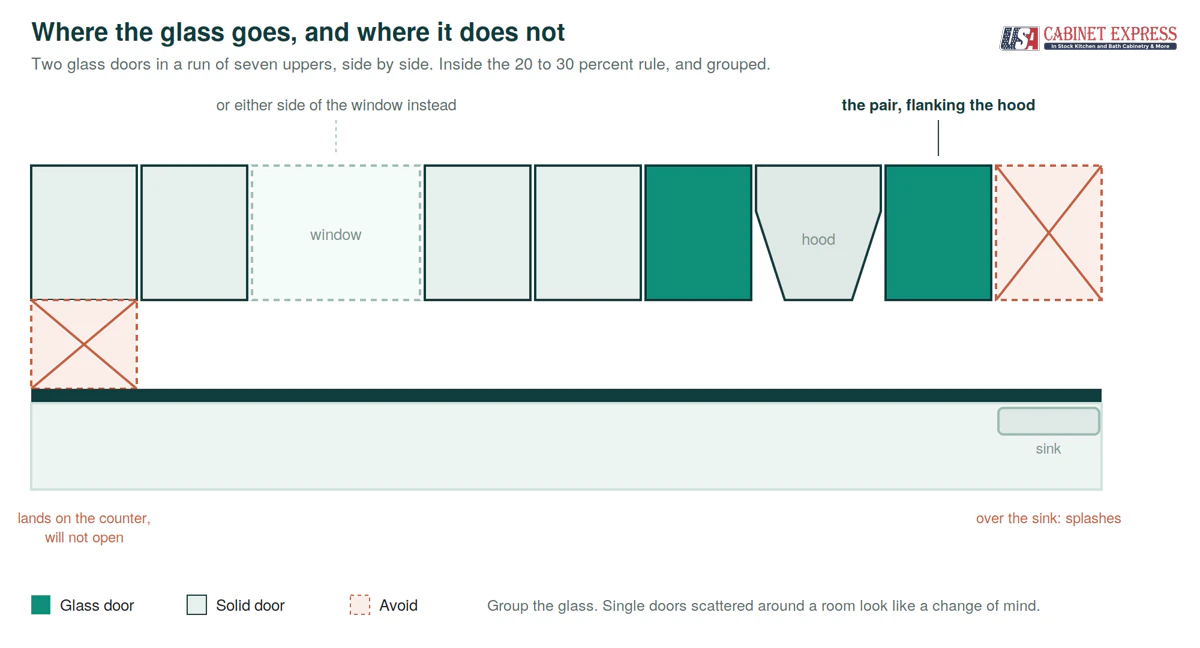
The rule that holds up in most kitchens: glass on roughly 20 to 30 percent of your uppers, grouped in one place. Two doors together look deliberate. Two doors at opposite ends of the room just look like someone changed their mind halfway.
Where it lands well
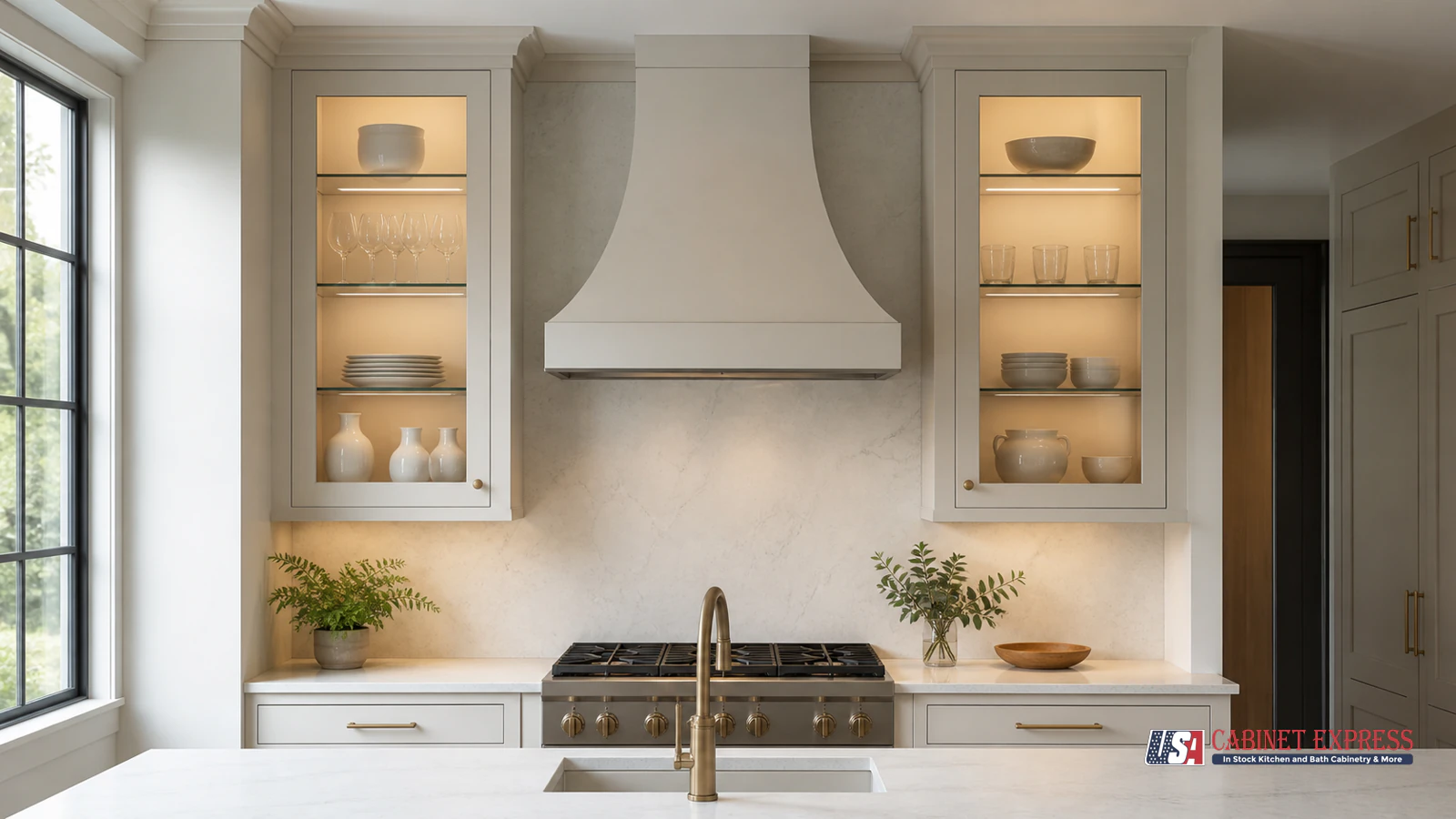
- Flanking the range hood. A matched pair either side gives the hood a frame and the symmetry does the work.
- Either side of a window. The glass picks up the daylight already coming in.
- One end of a long run. A wall of solid doors gets a full stop instead of just ending.
- An upper corner. Corner cabinets are awkward to use anyway, so giving one over to display costs you less than it looks.
- A bar or coffee run. The one place where the contents are already glassware and already worth showing.
Where it goes wrong
Over the sink, where the contents get splashed. On a small kitchen’s only uppers, where you need the volume more than the view. And on a cabinet that sits down on the countertop, where you can’t open the door unless the counter is completely clear, a trap one homeowner on r/kitchenremodel caught in their own designer’s plan.
Glass types compared
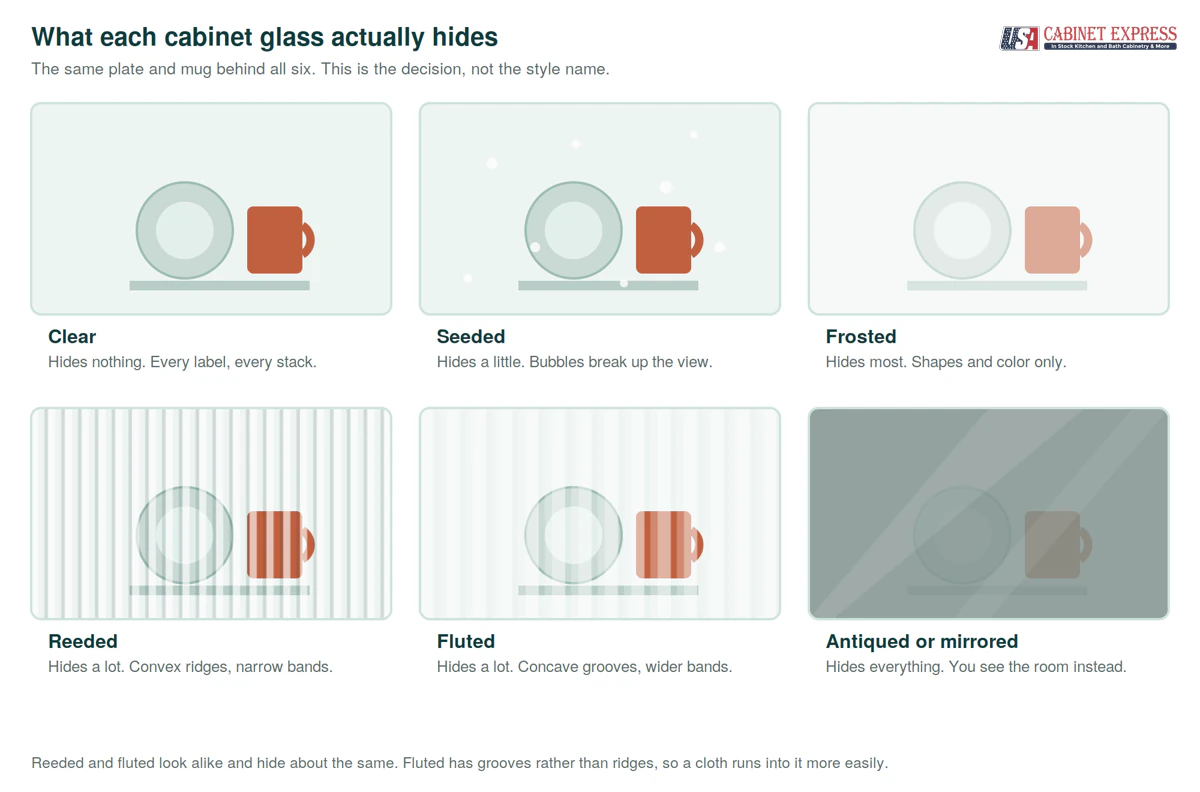
Most guides treat this as a style question. It is really a privacy question with a style side effect. Decide how much of your cupboard you want the room to see, then pick the glass that hides that much.
| Glass | How much it hides | Reads as | Living with it |
|---|---|---|---|
| Clear | Nothing. Every label, every stack | Classic, honest, unforgiving | Shows fingerprints. Demands tidy shelves. Cheapest and easiest to replace |
| Frosted | Most of it. Shapes and color only | Quiet, modern, soft | Hides clutter well. Shows greasy fingerprints more than clear does |
| Reeded | A lot. Contents blur into vertical stripes | The current favourite. Warm and textural | Convex half-rounds. The ridges collect dust and need a cloth run down them. Pairs with fluted door fronts |
| Fluted | The same as reeded | Identical at a glance | Concave grooves rather than convex ridges, which most people find easier to wipe out. Worth asking which one you are being quoted |
| Seeded | Some. Tiny bubbles scatter the view | Cottage, farmhouse, period | Forgiving of a slightly untidy shelf without hiding what is there |
| Antiqued or mirrored | All of it. You see the room, not the shelf | Dramatic, formal, bar-like | Reflects the kitchen back at you, which enlarges a small room. Shows every smudge |
| Leaded or textured | Varies with the pattern | Traditional, period-correct | The most expensive option and the hardest to match later if one breaks |
The shortcut. If you have something worth displaying, go clear and light it. If you want the look of glass without the obligation to curate, go reeded, fluted or frosted, and ask which of reeded or fluted you are being quoted, because they look alike and only one of them is easy to wipe out. If you are torn, go clear: it is the only choice you can undo later with film, and undo again if you change your mind back.
Mullion and grille: a frame decision, not a glass one
A mullion door divides the glass with wood bars. Treat it as a separate decision from the glass, because it changes the character of the door more than the glass does.
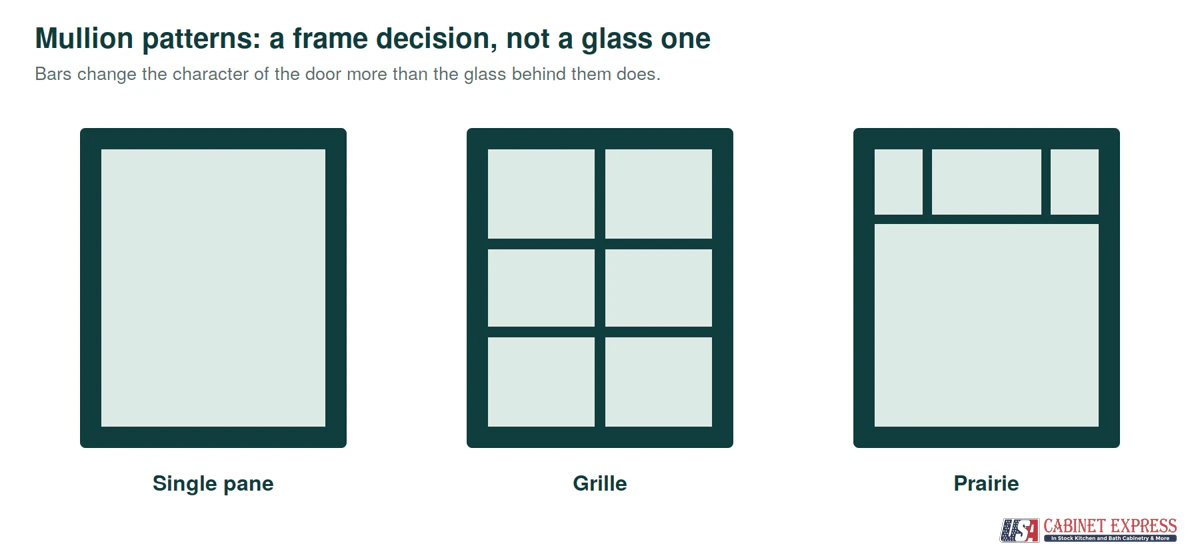
A single undivided pane reads modern and shows the most. A two by three grille reads traditional and chops the view into panels, which forgives a lot of untidy shelving. A prairie pattern, with bars only near the corners, splits the difference. If the rest of your kitchen is slab or a slim Shaker, a heavy grille will fight it. Match the bar width to the door rail width and it will look designed rather than added.
What glass doors change about the rest of the order
This is the part that surprises people at the quote stage. A glass door makes the inside of the cabinet part of the room, and the inside of a cabinet isn’t built to be looked at.
Finished interiors
A standard cabinet interior is often a plain veneer that nobody was meant to see. Behind glass it needs to be finished, and ideally matched or deliberately contrasted with a painted back panel.
Shelves
Melamine shelves look like melamine shelves through glass. Wood or glass shelves cost more and are the difference between a display cabinet and a cupboard with a window.
Lighting
Near mandatory. Unlit glass at night is a dark hole in a bright kitchen. Puck or strip lighting inside turns the same cabinet into the best thing in the room.
Hardware, and what goes in it
Keep the handles the same as the cabinets either side. Knobs on the glass doors and bars everywhere else looks like an oversight, not a choice. And decide what goes inside before you order, not after: a glass cabinet with cereal boxes in it is worse than a solid door, and it is the most common regret people report. Our sister showroom In Stock Today Cabinets goes further on the styling side, including how to zone the shelves so a glass cabinet does not read as clutter, which is the part most people get wrong after the doors are in.
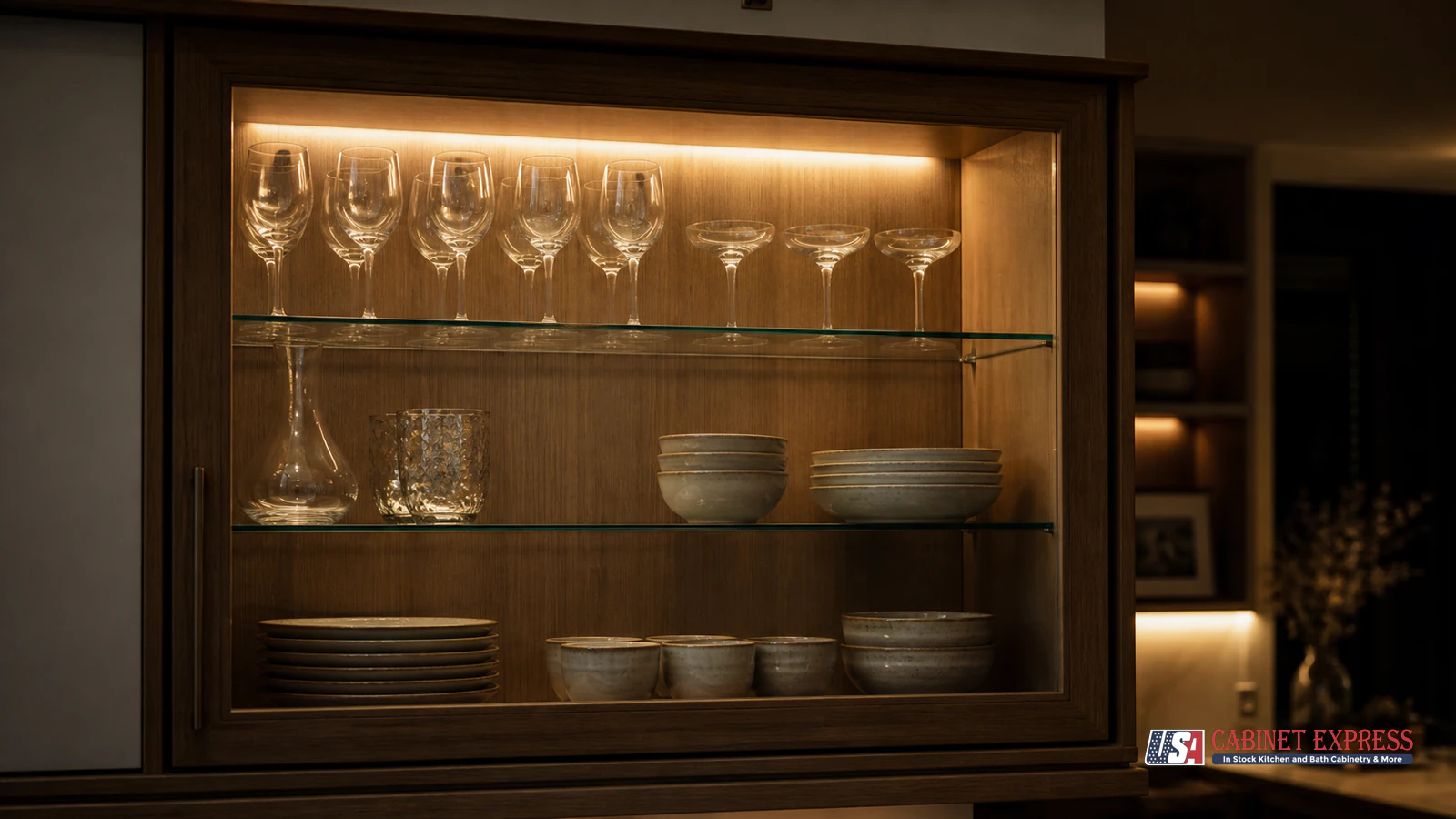
Hinges are the one thing that doesn’t change. Glass doors run on the same concealed soft-close hinges as solid doors, though a heavy glass panel may want an extra hinge on a tall door. Our opening mechanisms checklist covers how door weight drives hinge choice.
Tempered or not, and what breaks
Ask which you are getting. It is rarely on the quote.
Standard annealed glass breaks into long sharp shards. Tempered glass is heat treated so it shatters into small blunt pieces, and it is several times stronger to start with.
Neither one is unbreakable. A heavy pot swung into a door will break tempered glass too. What tempering changes is what happens next, which is why it is the obvious choice in a house with children, in a busy galley where people knock into things, and on any door below shoulder height. It adds modestly to the cost of the door and it is the cheapest insurance in the kitchen. On uppers in a quiet household, standard glass is a defensible saving.
Not sure how many glass doors your kitchen wants? Send us your layout. We will mark up where glass earns its place and where it will just make more housework, and price both versions.
Get a free design consultationWhat glass doors cost
Glass is priced as an upgrade on a wall cabinet, not as a separate product, so the number that matters is what it adds per door.
For a reference point, Colfax Glass publishes its pricing: roughly $150 to $500 per door installed, with the glass itself around $5 to $10 per square foot for clear and $8 to $15 for frosted. Your dealer prices it differently, because the glass arrives already in the cabinet. The order of magnitude is what you want from those numbers.
Three things drive the number. The glass type: clear is the baseline, frosted and reeded step up from there, leaded and antiqued sit well above. Whether the door is mullioned, since bars mean more joinery and more cuts. And whether the cabinet interior needs upgrading to be worth looking at, which is often the biggest of the three and the one nobody puts on a quote.
| Route | Per door installed | Suits |
|---|---|---|
| Retrofit glass insert | $75 to $200 | Adding glass to solid doors you already own |
| Stock replacement door | $150 to $250 | Standard sizes, clear or frosted |
| Semi-custom door | $250 to $400 | Unusual sizes, specific finishes, decorative glass |
| Fully custom door | $400 to $500 and up | Leaded glass, complex grille patterns, high-end species |
Put as a percentage, upper cabinets with glass generally run 25 to 50 percent more than the same cabinets with solid doors. Because you are only doing a fifth to a quarter of your uppers, that premium lands on a handful of cabinets rather than the whole kitchen.
Then add what the glass drags along with it. A painted or lined cabinet interior runs about $20 to $50 per cabinet. Interior lighting is roughly $30 to $80 per cabinet for battery pucks and $50 to $150 for hardwired strips, and hardwired is worth it if the walls are open anyway.
Because it is a per-door upgrade on a handful of doors, the total is usually far smaller than people brace for. Four to eight well-chosen doors, lit, generally stays under a thousand dollars on the glass and lighting side. That is a different conversation from re-doing a kitchen. Ask your dealer to price the glass doors as a line item so you can see it separately from the cabinets.
What people who live with glass fronts say
These come from a public r/kitchenremodel thread where a homeowner asked whether glass display cabinets were still in style. The replies are more useful than the question.
“The issue with glass cabinets is what you can store in them. In a tiny kitchen you probably need to be able to have tons of stuff shoved in there. And that wants hiding.”
The single best argument against glass, and it is about your kitchen’s size rather than your taste. If your uppers are already full, glass costs you the storage you cannot spare.
“I would only add the glass if you have items that look nice displayed. Storage can be done with or without the glass.”
Answer the what-goes-in-it question honestly before you order. Glassware, platters, a cocktail set and pretty bowls all qualify. Everyday plates and cereal boxes don’t.
“This only works as a display cabinet for rarely used items because it sits on the counter, so you can’t open the doors unless the counter is entirely clear.”
A physical constraint worth checking on the plan. A cabinet that lands on the countertop needs clear counter in front of it to open, which turns it into long-term storage whether you meant that or not.
“Make it opaque unless everyone in your household is VERY tall. The upper cabinets are for things you use least often, which will include many things you don’t want to look at all the time.”
From a second thread, where someone was choosing a glass type. High cabinets hold the things you reach for twice a year, which is exactly the category you least want on display. If you are torn between clear and something more opaque, that is the argument that should settle it.
“I chose plain glass with lights at the top back to backlight the objects. But only for a few, the other half are solid cabinets for storage.”
The 20 to 30 percent rule, arrived at independently by someone who did it. Note the lighting detail: at the top and toward the back, so it falls down over the contents instead of glaring out at the room.
“I don’t think glass goes in or out of style.”
On the dated question, this was the consensus. Glass fronts have been in kitchens for over a century. What dates is a heavy leaded pattern in a modern room, not the glass itself.
“If well lit, it can provide great mood lighting.”
Everyone who liked their glass cabinet mentioned lighting. Nobody who regretted theirs had lit it. Treat the light as part of the glass, not an extra.
Adding glass to doors you already have
This is possible on a five piece door, meaning one with a separate frame and a center panel, because the panel can come out and glass can go in its place. It isn’t possible on a slab door, which has no panel to remove.
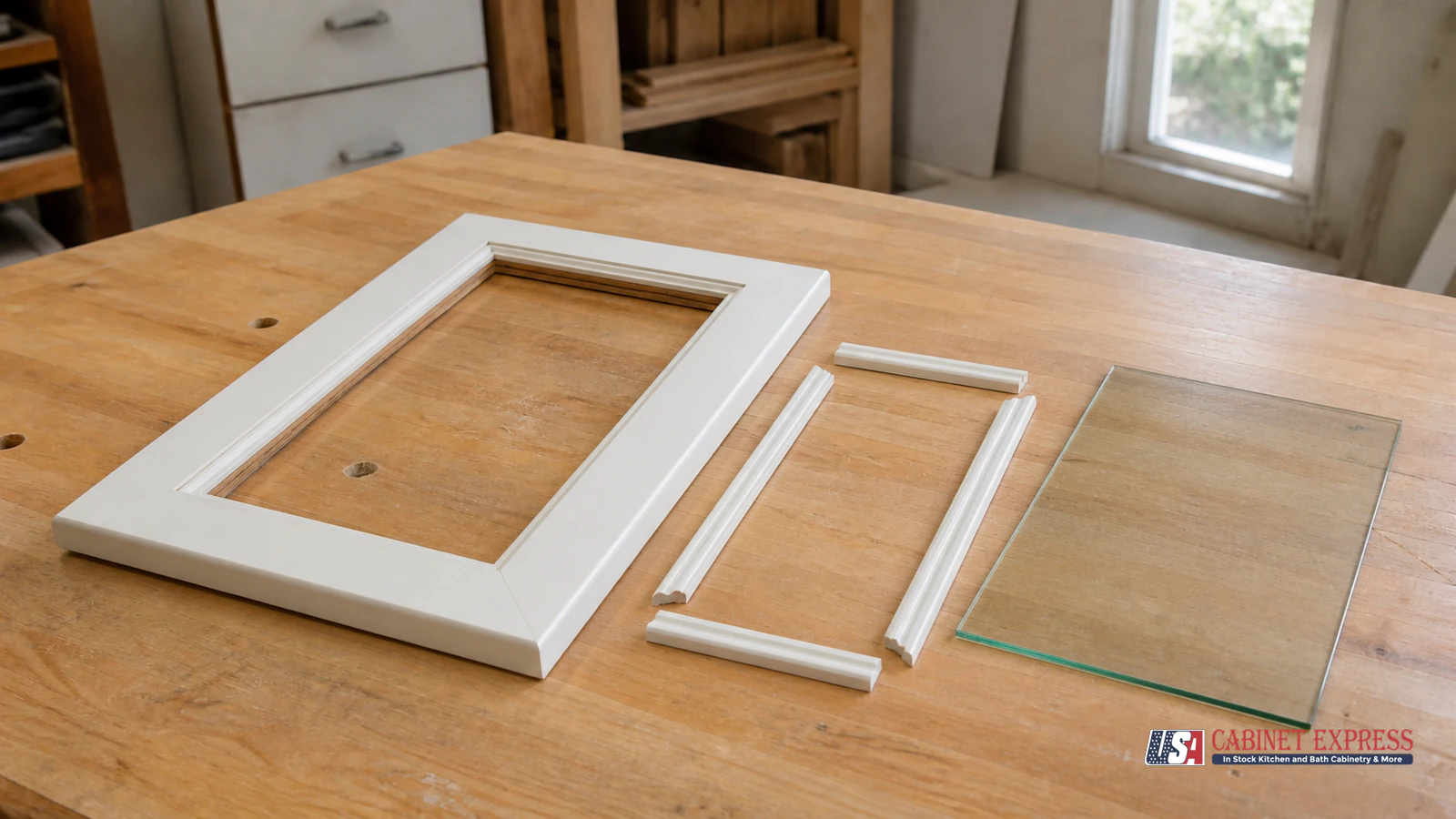
The mechanics, so you can judge a quote: the fitter measures the inside opening of the frame, takes about a sixteenth to an eighth of an inch off both dimensions so the glass is not pinched, and orders 3/16 or 1/4 inch glass, bedded on silicone or held with retainer molding. Expect roughly $75 to $200 per door installed for a straightforward insert.
Whether it is worth doing comes down to the finish. Cutting out a center panel means routing the back of the door, adding retainer molding, and refinishing the cut edges. On a painted door the touch-up is usually invisible. On a stained door, matching an aged finish at a fresh cut is where these projects go wrong, and the repaired edge is right at eye level.
When retrofitting makes sense, and when it doesn’t
- Worth it: two doors, painted, on cabinets you otherwise like, done by someone who does it regularly.
- Marginal: stained doors, where the refinishing risk is real and the result is on show.
- Not worth it: more than a few doors on cabinets you already want to replace. By the time you have paid for cutting, glass, molding and refinishing across several doors, you are within reach of new wall cabinets that arrive with the glass already in them and a warranty on the whole thing.
If you already have clear glass and want it hidden
Common situation, and it has a cheap fix. Adhesive window film, the kind that goes on with water and no glue, comes in frosted, reeded and patterned finishes and applies to the inside of the glass. A homeowner in that same Reddit thread recommended it precisely for this: go clear, and if you find you need the storage more than the display, film it.
It peels off without residue, so it costs nothing to try. It is the reason clear glass is the safe default when you can’t decide. Fabric or a simple curtain inside the door is the other reversible option and suits a period kitchen better than film does.
What we stock
Glass door wall cabinets are available through Fabuwood in the sizes that matter for the placements above, including the narrow 15 inch uppers that work well either side of a hood. Because glass is ordered as a wall cabinet option rather than a door style, the door profile and finish stay the same as the rest of your kitchen, so a glass cabinet matches its neighbors exactly.
See it in person before you commit. Reeded and seeded photograph nothing like they look on a wall at arm’s length, and how much they hide is the whole decision. Bring a plate and hold it behind the sample.
Glass cabinet doors: frequently asked questions
How many kitchen cabinets should have glass doors?
About 20 to 30 percent of your upper cabinets, grouped in one place rather than scattered. Two doors together read as a deliberate display. Single glass doors spread around a room read as an accident. In a small kitchen where every upper is needed for storage, the right number may be zero.
How much do glass cabinet doors cost?
Between about $75 and $500 per door installed, depending on the route. A retrofit glass insert into a door you already own runs about $75 to $200. A stock replacement door is roughly $150 to $250, a semi-custom door $250 to $400, and a fully custom door with leaded glass or a complex grille $400 to $500 and up. As a rule of thumb, glass uppers cost 25 to 50 percent more than the same cabinets with solid doors.
Are glass cabinet doors more expensive?
Yes, glass is priced as an upgrade on a wall cabinet. Clear is the cheapest, frosted and reeded step up, and leaded or antiqued sits well above. The larger cost is often indirect: finished interiors, better shelves and interior lighting, none of which a solid door needs.
Should cabinet glass be tempered?
In a house with children, in a busy galley kitchen, or on any door below shoulder height, yes. Tempered glass is several times stronger than standard annealed glass and shatters into small blunt pieces rather than long sharp shards. Neither type is unbreakable. Ask which you are being quoted, because it is rarely stated on the order.
Are glass front cabinets out of style?
No. Glass fronts have been in kitchens for over a century and the current interest in reeded and fluted glass has made them more popular, not less. What dates a kitchen is a heavy leaded pattern in a modern room, or glass used on so many cabinets that the room looks like a shop display.
What is the difference between reeded and fluted glass?
Reeded glass has convex ridges standing proud of the surface. Fluted glass has concave grooves cut into it. They look almost identical from across a room and hide about the same amount, but most people find fluted easier to clean, because a cloth runs into a groove more easily than around a ridge. The names are often used interchangeably, so ask which one you are actually being quoted.
What kind of glass is best for cabinet doors?
It depends on how much you want hidden. Clear shows everything and suits a curated display with lighting. Frosted and reeded hide most of the contents and suit people who want the look without the tidying. Seeded hides a little and suits cottage and period kitchens. Antiqued or mirrored hides everything and reflects the room back.
Can I add glass to my existing cabinet doors?
On a five piece door with a removable center panel, yes. On a slab door, no, because there is no panel to take out. The job means routing the back of the door, adding retainer molding and refinishing the cut edges. It works well on painted doors and is riskier on stained ones, where matching an aged finish at a fresh cut is difficult.
How do you cover glass cabinet doors you no longer want to see through?
Adhesive window film applied to the inside of the glass. It comes in frosted, reeded and patterned finishes, goes on with water rather than glue, and peels off without residue. Fabric panels or a small curtain inside the door are the other reversible option and suit a period kitchen.
Do you paint the inside of cabinets with glass doors?
Usually yes, and it is one of the best decisions available. A finished or painted interior turns a cupboard into a display cabinet. Many people paint the back panel a contrasting color so the contents stand out against it. Behind clear glass, an unfinished interior is very visible.
Do glass cabinet doors need lighting?
Practically speaking, yes. An unlit glass cabinet is a dark void at night in an otherwise bright kitchen. Puck lights or an LED strip inside the cabinet is what turns glass fronts from a design feature into the best thing in the room, and it is far cheaper to wire during the install than after.
What is a mullion cabinet door?
A glass door divided into panes by wood bars. A single undivided pane reads modern and shows the most, a grille pattern reads traditional and hides more, and a prairie pattern with bars only near the corners sits between the two. Match the bar width to your door rail width so it looks designed rather than added on.
Where should glass cabinets go in a kitchen?
Flanking a range hood, either side of a window, at one end of a long run of solid doors, in an awkward upper corner, or over a bar or coffee station. Avoid over the sink where contents get splashed, and avoid any cabinet that sits down on the countertop, because you can’t open it unless the counter is clear.
The short version
Glass cabinet doors are one of the cheapest ways to make a kitchen look considered, and one of the easiest to overdo. Keep them to roughly a fifth or a quarter of your uppers, group them, light them, and decide what goes inside before you order rather than after.
Pick the glass by how much you want hidden rather than by how it looks in a photograph, and if you can’t decide, take the clear and keep the film option in your pocket. For the other door decisions either side of this one, our guide to kitchen cabinet door styles covers all fifteen, and inset cabinet doors covers how the door sits in the frame.
See the glass before you choose it
Reeded, seeded and frosted all photograph differently from how they look on a wall. Come and hold a plate behind a sample, and we will mark up your layout for where glass earns its place.
Showrooms in Austin, Dallas and Houston, Texas; Chesapeake, Fairfax and Fredericksburg, Virginia; and St. Louis, Missouri.
Sources. Styling guidance drawn in part from In Stock Today Cabinets. Owner comments in this glass cabinet doors guide are quoted from a public r/kitchenremodel discussion. Product availability checked with Fabuwood in August 2026.
Availability changes by date, market and dealer. Confirm current options with your showroom before planning around them.