
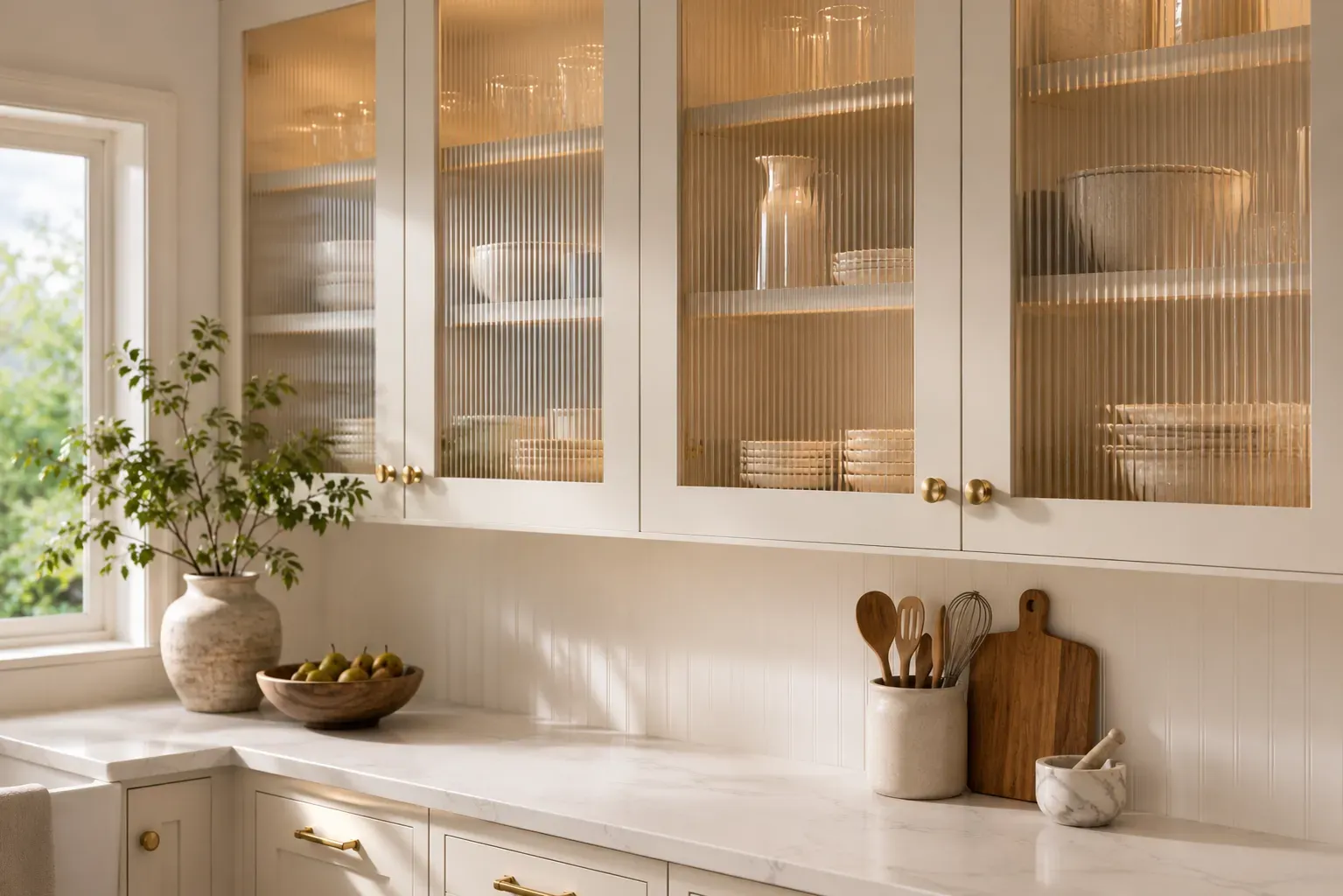

Fluted cabinet doors are everywhere right now, and you have probably saved a few photos while quietly wondering whether those grooves are worth the upkeep. Short answer: used in the right spots, fluted doors add the kind of texture a flat panel never can. Used everywhere, they turn into a cleaning chore you will notice by week two. This guide gives you the straight version, what fluted doors are, what they cost, where they actually belong, and how to keep them from dating your kitchen. It is written by a cabinet store that specs this detail for real kitchens most weeks, so the advice leans practical rather than pretty. If you are still comparing looks, start with our full kitchen cabinet door styles guide and come back here for the deep dive.
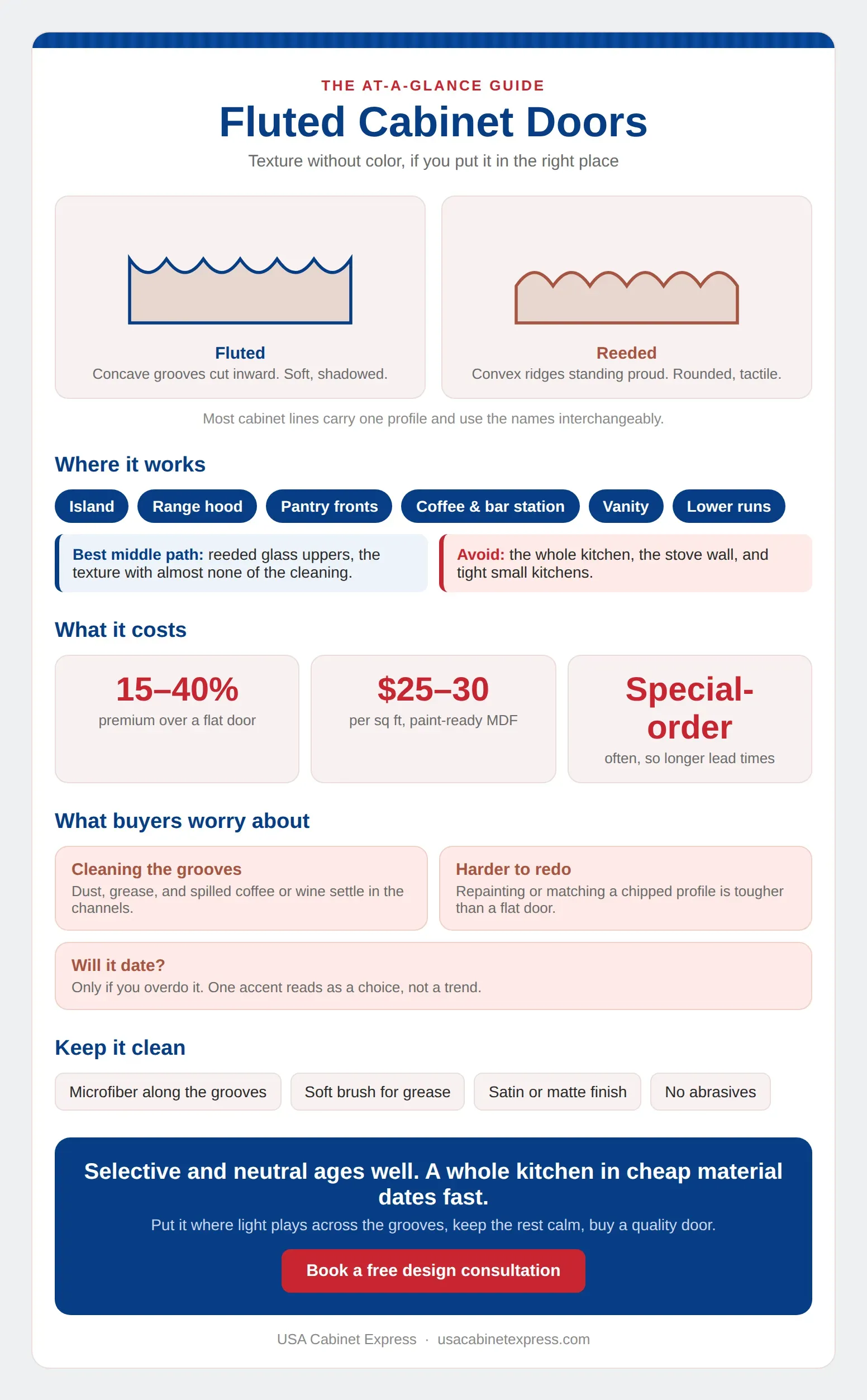
Fluted cabinet doors at a glance
What it is
Vertical rounded grooves milled or applied to a door or panel, borrowed from classical columns.
Best used as
An accent, on islands, range hoods, pantry fronts and lower runs, not the whole kitchen.
Typical cost
Roughly 15–40% more than a comparable flat door, driven by machining and finishing.
Upkeep
Moderate. Grooves hold dust and grease, so plan on a soft brush and a little patience.
Will it date?
Not if you keep it selective and neutral. The detail is centuries old, the overuse is what looks trendy.
What are fluted cabinet doors?
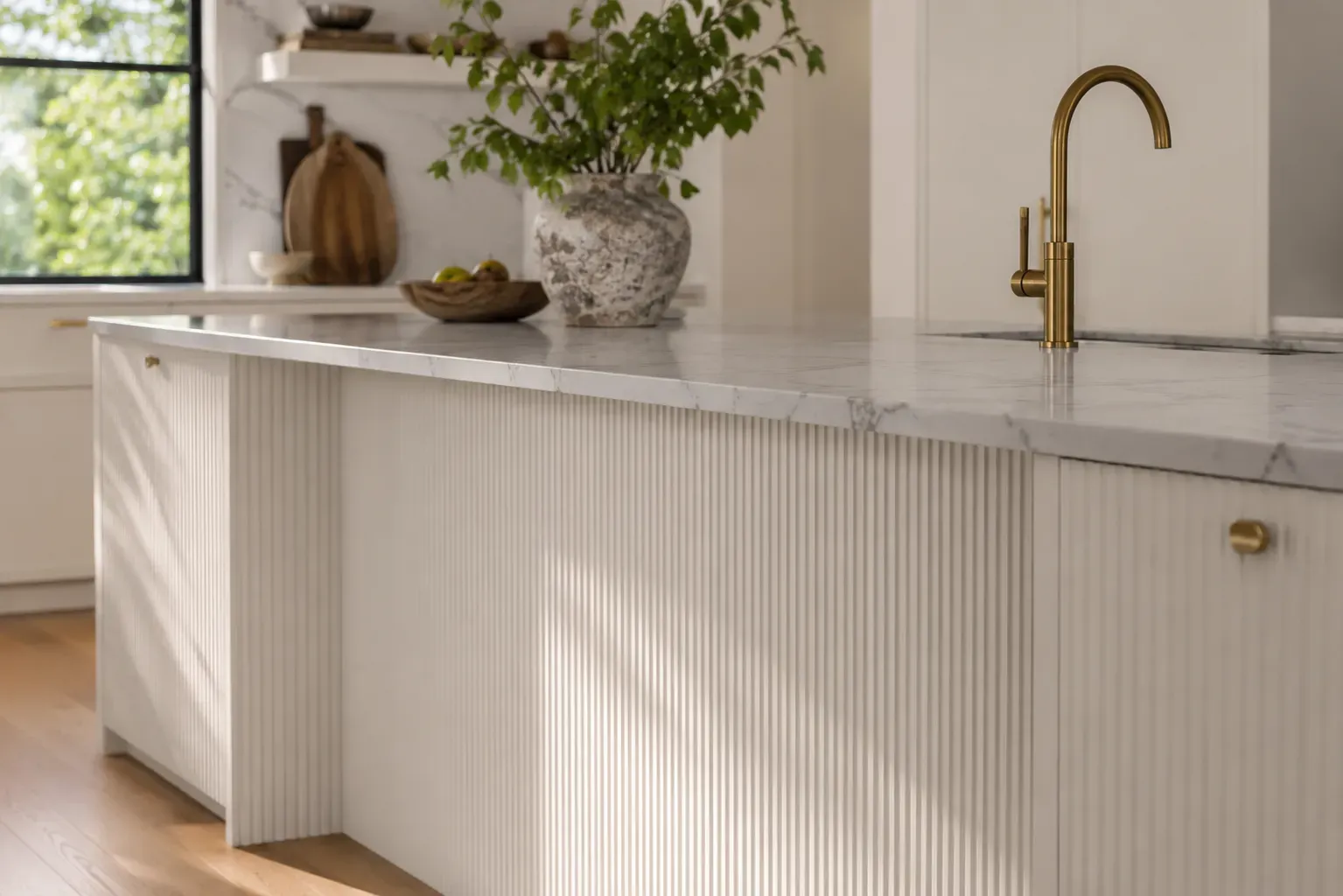
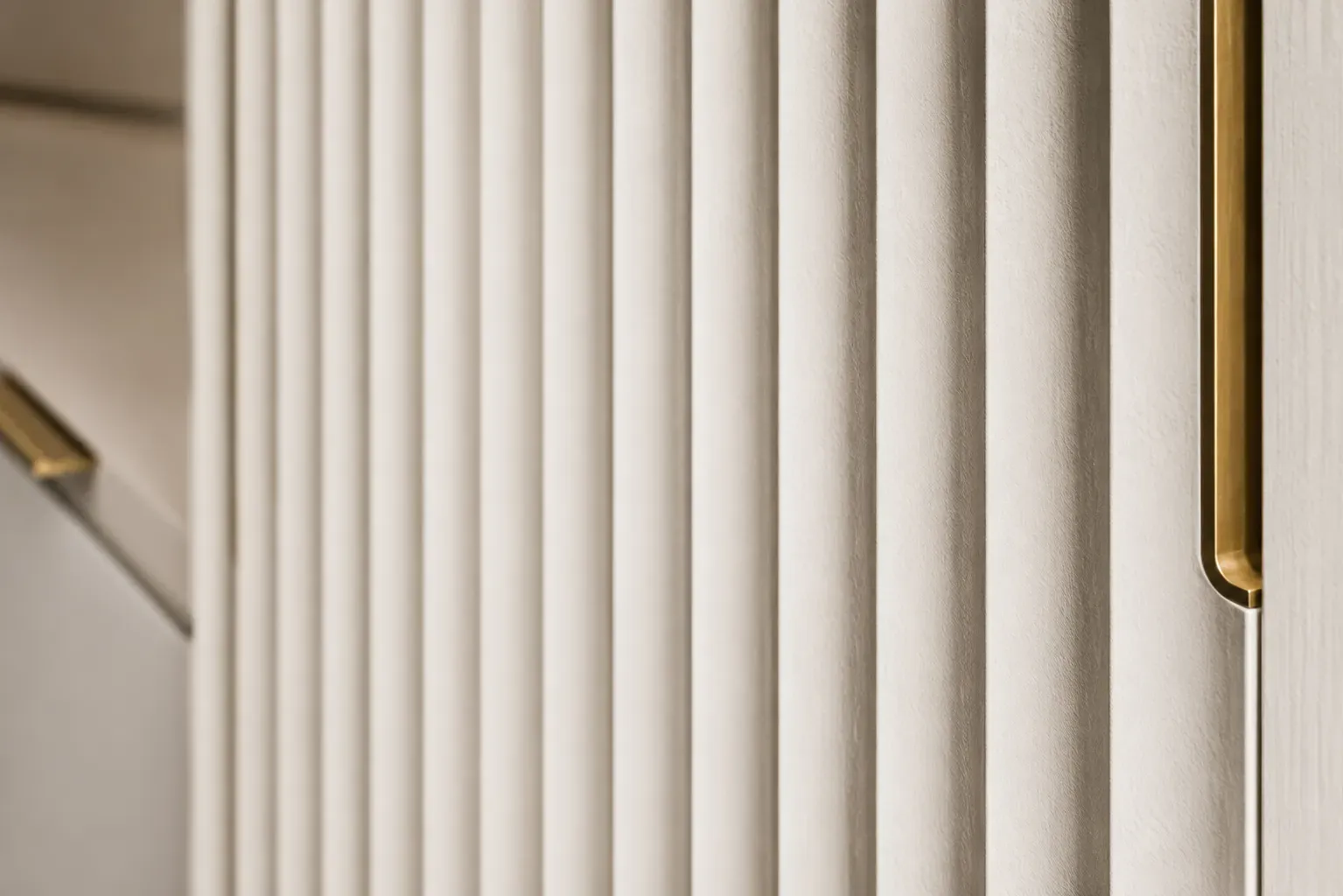
Fluted cabinet doors carry a series of narrow, evenly spaced vertical grooves across the face of the door or a flat panel. You will also see the look sold as ribbed, reeded, or textured cabinet fronts, all describing the same ridged profile. The effect is all about light. Those grooves catch shadow and highlight as you move around the room, so a surface that would read as flat suddenly has rhythm and depth. You get visual interest without adding a single bold color or a piece of ornate hardware, which is exactly why designers reached for it as warmer, quieter kitchens took over.
The idea is old. Fluting started on the stone columns of ancient Greek temples, where vertical channels made a heavy shaft feel lighter and alive. It ran through Renaissance millwork and the Art Deco era, and now it has landed on cabinet fronts, island ends and range hoods. That long history matters when people ask whether fluting is a fad, and we will come back to that question below.
Fluted vs reeded: is there a difference?
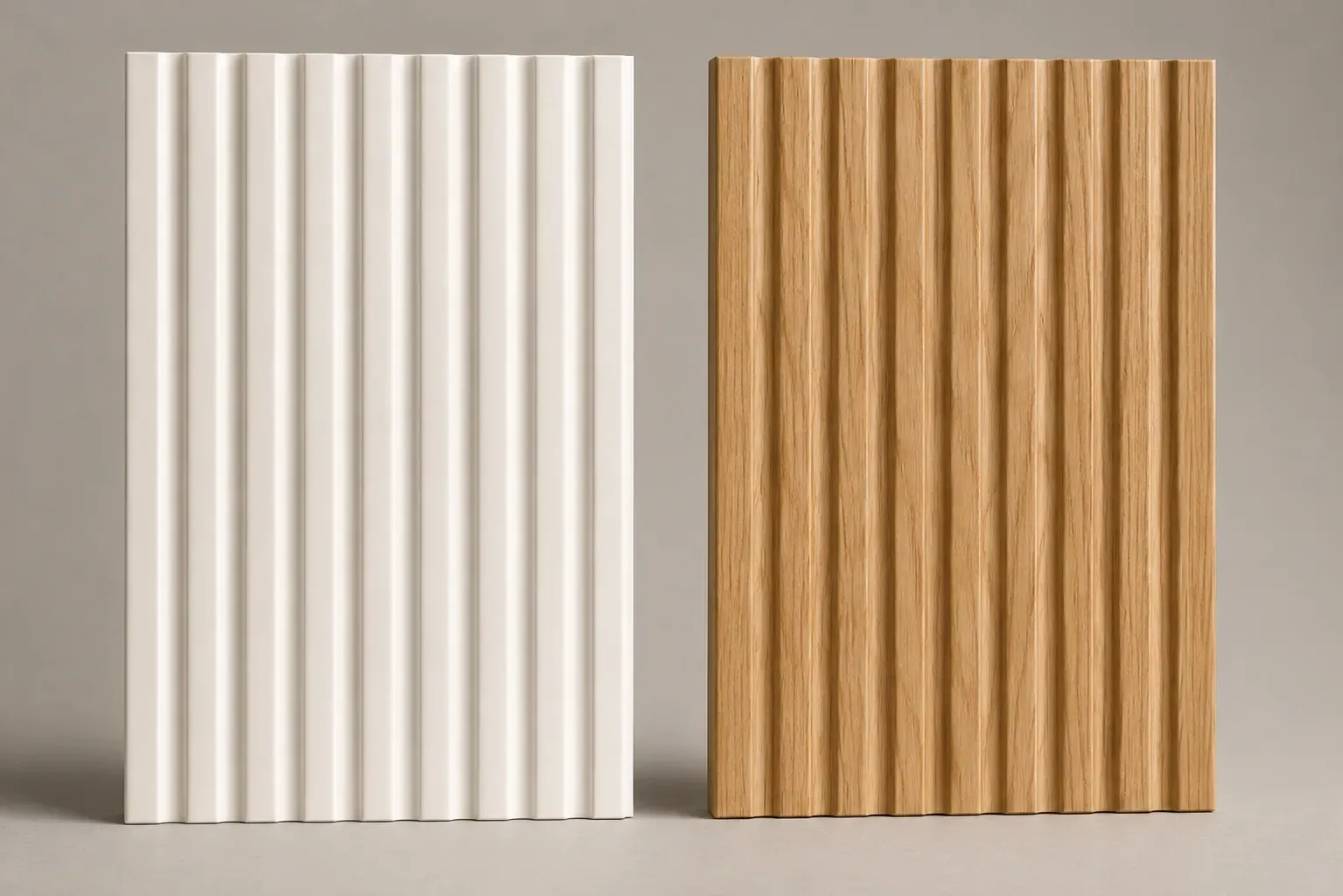
You will see both words used for the same doors, and in a showroom they are treated as interchangeable. There is a small technical distinction worth knowing if you want to sound sharp with your designer. Classic fluting is concave, the grooves cut inward like the channels on a Greek column. Reeding is the opposite, convex ridges that stand slightly proud of the surface, like a row of thin dowels laid side by side. Fluted tends to read softer and more shadowed, reeded reads a touch more sculptural and rounded.
In practice, most cabinet lines only carry one profile and label it either way. Here is how the family compares to the flat door styles you are probably weighing it against.
| Door look | Surface | Feel | Upkeep |
|---|---|---|---|
| Fluted | Concave vertical grooves | Soft, shadowed, architectural | Moderate |
| Reeded | Convex vertical ridges | Rounded, tactile, furniture-like | Moderate |
| Shaker | Recessed flat center panel | Classic, calm, easy to place | Low |
| Slab | Flat, no profile | Modern, minimal, quiet | Very low |
Where fluted cabinet doors actually work
This is the part that decides whether you love the result or regret it. Fluting is a strong pattern, and a strong pattern wants a job, not a whole kitchen. The homeowners who stay happy with it use it as a feature in one or two places and let calmer doors do the rest of the work. The vertical lines also pull the eye upward, which quietly adds a sense of height in rooms with standard ceilings.
Spots where fluted fronts earn their keep:
- Kitchen islands. Wrapping the island in fluting, especially the sides and end panels, turns it into a furniture piece without shouting.
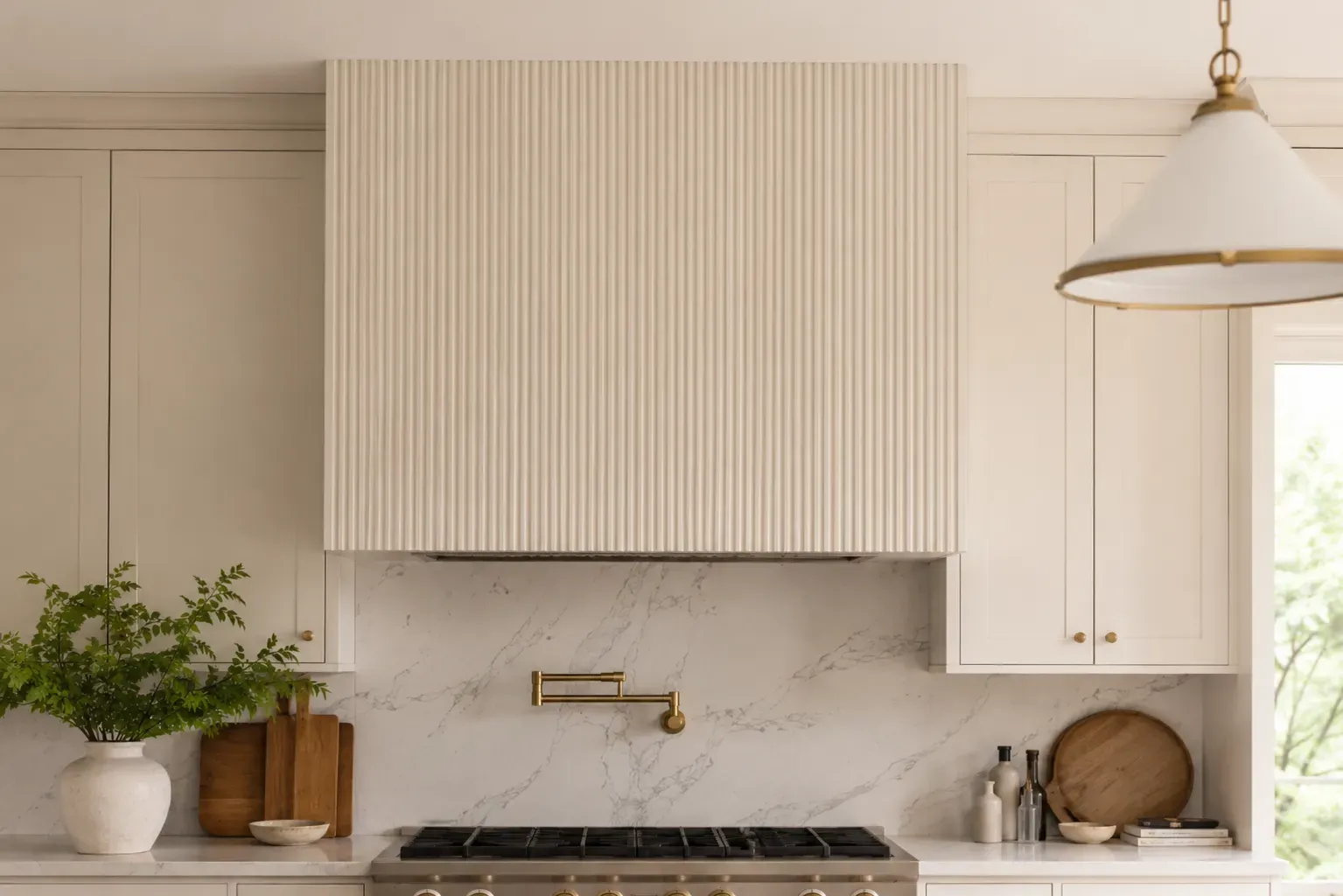
- Range hood surrounds. A fluted hood becomes the vertical anchor of the room and ties into the grooves elsewhere.
- Tall pantry and appliance panels. Long vertical runs are where fluting looks most like intentional millwork.
- Coffee stations and bar cabinets. A small zone of texture reads as a built-in, not a trend.
- Lower cabinet runs paired with plain uppers. Texture below, calm above, keeps the room balanced.
- Powder rooms and bath vanities. Lower splatter than a cooking zone, so the grooves stay cleaner and the furniture look shines.
A smart middle path many designers suggest is to skip fluted wood on the uppers and use reeded or fluted glass in wall and display cabinets instead. You get the same ribbed texture, but light passes through and there is far less surface to wipe. Pair any of these with a flat companion door, a slab or a shaker, so the fluting stays the star and the room does not feel busy. One more placement note: a heavily veined countertop fighting a fluted base tends to look cluttered, so a calmer solid surface usually sits better under all that pattern.
Materials: MDF, solid wood, or glass
The material you pick changes the price, the finish, and how well the grooves hold up. This is also where cheap and quality versions part ways, because a poorly made fluted door chips along the ridges where a good one does not.
| Material | Best finish | Why people pick it | Watch for |
|---|---|---|---|
| Paint-ready MDF | Painted | Smooth, even paint with no grain telegraphing through the grooves. Most common choice. | Low-grade MDF can chip on the ridge edges. Ask about density. |
| Solid wood | Painted or stained | Warmer look, holds a knock better, and stain shows the wood movement across the flutes. | Costs more and the grain can compete with the groove pattern. |
| Wood veneer | Clear or stained | A natural wood face at a lower price than solid stock. | Deep grooves are harder to wrap cleanly. Confirm the sample. |
| Reeded / fluted glass | Clear | Texture for uppers and display cabinets with almost none of the cleaning penalty. | Only suits wall and glass-front units, not full base doors. |
A quick rule of thumb: if you want a crisp painted color, choose MDF. If you want visible grain and a stained, natural look, choose solid wood. If you love a matte painted finish, it pairs beautifully with fluting and hides fingerprints better than high gloss, which can spotlight residue sitting inside the grooves.
What fluted cabinet doors cost?
Expect to pay a premium over a flat door. The extra machining to cut consistent grooves and the extra finishing time to coat every ridge both add up. Across suppliers, fluted fronts commonly land 15–40% above a comparable flat door in the same material and finish. Your final number depends on how much of the kitchen you cover and which route you take.
| Route | Rough cost | Good fit if |
|---|---|---|
| DIY appliqué or pole wrap | $ (lowest) | You are handy, patient with alignment, and updating one island or panel. |
| Paint-ready MDF fluted fronts | Around $25–$30 per sq ft for doors and drawer fronts | You want a clean painted accent without full custom pricing. |
| Semi-custom / RTA with fluted accents | $$ (mid) | You want matched cabinets, soft-close boxes, and a designer keeping it balanced. |
| Full custom joinery | $$$ (highest) | You want a bespoke groove profile and species with no compromises. |
Why the price swings so much: material (MDF is cheaper than solid wood), painted vs stained, stock profile vs a custom groove depth and spacing, and how many fronts you flute. Covering an entire kitchen in fluting is both the most expensive option and the one most likely to feel dated, so the budget-friendly and the design-friendly move happen to line up: use it as an accent.
Is the premium worth it? That is the honest question buyers wrestle with, and the answer depends on placement. As a single island or a range hood, the texture reads as custom for a modest add-on. Spread across every door, the cost climbs fast, and plenty of homeowners would rather put that money into counters or a backsplash. Two more line items to plan for: fluted fronts are often special-order rather than stock, so lead times run longer, and a truly custom groove profile or a curved front moves you into bespoke pricing that sits well above the figures above.
What buyers actually worry about
We pulled these straight from homeowners and designers debating fluting online, because the honest concerns matter more than the pretty photos.
Cleaning the grooves is the number one complaint, by a mile. On a 150-plus comment thread debating a fluted island, homeowners kept circling the same worry: dust settles into the channels, and spilled coffee, sauce or wine sinks in and stains. One warned fluted doors “attract dirt, dust, grease, and cat hair,” and toddlers and pets only add to it. It is manageable with the right brush, and it is a strong reason to keep fluting off the busiest cooking walls, or to use reeded glass uppers instead.
“It is hard to change later.” Fluted surfaces are tougher to repaint or adapt than a plain door because the profile is so specific. If you like to refresh your kitchen often, weigh that in.
“Cheap versions chip.” Low-density MDF can crumble on the ridge edges. This is a quality question, not a fluting question, and a good door solves it.
“Will it look dated in five years?” Only if you overdo it. A full kitchen of fluting reads as a specific moment. A single fluted island reads as a design choice. More on that below.
Fluted cabinet doors: pros and cons
The upside
- Real depth and shadow that flat doors cannot copy
- Adds interest without color or heavy hardware
- Vertical lines make a room feel taller
- Works across modern, transitional and warm minimal kitchens
- Architectural roots, so it can read timeless when used well
The trade-offs
- More cleaning than a flat panel, especially near cooking
- Costs 15 to 40 percent more than comparable flat doors
- Harder to repaint, repair or match later
- Overload risk if used on every surface
- Cheap MDF can chip on the ridges
Not sure where fluting belongs in your layout?
Our designers place this detail every week and will show you exactly where it works in your kitchen, and where a calmer door saves you money and cleaning time. In-stock options, free consultation, seven showrooms across Texas, Virginia and Missouri.
How to keep fluted doors clean
The cleaning concern is real but small once you have a routine. The grooves are shallow, so you are not scrubbing trenches, you are wiping a textured surface. A soft microfiber cloth handles daily dust when you run it along the grooves rather than across them. For grease near the range, a soft bristle brush or an old toothbrush with warm water and a drop of dish soap clears the channels fast. Skip abrasive pads and harsh solvents, which dull painted finishes and can wear the ridge edges. A satin or matte finish hides everyday residue better than gloss, and wiping spills when they happen, rather than at the end of the week, keeps the whole thing painless.
Is fluted cabinetry a trend that will date?
This is the question designers are openly arguing about right now, so you deserve both sides. One camp says fluting has hit saturation. It shows up in nearly every renovation feed, and once a detail is everywhere, some designers compare it to shiplap or chevron tile and start calling it overdone. The other camp points to history. Fluting has lived in architecture for centuries, from Greek columns to heritage millwork, which gives it a sense of permanence rather than novelty.
Both are right, and the tiebreaker is how you use it. Wrap an entire kitchen in fluted fronts in a bold color and you have bought into a specific moment that may feel tired in a few years. Add a single fluted island, a reeded glass upper, or a fluted range hood in a neutral finish, and you have made a considered, furniture-like choice that ages the way good millwork always has. Selective and neutral is the formula that survives. Homeowners can be blunter than designers about the risk, on one busy thread a commenter shrugged that fluted paneling is “the new shiplap.” If you want to keep tracking where the category is heading, our kitchen cabinet design trends page follows what is rising and what is cooling.
Does fluted cabinetry help or hurt resale?
Answer this one honestly before you order, because it splits along a single line: are you building a forever home or a house you may sell soon? If you plan to stay, your taste is the only vote that counts, and a well-placed fluted accent reads as a quality, custom detail that many buyers now see as a plus. If a sale is on the horizon, remember that fluting is an opinion. Some buyers love it, others read it as a trend and mentally price in a redo. Flat shaker and slab doors are the safer, broader-appeal choice, which is exactly why the accent approach hedges so well. A fluted island or hood adds character without committing the whole kitchen to a look a future buyer has to accept. If resale weighs on you, keep the fluting on pieces that are easy to swap and keep the bulk of the kitchen in a finish with wide appeal.
Getting fluted cabinet doors from USA Cabinet Express
You do not have to choose between the look you want and cabinets that actually last. We build fluted texture into real kitchens using a mix of ready-to-assemble and semi-custom cabinetry, so you get the accent without full custom pricing. Our designers help you decide where fluting belongs, which companion door balances it, and which finish holds up in your space. Boxes come with Blum soft-close hardware, and our lines meet CARB2, TSCA Title VI, NKBA and KCMA standards, so the quality question behind those chipped-ridge horror stories is off the table.
Prefer to see it before you commit? Compare finishes from Fabuwood and Mantra, or browse our RTA cabinet line, then map the whole plan in the visualizer. If you are also weighing the cabinet box itself, our guide to frameless cabinets covers that separate decision, and the right cabinet hardware can make or break a fluted door.
Price a fluted accent for your kitchen
Send us your plan or your rough measurements and we will quote a balanced layout, fluted where it counts, calm everywhere else. It is free, and there is no pressure to buy.
Fluted cabinet doors FAQ
Are fluted cabinet doors hard to clean?
They take a little more effort than flat doors because the grooves hold dust and grease, but the channels are shallow. A microfiber cloth run along the grooves handles daily dust, and a soft brush with warm soapy water clears grease near the range. Keeping fluting away from the busiest cooking wall makes upkeep easy.
Do fluted cabinet doors cost more than flat doors?
Yes. The extra machining and finishing usually put fluted fronts 15 to 40 percent above a comparable flat door in the same material. Paint-ready MDF fluted fronts often run around $25 to $30 per square foot, while DIY appliqués cost far less and full custom joinery costs more.
What is the difference between fluted and reeded cabinets?
Fluting is concave, with grooves cut inward, while reeding is convex, with ridges that stand slightly proud of the surface. Fluted reads softer and more shadowed, reeded reads more rounded and sculptural. Most cabinet lines carry one profile and use the two names interchangeably.
Can you paint or stain fluted cabinet doors?
Both work. Paint-ready MDF is the go-to for a smooth painted color with no grain showing through the grooves. Solid wood takes a stain well if you want to show natural grain, though the grain and the groove pattern can compete, so ask to see a sample first.
Are fluted cabinets still in style in 2026?
Yes, with a caveat. Some designers feel a full fluted kitchen has become overdone, but the detail itself has centuries of architectural history and stays current when used selectively. A fluted island, hood, or reeded glass upper in a neutral finish is a safe, lasting choice.
Where should I use fluted cabinets in a kitchen?
Islands, range hood surrounds, tall pantry and appliance panels, coffee or bar stations, and lower runs paired with plain uppers. Reeded or fluted glass suits wall cabinets. Use it as an accent rather than on every door, and pair it with a flat companion door to keep the room balanced.
Why are fluted cabinet doors so expensive?
The grooves have to be machined into every front, then every ridge has to be finished, which adds labor a flat door never needs. Fluted fronts are also often special-order rather than stock, and custom groove profiles or curved fronts push into bespoke pricing. Sticking to paint-ready MDF and an accent placement keeps the premium reasonable.
Are fluted cabinets worth the extra cost?
As a feature on an island or hood, most people feel the texture earns its modest premium and reads as custom. Across a whole kitchen, the cost climbs fast and some homeowners would rather spend it on counters or a backsplash. Worth-it usually comes down to using it selectively rather than everywhere.
Can you use fluted cabinets in a small kitchen?
Yes, but sparingly. In a compact kitchen, fluting on most cabinet faces can make the room feel busy. Keep it to one element, a run of pantry fronts or a single lower cabinet, and let plain doors carry the rest. Reeded glass uppers are a light-touch option that adds texture without crowding a small space.
Do fluted cabinet doors add or hurt home value?
It depends on the buyer. A tasteful fluted accent reads as a quality, custom detail to many buyers, but fluting is still an opinion, and some prefer plain shaker or slab. If you may sell soon, keep the fluting on easy-to-swap pieces and keep most of the kitchen in a broadly appealing finish.
Are fluted cabinet doors durable?
A quality door holds up well. The thing to watch is the ridge edges on low-density MDF, which can chip if knocked, and the fact that matching a damaged fluted profile later is harder than touching up a flat door. Solid wood resists knocks better, and buying a well-made door is what keeps the grooves crisp for the long run.
What cabinet style ages better: shaker, slab, or fluted?
Shaker is the safest long-term bet, slab is a close second, and fluted ages well when it is used selectively in quality materials. The risk with fluted is overuse in cheap materials, which is what makes the look feel tied to a moment. A restrained, well-made fluted accent tends to age like the architectural detail it is.
Can I get fluted doors on ready-to-assemble cabinets?
Yes. You can bring fluted texture into an RTA or semi-custom kitchen as an accent, which keeps the cost well below full custom while still giving you matched, soft-close cabinetry. A designer can spec which fronts get the fluted treatment and which stay flat.
Fluted cabinet doors reward restraint. Put them where the light can play across the grooves, an island, a hood, a run of pantry fronts, keep the rest of the kitchen calm, choose a quality door so the ridges never chip, and you end up with texture that looks crafted rather than trendy. Used that way, fluted cabinet doors are less a trend to chase and more a detail that has always belonged in good design.
Start with the complete cabinet door styles guide, then come see the doors in Austin, Dallas, Houston, Chesapeake, Fairfax, Fredericksburg, or St. Louis. Book your free consultation and start designing.