


Written by Helen Yasar
Showroom Associate, Fairfax VA

Reviewed by Emin Halac
Chief Executive Officer
Updated September 2026. Written from the showroom floor, not from a trend deck. Helen works with contractors and designers out of our Fairfax showroom at 2832 Dorr Ave, and the specification notes below come from jobs we have quoted, delivered, and occasionally had to fix.
If you specify kitchens for a living, the door style question is not really about taste. It is about what your supplier can actually deliver on your timeline, what survives a family kitchen for ten years, and what the homeowner will still be happy with when they sell. Those are three different questions, and the pretty photos in most trend articles answer none of them.
This guide covers the six cabinet door styles worth specifying right now, what the industry data actually measures, and where we expect the market to move. We have kept the two apart on purpose. Anyone publishing precise 2027 percentages is inventing them, because that data does not exist yet. Where we make a forward call, we show our reasoning and label it as ours.
If you need the wider picture first, construction types, box materials, sizing, overlays and pricing tiers, start with our sister brand’s Kitchen Cabinet Buying Guide. It covers RTA against stock against semi-custom and custom, framed against frameless, wood species, standard sizes, and installed cost tiers. This article assumes you have already made those calls and are now choosing the face of the cabinet.
How we know what we know
VERIFIED. The NKBA 2026 Kitchen Trends Report surveyed 634 North American kitchen and bath professionals (57% designers, 67% NKBA members), released September 2025. The 2026 U.S. Houzz Kitchen Trends Study surveyed 1,780 homeowners. MasterBrand’s 2027 outlook surveyed 2,000+ designers and dealers.
THE LIMIT. The full NKBA 2027 report has not been publicly released. Only thematic headlines from High Point Market are out: bold color, the “Purpose-Built Kitchen,” and lighting treated as the most powerful design tool. There are no published 2027 percentages anywhere. If you see some, be skeptical of the source.
OUR READ. Anything marked What we expect is our own projection, drawn from what moves through seven locations and what contractors reorder. It is reasoning, not data, and it is labeled every time.
Speccing a job this week?
We stock these profiles across seven locations in Texas, Virginia, and Missouri, with RTA lines that ship flat for same-day pickup. Bring measurements, leave with real samples.
The short version, if you are between appointments
SPEC WITH CONFIDENCE
Slim Shaker and flat slab. Between them they cover most of what walks through the door, and neither is a resale risk.
USE AS ACCENT ONLY
Fluted, reeded, and glass. One island, one pantry, one bank of uppers. Never the whole run.
THE STOCKING CALL
Wood grain now outsells paint. Warm neutrals replaced cool gray. Stock accordingly or you will be reordering.
Prefer to listen
The whole guide as a 10 minute conversation, including the euro hinge constraint and Emin’s 2027 read. Good for the drive between appointments.
Chapters: 0:48 the three door styles · 2:11 flat slab and the 69% number · 3:19 the euro hinge floor on rail width · 4:36 wood grain overtakes paint · 5:10 what is replacing grey · 6:45 our 2027 read · 8:05 availability beats aesthetics
First, separate the door from the box
Strip away the marketing names and there are only three main styles of cabinet doors, defined by what the centre panel does. A slab door has no centre panel at all, just one flat face. A recessed panel door sets the centre panel behind the surrounding frame, which is what a Shaker is. A raised panel door steps the centre panel outward from the frame. Everything else you will be shown in a showroom is a variation on those three: slim Shaker is a recessed panel with narrower rails, fluted is a slab with milling, glass is a frame with the panel removed. Knowing this makes every catalogue easier to read.
Beyond the profile itself, half the confusion on job sites comes from mixing up three further decisions that get discussed as if they were one.
Construction is the box: framed or frameless. Frameless gives you full access and a little more usable interior. See our guide to frameless kitchen cabinets if that is still open.
Overlay is how the door sits: full overlay, partial overlay, or inset, where the door sits flush inside the frame. Inset is an installation method, not a door profile. It is also the most expensive way to hang a cabinet door, because the tolerances are tighter, the face frame has to be dead square, and any seasonal movement in the door shows immediately as an uneven gap. Quote it accordingly and never assume a client asking for “the flush look” understands the premium.
Profile is the face of the door itself, which is what the rest of this article is about. You can put almost any profile on almost any box. Getting a client to understand that they are choosing three things, not one, prevents most of the change orders later.
1. Flat Slab, the Modern Default
A slab door is one flat panel. No frame, no recessed center, nothing to catch grease. It is the cleanest face you can put on a box, and it is the profile most often paired with frameless construction.
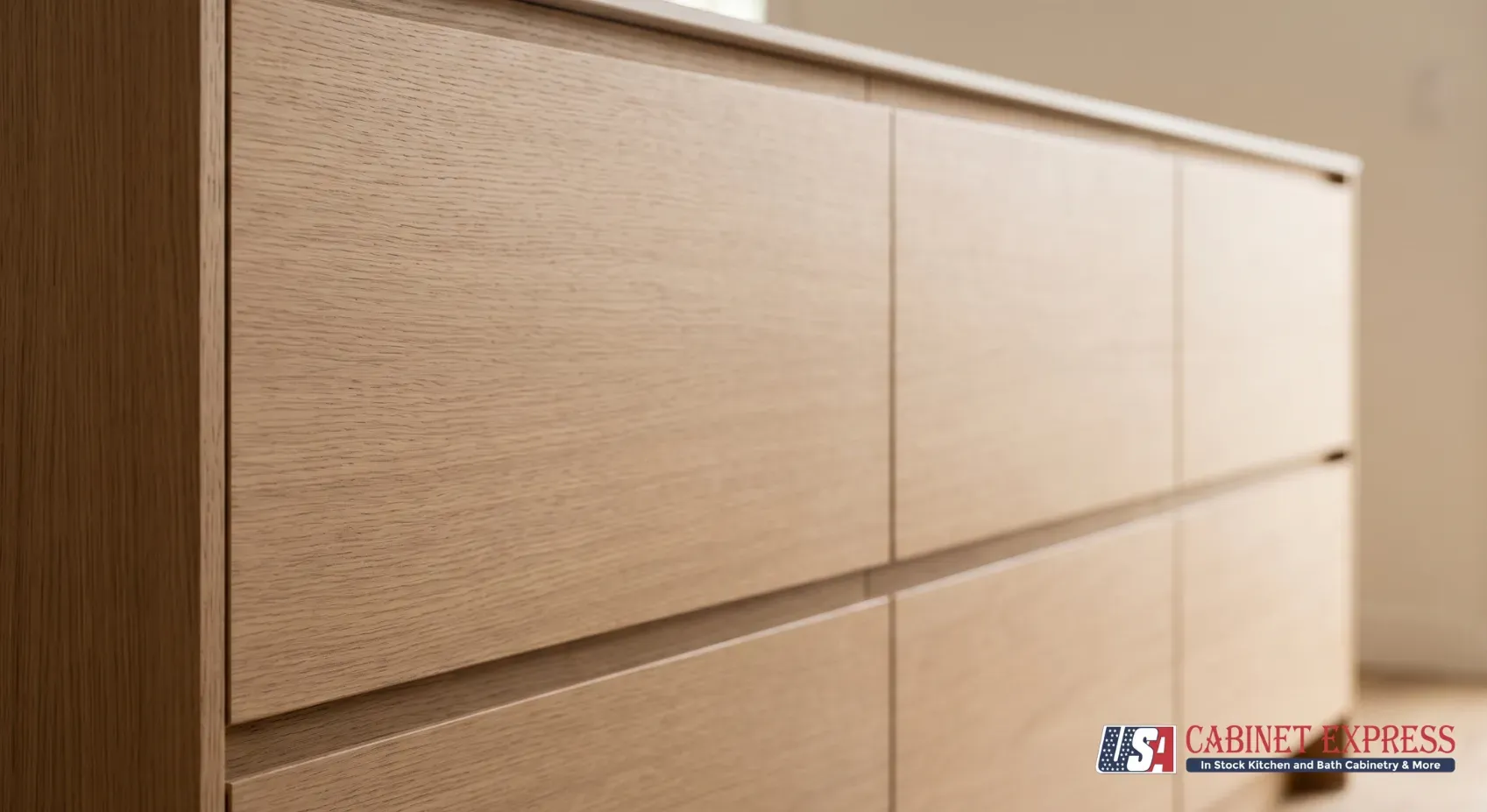
[VERIFIED] In the NKBA 2026 report, 69% of the 634 professionals surveyed named flat slab a growing style. That is the strongest single directional number in the dataset.
Spec notes. Slab is unforgiving on install. With no frame line to break up the elevation, an uneven reveal reads across the entire run, so budget alignment time or price it in. On the build side the core decides the outcome: high-density MDF stays flat and paints cleanly, plywood handles humidity better, particleboard fails at the edge once steam finds it. The edge banding, not the face, is what determines whether the door survives a decade. Run your thumb around every sample edge before you commit an order.
Why slab keeps winning on appliance walls. The same NKBA 2026 survey found 72% of professionals specifying panel-faced refrigeration and 85% panel-faced dishwashers. Once appliances disappear behind matching fronts, a slab is the profile that lets a whole wall read as one continuous surface. If a client wants integrated appliances, the door choice is close to made for you.
Where it goes wrong. Large flat faces show fingerprints and dents more than a recessed panel does. In a household with young children, a matte finish is not optional, it is the difference between a happy client and a callback.
What we expect. [OUR READ] Slab does not peak and fall. It becomes the baseline other profiles get measured against, the way white subway tile did. The version that dates is the glossy one. Matte and honest wood grain will keep aging well. Full breakdown in our slab cabinet doors guide.
2. Slim Shaker Cabinets, the One Replacing Standard Shaker
Slim Shaker cabinets keep five-piece frame-and-panel construction but narrow the stiles and rails. Traditional Shaker frames run roughly 2.25 to 3 inches. Slim versions bring that down to roughly two to two and a half inches, with micro-shaker going narrower still. From across a room it reads almost as clean as a slab, but up close it keeps a shadow line that a slab cannot give you.
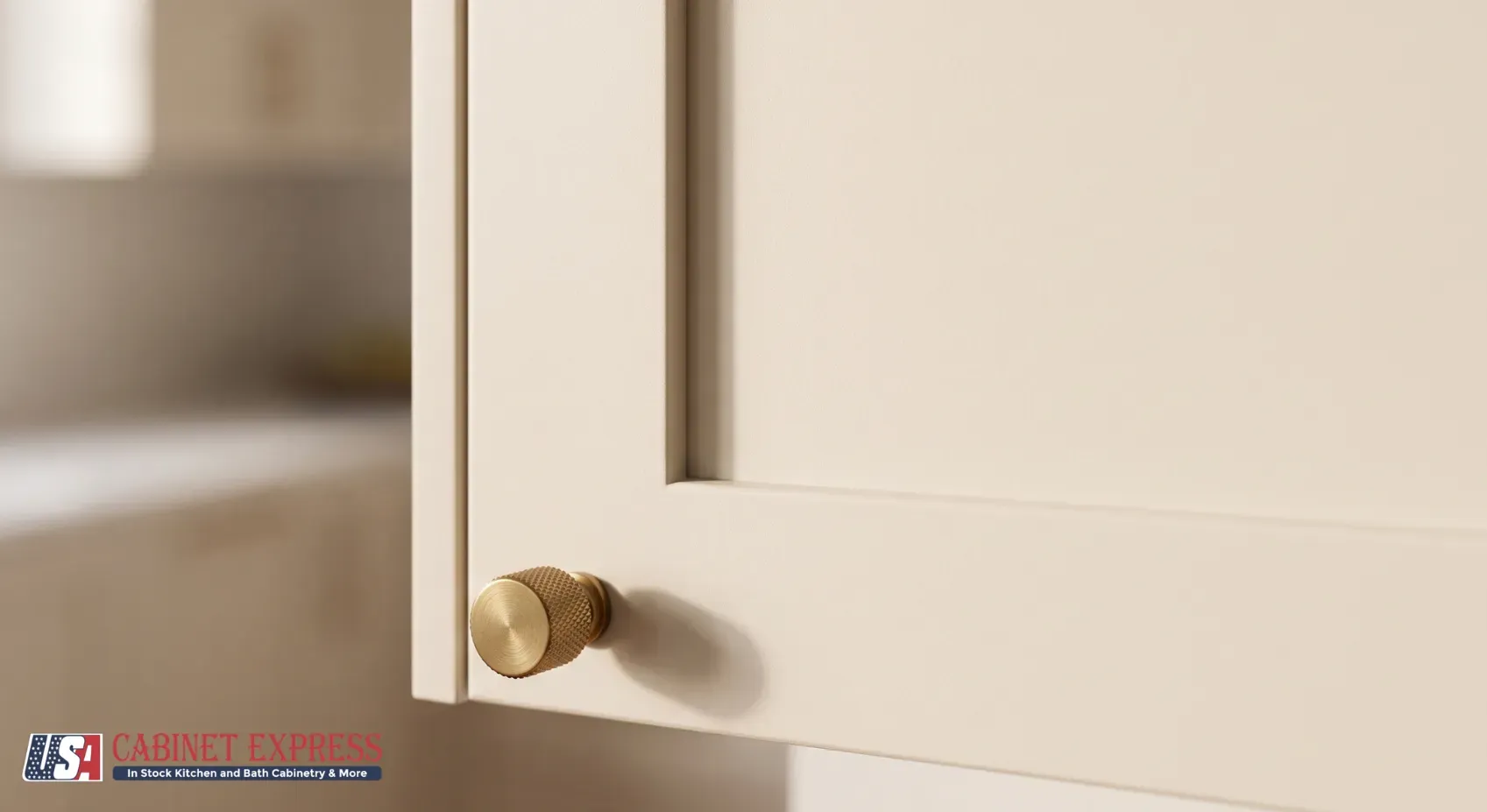
[VERIFIED] MasterBrand, surveying 2,000+ designers and dealers for its 2027 outlook, found plain Shaker being actively replaced, not by slab alone but by more detailed fronts: reeded, arched, glass-inserted, and wire-mesh panels.
Spec notes. Narrow frames are harder to build consistently, and small drawer fronts are where cheap fabrication shows first, because the frame can end up wider than the panel it surrounds. Ask what the substrate is before you order a full kitchen. A machined monolithic core avoids the hairline seam cracking that five-piece solid wood develops through seasonal humidity swings, which is the single most common warranty complaint we see on painted doors.
The constraint nobody mentions. There is a hard floor on how narrow a stile can go, and it is set by hardware, not taste. A standard concealed European hinge cup needs enough stile width to sit behind, and at roughly two inches you run out of material to cover it. Below that you are into a different hinge, a thicker door, or a front that does not swing at all. Trend coverage that tells you to specify half-inch rails is describing a showroom sample, not a hinged door on a working kitchen.
What we expect. [OUR READ] This becomes the safe default recommendation for contractors, taking the role standard Shaker held for fifteen years. It reads current without being a gamble. We do expect the most extreme micro-rails to eventually read as a 2020s signature, the same way heavy three-inch rails now read as 2010s. Our advice is to specify in the 2.25 to 2.5 inch range and let the finish do the modernising, rather than chasing the narrowest rail on the sample board.
What cabinetmakers actually specify
We went and read what working cabinet shops say to each other rather than what trend reports say to homeowners. On r/Cabinetry, asked directly about rail and stile dimensions for Shaker doors, the shop consensus lands between 2.25 and 2.625 inches, not the ultra-slim numbers in most design coverage.
“2 inches isn’t enough for a euro hinge to cover.”
“2 1/2 for shaker. Knobs looked lost at 3 inches.”
“I’ve used 2 5/8 for the last couple years. It’s right in that sweet spot of not looking too narrow or too chunky.”
Two things worth stealing from that thread. First, several shops keep the wider stile and narrow only the rails on small doors, which preserves hinge coverage while lightening the look. Second, the common practice is to use a solid or slab drawer front for anything under about six to seven inches tall, because a five-piece frame at that height reads as stunted no matter how well it is built. If your supplier is quoting five-piece fronts on every drawer, ask why.
3. Simplified Recessed Panel, the Bridge Profile
A flat center panel inside a frame that is slightly wider or more architectural than a slim Shaker, but without applied molding or heavy beveling. It sits between minimalism and traditional, which is precisely why it keeps winning jobs.
Spec notes. This is the forgiving one. It takes paint or stain, works with any hardware, hides ordinary wear in the recess, and keeps a long cabinet wall from reading as a monolith. In renovated older housing stock it usually does what the house wants without anyone having to argue about style.
Our transitional door styles guide covers the proportions in more detail, including the rail widths that keep it from tipping traditional.
What we expect. [OUR READ] Quietly the highest-volume profile in transitional homes, because it is the answer when a client says a slab feels too cold but Shaker feels too farmhouse. The failure mode is bulky rails and deep routing, which slides the whole kitchen back toward 2005.
4. Fluted and Reeded, Accent Only
Repeating vertical grooves or rounded ribs milled into the door face. Reeded generally means finer, closely spaced ridges. Fluted usually means broader channels. In practice the words get used interchangeably, so confirm which one your supplier means before you order.
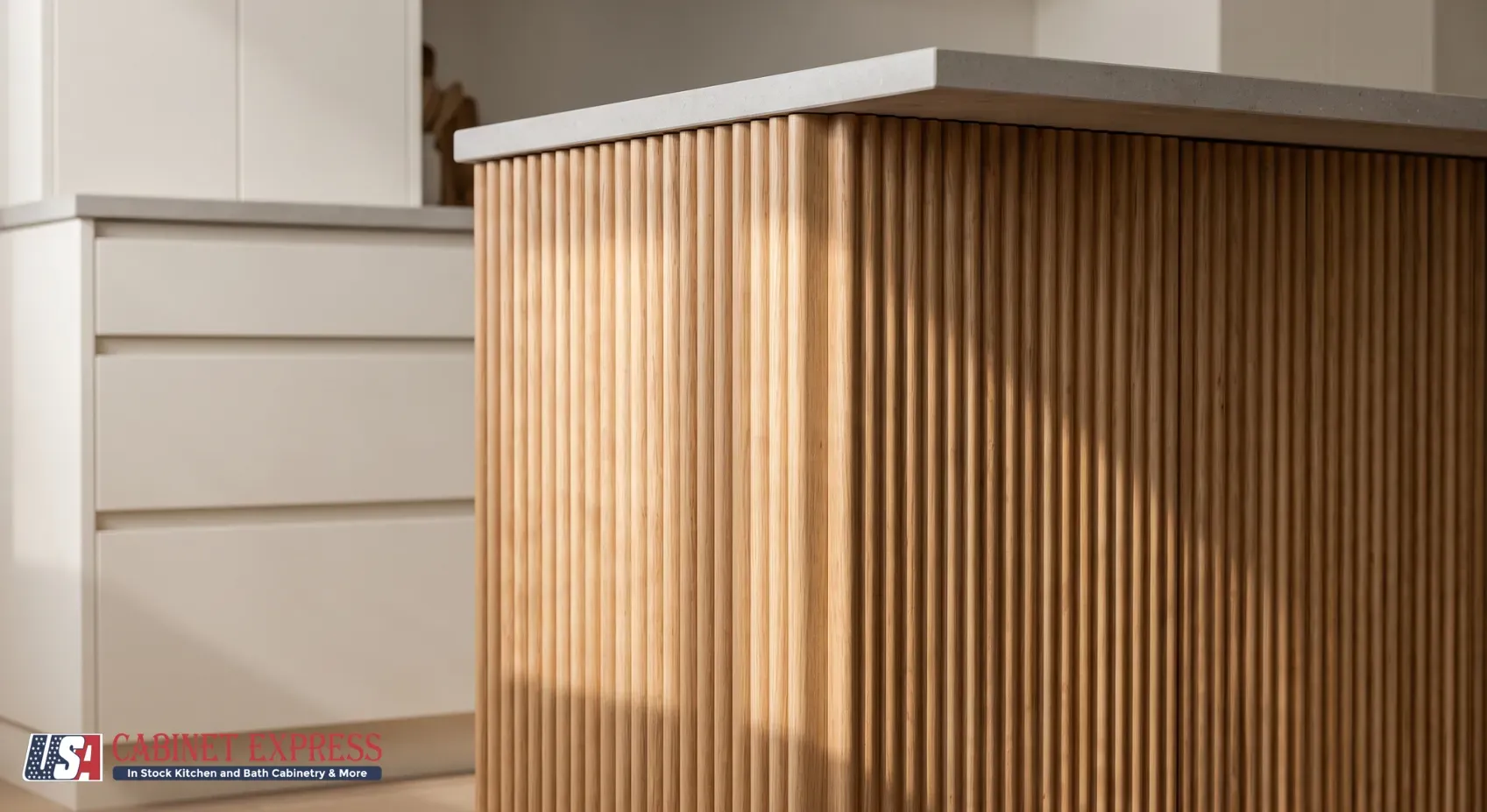
[VERIFIED] Houzz’s 2026 emerging-trends data shows the appetite for texture clearly: searches for sandstone rose 257%, Venetian plaster 94%, travertine 84%, terracotta 55%, and limewash 53%. Homeowners want surfaces that feel like something under the hand.
Spec notes. Set cleaning expectations before you install, not after. Grooves collect dust and cooking residue, and a fluted run behind a range will need real maintenance. Machined and veneered fluting also raises fabrication cost, so quote it as an upgrade rather than a like-for-like swap. Watch grain direction across adjacent doors, because a mismatch is far more visible on a ribbed face than a flat one.
The wider texture category. Fluting and reeding are the best known, but the same idea covers a group of details that keep appearing together in 2027 forecasts: shallow grooves, glass inserts, and wire-mesh or grille panels. MasterBrand’s dealer survey lists reeded fronts, arched doors, glass inserts, and wire mesh as the details replacing plain Shaker. Wire mesh in particular is worth knowing about, because clients increasingly ask for it by description rather than name, usually as “that chicken wire look” on a pantry or a bar cabinet.
What we expect. [OUR READ] Fluting holds its value if it stays on one island, one pantry, or a beverage run. Wall-to-wall fluting is the detail most likely to be regretted, and we expect it to be the clearest “that was the mid-2020s” marker a decade from now. Sell it as jewelry, not as the outfit. More in our fluted cabinet doors guide.
5. Glass and Reeded Glass, the Relief Valve
A framed door with the solid center replaced by clear, seeded, smoked, or reeded glass. Reeded glass blurs the contents without hiding them, which is why it has taken over from clear in most of what we sell.
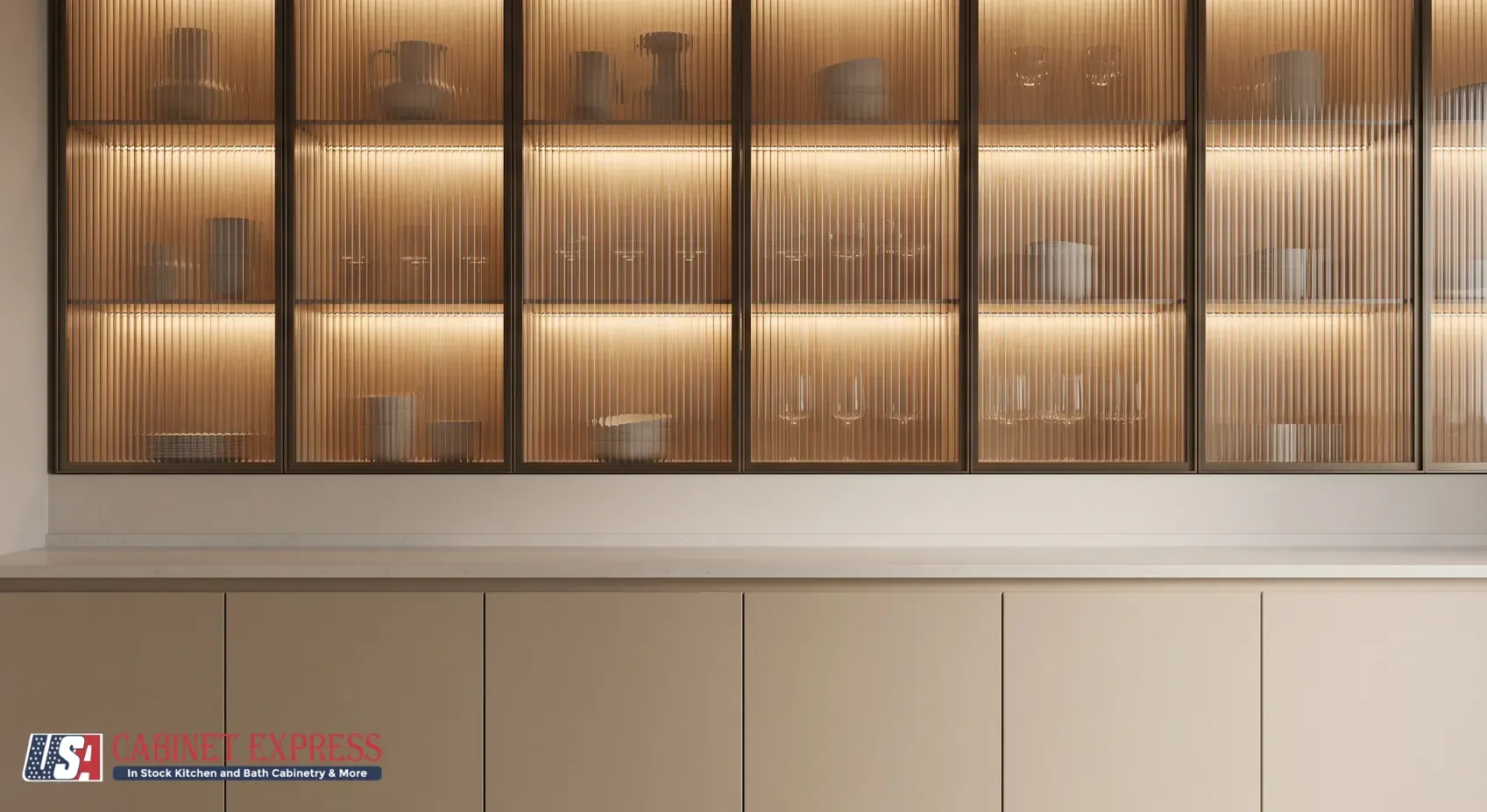
Spec notes. Specify safety glass and rate the hinges for the added weight. Under-rated hinges on glass doors are a predictable failure and an avoidable callback. Clear glass is a commitment the client may not fully understand, because it exposes everything inside permanently. Reeded solves that and is the easier sell. If interior lighting is part of the design, plan the wiring before the boxes go in, not after the counters land.
What we expect. [OUR READ] Steady rather than spiking. A few glass fronts have been good design for a century and will keep being good design. The parts tied to this specific moment are heavy tinting and full illuminated display walls. Detail in our glass cabinet doors guide.
6. Raised Panel, Quietly Coming Back
The profile everyone wrote off. A center panel that steps outward from the frame, traditionally with heavy molding and beveling.
[VERIFIED] MasterBrand’s dealer survey found raised panel seeing a modest comeback in “modern traditional” work, reversing a long decline. Their design director, Stephanie Pierce, put a shelf life on the related arched-door trend at “at least another two years,” which is a rare specific estimate from a manufacturer and worth noting precisely because most sources will not commit to one.
What we expect. [OUR READ] Not a full revival. What returns is the restrained version: a shallow step or soft profile in a warm painted finish, in a Colonial, Craftsman, or cottage house where it actually belongs. The ornate Tuscan raised panel of the early 2000s is not coming back, and you should say so plainly when a client asks. We wrote a longer answer to that exact question in are raised panel cabinets outdated.
Contractor spec comparison
| Profile | Install tolerance | Cleaning load | Relative cost | Most common failure | Best use |
|---|---|---|---|---|---|
| Flat slab | Low, reveals show | Lowest | $$ | Edge banding lifting | Frameless, full runs, panel-ready appliances |
| Slim Shaker | Moderate | Low | $$ | Seam cracking at rail joints | Whole-kitchen default, family jobs |
| Recessed panel | Forgiving | Low to moderate | $$ | Rails specified too heavy | Transitional, older housing stock |
| Fluted / reeded | Moderate, grain direction matters | Highest | $$$ | Residue in grooves near range | Island, pantry, bar. Accent only |
| Glass / reeded glass | Hinge rating critical | Moderate | $$$ | Under-rated hinges sagging | Uppers, display, breaking a long run |
| Raised panel | Forgiving | Higher, more edges | $$ to $$$ | Reads dated in the wrong house | Architecturally traditional homes only |
Cost is relative across comparable construction. Substrate and finish move the number far more than profile shape does. For installed cost tiers by cabinet grade, see the buying guide.
Finish and color: the part that actually changed
[VERIFIED] Wood grain has overtaken paint. NKBA found 59% of professionals call wood grain a growing finish, with white oak the top species at 51%. Houzz found wood cabinetry reached 29% of renovating homeowners against white at 28%, the first time wood has edged ahead. MasterBrand found white has fallen to the fourth most-preferred finish, behind light wood stains, creamy off-whites, and mid-tone stains.
[VERIFIED] On direction of color, Houzz’s 2026 emerging data shows rust up 178%, chocolate brown up 153%, mushroom up 69%, olive up 57%, sage up 55%, taupe up 50%, and cream up 44%. NKBA has neutrals at 96%, green at 86%, blue at 78%. MasterBrand reports 88% of surveyed homeowners now willing to experiment with color.
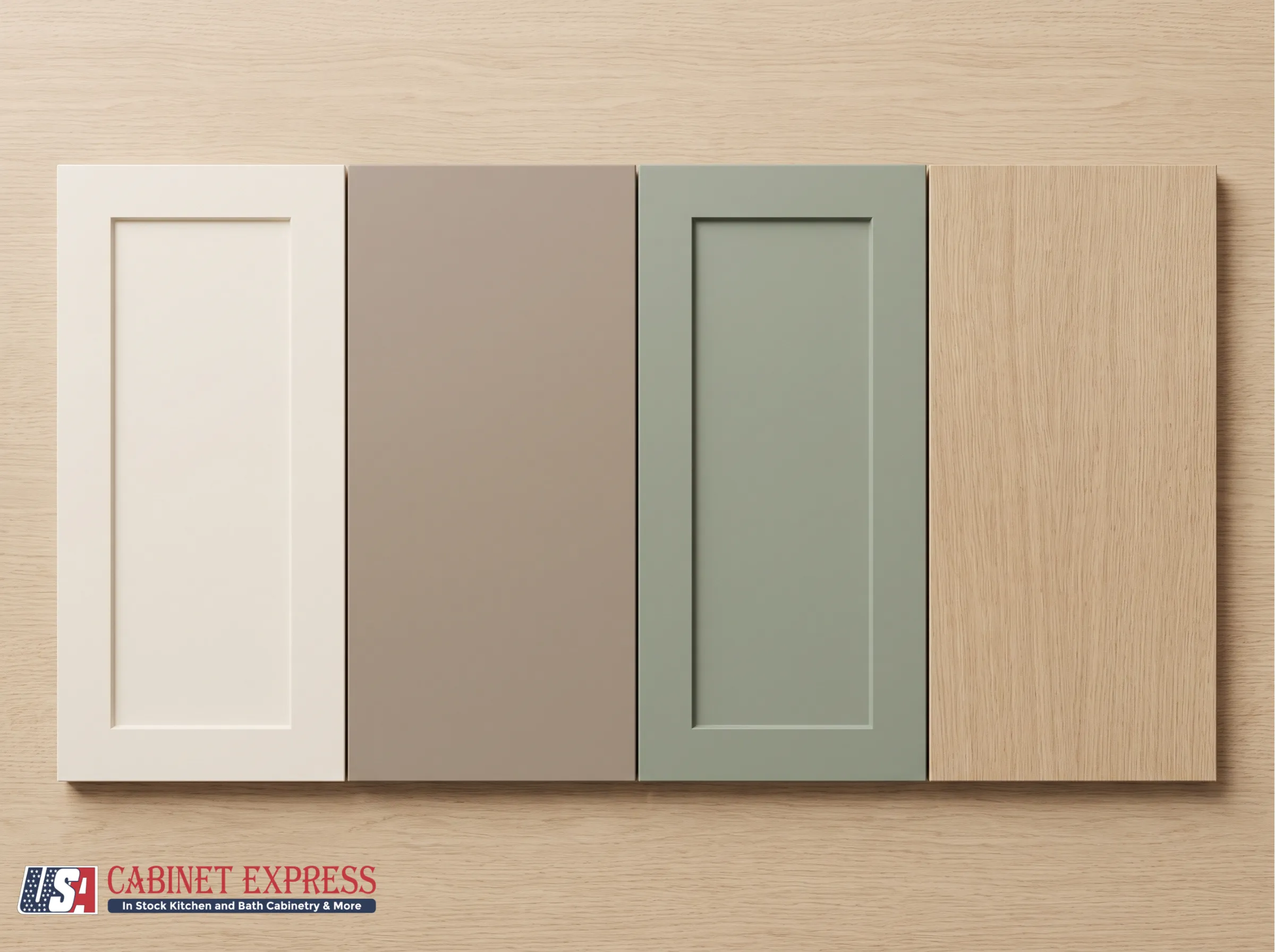
White oak specifically. When NKBA puts one species at the top with 51%, that is not a vague “wood is popular” signal, it is a stocking instruction. White oak works because rift and quarter-sawn cuts give you a straight, quiet grain that reads calm across a long run, where a flat-cut cathedral grain fights itself. It also takes a light natural or lightly smoked finish without going orange, which is the failure mode that killed honey oak. If you carry one wood species deep, carry that one.
Worth knowing if you source from European lines. U.S. sources agree green leads. The UK Houzz study, surveying more than 400 homeowners, puts blue ahead at 18% against green at 17%. Regional preference is real, and it matters if you are working from a European supplier’s stocking recommendations.
This is also why white shaker cabinets have not gone anywhere while looking noticeably different than they did five years ago. The profile survived; the white changed. A warm, creamy white on a narrower rail still sells constantly. The same door in a blue-undertone white is the one that now reads dated, and clients often cannot articulate why. When you are choosing kitchen cabinet colors, the undertone decides whether the kitchen feels current far more than the shade name does.
What is actually replacing grey. This is the question clients ask most often once you tell them grey is finished, and the answer is not white. Cool grey is being replaced by greige, taupe, and mushroom on the neutral side, and by sage and olive where the client wants colour. Those warm-neutral families do the same universal, goes-with-anything job that grey did for a decade, without the cold cast. The common thread is a neutral with warmth underneath it rather than blue. Worth noting for anyone tracking paint announcements: as of writing, neither Benjamin Moore nor Pantone has released a 2027 colour of the year, and Sherwin-Williams has published a 2027 forecast rather than a single colour. Treat any article claiming otherwise with suspicion.
Which colours are easiest to live with. Contractors get asked this constantly and the honest answer is medium-tone wood finishes and warm mid neutrals such as beige, cream, and greige. They hide fingerprints, dust, and the ordinary scuffing around handles far better than either a very dark or a very pale finish. Pure white shows everything, and a deep matte navy or black shows dust and skin oil more than photographs suggest. If a client cooks daily and has children, that is worth saying out loud before they pick.
Stocking shortlist. [OUR READ] A warm off-white, a mushroom or taupe, a sage or olive, and a mid-to-dark wood will cover the large majority of what clients pick. Cool gray and blue-undertone white are the two we would stop reordering.
Hardware, briefly
Hardware got quieter. Slim bar pulls, small knobs, and edge pulls suit narrow-rail and slab profiles. Warm living finishes, unlacquered brass and aged bronze, have taken the ground polished chrome and cool nickel used to hold. Handleless looks excellent in photographs and is harder to live with on heavy drawers and appliance panels, so we would not specify it throughout a family kitchen without saying that to the client first. Sizing guidance is in our cabinet hardware guide.
Our read, not data
What we expect heading into 2027
The full NKBA 2027 report is not out. What has been released from High Point Market is thematic: bold color, the “Purpose-Built Kitchen,” and lighting treated as the primary design tool. Everything below is our projection from those signals and our own order book. We would rather be transparent about that than dress a guess up as research.
We expect color to move onto the cabinet itself. For years bold color lived in the backsplash and the accessories, where it was cheap to change. The signals point to it migrating into cabinetry, and we expect it on islands, pantries, and bar runs well before it touches perimeter cabinets. That is also the sensible way to sell it, because it keeps the risk on a replaceable element.
We expect warm to keep deepening rather than reverse. Sherwin-Williams’ Colormix 2027 forecast, “Rewild,” is built on mosses, clays, and mineral blues. That extends the warm earthy direction of 2026 instead of correcting it. Our own read is that rust keeps oxidizing toward weathered copper and canyon tones rather than snapping back to gray.
We expect texture to spread, then get disciplined. Fluting is already everywhere. Our expectation is a correction where texture retreats to accent placement, and the kitchens that used it wall-to-wall are the ones that start looking dated first.
We expect frameless to stop being an upsell. Custom makers are already treating full-access construction as the standard rather than the premium option. If that holds, framed construction becomes the thing you justify rather than the default you assume.
We expect accessibility to move from request to baseline. Shorter wall cabinets, pull-out drawer bases, and lever hardware are appearing in briefs that have nothing to do with aging in place. Worth quoting proactively rather than waiting to be asked.
Survey data tells you what designers say they will specify. What I see is different, and it arrives about two quarters later: what actually gets ordered, in what colour, and how often it comes back. Those two things do not always agree, and the gap between them is where contractors get caught out.
Here is what I expect to matter most in 2027.
Availability will beat aesthetics. The profile a contractor can put in a client’s kitchen next month usually wins over the profile they have to wait eleven weeks for. That has always been true, but it is going to bite harder as more of the interesting work moves toward textured and machined fronts with longer lead times. My honest advice is to build your standard offer out of what is stocked, and treat the special-order door as the upgrade you sell deliberately, not the default you get talked into.
Colour is the real change, not the profile. Everyone is writing about door shapes. But a slim Shaker in warm mushroom and the same slim Shaker in cool grey are two completely different kitchens to the person living in it. The shift from cool to warm is the biggest change I have seen in years, and it happened faster than the profile changes did. If you are still ordering blue-undertone whites out of habit, that is the reorder I would fix first.
I expect more clients to take a colour risk, and more of them to regret it. The willingness is real. Managing it is the job. When a client wants a bold cabinet colour, put it somewhere replaceable. An island, a pantry run, a bar. Then the kitchen has personality and the client has an exit if they tire of it in four years. That single move has saved more of our clients from an expensive change of heart than any other piece of advice we give.
The quality question is moving from the door to the box. Buyers have learned to ask what a door is made of. Fewer of them ask about drawer construction, hinge brand, or what happens to the cabinet under the sink in year six. That is where the difference between a cheap kitchen and a good one actually lives, and it is where a contractor who explains it well separates themselves from a low bid.
What I am not expecting. I do not think Shaker disappears. I have heard that prediction for a decade. What I think happens is that the proportions keep tightening and the finishes keep warming, and in five years we will look back and call the wide white Shaker a period detail, the same way we now date a honey oak kitchen to a decade. That is evolution, not replacement.
“If a contractor asks me one question about door styles for 2027, I tell them to stop asking which style is trending and start asking which one they can get, in the finish the client actually wants, on the date they promised. That is the specification that keeps a job profitable.”
What is losing ground
Cool gray and blue-undertone white. High-gloss lacquer, which now reads like a phone screen in a room that wants texture. Heavy applied molding and ornate raised panels. Distressed and gray-washed wood. Polished chrome. Standard wide-frame Shaker is not obsolete, but the versions still selling well have better proportions, warmer finishes, and less farmhouse styling. The move is not traditional to modern. It is generic decoration toward profiles that suit the actual house.
When the client only needs new doors
Plenty of jobs do not need new cabinets. If the boxes are square, solid, and laid out sensibly, replacing cabinet doors and drawer fronts gets the client a different kitchen for a fraction of a full replacement. Every profile above is available as a door-only order, and new kitchen cabinet doors on sound boxes is the highest-value-per-dollar change most kitchens can make.
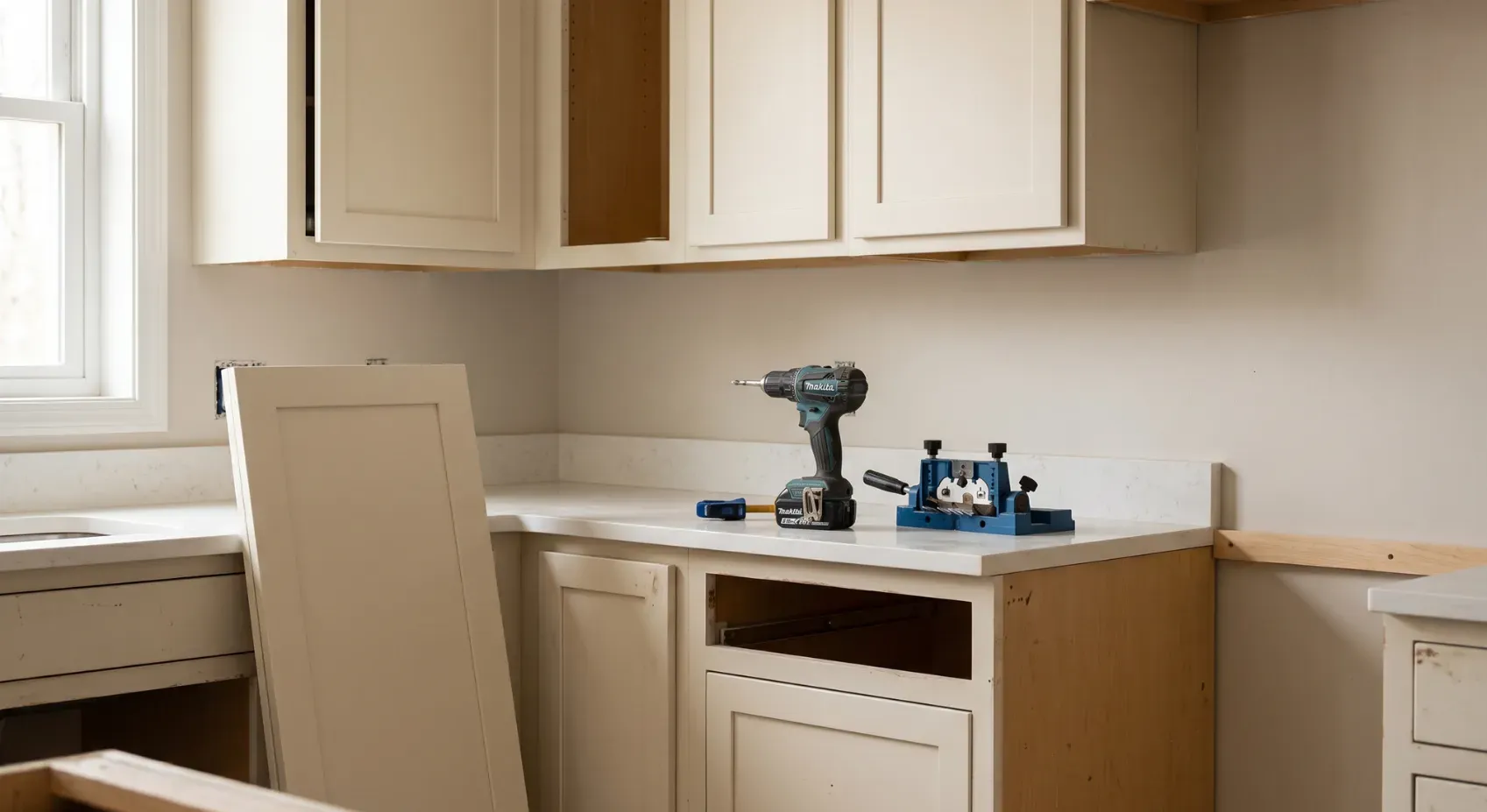
There are three versions of this conversation and they are not the same job. Painting kitchen cabinets keeps the existing doors and changes only the colour, which is cheapest and works if the profile is one the client still likes. Refacing keeps the boxes, replaces the doors and drawer fronts, and applies matching veneer to the exposed face frames so the whole kitchen reads new. Door replacement swaps the fronts without refacing the frames, which is cheaper than refacing but only looks right if the existing frames are in good condition and the finish is close. Price all three when the boxes are sound. Clients frequently arrive asking for one and leave choosing another once they see the numbers side by side.
Two things decide whether it is worth doing. First, box condition: check for swollen bottoms under the sink, racked face frames, and shelf sag before you quote anything. Second, layout: if the client wants the kitchen to work differently, doors will not fix that and you should say so early rather than after deposit.
Be straight with them about the cost, because the sticker shock is real. Homeowners posting quotes for door-only work regularly react badly to the number, having assumed “just doors” meant cheap. Walk them through the count. A typical kitchen is over twenty doors plus drawer fronts, each one needing hinge boring, hardware, and finishing to match. Showing the per-door math before the total lands makes the conversation go very differently.
A door swap is also the easiest way to test a profile in a house before committing. Slim Shaker or slab on a sound box is a low-risk way to modernise, and it keeps the trend exposure on something replaceable.
Put the spec in writing, for your own protection
There is a live suspicion among homeowners that a contractor will quote one grade of cabinetry and install another. You will find it stated openly in remodeling forums: the fear that semi-custom was sold and builder-grade was delivered. Whether or not it is fair, it shapes how clients read your quote.
The fix costs you nothing. Name the line, the door profile, the box material, the drawer construction, and the hinge brand on the quote itself. Blum, Grass, and Hettich are the names buyers recognise and check. A quote that says “soft-close hinges” invites doubt. A quote that says the specific hardware and the specific door series removes it, and it protects you later if a client claims they were promised something else.
Lead times, the constraint that decides most jobs
Door style is a scheduling decision before it is an aesthetic one. The profile a client falls in love with is worthless if it lands three weeks after the countertop template. Below are current supplier snapshots by cabinet tier, gathered September 2026.
| Cabinet tier | Typical lead time | What it means for door choice |
|---|---|---|
| Stocked RTA | Same day to ~4 weeks | Choose from what is on the floor. Personality goes into hardware and layout. |
| Semi-custom | ~4 to 9+ weeks | Most profiles available. Custom colour and grain matching push the upper end. |
| Custom | ~6 to 16 weeks | Where arched, curved, and grain-matched veneer work actually lives. |
| Imported European | ~11 to 14 weeks | Plan around it from day one. Not a mid-project change of mind. |
These are supplier snapshots checked in September 2026, not an industry benchmark. Always confirm against your own supplier, cabinet category, and region before you put a date in a contract.
The core assortment, if you are stocking or standardising
Profiles, three: classic Shaker for the traditional sell, slim Shaker as the default recommendation, flat slab for the modern client. Those three cover the large majority of jobs.
Finishes, five: a warm off-white, a mushroom or taupe, a mid-tone oak, a walnut or darker wood, and one muted green. Add a dark neutral if you sell a lot of islands.
Hardware baseline: soft-close hinges and full-extension drawer slides as standard, not as an upgrade line. Buyers now treat both as expected rather than premium, and quoting them as extras reads as padding.
Accent, one: a fluted or reeded front available on island and pantry sizes only. Stocking it in full-kitchen quantities encourages exactly the wall-to-wall use that dates fastest.
How to choose, by job type
| The job | What we would specify | Why |
|---|---|---|
| Flip or rental, selling within 2 years | Slim Shaker, warm off-white | Broadest buyer appeal, lowest objection rate |
| Forever home, design-led client | Slab in white oak or walnut | Material does the work; ages on its own terms |
| 1920s to 1950s house | Simplified recessed panel, possibly inset | Matches the architecture without pastiche |
| Busy family kitchen | Recessed panel or matte slab | Hides wear; no grooves to scrub |
| Client wants “something different” | Dominant profile plus fluted island | Contains the risk to one replaceable element |
| Tight timeline | Stocked RTA slab or Shaker | Ships flat, same-day pickup, no custom lead time |
Samples in your hand beat samples on a screen
The single most common complaint we hear from people who shopped online is that the door arrived looking nothing like the photograph. Colour especially. Screens lie about undertone, and a green that looked deep and moody on a listing can land grey and flat in a north-facing kitchen. Get the physical sample in the client’s actual room, under their actual light, before anyone signs. We carry these profiles in stock across Austin, Dallas, Houston, Chesapeake, Fairfax, Fredericksburg, and St. Louis, with dealer pricing on trade accounts.
Questions We Get From Contractors About Kitchen Cabinet Door Styles
What is the most popular kitchen cabinet door style right now?
Shaker kitchen cabinets still hold the largest installed share, but flat slab is the fastest growing. In the NKBA 2026 Kitchen Trends Report, 69% of 634 surveyed professionals named flat slab a growing style. For most jobs the practical answer is a slim Shaker or a slab, depending on whether the client wants any frame detail at all.
Which cabinet door style is cheapest to spec?
Slab built on a laminate or thermofoil-wrapped engineered core is usually cheapest, but the shape is not what drives price. A grain-matched wood veneer slab costs more than a paint-grade five-piece Shaker. Substrate and finish decide the number, which is why two quotes for “slab doors” can be thousands apart.
Is standard Shaker dated?
Not dated, but no longer automatic. MasterBrand’s survey of more than 2,000 designers and dealers found plain Shaker being replaced by more detailed fronts. Wide three-inch rails in a cool white read as the last decade. The same profile with a narrower rail in a warm finish does not.
Can I mix cabinet door styles in one kitchen?
Yes, with one rule: one dominant profile and one supporting accent. Slab perimeter with a fluted island, or slim Shaker with a few glass uppers. Three or more profiles in one room reads as showroom sampling rather than design. Keep the finish palette tight and repeat details on purpose.
Which door style is safest for resale?
A simplified recessed panel or well-proportioned slim Shaker in natural wood or a warm neutral. Both are defensible in almost any market. Keep the trend-forward choices, fluting and bold color, on replaceable elements such as an island or pantry, where a future owner can change them without redoing the kitchen.
What are the three main styles of cabinet doors?
Slab, recessed panel, and raised panel, defined by what the centre panel does. A slab has no centre panel. A recessed panel sets it behind the frame, which is what a Shaker is. A raised panel steps it outward. Slim Shaker, fluted, and glass fronts are all variations on those three.
What is the most expensive cabinet door style?
Inset, though strictly it is a way of hanging the door rather than a profile. The tolerances are tighter, the face frame must be dead square, and seasonal movement shows immediately as an uneven gap. Expect a meaningful premium over full overlay on both material and labour.
What colour is replacing grey in kitchen cabinets?
Warm neutrals, specifically greige, taupe, and mushroom, plus sage and olive where the client wants actual colour. They do the same universal job cool grey did without the cold cast. There is no single agreed successor, so treat these as a palette to choose from based on how much daylight the room gets and how much risk the client will take, rather than one right answer.
What cabinet colours will look outdated soon?
Cool grey and blue-undertone stark white are the two receding fastest. Orange-toned honey oak and heavy red-toned cherry remain dated. High-gloss finishes in any colour are also losing ground as matte and satin take over.
Which cabinet colour is easiest to keep clean?
Medium-tone wood finishes and warm mid neutrals such as beige, cream, and greige. They hide fingerprints, dust, and handle-area scuffing better than either extreme. Pure white shows everything, and deep matte navy or black shows dust and skin oil more than photos suggest.
What cabinet colours do we expect to trend in 2027?
[OUR READ] Grounded earthy tones carrying forward from 2026: sage, olive, and forest green, alongside creamy warm neutrals. Sherwin-Williams’ Colormix 2027 forecast, “Rewild,” is built on mosses, clays, and mineral blues, which extends the warm direction rather than correcting it. No survey percentages exist for 2027 yet, so treat any specific figure you see with caution.
Does the door style change my lead time?
It can, significantly. Stocked profiles in standard finishes ship immediately. Grain-matched veneer, custom color, arched doors, and machined fluting all add fabrication time. If the schedule is tight, choose from what is stocked and put the personality into hardware and layout instead.
Where we land
Safest specification: a simplified recessed panel or well-proportioned slim Shaker in natural wood or a warm neutral. Strongest contemporary specification: a matte slab in white oak, walnut, or a restrained painted finish. Best accent: fluted or reeded on one island, pantry, or bar, and nowhere else.
If you want the year-by-year view rather than the evergreen one, our 2026 door style outlook covers the shorter-term picture for dealers and contractors.
And if you would rather put your hands on the doors before committing a client, talk to a dealer rep at your nearest showroom. Helen is at the Fairfax location on Dorr Avenue most weekdays.
Sources. NKBA 2026 Kitchen Trends Report (n=634 industry professionals, September 2025) · 2026 U.S. Houzz Kitchen Trends Study (n=1,780 homeowners) · 2026 UK Houzz Kitchen Trends Study (n=400+) · Houzz 2026 Emerging Summer Trends Report · MasterBrand 2027 outlook (n=2,000+ designers and dealers) · Sherwin-Williams Colormix Forecast 2027 “Rewild” · NKBA 2027 Kitchen Trends Report, partial thematic release via High Point Market.
Forward-looking statements marked [OUR READ] are USA Cabinet Express projections, not survey findings. The full NKBA 2027 report had not been publicly released at the time of writing. Reviewed for technical accuracy by Emin Halac.