


Not every kitchen comes with a walk-in pantry. If yours didn’t, you’re in good company. According to the National Association of Home Builders, roughly 85% of buyers rank a kitchen pantry as “desirable” or “essential,” but a significant portion of existing homes (especially condos, townhomes, and pre-1990s builds) simply don’t have one.
The good news? You don’t need a dedicated pantry room to store dry goods, spices, snacks, and small appliances. The cabinets you already have (or the ones you’re about to buy) can do the job, if you configure them the right way.
We’ve helped hundreds of homeowners across our locations in Texas, Virginia, and Missouri solve exactly this problem. Here’s what actually works.
Key Takeaways
Key Takeaways
No Pantry? No Problem.
Turn Your Cabinets Into Storage That Works.
Six strategies that convert standard kitchen cabinets into organized pantry storage, no renovation required.
85%
of buyers rank a pantry as essential
30–40%
of cabinet space typically wasted
$30–$150
cost per upgrade (pull-outs & inserts)
The 6 Moves That Matter
Add a Tall Pantry Cabinet
An 84–96″ tall cabinet with adjustable shelves holds as much as a small closet pantry. Place it beside the fridge or at the end of a cabinet run.
Highest single impactInstall Pull-Out Shelves
Sliding trays in base cabinets bring back-row items into full view. One 30″ cabinet with two pull-outs holds 40–60 cans plus bottles.
Recovers 30–40% wasted spaceFix the Corner Cabinets
A 36″ corner base has ~12 sq ft of shelf area but only ~4 sq ft is reachable. A Lazy Susan or half-moon pull-out unlocks the rest.
$40–$300 to solveGo Vertical: 42″ Wall Cabinets
Upgrading from 30″ to 42″ wall cabinets adds 25–40% more storage. Use the top shelf for bulk items and backup supplies.
+25–40% wall storageOrganize by Usage Zones
Group food by how often you reach for it, not by category. Daily items at eye level, cooking staples below, bulk up top, specialty in corners.
4-zone systemClear Containers + Labels
Square containers use shelf space more efficiently than bags or round jars. You see what you have, stop buying duplicates, and restock faster.
5 min/week to maintainThe 4-Zone Storage System
1
Daily
Coffee, cereal, oils, top spices. Eye-level shelves.
2
Cooking
Pasta, rice, flour, cans, broth. Lower pull-outs.
3
Bulk
Extras, warehouse buys, holiday items. Top shelves.
4
Specialty
Rare ingredients, one-off items. Corner cabinets.
Ready to solve the pantry problem? Tall cabinets, pull-outs, and accessories are in stock at all USA Cabinet Express showrooms. TX · VA · MO
Get a Free Quoteusacabinetexpress.com
Why Standard Cabinets Fall Short as Pantry Substitutes?
Before jumping into solutions, it helps to understand why most kitchen cabinets fail at pantry duty in the first place.
Standard base and wall cabinets are 12 to 24 inches deep. That’s fine for plates and glasses, where you stack a few and pull them forward. But food storage works differently. Canned goods pile up. Cereal boxes get shoved behind pasta boxes. Spice jars multiply. And that one bag of quinoa you bought in January? It’s still back there somewhere.
The core problem is visibility and access. When you can’t see what you have, you buy duplicates. When items sit three rows deep on a fixed shelf, you stop reaching for the ones in the back. The USDA estimates that American households waste roughly 30 to 40% of their food supply, and poor storage plays a direct role.
Fixing this doesn’t require a renovation. It requires rethinking how you use the cabinet space you already have.
Tall Pantry Cabinets: The Closest Thing to a Built-In Pantry
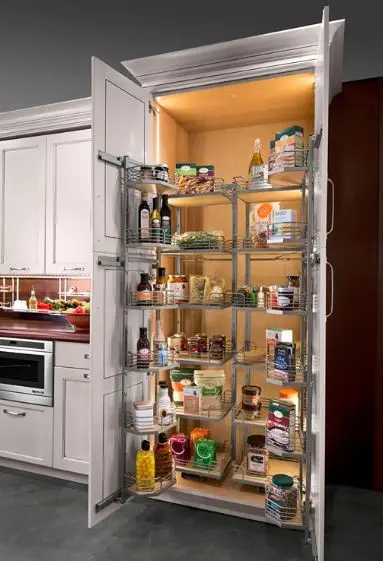
If you’re buying new cabinets or replacing old ones, the single best move for a pantry-less kitchen is adding a tall pantry cabinet. These are typically 84 to 96 inches high, 18 to 24 inches deep, and 12 to 36 inches wide. They fit into the same footprint as a standard cabinet column but give you floor-to-ceiling storage.
Both Fabuwood and Mantra offer tall utility cabinets in their standard lines. The Fabuwood Galaxy and Nexus collections include 18-inch and 24-inch wide tall cabinets with adjustable shelving, soft-close doors, and plywood box construction. Mantra’s lineup covers similar dimensions at a lower price point, which makes them a strong option for rental properties or budget renovations.
Where to place a tall pantry cabinet:
- End of a cabinet run. If your L-shaped or galley kitchen has a terminating wall, a 24-inch wide tall cabinet fits without eating into counter space.
- Beside the refrigerator. This creates a “storage wall” effect, grouping your cold and dry food storage in one zone.
- In an adjacent hallway or mudroom. If your kitchen footprint is truly maxed out, a tall cabinet placed just outside the kitchen still keeps food within a few steps.
One tall cabinet with five or six adjustable shelves holds roughly the same volume as a small walk-in closet. It’s the highest-impact single addition you can make.
Pull-Out Shelves and Drawers: Fix the "Deep Cabinet" Problem
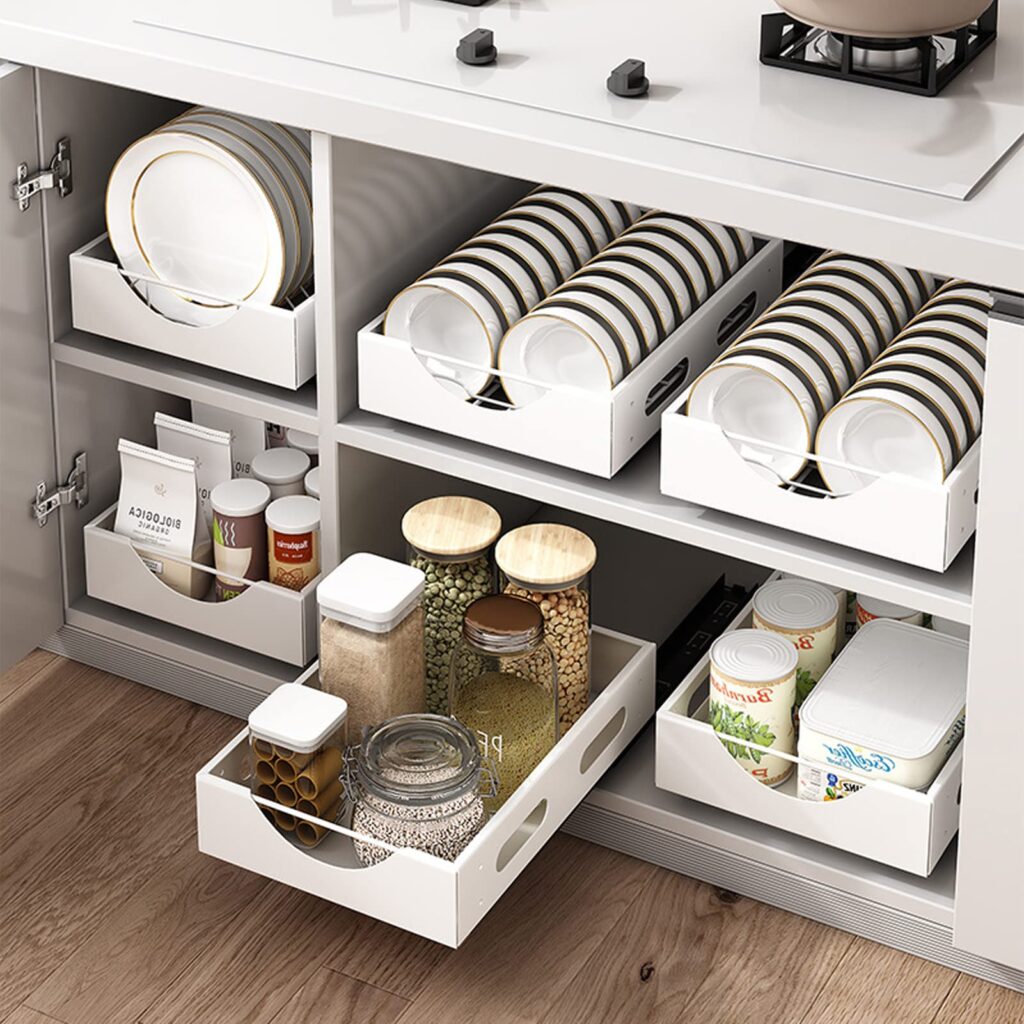
If you already have base cabinets and don’t plan to replace them, pull-out shelves are the fastest upgrade. A standard 24-inch deep base cabinet with fixed shelves wastes about 30 to 40% of its usable space because items in the back become invisible.
A pull-out shelf changes that completely. You slide the tray forward, see everything at once, and grab what you need. No bending over, no reaching past rows of cans.
USA Cabinet Express carries a range of cabinet accessories including pull-out trays, soft-close drawer glides, and full-extension drawer systems. If you’re ordering new RTA cabinets, you can spec pull-out inserts at the time of purchase rather than retrofitting later.
What to store on pull-outs in base cabinets:
- Bottom shelf: Heavy items like canned goods, bottled sauces, oils, and vinegars.
- Upper pull-out tray: Lighter items like pasta, rice, cereal, and baking supplies.
- Door-mounted rack (if available): Foil, plastic wrap, and sandwich bags.
A two-tray pull-out system in a single 30-inch base cabinet can hold 40 to 60 canned goods plus a row of taller bottles. That’s more than many homeowners keep in a dedicated pantry shelf.
Lazy Susans and Corner Cabinet Solutions
Corner cabinets are the biggest wasted space in most kitchens. The standard blind corner cabinet gives you a deep, dark box where food goes to die. A 36-inch corner base has roughly 12 square feet of shelf area, but without a rotating or pull-out mechanism, you can only reach about 4 of those square feet.
Two solutions work well here:
Lazy Susan (rotating shelves): A two-tier Lazy Susan installs inside a corner base cabinet and lets you spin the entire shelf to bring items forward. These are best for canned goods, condiments, and boxed items. They cost between $40 and $150 depending on material and diameter.
Half-moon pull-out shelves: These mount to the cabinet door and swing outward when you open it, pulling the shelf contents into full view. They’re more expensive ($100 to $300) but recover nearly all the dead space in a blind corner.
If you’re ordering cabinets for a new kitchen, ask about corner cabinet options during your free consultation. The cabinet layout stage is the best time to solve the corner problem, not after installation.
Vertical Storage: Use the Space Between Countertop and Ceiling
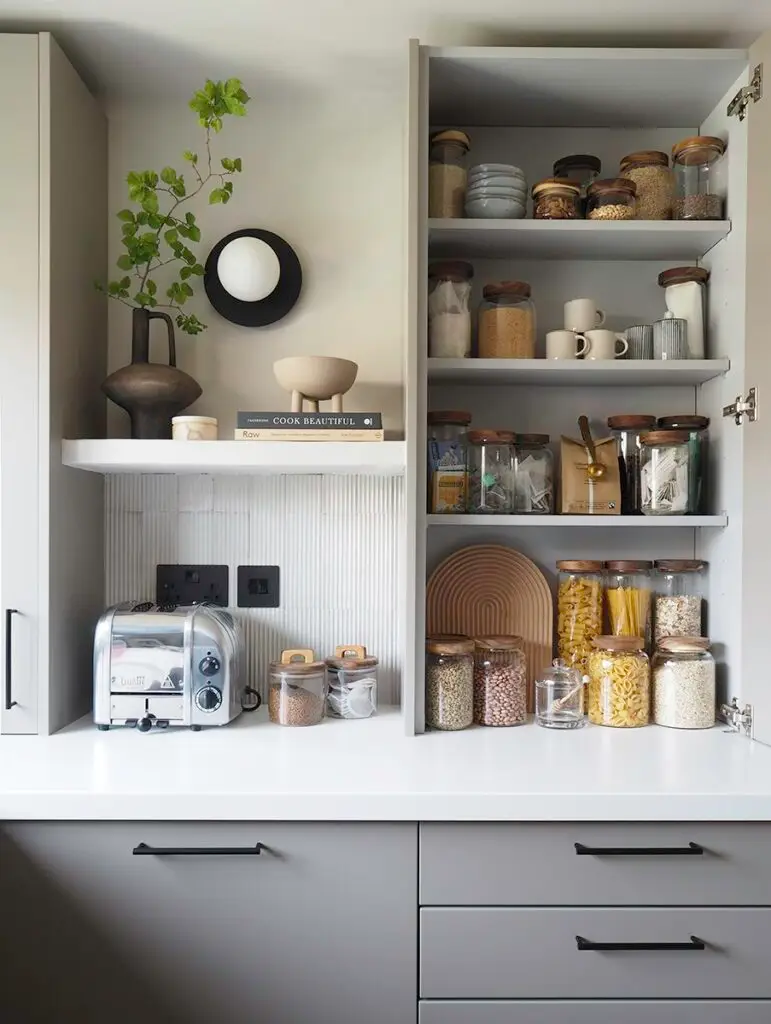
Most kitchens have 18 inches between the countertop and the bottom of wall cabinets, plus another 12 to 18 inches of unused space above the wall cabinets. Both zones can store food if you think vertically.
Below the wall cabinets: Mount a slim shelf or rail system on the backsplash wall. This is the right spot for spice jars, cooking oils you use daily, and a small container of coffee or tea. It keeps these high-frequency items at arm’s reach without taking up cabinet or counter space.
Above existing wall cabinets: If your wall cabinets stop 12 inches below the ceiling, that gap is wasted. You can either install taller cabinets during a remodel (42-inch wall cabinets reach the ceiling in a standard 8-foot kitchen) or use the top of existing cabinets for attractive baskets holding items you access less frequently: holiday baking supplies, bulk paper towels, or extra bags of flour.
Full-height wall cabinets: If you’re planning a remodel, going with 42-inch wall cabinets instead of the standard 30-inch or 36-inch models adds 25 to 40% more wall storage. Both Fabuwood and Mantra offer 42-inch wall cabinet options in most door styles. The top shelf won’t be easy to reach every day, but it’s the right place for backup supplies and bulk purchases.
Drawer Inserts and Dividers: Organize What You Already Have
Sometimes the cabinet space is fine. It’s the organization inside that’s the problem.
Drawer dividers, adjustable shelf risers, and tiered inserts can double the usable capacity of existing cabinets without adding a single new box. Here’s what works for food storage specifically:
Spice drawer inserts: A shallow drawer (4 to 6 inches deep) fitted with an angled insert lets you store 30 to 40 spice jars label-up. This beats the spinning spice rack on the counter and eliminates the jumbled spice shelf inside a cabinet. If you cook regularly, a dedicated spice drawer is one of the highest-value organization upgrades.
Shelf risers for canned goods: A $10 wire riser placed on a cabinet shelf creates two levels. Smaller cans go on top; taller cans and bottles go underneath. This simple addition nearly doubles the usable space on a single shelf.
Lid organizers and tray dividers: Cutting boards, baking sheets, and container lids stack better when held vertically by dividers instead of piled flat. These free up the horizontal shelf space for actual food.
Clear containers with labels: Transferring dry goods (flour, sugar, rice, oats, pasta) from bags into uniform clear containers does three things at once: makes contents visible, controls portion sizes for reordering, and eliminates the visual chaos of mismatched packaging. Square or rectangular containers use shelf space more efficiently than round ones.
Glass-Front Cabinet Doors: See Everything at a Glance
If you have a section of wall cabinets dedicated to dry goods storage, swapping the solid doors for glass-front doors makes the contents visible without opening anything. This sounds minor, but it changes behavior.
Here’s a quick guide to help you get started:
When you can see your pantry inventory at a glance, you stop buying things you already have. You notice when you’re running low on staples. And you’re more likely to keep the shelves tidy because the mess is visible.
Fabuwood offers glass door inserts across several collections, including the Allure and Nexus lines. If you’re working with existing cabinets, a local cabinet shop can often retrofit glass panels into your current door frames for $50 to $100 per door.
One practical tip: dedicate glass-front cabinets to your most-used dry goods (cereals, snacks, pasta, baking staples) and keep the less photogenic items (bulk paper goods, cleaning supplies) behind solid doors. This gives you visibility where it matters and a clean overall look.
Kitchen Carts and Freestanding Pantry Units
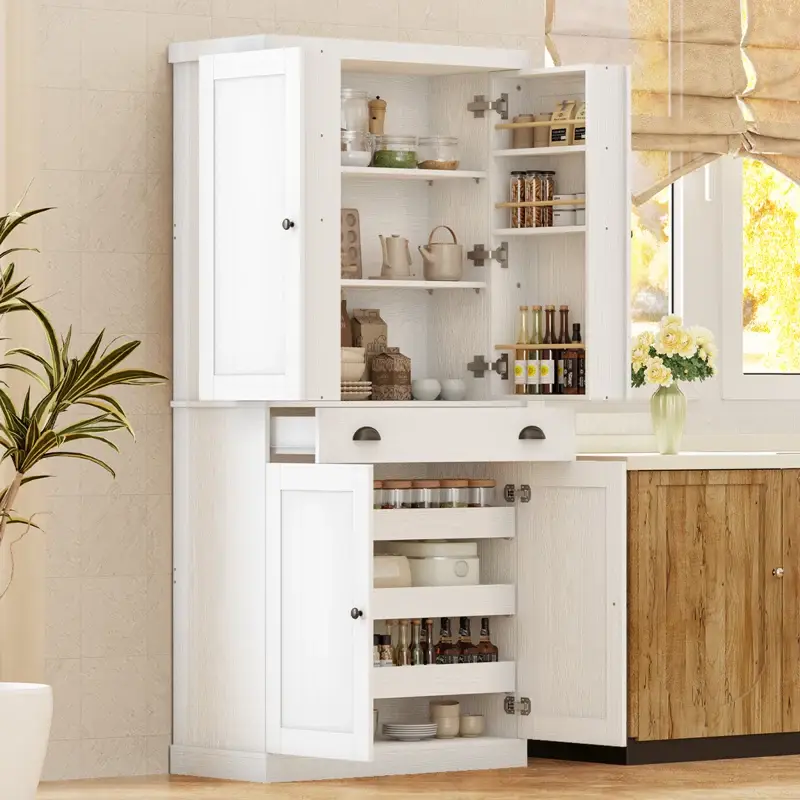
For renters or homeowners who can’t modify their cabinets, freestanding furniture fills the gap.
A rolling kitchen cart with two or three shelves and a solid top surface does double duty as food storage and prep space. Park it against a wall or at the end of a counter when not in use, then roll it into the workspace when you’re cooking. Carts with enclosed sides or cabinet doors hide the contents and keep the kitchen looking clean.
A freestanding pantry cupboard (sometimes called a “hutch” or “armoire”) can hold as much as a small closet pantry. These range from 24 to 36 inches wide and 60 to 72 inches tall. Place one in a dining area, hallway, or any available wall space adjacent to the kitchen.
The main advantage of freestanding units: they require zero installation, zero modification, and they move with you.
A Zone-Based Approach to Cabinet Pantry Storage
Regardless of which specific solutions you use, the organizational principle that makes everything work is zoning. Group your stored food by usage pattern, not by type.
Zone 1: Daily essentials (eye-level shelves and upper pull-outs). Coffee, tea, cereal, bread, snack bars, cooking oils, salt, pepper, and the five to ten spices you use most. These should be within arm’s reach from your primary prep area.
Zone 2: Cooking staples (lower pull-outs and mid-level shelves). Pasta, rice, flour, sugar, canned tomatoes, broth, beans, and baking supplies. These get used several times a week but don’t need to be as instantly accessible as Zone 1.
Zone 3: Backup and bulk (top shelves, above-cabinet storage, tall pantry upper shelves). Extra packages, bulk warehouse purchases, holiday ingredients, and items you restock monthly. These are fine to reach for with a step stool once a week.
Zone 4: Specialty and seldom-used (corner cabinets, hard-to-reach spots). That specialty vinegar, the truffle oil, the matcha powder you bought for one recipe. These items are real but infrequent. Corner cabinet Lazy Susans are the right home for them.
This system works whether you have four cabinets or fourteen. The key is matching access frequency to access difficulty.
What to Do Next?
If you’re working with an existing kitchen, start with pull-out trays and drawer inserts. These two upgrades alone can recover 30 to 40% of your wasted cabinet space, and they install in under an hour each.
If you’re planning a remodel or buying new cabinets, talk to our design team about incorporating a tall pantry cabinet, 42-inch wall cabinets, and corner cabinet pull-out systems into your layout from the start. It’s always easier (and cheaper) to solve the pantry problem at the design stage.
Visit any of our showrooms in Austin, Houston, St. Louis, Chesapeake, Fairfax, or Fredericksburg to see pull-out systems, tall cabinets, and accessory options in person. Or request a free quote to get started online.
FAQs for Kitchen Cabinet Pantry Storage
How much does it cost to add pantry storage to existing cabinets?
Pull-out shelf inserts run $30 to $80 each. A full Lazy Susan system costs $40 to $150. Drawer dividers and shelf risers are under $20. If you’re replacing cabinets, a tall pantry cabinet from Fabuwood or Mantra starts around $300 to $600 depending on size and finish.
Can RTA cabinets work as pantry cabinets?
Yes. Our in-stock RTA cabinets in Shaker White, Shaker Blue, and Shaker Gray include tall utility cabinet options with adjustable shelves. They’re plywood construction with soft-close hinges, and you can pick them up same-day from any USA Cabinet Express location.
What’s the best cabinet width for pantry storage?
For a tall pantry cabinet, 18 to 24 inches wide is the most practical range. An 18-inch wide unit fits in tight spaces while still holding a useful amount of food. A 24-inch unit offers more capacity and better shelf access.
Should I use open shelving instead of cabinets for pantry storage?
Open shelving looks great in photos, but it collects dust and requires constant tidying to look presentable. For food storage specifically, enclosed cabinets with pull-out shelves give you better visibility than fixed-shelf cabinets and better protection than open shelves. It’s the best of both approaches.
How do I keep cabinet pantry storage from getting messy?
Three things make the biggest difference: clear containers for dry goods (so you see what you have), a zone-based layout (so everything has a designated spot), and pull-out trays or drawer inserts (so you can actually reach everything without shoving items aside). Once the system is set up, maintaining it takes about five minutes a week.
What’s the difference between a tall pantry cabinet and a utility cabinet?
They’re functionally the same. “Pantry cabinet” usually refers to a tall cabinet with multiple fixed or adjustable shelves designed for food storage. “Utility cabinet” is the broader term that also covers broom closets and cleaning supply storage. Both use the same cabinet box, just with different interior configurations.
Conclusion
Turning clutter into order is easier than you think. With the right strategies, you can transform any space into a functional and stylish area. Whether it’s a small kitchen or a larger room, smart storage solutions make all the difference.
From pull-out systems to repurposed baskets, these ideas ensure every corner of your home works for you. Utilizing vertical space with shelves or wall organizers can double your storage capacity. Grouping similar items like food or spices keeps everything within reach.
We’re committed to helping you create a stress-free, beautifully organized environment. By adopting these techniques, you’ll enjoy a seamless and efficient daily routine. Let’s make your home a place of both functionality and elegance.