
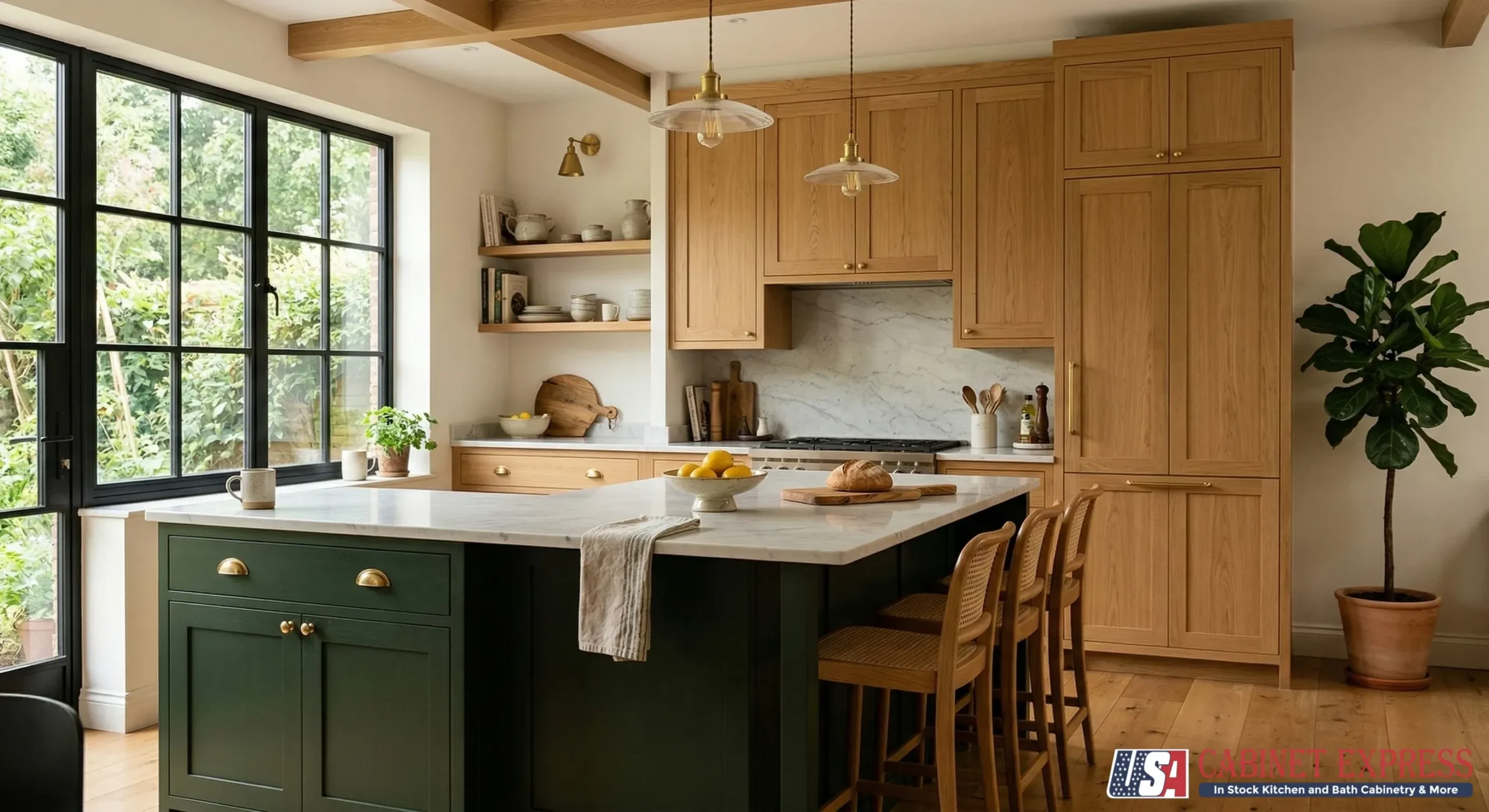

Over 61% of homeowners now rank energy efficiency and sustainable features among their top three priorities when renovating, according to the National Association of Home Builders (NAHB). That priority is showing up loudest in the kitchen. The shift isn’t subtle — it’s rewriting how cabinets get designed, built, and sold.
Sustainability in cabinetry means three things: where the materials came from, what chemicals were used during manufacturing, and how long the cabinets will actually last before hitting a landfill. Over 9.8 million tons of old cabinets end up in landfills every year in the U.S. alone. That number should bother anyone planning a kitchen remodel.
This guide covers the door styles, materials, finishes, and certifications that separate real sustainable cabinets from greenwashed marketing. You’ll also get a checklist to bring to your next design consultation.
How to Choose Sustainable Kitchen Cabinet Door Styles
Materials, door styles, certifications, and the checklist that separates real sustainability from greenwashing — for 2026.
a top 3 reno priority (NAHB)
landfilled yearly in the U.S.
market by 2030
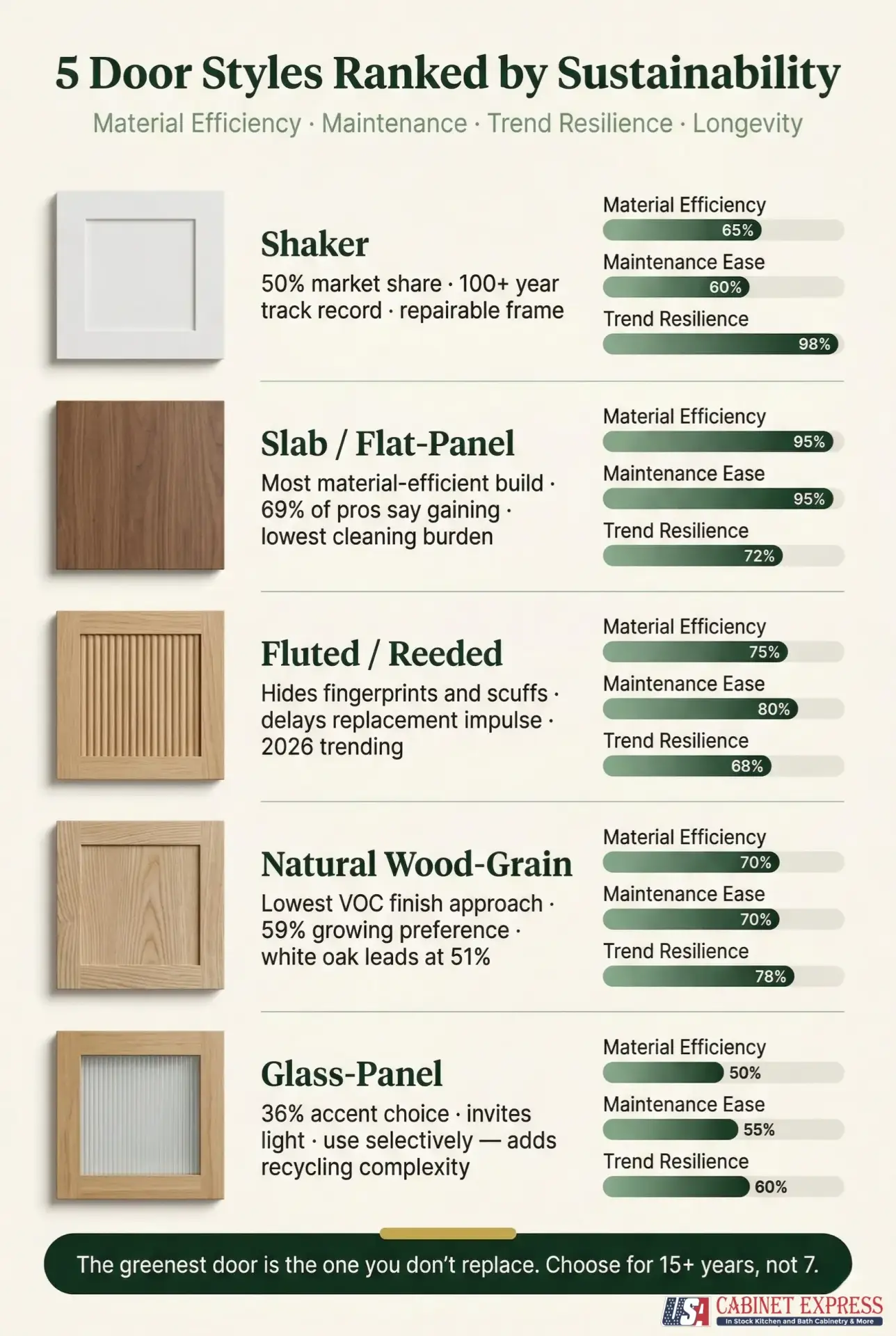
Five Door Profiles, Ranked by Sustainability
Door geometry drives material use, maintenance burden, and longevity.
Shaker
Five-piece frame with floating center panel. Over a century of trend staying power — the greenest door is the one you keep.
Trend-proofRepairable~50% market share
Slab / Flat-Panel
Single flat piece — no frame, no panel, no waste. Most material-efficient build. Flat surface extends finish life.
Least waste69% pros say “gaining”
Fluted / Reeded
Vertical grooves add depth without heavy materials. Textured surfaces hide fingerprints and scuffs — delays replacement impulse.
Hides wear2026 trending
Natural Wood-Grain
Clear oil or water-based topcoat over honest grain. Lowest VOC finish approach. NKBA: 59% growing, white oak leads at 51%.
Lowest VOC59% growing
Glass-Panel
Accent pieces that invite light. 36% of homeowners pick glass-front as primary accent. Use selectively — adds recycling complexity.
36% accent choiceUse selectively
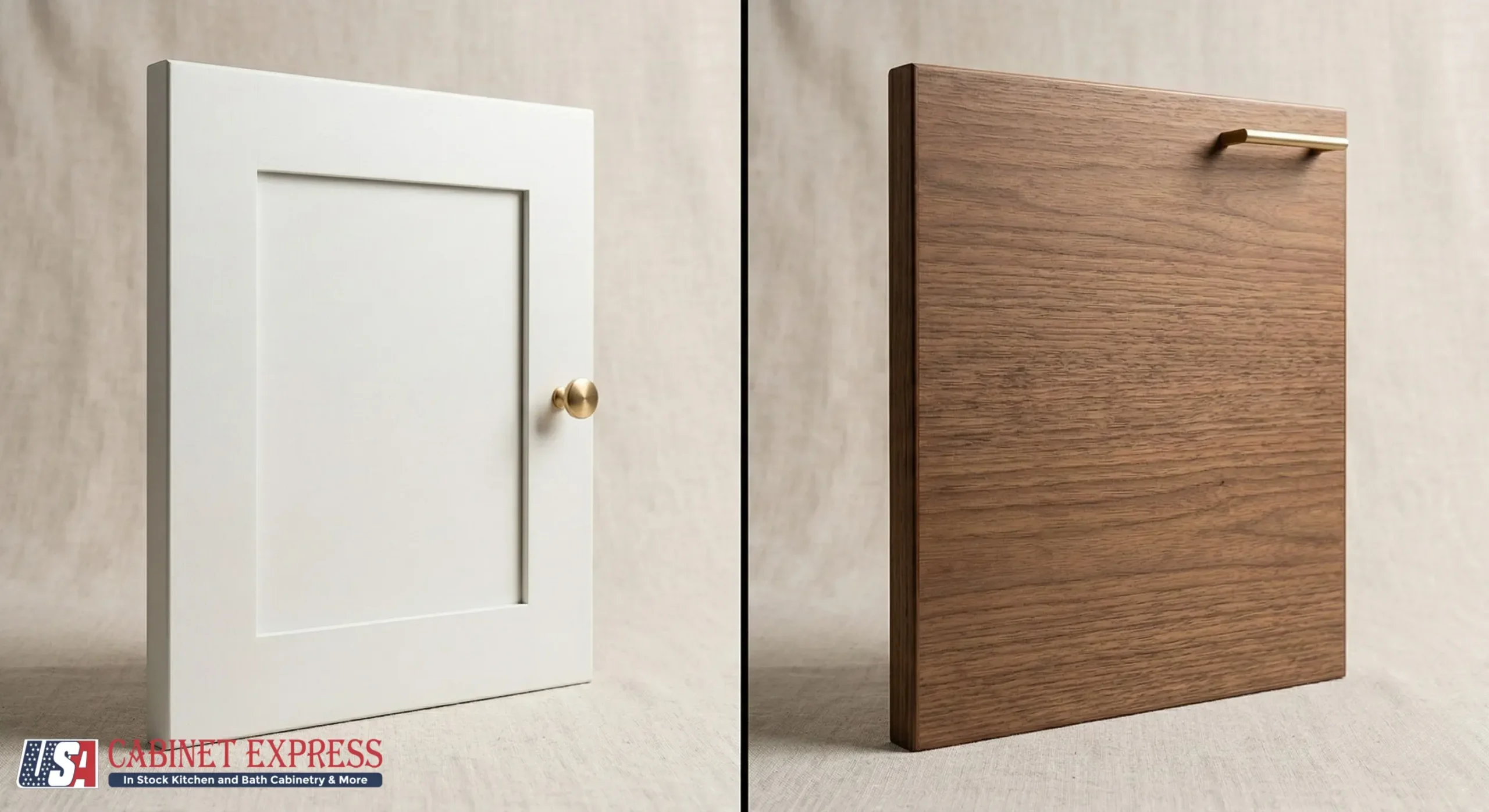
Shaker vs. Slab Sustainability Showdown
Shaker takes trend resilience and repairability. Slab takes material efficiency and low maintenance.
Sustainable Substrates at a Glance
What the cabinet is made of matters more than how it looks.
The VOC Gap Is Enormous
Low-VOC finishes: under 50 g/L. Traditional lacquers: 380–450 g/L.
Water-Based & UV-Cured
90% fewer solvents. UV hardens instantly. Scratch & moisture resistant.
Natural Oils & Hard-Waxes
Zero VOC. Penetrates wood fiber. Easy spot repair.
Zero-VOC Acrylics
Great coverage. No off-gassing. Mineral & clay for matte.
The Labels That Actually Mean Something
No third-party stamp? No proof. Eight certifications to check.
The Greenest Upgrade by the Numbers
If the boxes are sound, refacing — not replacing — is the highest-impact move.
10 Points to Check Before You Buy
Bring this to your next showroom visit.
See It In Person at USA Cabinet Express
Three brands. Seven locations. In stock for same-day pickup.
All-plywood boxes. Solid birch & maple. Dovetail joints. Blum soft-close. Galaxy (Shaker), Illume (Slab), and more.
All-plywood. Solid wood frames. Soft-close. Alcott & Omni Shaker. 1–3 week lead times.
Shaker White, Gray, Blue. Plywood. Full-extension glides. Flat-packed. Same-day pickup.
7 Locations: Austin TX · Dallas TX · Houston TX · Chesapeake VA · Fairfax VA · Fredericksburg VA · St. Louis MO
Browse Cabinets · Kitchen Visualizer · Get a Free Quote
© 2026 USA Cabinet Express · usacabinetexpress.com
Your 10-Point Sustainability Checklist For Sustainable Kitchen Cabinet Door Styles
Use this during your next design consultation or showroom visit:
- Can you keep your existing cabinet boxes? If they’re structurally sound, refacing with new doors and veneers is the greenest path forward.
- Check the core material. Demand CARB Phase 2 or NAUF compliance for any MDF or particleboard. Plywood cores have lower embodied carbon when budget allows.
- Verify the wood source. Ask for FSC or PEFC chain-of-custody documentation. No certificate? No purchase.
- Examine the finish chemistry. Water-based, UV-cured, or natural oil finishes only. Ask for the VOC content in grams per liter — under 50 g/L is the target.
- Choose a timeless door style. Shaker and slab doors resist trend fatigue. A door style you’ll keep for 15–20 years is inherently more sustainable than one you’ll replace in seven.
- Inspect the edge banding. On slab and MDF-core doors, solvent-free polyurethane reactive (PUR) edge banding is the standard for moisture protection.
- Ask about certifications. GREENGUARD Gold, KCMA ESP, Blue Angel, or Cradle to Cradle add verified credibility beyond marketing claims.
- Factor in logistics. Locally manufactured cabinets or flat-packed RTA cabinets have lower transportation carbon footprints than fully assembled imports shipped across continents.
- Plan for maintenance, not replacement. Choose finishes you can touch up or recoat. Choose hardware you can replace. Choose standard sizes that future tradespeople can match.
- Beware of greenwashing. Vague terms like “eco-friendly,” “all-natural,” or “green” without a named, third-party certification behind them are marketing — not proof.
The 2026 Design Landscape: What Changed and Why It Matters
The all-white, high-gloss kitchen is done. Designers and homeowners have moved on — all-white cabinet specifications dropped roughly 40% between 2023 and 2026. Cool grays followed close behind.
What replaced them? Nature-inspired warmth. Designers call it biophilic design — bringing the natural world indoors through real textures, earth tones, and honest materials. White oak alone is on track to capture 40% of the cabinet market by late 2026.
The palette for 2026 leans into warm neutrals (mushroom, taupe, greige), muted greens (sage, olive), and rich accent tones (navy, charcoal, deep forest green). MasterBrand named “Lush Forest” — a near-black green — their 2026 Finish of the Year. Two-tone layouts, with lighter uppers and darker base cabinets, add depth without relying on artificial contrast.
Matte finishes dominate. About 70% of painted cabinet orders now specify matte or satin over gloss. Matte hides fingerprints and small scratches better, so you go longer between touch-ups. Longer finish life means less waste.
These shifts line up with green goals: real materials over fake ones, lasting quality over fast fashion, and classic looks over flash-in-the-pan trends.
Door Styles Ranked by Sustainability
Door style affects sustainability more than most people think. How a door is built — how many pieces, how easy to clean and refinish — shapes how much material it uses and how long it lasts.
Shaker Doors: The Workhorse
Shaker remains the single most popular cabinet door style in America, commanding roughly 50% of all cabinet sales. Houzz data puts it at 61% of renovation projects. There’s a reason for that kind of dominance: the Shaker profile works in traditional, transitional, and modern kitchens without looking dated in any of them.
Shaker’s green edge comes from trend staying power. A door style you won’t want to tear out in seven years is greener than one you will. This profile has held up for over a hundred years. It’s not going anywhere.
A true Shaker door has five pieces — two stiles, two rails, and a floating center panel. That floating panel isn’t just a look. It gives wood room to swell and shrink with humidity without warping the frame. In humid climates like Florida or the Gulf Coast, this detail keeps doors straight for decades.
The trade-offs? Shaker doors need more raw material and more precise milling than flat panels. The corners where the frame meets the center panel trap dust and cooking grease. Skip the cleaning, and the finish breaks down faster at those joints.
The 2026 twist: the Slim Shaker. These doors use 2-inch rails and stiles instead of the usual 2.5-inch. The look is lighter and more modern. It also uses a bit less wood per door — a small gain that adds up across a full kitchen.
What this looks like in practice: [Fabuwood’s Allure Galaxy line](https://usacabinetexpress.com/cabinet-brands/fabuwood/) — available at USA Cabinet Express — is one of the best-selling Shaker cabinets in the country. It checks the boxes: all-plywood boxes, solid birch and maple doors, dovetail joints, and CARB2-compliant materials. Galaxy comes in painted finishes like Frost (white) and Dove, plus stained tones like Cobalt and Horizon. On a tighter budget? [Mantra’s Alcott and Omni doors](https://usacabinetexpress.com/cabinet-brands/mantra/) use all-plywood builds with solid wood frames and soft-close hardware. Lead times run 1–3 weeks.
Slab (Flat-Panel) Doors: Maximum Efficiency
Slab doors are one flat piece of material. No frame, no panel, no profile. They use less material than any other door type. Less cutting, less joining, less scrap, less energy in the factory.
The NKBA says 69% of design pros see slab doors gaining ground in 2026. The clean, European-influenced look fits right into modern kitchens.
Cleaning a slab door takes seconds. No grooves, no corners trapping grease. The flat surface keeps the finish in good shape longer because there’s nowhere for moisture to pool and eat through the coating.
Most modern slab doors are built on engineered cores — high-density MDF or stable plywood — then wrapped in wood veneer, eco-laminate, or low-VOC paint. One log can yield thousands of square feet of micro-thin veneer. That stretches the value of every harvested tree far beyond what solid-wood building allows.
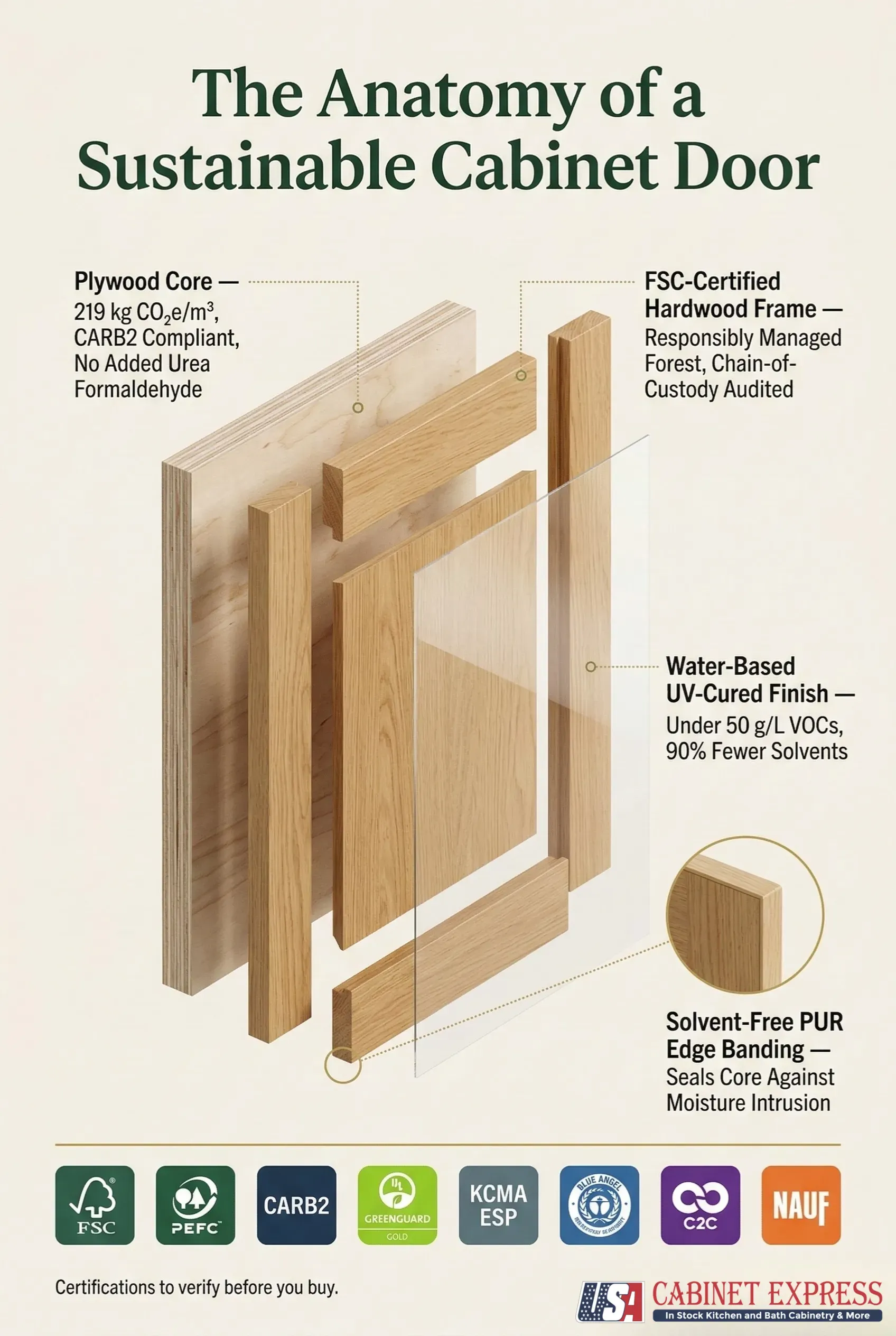
The weak spot? Edges. Good edge banding — solvent-free polyurethane reactive (PUR) adhesive is the current standard — seals the core against water. A slab door with loose edges and an MDF core will swell and fail fast once moisture gets in.
If slab is your style: Fabuwood’s Illume series — the Catalina and Tuscany lines — gives you frameless, full-overlay slab doors with tight edge-banding and lacquered MDF surfaces. No face frame means 10–15% more usable space inside each box. Illume meets CARB2 and TSCA Title VI standards and carries Fabuwood’s Q12 quality mark and KCMA rating.
Fluted and Reeded Doors: Texture With Purpose
Fluted and reeded panels — doors with vertical grooves cut into the face — are a big 2026 trend. They add depth and visual weight without heavy materials or fussy multi-piece builds.
The green angle here is often missed. Textured surfaces hide fingerprints and small scuffs far better than smooth, glossy finishes. Owners see their doors as “newer” for longer, which pushes back the urge to refinish or replace. Built in FSC-certified veneer or sustainably sourced hardwood, fluted panels look great and hold up their eco claims.
Natural Wood-Grain Doors
Showing off the natural grain — through wire-brushing, sand-blasting, or a clear finish over a well-figured board — is one of the strongest 2026 moves. The NKBA says wood grain is passing painted cabinets in popularity. Among surveyed pros, 59% call it a growing trend. White oak leads at 51%, with walnut and ash close behind.
This “less is more” approach reduces reliance on heavy paints and chemical coatings. A clear natural oil or water-based topcoat over quality hardwood is among the lowest-VOC finishing options available. The material speaks for itself.
The sustainability requirement here is sourcing. Beautiful wood grain means nothing if the timber came from illegally logged old-growth forest. FSC or PEFC chain-of-custody certification is non-negotiable for this style.
Glass-Panel and Mixed-Insert Doors
Glass-front cabinet doors serve as accent pieces — Houzz data shows 36% of homeowners choose glass-front doors as their primary accent cabinet style. Reeded glass, seeded glass, and recycled glass inserts are all gaining traction in 2026.
From a sustainability perspective, glass-front doors invite light into the kitchen, which can reduce the need for additional task lighting. Recycled glass and recycled metal mesh inserts support a circular material lifecycle.
The downside: glass adds material complexity. A glass-panel door has more components (glass, frame, seals), which complicates end-of-life recycling. Use them selectively — a few accent doors, not the entire kitchen.
Shaker vs. Slab: The Sustainability Comparison
Because Shaker and Slab are the two dominant choices, a direct comparison helps frame the decision:
| Feature | Shaker (5-Piece) | Slab (Flat Panel) |
|---|---|---|
| Material efficiency | Lower — more milling, joinery, and offcut waste | Higher — large-format sheet goods, minimal waste |
| Climate resilience | Excellent — floating center panel accommodates wood expansion | Excellent — engineered cores prevent structural warping |
| Maintenance burden | Higher — recessed corners collect dust and aerosolized grease | Very low — flat surface wipes clean in seconds |
| Repairability | High — individual frame pieces can sometimes be repaired | Moderate — surface damage may require full door replacement |
| Trend resilience | Extremely high — 100+ years of staying power | Growing — strong for contemporary and minimalist spaces |
| Aesthetic range | Very wide — suits traditional, transitional, farmhouse, modern | Narrower — best for contemporary, minimalist, industrial |
Which is “greener”? Neither wins outright. Shaker wins on trend resilience and repairability. Slab wins on material efficiency and low maintenance. The most sustainable choice depends on your kitchen’s climate, your design preferences, and — critically — what core material and finish you pair with the door style.
Sustainable Materials: What to Specify
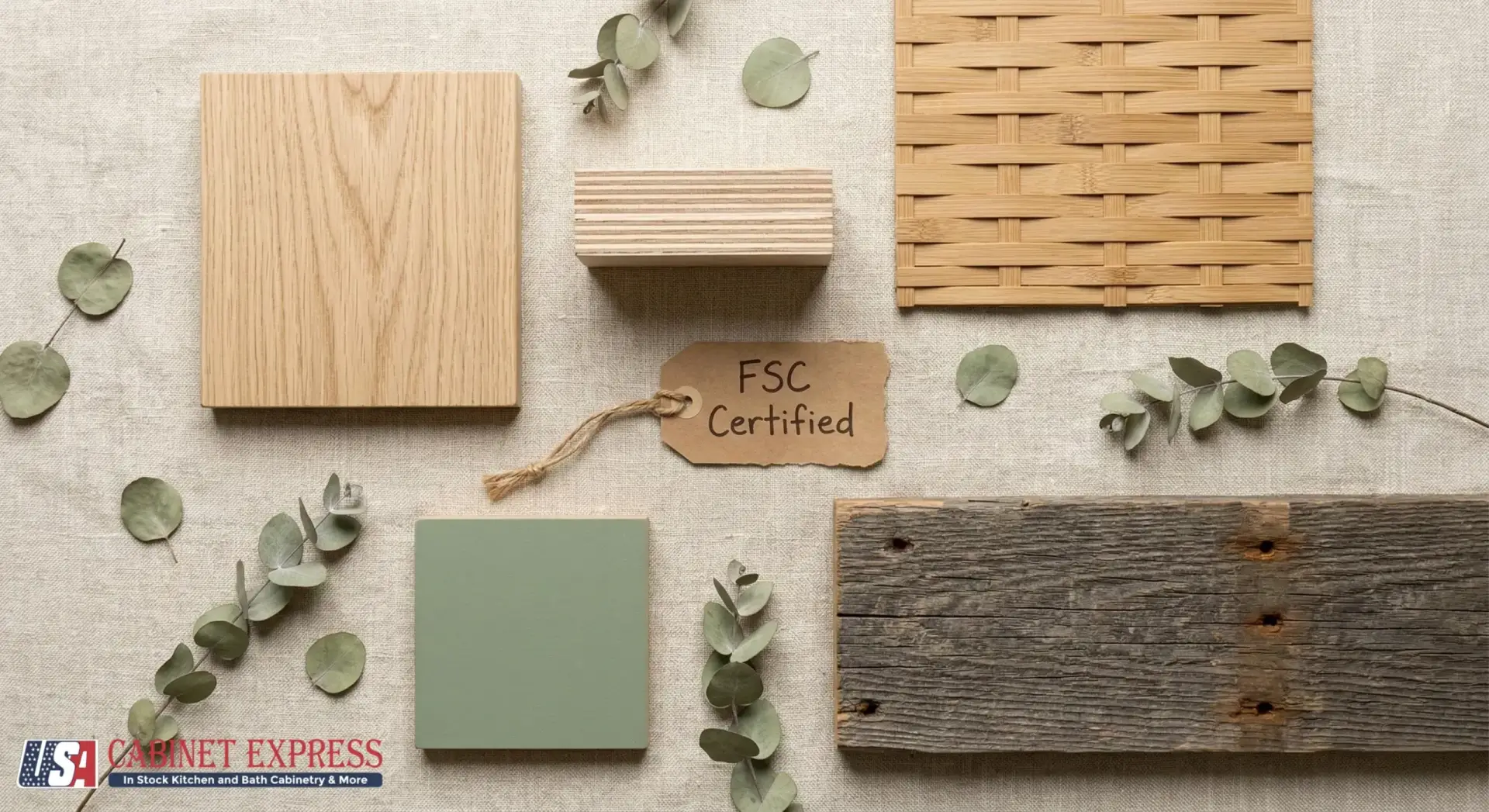
FSC-Certified Hardwoods
The Forest Stewardship Council (FSC) stamp means the timber came from forests managed to protect wildlife, water, and local communities. PEFC (Programme for the Endorsement of Forest Certification) sets a similar bar.
Solid hardwoods like maple, oak, and cherry can be sanded down and refinished many times across a lifespan of 50+ years. You maintain the same material instead of tossing and replacing it. That alone is a huge win.
The trade-off: FSC adds a 20–40% price bump over non-certified wood. Solid wood is also heavy, costly to ship, and moves with humidity.
Bamboo
Bamboo is ready to harvest in three to five years. Hardwoods take 20 to 60. It’s a grass, not a tree, and it’s tough — its Janka hardness rating (1,400–1,600) beats red oak (1,290).
But the green story has fine print. About 99% of bamboo sold in the West is grown on Asian plantations and shipped overseas. Those plantations can crowd out native plants and drain local water. The shipping miles eat into the fast-growth advantage.
The real red flag is glue. Bamboo gets sliced into strips and pressed together. If the maker uses urea-formaldehyde binders, the eco story falls apart. Always check that bamboo cabinets use formaldehyde-free adhesives.
Reclaimed Wood
Reclaimed timber skips the carbon cost of logging, hauling, and milling new wood entirely. It looks like nothing else — every plank carries its own history.
The catch: supply is limited and hard to predict. Pulling nails, kiln-drying, and re-milling old wood to modern specs takes time and skilled labor. That pushes the price up. For most kitchens, the smart play is using reclaimed wood as an accent — an island face, open shelves, a pantry feature wall — rather than full runs of cabinets.
Eco-Engineered Boards (MDF, Plywood, Particleboard)
High-grade MDF has come a long way from its “cheap furniture” days. The good stuff is made from wood scraps, sawmill offcuts, and recycled fiber. It puts the whole tree to use and keeps waste out of landfills.
MDF is isotropic — it swells and shrinks evenly in all directions, unlike solid wood. That makes it resist warping and cracking, which is why it works so well as a base for painted Shaker and Slab doors. Its smooth surface takes low-VOC water-based paint cleanly.
Plywood has a smaller carbon footprint. In published EPDs, softwood plywood comes in around 219 kg CO₂e/m³ versus 469 kg CO₂e/m³ for MDF at the factory-gate stage. Where budget allows, plywood cores are the greener pick.
For either material, insist on CARB Phase 2 compliance or NAUF (No Added Urea Formaldehyde) to keep off-gassing low.
Emerging Bio-Based Materials
The newest frontier: boards made from crop waste. Wheatboard and sorghum board turn leftover stalks into sturdy panels. Mycelium (the root network of fungi) and hemp board are even more experimental — but both grow fast, absorb carbon, and skip the need for timber entirely. Hemp grabs more carbon per acre during growth than tree farms do. These options are still niche, but they point where the industry is headed.
| Material | Key Sustainability Advantage | Key Limitation | Best Application |
|---|---|---|---|
| FSC-Certified Hardwood | Carbon sequestration, 50+ year lifespan, refinishable | 20–40% price premium; humidity-sensitive | Long-term investment kitchens; traditional designs |
| Bamboo | Matures in 3–5 years; extreme surface hardness | Shipping carbon; monoculture risks; verify adhesives | Modern, high-traffic kitchens |
| Reclaimed Wood | Zero virgin timber; unique aesthetic | Inconsistent supply; labor-intensive processing | Accent pieces; rustic or industrial features |
| Plywood (eco-engineered) | Lower embodied carbon than MDF; dimensionally stable | Higher cost than MDF/particleboard | Slab door cores; moisture-prone areas |
| Recycled MDF | Diverts wood waste from landfills; warp-resistant; smooth | Heavy; edge swelling risk if unsealed | Painted Shaker and Slab doors |
| Bio-Board (Wheat/Hemp) | Upcycles agricultural waste; zero deforestation | Limited commercial availability | Eco-forward projects; interior carcass |
Finishes That Protect Both the Cabinet and Your Health
The finish on your cabinet doors matters as much as what’s underneath. Old-school paints and lacquers were packed with VOCs — chemicals like formaldehyde, benzene, and toluene that seep into your air at room temperature. In a tight, well-sealed modern home, those fumes have nowhere to go.
Low-VOC finishes put out under 50 grams per liter. Old solvent-based lacquers? Up to 380–450 grams per liter. That gap is enormous.
Water-based and UV-cured finishes have largely replaced solvent-based systems in sustainable cabinetry. Water-based coatings emit up to 90% fewer harmful solvents during application and curing. UV curing hardens the finish instantly using ultraviolet light instead of slow chemical evaporation, trapping any remaining micro-emissions and creating a scratch-resistant, moisture-resistant surface.
Natural oils and hard-waxes — linseed oil, tung oil, and hard-wax blends — penetrate into the wood fiber to protect from within. They’re zero-VOC, they maintain the tactile feel of real wood, and they’re easy to reapply for spot maintenance without full refinishing.
Zero-VOC acrylic paints provide excellent coverage and adhesion for painted cabinetry without toxic off-gassing. Mineral-based and clay paints are gaining traction in luxury eco-remodels, offering deep, matte textures from entirely natural, earth-derived compositions.
A durable finish is itself a sustainability strategy. A high-performance coating that keeps cabinets looking fresh for 15–20 years delays the massive environmental cost of premature replacement.
Cabinet Refacing: The Greenest Kitchen Upgrade
Full cabinet replacement isn’t always necessary — and it’s rarely the most sustainable option.
If the cabinet boxes are still solid, refacing saves them. You swap out doors, drawer fronts, hinges, and handles. A matching veneer or laminate covers the visible frame.
The numbers tell the story. Refacing a standard kitchen saves 8 to 12 mature trees and cuts about 2.3 tons of CO₂ that would come from building, milling, and shipping new boxes. Good laminates today are thermally bonded under vacuum — they hold up against scratches and moisture for 15 to 20 years.
Financially, refacing costs 30–50% less than full replacement. That’s $4,000–$9,000 for refacing versus $12,000–$25,000+ for new FSC-certified cabinets on a standard kitchen.
Before planning any kitchen remodel, ask one question first: are the existing boxes structurally sound? If yes, refacing is the single most impactful sustainability decision you can make.
RTA Cabinets: The Overlooked Sustainability Play
Ready-to-Assemble (RTA) cabinets offer a sustainability advantage that gets almost no attention: shipping efficiency.
Flat-packed RTA cabinets take up dramatically less shipping volume than pre-assembled units. More product fits on each truck, which means fewer trucks on the road, less fuel burned, and lower transportation carbon emissions per cabinet. Computer-aided manufacturing in the factory maximizes material yield from every sheet of plywood or MDF, minimizing scrap waste.
High-quality RTA lines now match custom-built units in material quality and durability. The idea that flat-pack means disposable stopped being true years ago.
USA Cabinet Express carries its own RTA line in three Shaker finishes — White, Gray, and Blue. All three use plywood builds, soft-close hinges, and full-extension drawer glides. They’re in stock for same-day pickup at any of our seven locations. And because they ship flat, you cut transport emissions before the box even reaches your kitchen.
Certifications That Actually Mean Something
The “green” label on a cabinet means nothing without third-party verification. These are the certifications worth looking for — and what each one actually validates:
FSC (Forest Stewardship Council) — Confirms wood comes from responsibly managed forests with audited chain-of-custody tracking. The global standard for sustainable timber sourcing.
PEFC (Programme for the Endorsement of Forest Certification) — A comparable forest management standard used widely in Europe and internationally.
CARB Phase 2 / EPA TSCA Title VI — The strictest North American limits on formaldehyde from composite wood products (MDF, particleboard, hardwood plywood). CARB Phase 2 is now the federal baseline. If a cabinet doesn’t meet it, walk away.
GREENGUARD / GREENGUARD Gold — Run by UL Solutions. Products are lab-tested for chemical emissions against strict air quality limits. The Gold tier is tighter — built for schools and healthcare spaces.
KCMA ESP (Environmental Stewardship Program) — The only certification program specifically designed for kitchen and bath cabinets. Validated by ANSI, it covers air quality, resource management, environmental stewardship, and community relations.
What stacked certifications look like in practice: Fabuwood — one of the brands we carry at USA Cabinet Express — holds KCMA, CARB2, TSCA Title VI, ICC-ES, and AWI Premium Grade marks all at once. They source FSC-certified wood and use low-VOC finishes across the board. When one maker stacks that many verified standards, it takes the guesswork out of your checklist.
Blue Angel (Der Blaue Engel) — Germany’s government eco-label, running since 1978. One of the toughest in the world. For cabinets, the DE-UZ 38 standard caps formaldehyde near zero, bans harmful biocides and heavy metals, and requires sustainable wood sourcing and clean manufacturing.
Cradle to Cradle (C2C) — Scores products on material health, recyclability, clean air, water care, and social fairness. C2C-certified cabinets are built to be cycled into new products or safely returned to the earth. The gold standard for circular design.
NAUF / NAF — No Added Urea Formaldehyde / No Added Formaldehyde. Indicates the adhesive system used in composite boards. Look for these designations on MDF and particleboard specifications.
Answering Your Most Common Questions. FAQs for Sustainable Kitchen Cabinet Door Styles
What are the cabinet trends for 2026?
Warm neutrals replacing cool whites and grays. Natural wood finishes (especially white oak and walnut) over heavy paint. Two-tone layouts with lighter uppers and deeper lowers. Matte and satin finishes instead of high-gloss. Slim Shaker and slab door profiles. Textured elements like fluted and reeded panels. Sage green as the standout color. Brushed brass and satin nickel hardware replacing flat black.
What is the most timeless kitchen cabinet door style?
Shaker. It’s dominated kitchen design for over a century and currently holds roughly 50% market share. The clean, flat-paneled profile with simple frame construction works across every design era and every kitchen aesthetic. Raised panel and slab round out the top three for long-term staying power.
What kitchen cabinets are out of style in 2026?
All-white kitchens (down 40%), monochromatic gray schemes, overdone farmhouse style, overly ornate raised panels with heavy cathedral arches, high-gloss finishes, open shelving overload, and basic subway tile backsplashes. The direction is away from anything that reads as mass-produced or impersonal.
What is the 1/3 rule for cabinets?
A hardware sizing guideline: your drawer pull should be approximately one-third the width of the drawer or door. A 30-inch drawer gets a 10-inch pull. A 15-inch door gets a 5-inch knob or pull. When you’re between sizes, size up. The rule applies more strictly to drawers than doors.
Should cabinet knobs and pulls match?
They don’t need to be identical, but they should share a consistent finish. Mixing types — knobs on doors, pulls on drawers — is standard practice and adds visual interest while improving functionality. The current favorites: brushed gold, satin nickel, and matte black. Push-to-open (hardware-free) designs are also gaining ground, especially on slab doors where unbroken surfaces are part of the aesthetic.
What is the 3×4 kitchen rule?
A layout guideline that organizes the kitchen into three functional zones — cooking, cleaning, and storage — with at least four feet of clear counter space in each zone. It’s based on the classic kitchen work triangle concept. Key clearances: 36–48 inches between counter and island, minimum 36 inches between sink and stove.
What are the most sustainable kitchen cabinets?
Cabinets built from FSC-certified or PEFC-certified wood, finished with zero-VOC or water-based coatings, and made to CARB Phase 2 or stricter emission limits. Refacing (keeping boxes, swapping doors) is the single most sustainable renovation move. Bamboo and reclaimed wood work with caveats — check sourcing and glue. Fabuwood — which holds FSC, KCMA, CARB2, TSCA Title VI, and AWI Premium Grade marks — is a brand that stacks real verified credentials. Mantra by MasterBrand gives you all-plywood, solid-wood-frame builds at a lower price tier. Both are at USA Cabinet Express.
What are common cabinet building mistakes?
Choosing price over quality (particleboard cores that warp and sag within years). Inaccurate measurements — even a 1/8-inch error causes problems during installation. Ignoring moisture resistance in the material and finish. Using formaldehyde-heavy adhesives. Skipping edge banding on MDF cores. Poor hardware quality that leads to sagging doors. Not coordinating with plumbers and electricians before installation begins.
The Circular Economy: What Happens When Your Kitchen Is Done
The old model — build, use, demolish, dump — is ending. Circular economy principles are reshaping how the cabinet industry handles end-of-life products.
MDF recycling breakthroughs. Until a few years ago, recycling MDF seemed impossible. The resins holding the wood fibers together couldn’t be pulled apart. New tech changed that. The Osiris process (Unilin) and systems from MDF Recovery use controlled steam and pressure to separate fibers from resin without wrecking the fiber. Those fibers go right back into making new panels, insulation, and laminates.
IKEA has pledged to hit 40% recycled MDF in their fiberboard by 2030. That kind of demand is pulling real money into closed-loop recycling across Europe.
Design for disassembly. Cabinets designed with standard sizes, replaceable hardware, and minimal mixed-material bonding (avoiding complex film-adhesive-composite stacks) are far easier to recycle, repurpose, or reface at end of life. This is a design decision you make at the beginning of the project, not the end.
What to Choose: A Practical Summary
The sustainable kitchen cabinet market is projected to reach $16.48 billion by 2030, growing at 5.32% annually. This isn’t a niche anymore. It’s the direction the entire industry is moving, and 64% of younger buyers say they’ll pay a 9.7% premium for verified sustainable products.
For most homeowners in 2026, the highest-impact path looks like this: keep your boxes if they’re solid. Buy high-quality replacement doors. Pick a Shaker or slab profile you’ll still like in 15 years. Go with plywood or NAUF-certified MDF cores. Finish with water-based or UV-cured low-VOC coatings. Back every green claim with a real certification — FSC, CARB2, GREENGUARD Gold, or ESP at minimum.
The most sustainable kitchen isn’t the one built from the most exotic materials. It’s the one that doesn’t need to be rebuilt.
Ready to Build Your Sustainable Kitchen? Visit USA Cabinet Express.
We carry Fabuwood, Mantra, and our own RTA cabinet line — all built with the quality materials and construction standards covered in this guide. Our cabinets are in stock, priced right, and ready for same-day pickup or fast delivery.
Homeowners, contractors, and designers — our cabinet experts can walk you through every material, finish, and door style in person.
Schedule a free design consultation or stop by any of our seven showroom and warehouse locations:
Texas
- Austin, TX — 2112 Rutland Dr #185, Austin, TX 78758 (469) 342-4810
- Dallas, TX — Visit our Dallas showroom
- Houston, TX — Visit our Houston showroom
Virginia
- Chesapeake, VA — 500 Woodlake Cir, Unit C, Chesapeake, VA 23320 | (757) 937-1737
- Fairfax, VA — Visit our Fairfax showroom
- Fredericksburg, VA — 12 Commerce Pkwy, Suite 101, Fredericksburg, VA
Missouri
- Louis, MO — 2605 S Hanley Rd, Saint Louis, MO 63144| (314) 900-0440