

To one cabinet dealer, “American-made” means every part was cut, finished and assembled in the United States. To the next, it means the boxes were put together here from doors and panels made overseas. Both can be telling the truth, and right now the difference shows up in the price.
Imported kitchen cabinets, vanities and their parts already carry a 25% tariff. On January 1, 2027, that rate is scheduled to double to 50%. So before you pay more for American-made kitchen cabinets, or assume a cabinet dodges the tariff because the company is based here, read the label closely. Below: what each label means, how the tariff treats cabinets built from mixed parts, where the brands we sell say their cabinets are made, and what to ask before you sign a quote.
The short answer
Yes, American-made kitchen cabinets exist. But a lot of cabinets sold as “American” are assembled in the U.S. from a mix of U.S. and imported parts. Under Federal Trade Commission rules, only a cabinet that is all or virtually all made here can carry an unqualified Made in USA label. Get the country of origin in writing, and ask whether any imported parts carry the tariff.
Key Takeaways
- “Made in USA” is a legal standard. The FTC requires the cabinet, parts included, to be all or virtually all made in the U.S.
- “Assembled in USA” only means the main assembly happened here. The parts can come from anywhere.
- The tariff applies to imported cabinet parts as well as finished cabinets, so a cabinet assembled here from imported doors can still carry tariff costs.
- The rate is scheduled to go from 25% to 50% on January 1, 2027. Canada and Mexico get no exemption.
- Where a cabinet was built says little about its quality. Check the box, the drawers and the KCMA seal.
What “American-Made” Means on a Kitchen Cabinet
“American-made” isn’t a phrase the seller gets to define. The Federal Trade Commission sets the standard, and in 2021 it turned its long-standing policy into the Made in USA Labeling Rule. Per the FTC’s business guidance, an unqualified Made in USA claim needs final assembly or processing in the U.S., all significant processing in the U.S., and all or virtually all components made and sourced here.
There’s no fixed percentage. The FTC looks at how much of the manufacturing cost comes from U.S. parts and processing, how far removed any foreign content is from the finished product, and how much that content matters to the product’s form or function.
For a kitchen cabinet, that’s a high bar. The box panels, face frames, doors, drawer boxes and finish all count.
The labels you’ll actually see
| Label or claim | What it means | What it tells you about the tariff |
|---|---|---|
| Made in USA | All or virtually all of the cabinet, parts included, is made in the U.S. | Little or no imported content, so little tariff exposure on the cabinet itself |
| Made in USA of U.S. and imported parts | A qualified claim. The cabinet has significant U.S. content and processing, plus some imported parts. | The imported parts may carry the tariff |
| Assembled in USA | The principal assembly happens in the U.S. and is substantial. The parts can be imported. | The imported parts may carry the tariff. Ask which parts. |
| “American company” or no origin claim | Says nothing about where the cabinet was built | Unknown until you get the country of origin |
Based on the FTC’s Made in USA guidance. The FTC says simple “screwdriver” assembly of foreign parts usually doesn’t qualify as Assembled in USA.
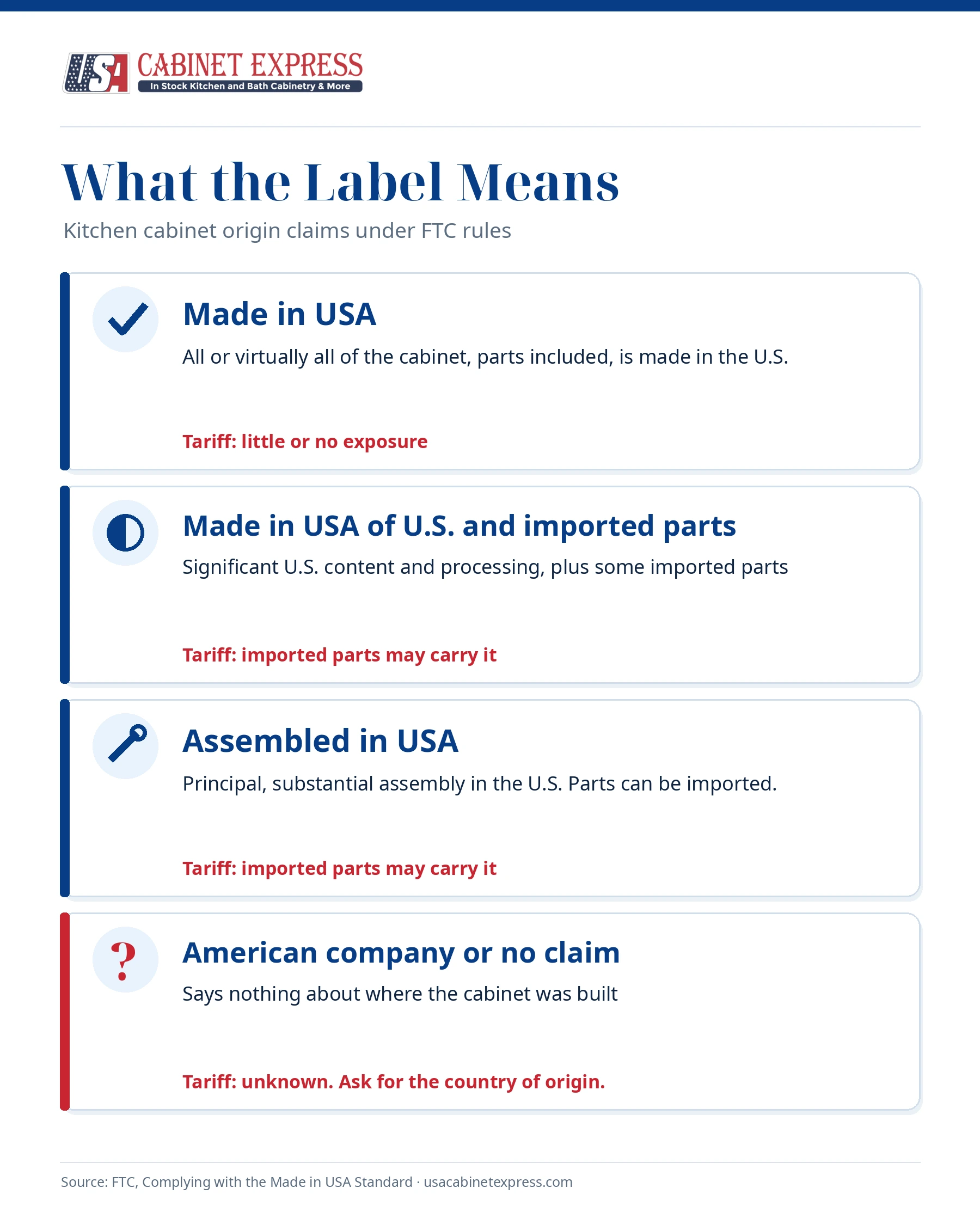
The FTC also says a company shouldn’t imply that a whole product line is American-made when only some of its products meet the standard. That matters in a showroom that carries several brands, because origin can change from one line to the next. Ask about the specific line on your quote.
Where Most Kitchen Cabinets Are Made
A lot of the kitchen cabinets sold in the U.S. are built, at least in part, somewhere else. The trade cases show it. Cabinets and cabinet components from China have carried antidumping and countervailing duties since 2020, and in 2024 the Commerce Department ruled that certain cabinets finished in Vietnam or Malaysia with Chinese components fall under the same orders.
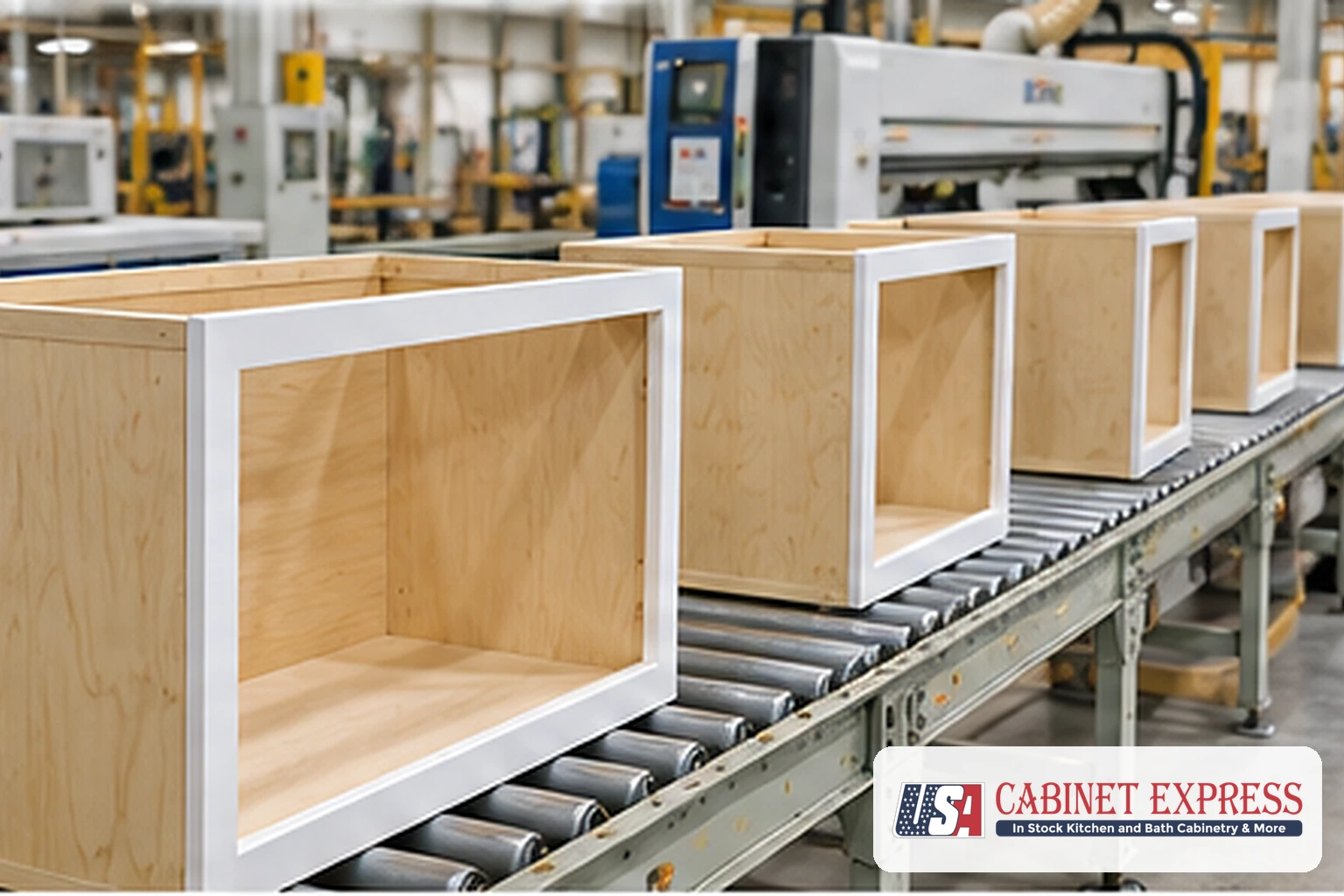
On the domestic side, the industry is consolidating. MasterBrand, the company behind Mantra, completed its merger with American Woodmark on May 28, 2026. Cabinetworks Group, which owns KraftMaid and Merillat, lists assembly and component plants in Middlefield, Ohio. Fabuwood assembles its cabinets at a one-million-square-foot headquarters plant in Newark, New Jersey, and added a West Coast facility in 2025.
So if you’re shopping for made in USA kitchen cabinets, “made in America” can mean anything from a fully domestic custom shop to a U.S. assembly line using imported doors and panels. Homeowners have noticed. As one commenter in an r/kitchenremodel tariff thread put it, “made in America” often just means “assembled in America.”
The 2027 Cabinet Tariff: What Changes on January 1
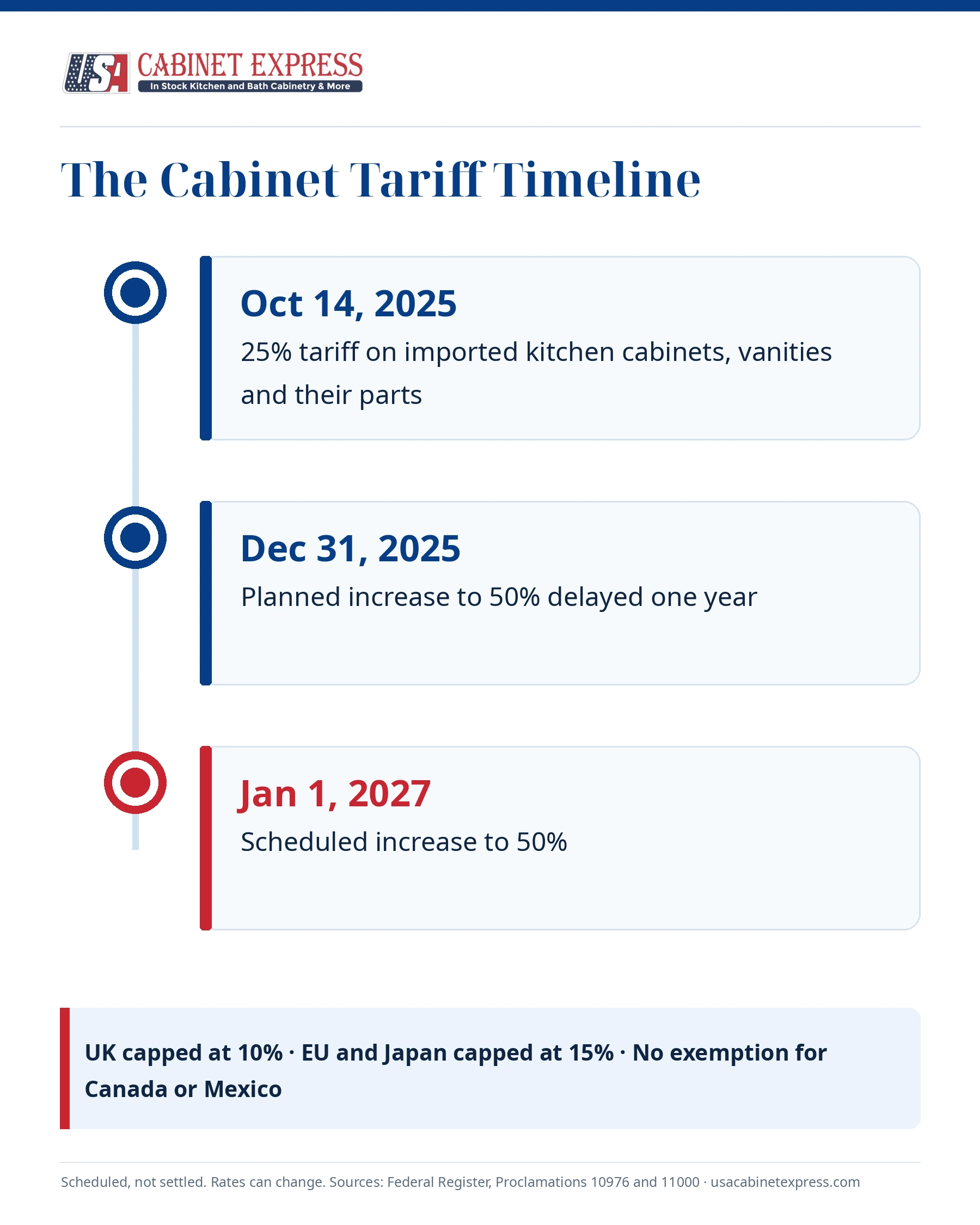
Since October 14, 2025, imported kitchen cabinets, vanities and their parts have carried a 25% tariff under Section 232 of the Trade Expansion Act (Proclamation 10976). The original plan was 50% from January 1, 2026. Then on December 31, 2025, Proclamation 11000 pushed the increase back a year, to January 1, 2027.
| Question | Answer |
|---|---|
| Rate today | 25% on covered kitchen cabinets, vanities and their parts |
| Scheduled for January 1, 2027 | 50% |
| United Kingdom | Capped at 10% |
| European Union and Japan | Capped at 15% |
| Canada and Mexico | No exemption. Cabinets from both countries pay the same rate. |
| Other duties | Stacks on top of Section 301 tariffs on Chinese goods and any antidumping or countervailing duties |
| When it’s charged | When the cabinets or parts enter U.S. customs |
Sources: Proclamations 10976 and 11000; Kelley Drye & Warren; TheStreet; CargoTrans. Rates are as scheduled in November 2026 and can change.
The tariff is charged on the import value, not the price on the showroom tag. A cabinet that enters the country valued at $400 owes $100 at 25% and $200 at 50%. How much of that lands on your quote depends on the seller’s costs and margins.
And January 1 isn’t locked in. The increase has been delayed once already, and trade deals can change the rate for a given country. TheStreet’s advice is to treat the date as “scheduled, not settled.” We agree.
Does “Assembled in USA” Protect You From the Tariff?
Only partly. The tariff applies to parts of kitchen cabinets and vanities as well as finished ones (Kelley Drye’s summary of the proclamation spells this out). A cabinet assembled in Ohio or New Jersey from imported doors or panels can still carry tariff costs on those parts. A cabinet built from U.S. materials in a U.S. plant doesn’t pay the tariff on the cabinet itself, although its maker may still pay more for imported hardware or plywood.
That’s why domestic cabinets don’t automatically hold their prices either. When imported cabinets cost more, demand for domestic ones goes up, and U.S. makers still buy some inputs from abroad. Less imported content means less tariff exposure, but the price can still move.
Two questions for your dealer
- Which parts of this cabinet line are imported, if any?
- Is any tariff built into the price, or charged as a separate surcharge that could change before delivery?
Are American-Made Cabinets Better Quality?
Not automatically. Where a cabinet was built tells you about tariffs and supply chains. It tells you much less about how long the cabinet will last. A well-run plant overseas can build a better box than a careless shop at home, and the reverse happens too.
If you only have a minute in a showroom, pull a drawer all the way out. It tells you more about a cabinet line than the country on the carton. Then work through the rest:
- Open a base cabinet. The box should be plywood or a dense, high-grade engineered board, with sealed edges.
- Look at the drawer corners. You want dovetail joints or a quality metal drawer system on full-extension slides.
- Check the hinges. Concealed, soft-close and adjustable means the doors can be realigned years from now.
- Run a hand along a door edge and the back of a door. The finish should be as even there as on the face.
- Look for the KCMA seal. Cabinets certified to ANSI/KCMA A161.1 passed 14 tests covering structure, door and drawer operation, and finish, and KCMA says 40% to 50% of manufacturers fail on their first attempt.
- Ask to see the TSCA Title VI label. Plywood, MDF and particleboard made in or imported into the U.S. must be certified and labeled as meeting EPA formaldehyde limits (EPA).
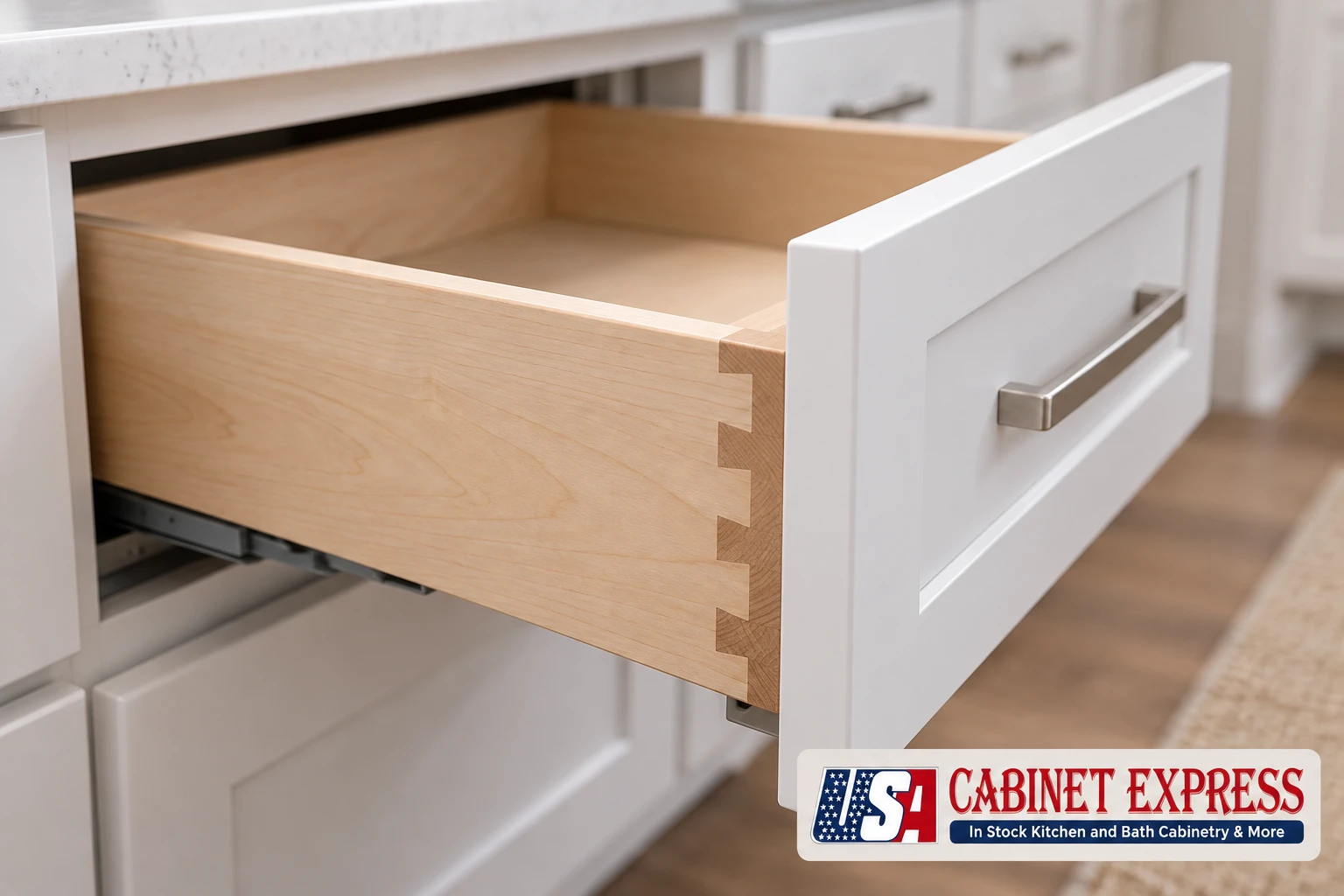
Our guide to what makes kitchen cabinets luxury walks through a five-minute version of this showroom check. For flat-pack lines, our RTA cabinet reviews cover what to look for in RTA specs and labels.
Where the Cabinet Brands We Sell Are Made
If you want American-made kitchen cabinets, start with what the manufacturer itself publishes. Here’s what each brand we sell says about where its cabinets are made. Where a brand doesn’t say, we tell you that instead of guessing.
| Brand | Who makes it | What the manufacturer says | What that means for you |
|---|---|---|---|
| Fabuwood (Allure, Illume, Quest, Value Premium) |
Fabuwood Cabinetry, Newark, NJ | Its cabinets are “a combination of USA and Globally sourced components all assembled in the USA” (Fabuwood FAQ) | Assembled in USA. Ask which components are imported for the line and door you choose. |
| Mantra | MasterBrand Cabinets | Cabinets ship from facilities in Jackson, GA; Carlisle, PA; or North Las Vegas, NV, and reach the dealer in 15 days or less (Mantra FAQ) | Ships from U.S. facilities. MasterBrand doesn’t publish where the boxes and doors are made, so ask for the country of origin. |
| Wolf Classic | Wolf Home Products, York, PA | Wolf’s December 2025 sell sheet says the line is “built in the USA from globally sourced components,” and labels its Heritage Series Made in the USA (Wolf Classic sell sheet) | Built in the USA from U.S. and imported parts. Ask which series you’re buying. |
| Our RTA Shaker line (White, Gray, Blue) |
USA Cabinet Express exclusive line | Not published on our site yet | Ask us for the spec sheet and country of origin before you order. Contact us. |
For more on one of these lines, read our Mantra cabinets reviews. They cover construction, lead times and what owners and installers report.
Other brands buyers ask about
- KraftMaid is owned by Cabinetworks Group, which lists assembly and component plants in Middlefield, Ohio. Ask about the origin of the specific line and parts.
- American Woodmark is now part of MasterBrand after the May 2026 merger. The brand names may stay the same, so ask your dealer whether anything changed about where a line is built.
- For any other brand, check the website, then the invoice and carton labels. If none of them says where the cabinets are made, ask for the country of origin in writing.
How to Check Where Your Cabinets Are Made
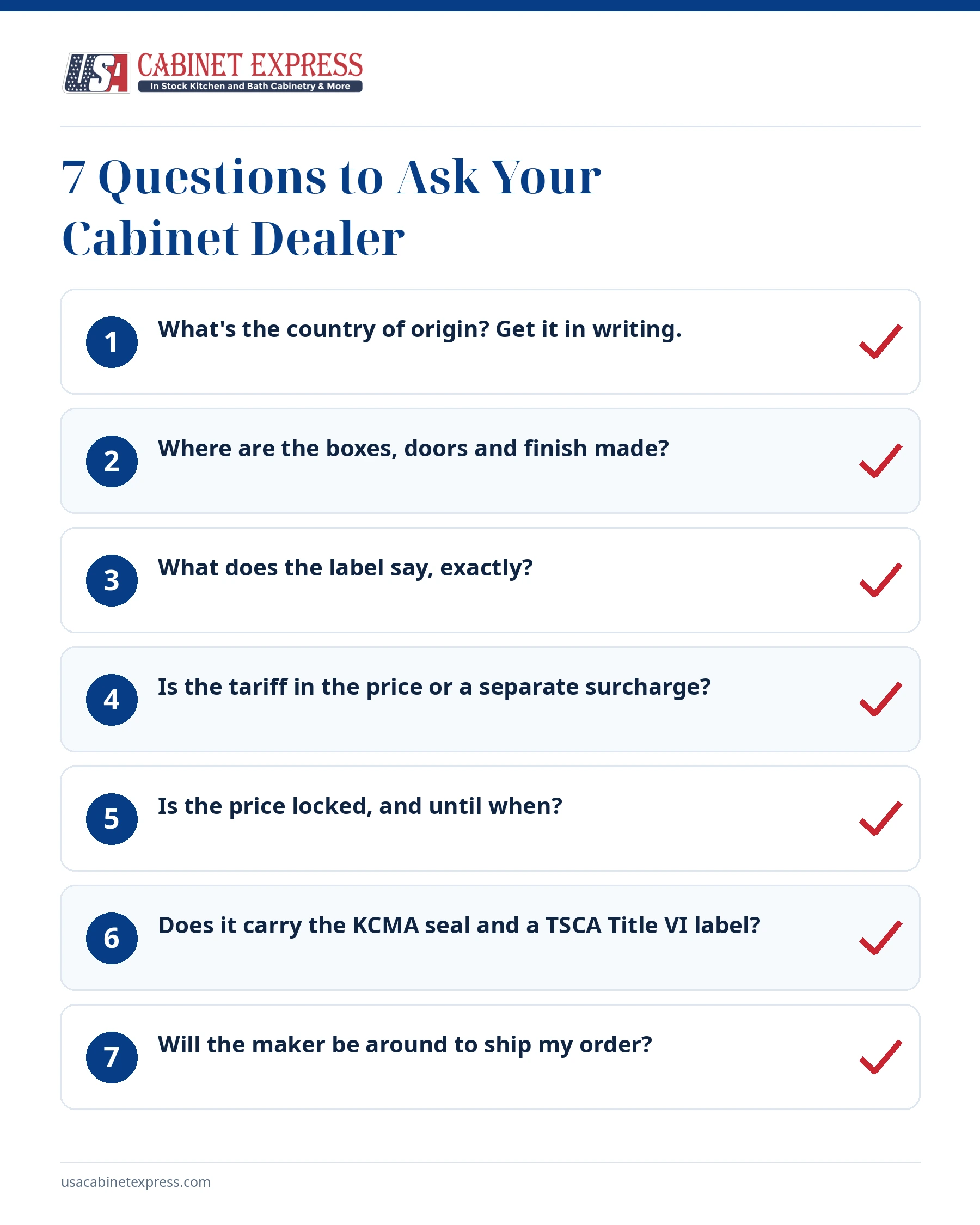
Use this list with any dealer, including us. A good dealer answers all seven without hesitating.
- Get the country of origin in writing, on the quote or the invoice.
- Ask where the boxes, doors and finish are made. The assembly location is only part of the answer.
- Read the exact label wording. “Made in USA,” “Made in USA of U.S. and imported parts” and “Assembled in USA” mean different things.
- Ask how the tariff shows up on the quote: built into the price, or a separate surcharge that can change.
- Ask whether the price is locked, and until when. If your cabinets ship after January 1, 2027, get it in writing who pays any difference.
- Look for the KCMA seal and the TSCA Title VI label.
- Check the maker’s staying power. In 2026 Fabuwood started a relief program for homeowners who lost deposits when U.S. cabinet makers closed mid-project. A domestic factory only helps if it ships your order.
Should You Buy Kitchen Cabinets Before January 1, 2027?
If your design is final and your budget is set, buying before January 1 can make sense. Duty is assessed when goods enter U.S. customs (CargoTrans), so cabinets that already cleared at 25% aren’t taxed again when the rate changes. Cabinets made or imported to order after New Year’s may be priced differently.
If your design isn’t final, don’t rush it.
A layout mistake costs more than a tariff, and the January date could still move. Get a written quote with a price-lock date, confirm the ship date, and ask which side of January 1 your cabinets fall on.
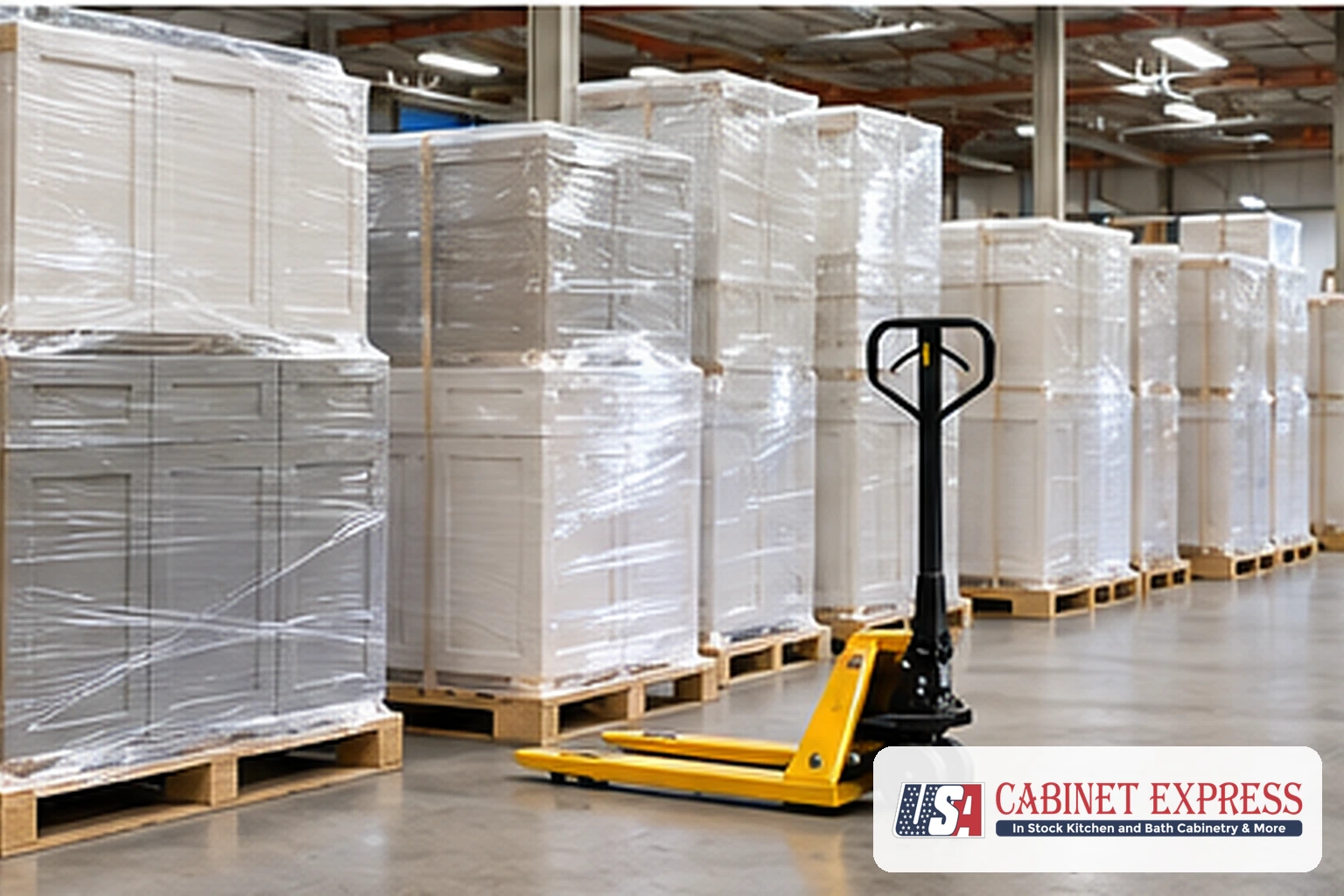
In-stock cabinets take a lot of the guesswork out. At USA Cabinet Express, in-stock cabinets are priced today and ready for same-day pickup or fast delivery, with a Best Price Guarantee on in-stock cabinets. Ask our designers where any cabinet on your quote is made, and try finishes first in the Kitchen Visualizer.
Get a written quote before January 1
Book a free 3D kitchen design and compare Fabuwood, Mantra and in-stock options side by side, including where each one is made.
Frequently Asked Questions About American-Made Kitchen Cabinets
Are there kitchen cabinets made in the USA?
Yes. Some manufacturers and custom shops build cabinets in U.S. plants from mostly U.S. materials. Many others assemble cabinets in the U.S. from a mix of U.S. and imported parts. Only cabinets that are all or virtually all made here can carry an unqualified Made in USA label.
Are Fabuwood cabinets made in the USA?
Fabuwood says its cabinets combine U.S. and globally sourced components and are all assembled in the U.S. Its headquarters and main plant are in Newark, New Jersey, and it added a West Coast facility in 2025.
Are Mantra cabinets made in the USA?
Mantra is a MasterBrand line. Mantra says its cabinets ship from facilities in Jackson, Georgia; Carlisle, Pennsylvania; and North Las Vegas, Nevada. MasterBrand doesn’t publish where the boxes and doors themselves are made, so ask for the country of origin on your order.
Are Wolf cabinets made in the USA?
Wolf Home Products says Wolf Classic cabinets are built in the USA from globally sourced components, and it labels its Heritage Series Made in the USA. Ask which series and parts you’re buying.
Are KraftMaid cabinets made in the USA?
KraftMaid is owned by Cabinetworks Group, which lists assembly and component plants in Middlefield, Ohio. Ask the dealer about the origin of the specific line and parts you’re buying.
Does the cabinet tariff apply to cabinets from Canada and Mexico?
Yes. The Section 232 tariff on kitchen cabinets and vanities has no USMCA exemption, so cabinets from Canada and Mexico pay the same rate. Imports from the United Kingdom are capped at 10%, and imports from the European Union and Japan at 15%.
Is the cabinet tariff charged on the retail price?
No. It’s charged on the import value when the cabinets or parts enter the U.S. How much of it reaches your price depends on the seller’s costs and margins.
Are there American-made RTA cabinets?
Yes, a few RTA brands advertise U.S.-made cabinets. Check the label wording and the box specs the same way you would for assembled cabinets. Our RTA cabinet reviews walk through what to look for.
Visit a USA Cabinet Express Showroom
See the boxes, drawers and finishes in person, and bring your questions about origin and pricing. Find your nearest showroom:
If you’re not sure which line fits your budget, schedule a free consultation and we’ll walk you through it.
American-made kitchen cabinets exist, but the phrase covers a lot of ground. Read the label, ask where the parts come from, and get your price and ship date in writing before January 1.
Sources
- FTC: Complying with the Made in USA Standard
- Federal Register: Proclamation 10976, Adjusting Imports of Timber, Lumber, and Their Derivative Products (Oct. 6, 2025)
- Federal Register: Proclamation 11000, Amendments to Adjusting Imports of Timber, Lumber, and Their Derivative Products (Jan. 9, 2026)
- Kelley Drye & Warren via Mondaq: New Section 232 tariffs on timber, lumber and derivative products (Oct. 3, 2025)
- TheStreet: The factories meant to absorb your kitchen tariff are shrinking (Sept. 14, 2026)
- CargoTrans: Kitchen cabinet tariffs, 25% now and 50% from Jan. 1, 2027
- Federal Register: Wooden Cabinets and Vanities From China, final scope determination (July 17, 2024)
- MasterBrand and American Woodmark: merger completion release, SEC Form 8-K (May 28, 2026)
- Cabinetworks Group: About (plant locations)
- Fabuwood: Frequently Asked Questions
- Kitchen & Bath Business: Fabuwood expands to the West Coast (2025)
- Fabuwood: Manufacturing Relief Program
- Mantra Cabinets: Frequently Asked Questions
- Wolf Home Products: Wolf Classic sell sheet (December 2025)
- KCMA: The ROI of durable cabinets and ANSI/KCMA A161.1
- EPA: Frequent questions for consumers about the Formaldehyde Standards for Composite Wood Products Act
- Reddit r/kitchenremodel: Do we think cabinet prices will immediately go up 50%? (2025)
Tariff rates and dates reflect published proclamations as of November 2026 and can change. This article is general information, not legal or trade advice.