
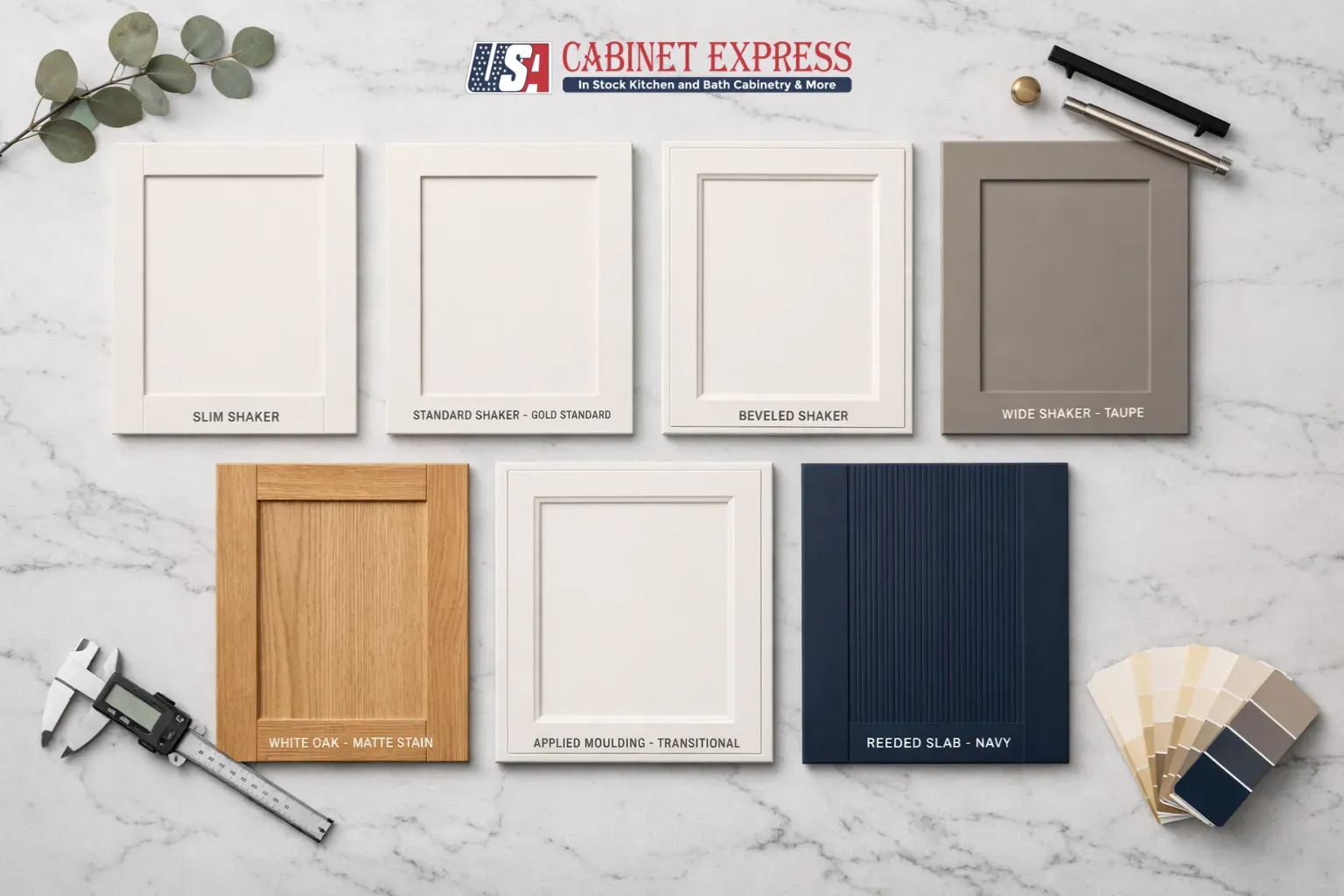

Transitional style commands 25% of the U.S. kitchen market—more than Modern (12%), Contemporary (11%), and Farmhouse (7%) combined, according to the 2025 U.S. Houzz Kitchen Trends Study. Yet the term is one of the most misused words in kitchen design. Walk into most showrooms and “Transitional” means little more than “not quite anything.”
This guide changes that. We’ve distilled Transitional design down to 20 measurable specifications—from rail widths in inches to Light Reflectance Values, from hinge boring distances to installation tolerances—so you can verify every metric before ordering a single cabinet. Whether you’re a homeowner planning a renovation, a contractor quoting a project, or a dealer building inventory, this checklist turns subjective taste into objective, data-driven decisions.
10 Key Takeaways for Transitional Kitchen Cabinet Door Styles
- Transitional holds 25% market share—the highest of any style—making it the safest investment for resale value.
- Rail/stile width is the #1 metric: 2.25”–3.00” = True Transitional; 0.75”–1.00” = Slim/Modern; 3.50”+ = Traditional.
- HDF panels eliminate the hairline paint fractures that plague solid wood doors—the superior substrate for painted Transitional cabinets.
- Warm Whites (LRV 82–85) are replacing stark whites; Mushroom/Taupe (LRV 45–60) is the breakout trend for 2026.
- The 60/30/10 two-tone ratio prevents design chaos: 60% perimeter, 30% island, 10% hardware accent.
- Full overlay with uniform 1/8” (3mm) reveals is the Transitional default—uneven gaps instantly read as cheap.
- Hardware follows the Rule of Thirds: pull length = ~1/3 of drawer width. Always size up, never down.
- 35mm concealed cup hinges at 110° with soft-close are the baseline spec. Confirm boring distance before drilling.
- A Transitional kitchen recoups 85–96% of remodel cost at resale, with a Style Life of 10–15 years.
- Specify everything. The 20-point checklist below is your insurance against design regret.
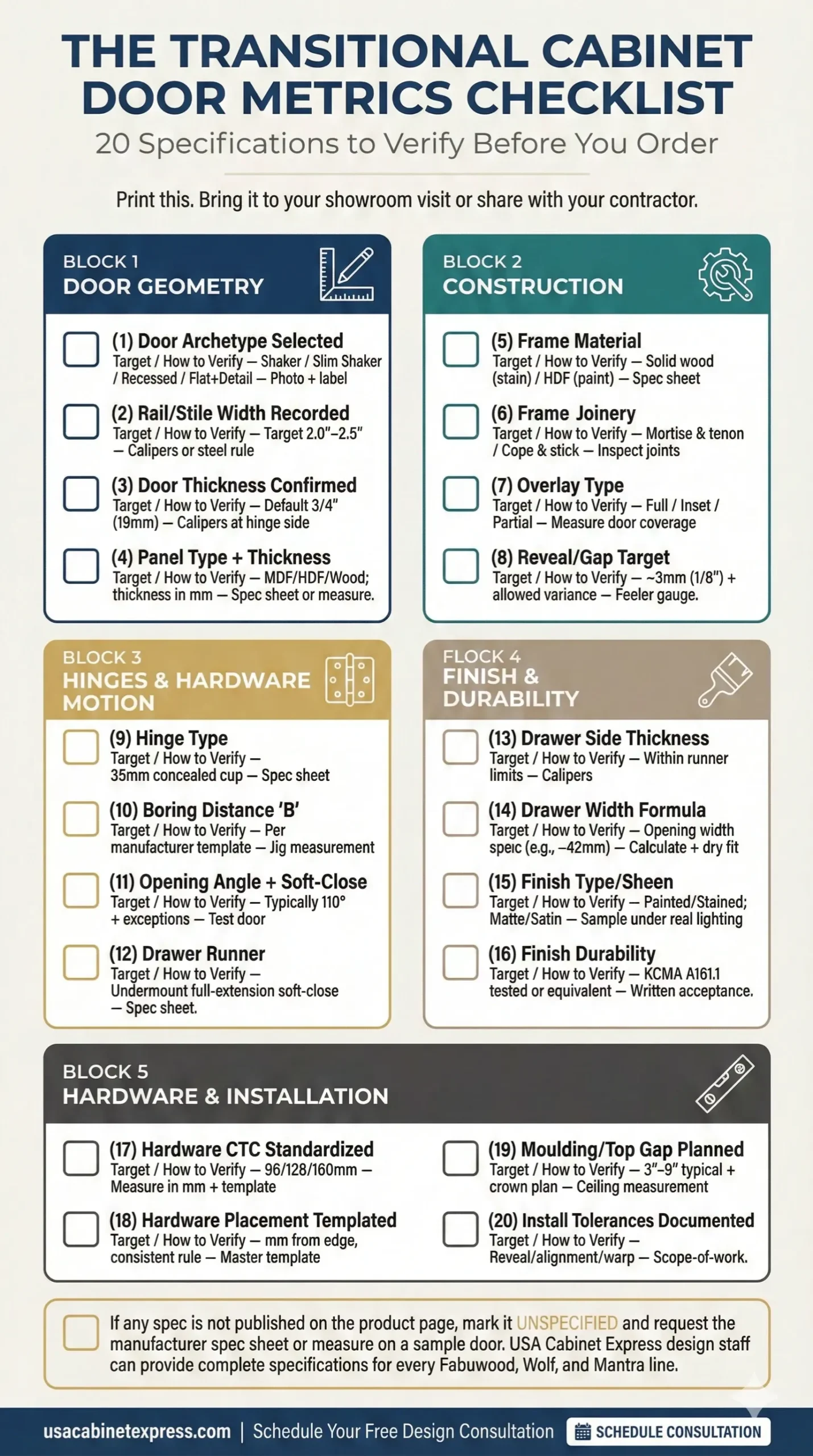
The 20-Point Transitional Cabinet Door Metrics Checklist
Print this. Bring it to your showroom visit. Share it with your contractor.
If a product page doesn’t publish a spec below, mark it “unspecified” and request the manufacturer spec sheet or measure on a sample door.
| # | Checklist Item | Target / Spec to Record | How to Verify | ✓ |
|---|---|---|---|---|
| 📐 Door Geometry | ||||
| 1 | Door Archetype | Shaker / Slim Shaker / Recessed Panel / Flat + restrained detail | Photo + label face geometry | ☐ |
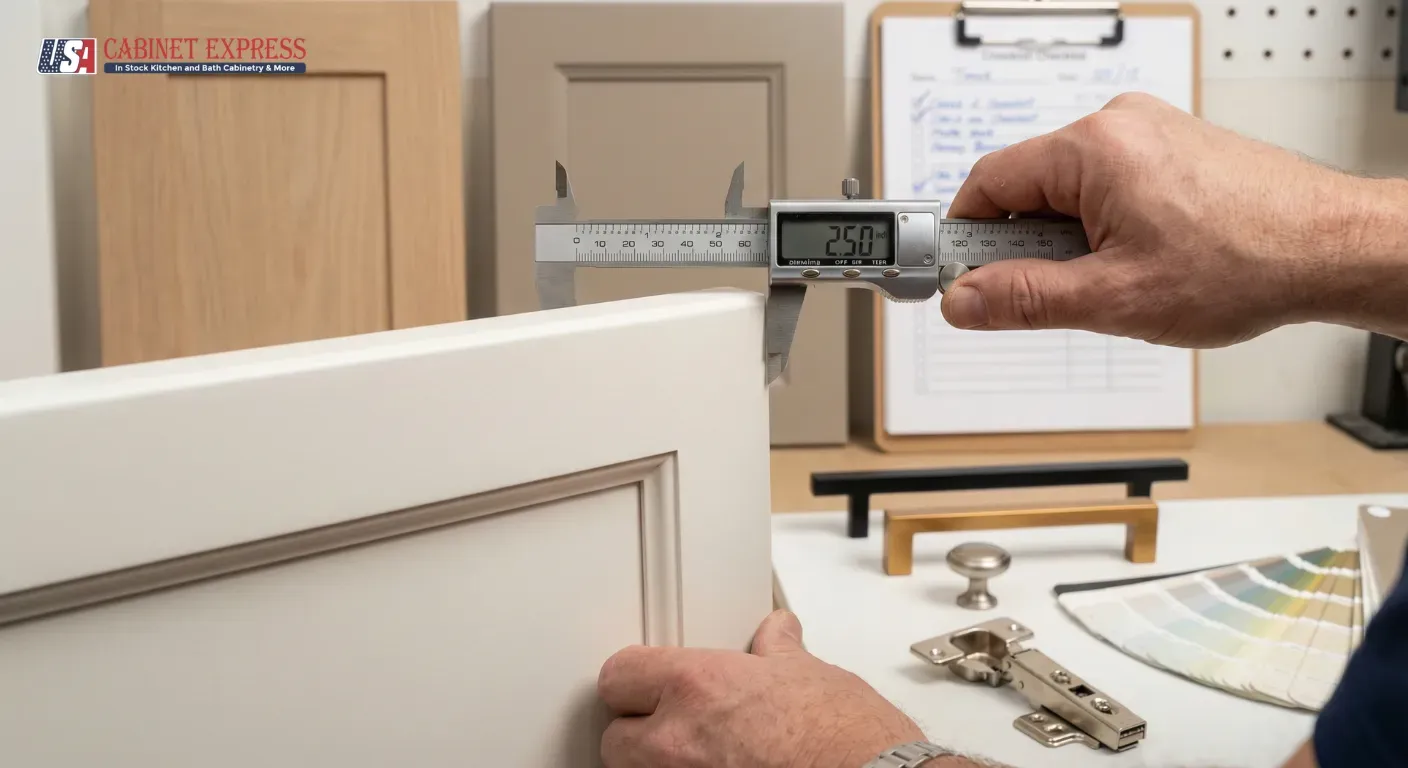
| 2 | Rail / Stile Width | ___ in / ___ mm (target 2.0″–2.5″) | Calipers or steel rule at frame member | ☐ |
| 3 | Door Thickness | ___ in / ___ mm (default ¾″ / 19mm) | Calipers at hinge side | ☐ |
| 4 | Panel Type + Thickness | MDF / HDF / Wood; ___ in / ___ mm | Spec sheet or direct measurement | ☐ |
| 🔩 Construction | ||||
| 5 | Frame Material | Solid wood (stain) / HDF (paint) | Spec sheet verification | ☐ |
| 6 | Frame Joinery | Mortise & tenon / Cope & stick | Inspect joints on raw doors | ☐ |
| 7 | Overlay Type | Full overlay / Inset / Partial | Measure door coverage over frame | ☐ |
| 8 | Reveal / Gap Target | ___ mm (target ≈3mm / ⅛″) + allowed variance | Feeler gauge at multiple points | ☐ |
| ⚙️ Hinges & Motion Hardware | ||||
| 9 | Hinge Type | 35mm concealed cup confirmed | Spec sheet | ☐ |
| 10 | Hinge Boring Distance | ___ mm (per manufacturer template/jig) | Measure with jig for repeatability | ☐ |
| 11 | Hinge Angle + Soft-Close | ___° (110° typical) + soft-close yes/no + exceptions noted | Spec sheet; test door operation | ☐ |
| 12 | Drawer Runner Type | Undermount, full-extension, soft-close | Spec sheet confirmation | ☐ |
| 🎨 Finish & Durability | ||||
| 13 | Drawer Side Thickness | ___ in / ___ mm (within runner system limits) | Calipers measurement | ☐ |
| 14 | Drawer Width Formula | Opening width minus runner spec (e.g., −42mm) | Calculate + dry fit | ☐ |
| 15 | Finish Type / Sheen | Painted / Stained; Matte / Satin / Semi-gloss | Sample door under actual room lighting | ☐ |
| 16 | Finish Durability | KCMA A161.1 tested or equivalent standard documented | Written acceptance criteria from manufacturer | ☐ |
| 🔧 Hardware & Installation | ||||
| 17 | Hardware CTC | 96 / 128 / 160mm standardized across kitchen | Measure in mm + drilling template | ☐ |
| 18 | Hardware Placement | ___ mm from edge/corner; consistent rule applied | One “master template” replicated | ☐ |
| 19 | Moulding / Top Gap | Top gap ___ in (3″–9″ typical) + crown molding plan | Measure ceiling to cabinet top | ☐ |
| 20 | Install Tolerances | Reveal / alignment / warp allowances documented | Specify in scope-of-work before installation | ☐ |
The sections below explain the reasoning behind each metric, how it affects your kitchen’s aesthetics and longevity, and how specific product lines map to these specifications.

What “Transitional” Means in Kitchen Cabinetry
According to both the NKBA and leading design authorities, Transitional cabinetry is characterized by a calculated blend of modern simplicity and traditional comfort. It uses cleaner door lines—typically from the Shaker family or flat/flush profiles—with restrained detailing rather than ornate profiling. It omits overt ornamentation and tends toward flatter, simpler cabinet-door geometries, with room for selective elements like mitering, subtle raised panels, or reeding when kept controlled.
For the homeowner, this translates to a kitchen that signals “updated” without committing to a trend that ages quickly. For the contractor and dealer, it means the highest market liquidity—a Transitional kitchen doesn’t alienate buyers who prefer Traditional (it’s close enough) or Modern (it’s clean enough). It eliminates the “Renovation Objection” from prospective home buyers.
But “Transitional” only becomes actionable when translated into specifiable dials—measurable dimensions, material choices, and finish standards that can be documented, ordered, and verified. The following sections break down each metric.
Door Geometry: Rail Width, Profiles, and Panel Depth
The Shaker Archetype
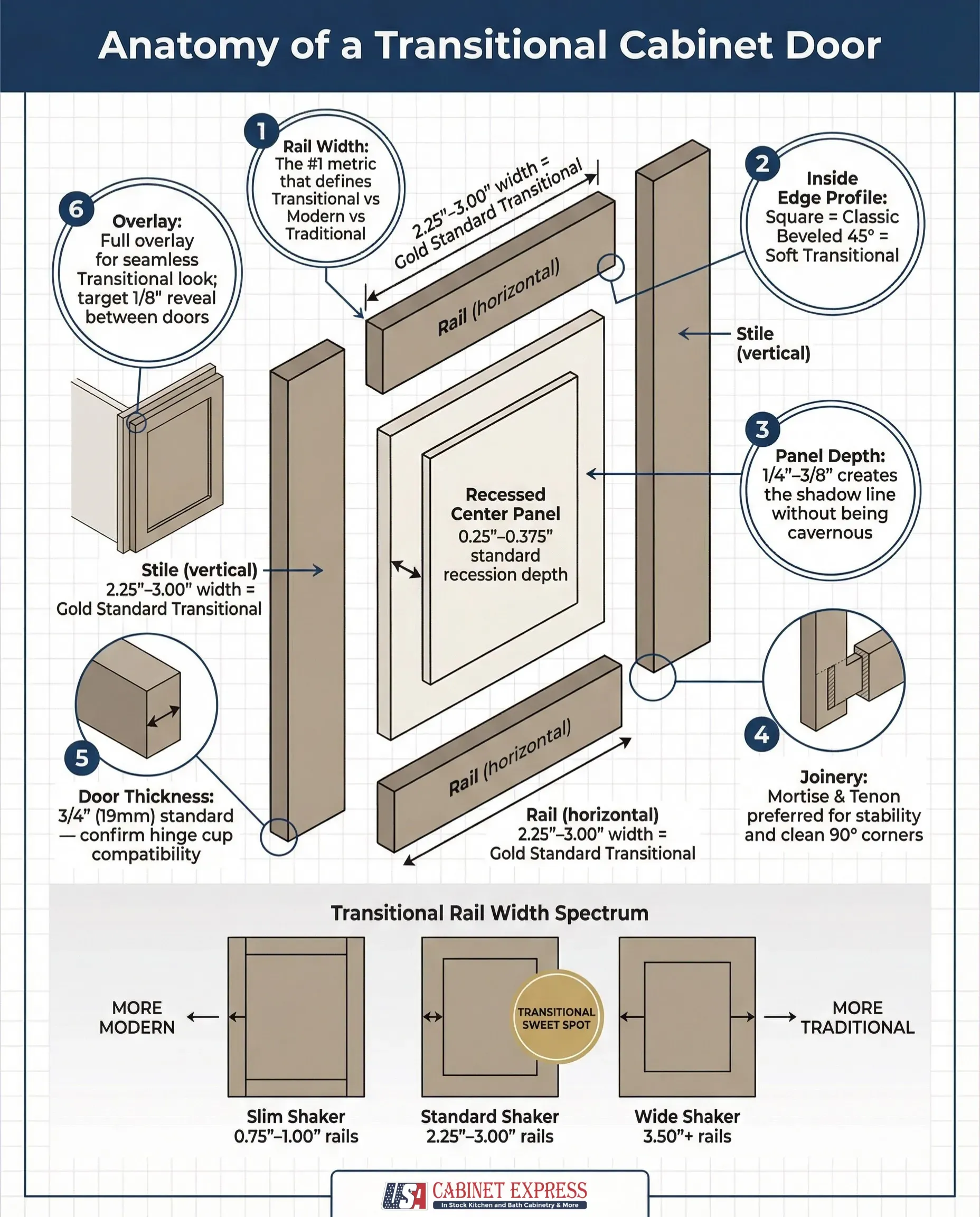
The Shaker door is the fundamental unit of Transitional design. Its five-piece construction—a four-piece frame (two vertical stiles and two horizontal rails) surrounding a recessed center panel—creates visual relief through depth and shadow without the noise of raised molding or applied carvings. It bridges eras: the structural language of traditional furniture with the clean, unadorned lines of modernism.
The character of the entire kitchen is dictated by one critical variable: the width of the rail and stile. This single dimension determines whether your space reads Historic, Transitional, or Modern.
| Door Style | Rail / Stile Width | Transitional Orientation | Recommended Usage | Complexity Score (0–10) |
|---|---|---|---|---|
| Slim Shaker | 0.75″ – 1.00″ | Modern / Contemporary | Urban apartments, minimalist designs, small kitchens. Increasingly requested by younger homeowners. | 1.5 |
| Standard Shaker
⭐ Gold Standard |
2.25″ – 3.00″ | True Transitional | Universal appeal, highest resale value. Fits equally well in a 1920s bungalow or 2026 new-build. The safest bet for ROI. | 3.0 |
| Wide Shaker | 3.50″ + | Traditional / Heritage | Large estate kitchens, high ceilings (9ft+), statement islands. Can feel squat in standard 8ft rooms. | 4.5 |
The “Gold Standard” (2.25”–3.00”) provides enough surface area for solidity and permanence, creates a distinct shadow line, and allows standard hardware installation without visual congestion. It is the architectural equivalent of a navy blue suit—appropriate in almost any context and immune to radical shifts in taste. This is the safest bet for resale value.
Slim Shaker (0.75”–1.00”) shifts the aesthetic toward Contemporary. It mimics slab-door sleekness while retaining the textural interest of a framed door. If we assign a Complexity Score where a flat slab is 0 and a raised-panel cathedral door is 10, the Slim Shaker registers at roughly 1.5 versus the Standard Shaker’s 3.0. Increasingly requested by younger homeowners and urban dwellers who find standard Shakers “too farmhouse” but slab doors “too clinical.”
Wide Shaker (3.50”+) leans Traditional—implying luxury, permanence, and heritage. Best deployed in large kitchens with high ceilings (9 feet and above). In a standard 8-foot ceiling room, a 4-inch rail can make cabinetry feel squat and heavy.
Modified Transitional Profiles
Homeowners increasingly seek subtle differentiation from the millions of identical white Shaker kitchens installed over the last decade. Two modifications are defining 2026:
The Beveled Inside Edge: Replaces the standard 90° square sticking with a 45° chamfer where the frame meets the panel. The practical advantage: a bevel allows easier cleaning, as the cloth glides over the angle rather than digging into a sharp corner—a functional metric that resonates with practical homeowners. Aesthetically, it catches light differently, creating a graduated shadow rather than a harsh line, softening the transition between frame and panel into a more “furniture-like” appearance.
The Micro-Step Detail: A small step or subtle ogee curve on the inside edge adds a layer of shadow and complexity (moving the Complexity Score from 3.0 to 3.5) without entering ornate raised-panel territory. Particularly effective in “New Traditional” kitchens where standard Shaker feels too austere.
Recessed Panel Depth
Standard (0.25”–0.375”): Creates the characteristic shadow line that gives Shaker cabinetry visual depth. Sufficient separation from a flat slab without creating a cavernous, dust-collecting recess.
Deep (0.50”): More dramatic, high-contrast shadows under recessed lighting. Trade-off: harder to clean, collects more dust.
Shallow / Reverse Raised Panel: A thick solid wood center panel machined at the edges to sit nearly flush. Provides the weight, tactile solidity, and sound-dampening qualities of a solid door—when you close a cabinet and it sounds substantial rather than hollow, that’s this construction at work. A critical auditory metric of luxury.
Material Science and Construction
The kitchen is a hostile environment—humidity fluctuations, heat, and physical impact challenge materials daily. The choice between solid wood, MDF, and HDF is structural engineering as much as aesthetics.
The Hairline Fracture Problem
In a painted five-piece solid wood door, the stiles, rails, and center panel expand at different rates and in different directions relative to wood grain. This movement exerts stress on the paint finish at joints, eventually breaking the seal and creating visible hairline cracks. While structurally harmless, these cracks disrupt the flawless aesthetic demanded by Transitional design.
Why HDF Wins for Painted Finishes
Density: HDF exceeds 50 lbs/ft³ (approx. 800 kg/m³) versus standard MDF at 30–50 lbs/ft³. Higher density enables tighter, more precise machining without fuzzing or crumbling.
Dimensional Stability: Engineered to be isotropic—no grain direction means even, minimal expansion. This virtually eliminates joint fractures, keeping the painted finish pristine for the life of the cabinet.
Surface Quality: No grain to telegraph through paint over time. A perfectly smooth canvas.
The Industry Gold Standard: Hybrid construction—solid wood frames for screw-holding power and hinge rigidity, paired with MDF/HDF center panels for finish stability. This “best of both worlds” approach is what premium manufacturers use in their Allure-tier product lines.
Wood Species for Stained Applications
| Wood Species | Janka Rating | Best Application | 2026 Trend Outlook |
|---|---|---|---|
| Maple | ~1,450 | Industry standard for paint-grade. Hard, closed-grain, finishes smooth. Preferred when solid wood is required. | ● STABLE
The default choice. |
| Birch | ~1,260 | Cost-effective paint-grade alternative. Slightly softer than maple, similar smooth finish. | ● STABLE
Budget-friendly option. |
| White Oak
🔥 Trending |
~1,290–1,360 | Open grain provides tactile texture for stained Transitional applications. Key component of the “Organic Transitional” trend. | ▲ SURGING
Projected 40% market share by late 2026. |
Construction Joints
Mortise & Tenon (Cope & Stick): The stile and rail meet at a 90° butt joint. Historically accurate Shaker construction—robust, accommodates slight expansion. Reinforces the geometric, rectilinear Transitional aesthetic. Preferred for long-term stability.
Mitered Joint: Corners meet at 45° like a picture frame. Used for intricate molded profiles, but more susceptible to opening due to humidity changes. For strict Transitional design, Mortise & Tenon is the better choice.
Color and Finish Metrics: The 2026 Forecast
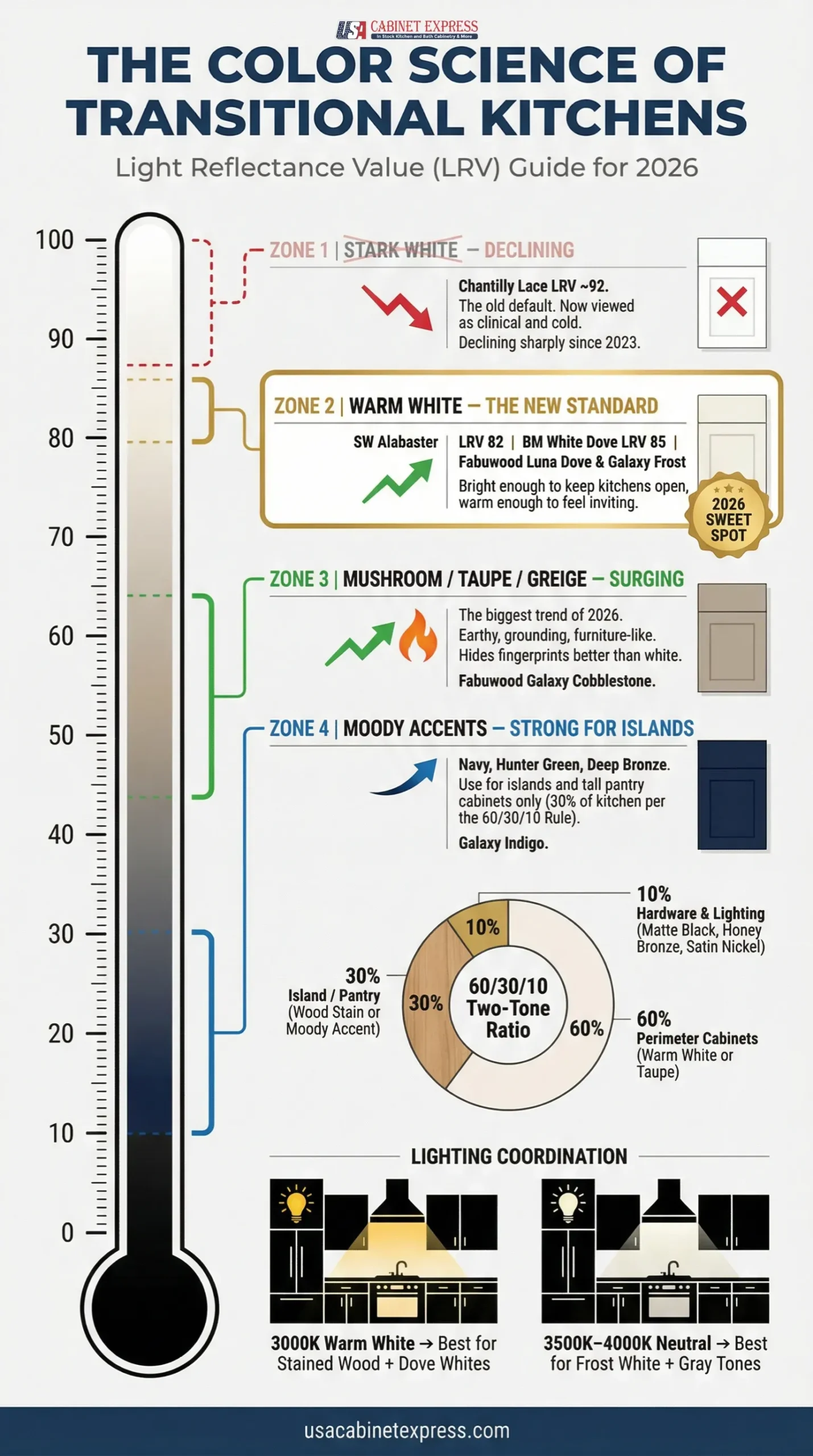
If the door profile is the skeleton of the kitchen, the finish is its skin. The key metric is Light Reflectance Value (LRV)—a scale of 0 (Black) to 100 (Pure White) measuring how much light a color reflects. Getting the LRV right prevents a space that feels “hospital sterile” (too high) or “cave-like” (too low).
The White Spectrum: From Stark to Warm
For much of the last decade, stark brilliant white (LRV ~92) was the default. The 2025/2026 data shows a sharp decline—these high-LRV whites are now viewed as too clinical for the warm/organic trend defining this era. The new standard is Warm White (LRV 82–85): think Sherwin Williams Alabaster (LRV 82) or Benjamin Moore White Dove (LRV 85). Bright enough to keep a kitchen open, warm enough to feel inviting.
Breakout Trend: Mushroom and Taupe (LRV 45–60)
The most significant 2026 shift. These earthy mid-tones are grounding, hide fingerprints better than white, and feel “furniture-like”—contributing to the “Un-Kitchen” trend where the kitchen becomes a seamless continuation of the living room. They possess a warmth that pure gray lacks.
Stain Revival
White Oak and Walnut are returning in force, typically in two-tone applications (white perimeter, wood island). The 2026 metric is Matte or Satin sheen (5–20%)—the high-gloss polyurethane of the 1990s is obsolete. Low sheen lets wood grain texture be the hero, feeling more natural, tactile, and authentic.
| Finish Category | Target LRV | Paint Benchmark / Cabinet Match | 2026 Trend Outlook |
|---|---|---|---|
|
Warm White |
82 – 88 | SW Alabaster (LRV 82) · BM White Dove (LRV 85) · Fabuwood Luna Dove · Galaxy Frost | ▲ HIGH
The new standard white. Replaces stark LRV 90+ whites. |
|
Mushroom / Taupe 🔥 Breakout Color |
45 – 60 | Warm greige / putty tones · SW Universal Khaki · BM Revere Pewter · Fabuwood Galaxy Cobblestone | ▲▲ SURGING
The “It” color for 2026. Earthy, grounding, furniture-like. |
|
Moody Accent |
10 – 25 | Navy · Hunter Green · Deep Bronze · SW Hunt Club · Fabuwood Galaxy Indigo | ▲ STRONG
For islands and base cabinets only (30% of the 60/30/10 ratio). |
|
Natural Wood Stain |
N/A (Texture) | White Oak · Walnut · Matte / Satin sheen (5–20%) · Fabuwood Galaxy Timber | ▲▲ VERY HIGH
Projected 40% of new cabinetry. Replacing gray stains. |
60/30/10 Two-Tone Ratio
The Transitional formula for multi-finish kitchens:
60% Main Color (perimeter cabinets)—Warm White or Taupe. Maintains brightness and openness.
30% Secondary Color (island or tall pantry)—Natural Wood Stain or Deep Earth Tone. Anchors the room visually.
10% Accent (hardware + lighting)—Matte Black, Honey Bronze, or Satin Nickel. Prevents the mix from becoming chaotic.
Lighting coordination: Match cabinet finish to bulb temperature. 3000K (Warm White) for stained wood and Dove whites. 3500K–4000K (Neutral White) for Frost whites and gray tones.
Hardware Metrics
In Transitional design, hardware is a critical geometric element that reinforces—or undermines—the clean-lines philosophy. Selection is governed by specific ratios and placement rules.
Rule of Thirds
Pull length should equal approximately one-third the width of the drawer front. A standard 30” drawer calls for a pull of roughly 10” (256mm). When standard manufacturing sizes (5”, 7”, 9”, 12”) require approximation, always size up—a pull that’s too small reads “Traditional” or “Country.” A longer pull reads “Modern” and “Transitional.”
Placement Rules
Drawers: Centered vertically and horizontally. Non-negotiable.
Doors: Knob or pull placed on the stile, aligned with the top of the bottom rail (uppers) or bottom of the top rail (bases). Center in the stile width, typically 1.25”–1.5” from the edge. Never drill at the rail-stile joinery point—a common amateur mistake.
CTC Standardization: Choose one or two Center-to-Center standards (e.g., 128mm + 160mm) for the entire kitchen. Always measure in millimeters. This simplifies drilling templates, reduces errors, and makes future replacement painless.
Style and Finish
The Transitional Default: Knobs on Doors, Pulls on Drawers. Separates motions and adds visual interest. For a more Modern Transitional look, pulls on both (vertical on doors, horizontal on drawers) creates a linear, architectural aesthetic.
Matte Black: High contrast, graphic punch. Best with White and Timber finishes.
Honey Bronze / Satin Brass: Warmth and luxury. Pairs beautifully with Dove and Indigo tones.
Satin Nickel: The timeless safe choice, though trending down slightly in favor of warmer metals
Economic Analysis: Transitional as Financial Strategy
Transitional design is backed by hard economic data:
Market Dominance: 25% market share (Houzz 2025). The most liquid asset in terms of resale—it doesn’t alienate any buyer segment.
Cost Recovery: A minor kitchen remodel with Transitional Shaker doors recoups approximately 85–96% of cost at resale. Homes with white or wood-tone cabinets sell faster and at a premium compared to homes with dark, heavy, or highly stylized cabinetry.
Style Longevity: Projected Style Life of 10–15 years before looking dated—roughly double the longevity of Farmhouse (5–7 years) or Industrial (5–7 years) kitchens.
The 2026 Micro-Shift: While Transitional dominates, there’s a noted 5% rise in “Traditional” styling. This means 2026 Transitional is moving slightly away from the severe square Shaker toward beveled edges and micro-step details—making refined profiles a forward-looking investment.
The “Un-Kitchen”: Living Integration Metrics
The “Un-Kitchen” trend describes kitchens that blend seamlessly with living spaces rather than reading as utilitarian. Transitional cabinetry drives this through three metrics:
Paneled Appliances: Cabinetry metrics (rail alignment, color match) extend to the refrigerator and dishwasher. Ensuring appliance panel rail heights match adjacent cabinetry is a critical “Professional Grade” detail often missed by DIYers.
Furniture Toe-Kick: Transitional islands use furniture-base molding or legs instead of standard recessed toe-kicks. This requires ordering “furniture ends” rather than standard skins—transforming the island from a box into a piece of furniture.
Lighting Temperature: Cabinet finish (LRV) must be coordinated with bulb temperature. 3000K for stained wood and warm whites; 3500K–4000K for bright whites and gray tones.
Installation Tolerances
Transitional kitchens rely on straight lines and clean geometry. Uneven reveals, misaligned doors, and sloppy crown molding immediately undermine the aesthetic. These tolerances must be managed at installation—not argued about after.
Reveal/Gap: ANSI/AWI standards specify ~3.2mm (⅛”) for frameless full-overlay cabinets. Define acceptable variance by quality tier (Premium, Custom, or Economy) and specify in writing before work begins.
Crown and Top Gap: Plan before ordering. Typical gaps range from 3” to 9” depending on ceiling height. If running cabinets to the ceiling, confirm ceiling flatness with a laser level—small variations become visible when crown molding bridges the gap.
Verification: Use levels and laser alignment at every elevation. Measure reveals at multiple points per run. Pre-plan all filler and crown strategy with measurements taken on-site, not from drawings.
USA Cabinet Express: Products Matched to the Metrics
Applying the metrics above to the specific product lines available at usacabinetexpress.com enables precise, data-driven selection:
| Product Line | Door Profile | Rail Metric | Construction | Best For |
|---|---|---|---|---|
| Fabuwood Galaxy
Workhorse |
Standard Shaker (5-piece) |
2.5″–3.0″ | Q12 Dovetail, Solid Wood Frame, MDF Panel | Fits 90% of Transitional briefs. Frost, Timber, Indigo, Cobblestone finishes. |
| Fabuwood Luna | Wide-Rail Shaker Beveled Edge |
Wide + bevel | HDF frames + ⅝″ MDF panel | Softer “New Traditional” feel. Dove finish targets LRV 82–85. |
| Fabuwood Nexus | Wide-Frame Architectural |
3.5″+ | Premium joinery, heavy proportions | Large kitchens, high ceilings. Mimics high-end custom joinery. |
| Fabuwood Fusion | Full Overlay Wide Rail Moldings |
Contemporary | Mortise-and-tenon, ⅜″ MDF panel | Contemporary twist on traditional cabinetry. |
| Imperio | Flat Panel + Applied Moulding |
Hybrid | MDF panel + applied mouldings | Clean panels with classic molding accents. Explicitly transitional. |
| Mantra Omni | Standard Shaker | 2¼″ (published) | 5-piece, standard construction | Budget-efficient. Published rail width makes it easy to spec. |
| Wolf Classic | Modern Shaker (Dartmouth) |
Standard | 5-Year Warranty, 14 accent colors | Entry-to-mid tier. Excellent for two-tone configurations. |
Explore these lines in person: Austin | Dallas | Houston | St. Louis | Chesapeake | Fredericksburg
Frequently Asked Questions for Transitional Kitchen Cabinet Door Styles
What is a Transitional cabinet door style?
A measurable blend of modern simplicity and traditional comfort—typically cleaner door lines from the Shaker family or flat/flush profiles, with restrained detailing rather than ornate profiling. It’s defined by specific metrics (rail width, panel depth, overlay type, hardware placement), not by vague “middle ground” language.
What rail/stile width looks most Transitional?
The Gold Standard is 2.25”–3.00”. Slim Shaker (0.75”–1.00”) leans Modern; Wide Shaker (3.50”+) leans Traditional. The Fabuwood Galaxy series sits at the 2.5”–3.0” sweet spot; Mantra Omni publishes 2¼” rails.
Is Shaker always Transitional?
No. Shaker can read Modern, Transitional, or Traditional depending on rail width, edge profile, finish, and hardware placement. That’s why measuring these dimensions matters more than assuming “Shaker = Transitional.”
What is HDF and why does it matter for painted cabinets?
HDF (High Density Fiberboard) exceeds 50 lbs/ft³ density, providing dimensional stability that virtually eliminates the hairline paint fractures at joints that plague solid wood doors. It offers a perfectly smooth paint surface with zero grain telegraphing.
What colors are trending for Transitional kitchens in 2026?
Warm Whites (LRV 82–85) are replacing stark whites. Mushroom/Taupe neutrals (LRV 45–60) are the breakout trend. Natural wood stains (especially White Oak) are projected to capture 40% of the cabinet market. Two-tone designs using the 60/30/10 ratio are the dominant configuration.
What reveal should I expect between cabinet doors?
ANSI/AWI standards specify approximately 3.2mm (⅛”) for frameless full-overlay cabinets. Always specify both the target reveal and permitted variance in writing before installation begins.
What hinge specs matter most?
At minimum: 35mm cup standard, boring distance, cup depth, opening angle (typically 110°), and confirmation the hinge supports your door thickness. Soft-close is baseline—note any exceptions for corner or Lazy Susan configurations.
How do I know if a cabinet finish is durable?
Look for testing against the KCMA A161.1 standard—which includes heat/humidity exposure, hot/cold cycling, chemical resistance, and edge soak tests. Ask the manufacturer directly and document the answer.
What is the “Un-Kitchen” trend?
The design philosophy where the kitchen blends seamlessly with living spaces. Transitional cabinetry drives this through paneled appliances (matching rail heights), furniture-style toe-kicks on islands, and coordinated lighting temperatures matched to cabinet LRV values.
Which USA Cabinet Express line is best for a Transitional kitchen?
Fabuwood Galaxy is the Transitional Workhorse (90% of briefs). Luna is ideal for a softer “New Traditional” look. Nexus suits large architectural statements. Mantra Omni provides budget-efficient Transitional at published specs. Wolf Classic offers two-tone flexibility with 14 accent colors.
Can I update existing cabinets to look more Transitional without full replacement?
Yes. Change hardware to bar pulls sized at one-third of drawer width. Repaint in a Warm White (LRV 82–85) or Taupe. Add glass inserts on select uppers. Replace ornate crown with flat profiles. Even updating hardware placement using the proper Transitional template can transform the look.
What ROI does a Transitional kitchen provide?
A minor remodel with Transitional Shaker doors recoups 85–96% of cost at resale. Transitional holds 25% market share and has a projected Style Life of 10–15 years—roughly double that of trend-specific styles.
Conclusion
The trajectory for 2026 is clear: the kitchen is softening. The hard lines, high gloss, and clinical whiteness of the past decade are yielding to organic warmth and tactile sophistication. Buyers are educated, demanding value through RTA and in-stock availability while refusing to compromise on aesthetics through Slim Shaker proportions, warm color science, and natural wood grain.
By adhering to the 20 metrics in this checklist—from rail width to LRV values, from hinge boring distances to installation tolerances—you ensure your kitchen is not just “remodeled” but architecturally aligned with the enduring principles of Transitional design. You transform subjective taste into objective specification, maximizing both daily enjoyment and future resale.
ur Next Steps
- Print the 20-Point Checklist and bring it to your showroom visit or share it with your contractor.
- Order sample doors to evaluate finish quality and color accuracy under your home’s actual lighting.
- Visit your nearest USA Cabinet Express showroom to see and measure door profiles, finishes, and hardware in person.
- Request a project quote with every metric specified—armed with this checklist to eliminate guesswork.
Schedule Your Free Design Consultation at USA Cabinet Express
Contact USA Cabinet Express Showrooms
Austin, Texas – (469) 336-9201 — 2112 Rutland Dr #185, Austin, TX 78758
Chesapeake, Virginia – (757) 296-6669 — 1543 Sams Cir, Chesapeake, VA 23320
St. Louis, Missouri – (314) 900-0440 — 2605 S Hanley Rd, Saint Louis, MO 63144
Dallas, Texas – (469) 990-2200
Houston, Texas – (281) 306-6060
Fredericksburg, Virginia – (540) 515-1500
Hours: Mon–Fri 8AM–6PM, Sat 9AM–5PM, Sun Closed
Explore online at usacabinetexpress.com
Start your kitchen transformation today with USA Cabinet Express—where quality, style, and value meet.