
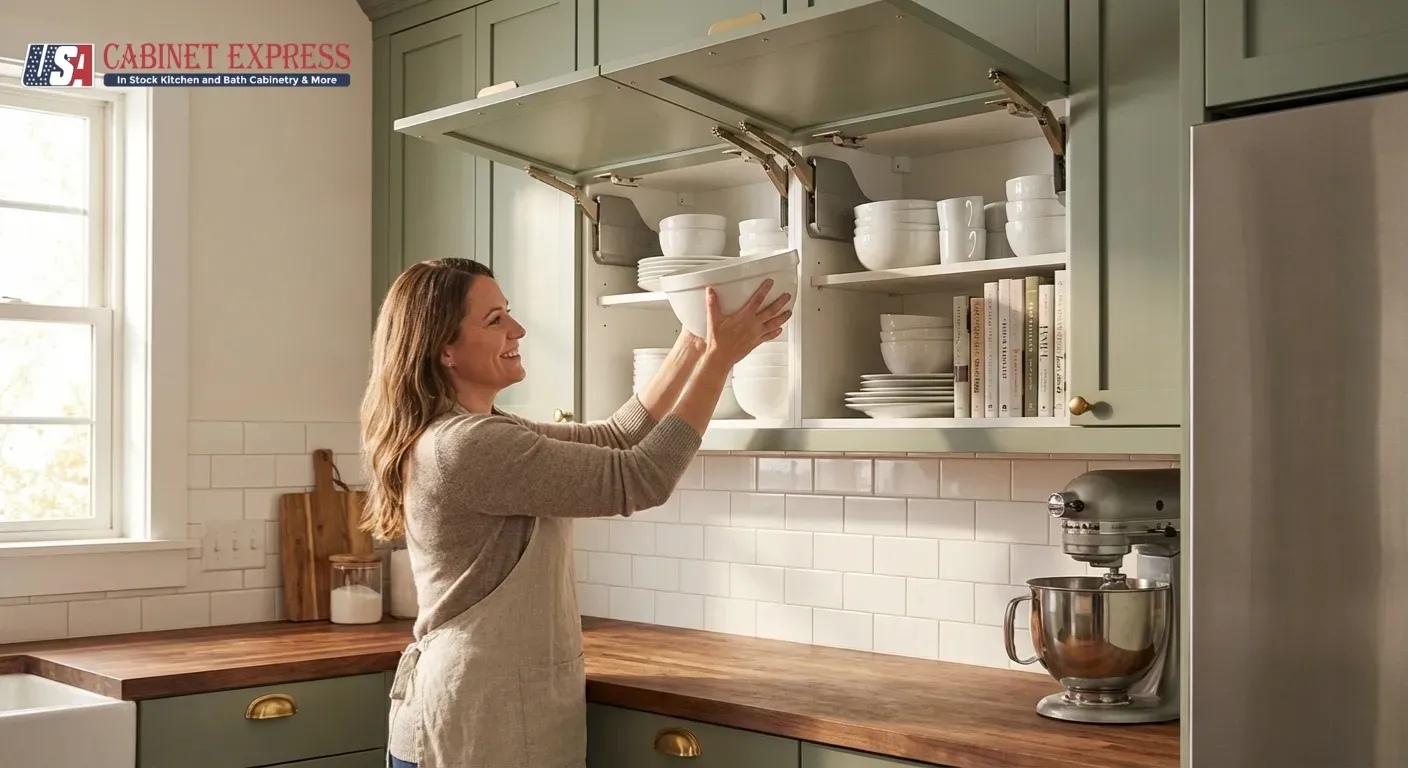

Your ultimate guide to selecting the right cabinet hardware for your kitchen remodel
The opening mechanism on your kitchen cabinet doors is far more than a simple hinge—it’s the kinetic interface that determines how you interact with your kitchen every single day. Whether you’re reaching for your morning coffee mug, grabbing a mixing bowl for weekend baking, or storing heavy cookware, the hardware you choose directly impacts your kitchen’s ergonomics, safety, durability, and overall feel of quality.
At USA Cabinet Express, we’ve installed thousands of kitchens across Texas, Virginia, and Missouri, and we’ve learned that the difference between a kitchen that functions beautifully for 20+ years and one that frustrates homeowners within months often comes down to proper hardware specification.
This comprehensive checklist covers everything from traditional concealed hinges to sophisticated SERVO-DRIVE motorized systems, helping you make informed decisions whether you’re a homeowner planning a remodel, a contractor specifying for clients, or a designer creating your next masterpiece.
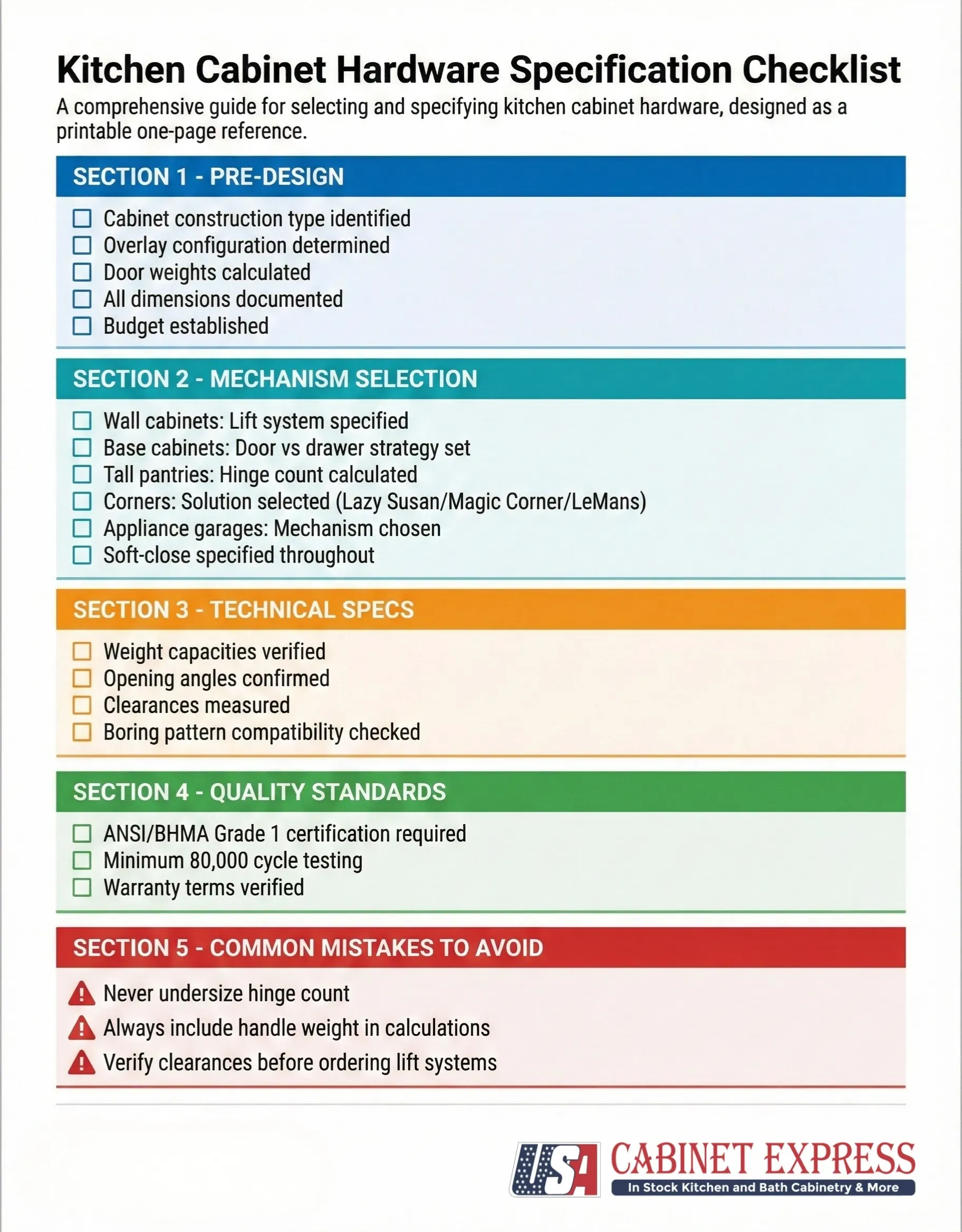
10 Key Takeaways for Kitchen Cabinet Door Opening Mechanisms
Before diving into the technical details, here are the essential points every kitchen decision-maker should understand:
- European concealed cup hinges (35mm) have become the industry standard, representing 85-90% of modern kitchen installations due to their adjustability, clean aesthetics, and durability.
- Soft-close is no longer a luxury—it’s expected. Premium hinges from manufacturers like Blum, Hettich, and Grass now integrate hydraulic damping directly into the hinge mechanism, preventing slamming and extending cabinet life.
- Lift-up systems (like Blum AVENTOS) transform wall cabinet accessibility by moving doors upward and out of your way, eliminating the head-bumping hazard of traditional swing doors left open during cooking.
- Power Factor calculation is critical for lift systems. The formula (Cabinet Height in mm × Door Weight in kg) determines which mechanism strength you need—get it wrong, and doors either won’t stay open or slam shut aggressively.
- Corner cabinets waste 50%+ of their space without specialized hardware. Magic Corner pull-outs and LeMans systems can recover nearly all of this “dead zone” storage.
- Push-to-open (handleless) designs require careful planning. Systems like Blum TIP-ON BLUMOTION combine push-to-open with soft-close, but electrical SERVO-DRIVE options offer the most refined experience for high-end kitchens.
- Quality hinges should pass the “wiggle test.” Grasp the door near its free edge—premium hardware moves the entire cabinet box before any play develops in the hinge pivot.
- ANSI/BHMA Grade 1 certification (100,000+ cycles) is the benchmark for commercial-grade durability and should be specified for high-use residential cabinets like pantries and trash pull-outs.
- Boring pattern compatibility matters. The 45mm pattern (Blum standard) and 52mm pattern (Hettich legacy) are NOT interchangeable—verify your fabricator’s machinery before specifying hardware.
- Pocket door systems and tambour doors eliminate swing clearance issues but require planning during the design phase—they cannot be effectively retrofitted.
Understanding Your Options: The Complete Mechanism Taxonomy
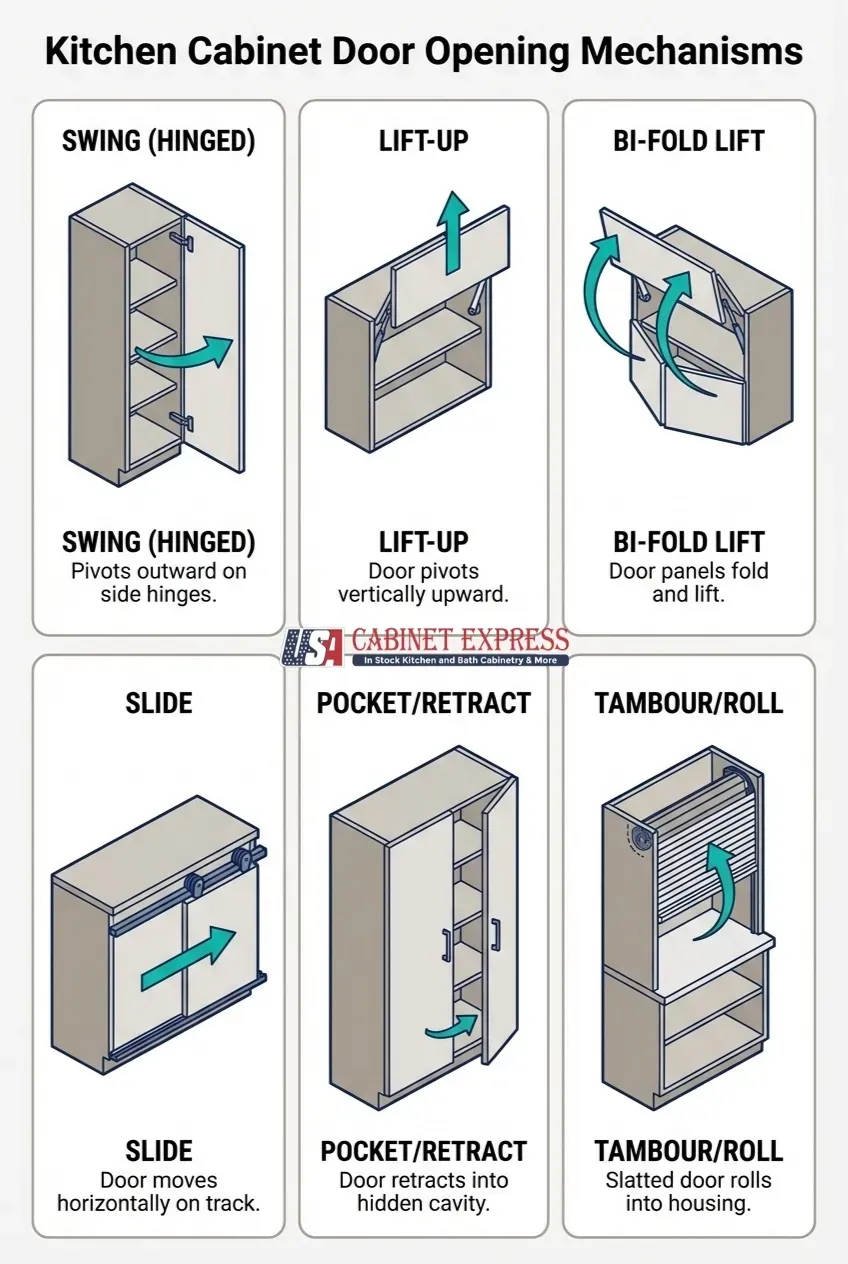
Cabinet door mechanisms fall into distinct categories based on their motion path. Understanding this taxonomy helps you match the right hardware to each cabinet application.
Motion Path Categories
| Motion Type | How It Works | Best Applications |
|---|---|---|
| Swing (Hinged) | Door rotates about a side axis | Standard base and wall cabinets |
| Lift | Door rotates about top axis via linkages | Wall cabinets, appliance garages |
| Slide | Door translates horizontally on tracks | Wide openings, pantry cabinets |
| Pocket / Retract | Door slides into hidden cavity | Appliance garages, media centers |
| Fold + Slide | Bi-fold panels then park alongside | Large openings, corner solutions |
| Roll / Tambour | Slats run in curved tracks | Appliance garages, no-swing zones |
Section 1: Hinged Door Systems—The Foundation of Modern Cabinetry
European Concealed Hinges (Cup Hinges)
European concealed hinges have revolutionized cabinet construction since their introduction in the 1950s. These hinges feature a cylindrical cup (typically 35mm diameter) mortised into the door’s interior face, connected via an articulating arm to a mounting plate on the cabinet sidewall.
Why They Dominate Modern Kitchens:
- Completely hidden when doors are closed
- Three-way adjustability (vertical, horizontal, depth) allows perfect alignment
- Quick clip-on installation and removal
- Compatible with frameless AND face-frame construction
- Support for soft-close integration
Technical Specifications You Should Know
| Specification | Standard Values | Notes |
|---|---|---|
| Cup Diameter | 35 mm (standard), 26 mm (compact) | 35 mm is the industry standard |
| Cup Depth | 11–13 mm (standard), 15.5 mm (soft-close) | Verify against door thickness |
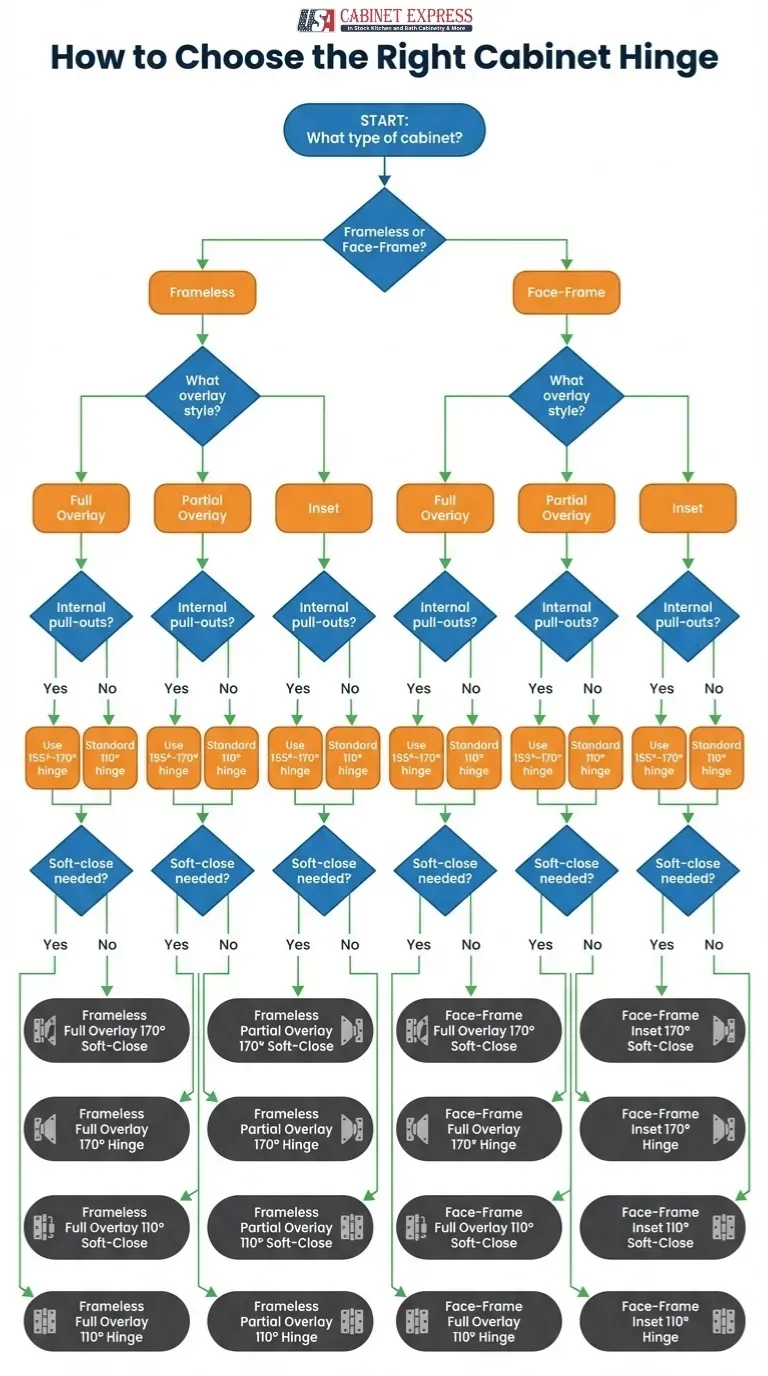
| Opening Angles | 95°, 110°, 120°, 155°, 165°, 170° | 110° default; 155°+ for pull-out access |
| Adjustment Range | ±2 mm vertical, ±2 mm horizontal, ±4 mm depth | Premium hinges offer 6-way adjustment |
| Load Capacity | 5–8 kg per hinge (35 mm) | Add hinges for tall or heavy doors |
| Cycle Rating | 100,000–200,000 cycles | Grade 1 = 100,000 cycles minimum |
The Overlay Decision: Full, Partial, or Inset?
The “overlay” describes how much of the cabinet face the door covers:
Full Overlay (Straight Arm Hinge)
- Door covers the entire front edge of the cabinet side panel
- Creates the seamless look preferred in contemporary kitchens
- Standard for end-of-run cabinets or individual boxes
- Typical overlay: 1¼” (32mm)
Partial/Half Overlay (Half-Crank Arm)
- Used when two doors share a single partition wall
- Each door covers half the partition thickness
- The hinge arm has a slight bend to “crank” the door away from center
Inset (Full-Crank Arm)
- Door sits flush within the cabinet opening
- Creates a premium, furniture-quality aesthetic
- Requires precise reveals (typically 2-3mm)
- Most demanding installation; highest visual impact
Pro Tip from Our Installation Team: The “wiggle test” is the fastest way to assess hinge quality. Grasp the door near its free edge and attempt lateral movement—premium hinges from Blum, Hettich, and Grass will move the entire cabinet box before any play develops in the hinge pivot. Inferior hardware exhibits knuckle movement first, indicating excessive tolerance that will cause sagging within 6-12 months.
Soft-Close Technology: From Luxury to Standard
Soft-close mechanisms use fluid dynamics (typically silicone oil dampers) to decelerate the door before it strikes the cabinet face. What was once a premium upgrade has become an expected feature in quality cabinetry.
Integrated vs. Add-On Soft-Close:
| Type | How It Works | Cost | Best For |
|---|---|---|---|
| Integrated (Blum BLUMOTION, Hettich Silent System) | Damper built directly into hinge cup or arm | $9–20 per hinge | New installations, consistent performance |
| Add-On Dampers (Blum 973A Adapter) | Clips onto existing hinges | $6–10 each | Retrofitting existing cabinets |
| Cabinet-Mounted Dampers | Plunger installed inside cabinet corners | $2–8 each | Budget-friendly retrofits |
Critical Feature: Soft-Close Deactivation
Premium hinges include a switch to deactivate damping on individual hinges. Why? If a door is small and light, the resistance of two soft-close hinges may prevent it from closing completely—it will hang open. Deactivating one hinge balances the force.
Opening Angles: Matching Hardware to Application
The opening angle determines how far the door swings and whether internal pull-outs can clear the door frame:
| Opening Angle | Best Applications | Notes |
|---|---|---|
| 95° | Thick doors, blind corners, restricted spaces | Prevents collision with adjacent appliances |
| 110° | Standard cabinets (industry default) | Works for most applications |
| 120°–125° | Extended access needs | Slightly more clearance |
| 155°–170° (Zero Protrusion) | Cabinets with internal pull-outs, waste bins, roll-out trays | Door thickness won’t block drawer from extending |
When to Specify 155°+ Hinges: If your cabinet contains ANY internal organizer that extends past the door frame (trash pull-outs, spice racks, roll-out shelves), you MUST use wide-angle hinges. Standard 110° hinges will block the organizer from fully extending.
Section 2: Vertical Lift Systems—Transforming Wall Cabinet Ergonomics
Traditional side-hung doors on wall cabinets have a fundamental problem: when left open during food preparation, they project into the user’s workspace at head level. Vertical lift systems solve this by moving the door panel upward, parallel to, or over the cabinet.
The Blum AVENTOS Family: Industry-Leading Lift Systems
Blum’s AVENTOS represents the gold standard for lift systems, with options for virtually every wall cabinet configuration:
AVENTOS HK top (Stay Lift)
- Application: Standard wall cabinets 10-24″ tall
- Motion: Door pivots upward from the hinge point and stays at any angle
- Key Feature: Only 4 lift mechanism types cover ALL applications
- Best For: Above-refrigerator cabinets, range hood surrounds, standard wall units
AVENTOS HF top (Bi-Fold Lift)
- Application: Tall wall cabinets 18⅞” to 48″ tall
- Motion: Two-part door folds at center while lifting
- Key Feature: Handle remains within reach even when fully open
- Best For: Large pantry units, tall wall cabinets, limited headroom situations
AVENTOS HS top (Up-and-Over)
- Application: Cabinets 13¾” to 31½” tall, max door weight 47.3 lbs
- Motion: Single door swings up in an arc over the cabinet top
- Key Feature: Completely unobstructed view of interior; works with crown molding
- Best For: Dramatic reveals, cabinets with decorative cornices
AVENTOS HL top (Parallel Lift)
- Application: Appliance garages, cabinets 11¾” to 22¾” tall
- Motion: Door lifts straight up while remaining parallel to cabinet face
- Key Feature: Door doesn’t project into room—ideal where swing clearance is limited
- Best For: Counter-mounted appliance garages, units below other cabinets
AVENTOS HK-S and HK-XS (Compact Lifts)
- Application: Small cabinets above refrigerators, range hoods (heights as small as 7⅜”)
- Motion: Compact stay-lift mechanism
- Best For: Space-constrained installations where full-size mechanisms won’t fit
Power Factor: The Critical Calculation
Unlike hinges (specified by quantity), lift systems are specified by Power Factor (PF)—a torque calculation ensuring the spring mechanism properly supports the door weight.
The Formula:
Power Factor = Cabinet Height (mm) × Door Weight (kg)Important: Door weight MUST include handle weight (often doubled in safety calculations).
Example Calculation:
- Cabinet Height: 381mm (15 inches)
- Door Weight (including handle): 4.5 kg (≈10 lbs)
- Power Factor: 381 × 4.5 = 1,714.5
Consult manufacturer catalogs to find the mechanism covering this PF range. When values fall between two mechanisms, choose the stronger option—tension can be adjusted downward, but undersized mechanisms cause dangerous door drops.
Competitor Lift Systems Worth Considering
Grass Kinvaro Systems
- Kinvaro L-80 parallel lifter: Cabinets 13-25/32″ to 23-5/8″ tall
- Kinvaro T-Slim: Only 12mm thick—industry’s thinnest mechanism
- Integrated adjustable soft-close and stay-put functionality
Hettich Lift Advanced
- Gas-pressure-spring operation
- 3D door adjustment (±3mm)
- Compatible with 32mm system drilling
📞 Ready to Upgrade Your Kitchen Hardware?
At USA Cabinet Express, we stock Fabuwood, Wolf, Mantra, and other premium cabinet brands with quality hardware included. Our design team can help you specify the right mechanisms for your project.
Schedule a Free Design Consultation →
Visit a Showroom Near You:
- Texas: Austin • Dallas • Houston
- Virginia: Fairfax • Fredericksburg • Chesapeake
- Missouri: St. Louis
Section 3: Push-to-Open and Motorized Systems
Mechanical Push-to-Open (Blum TIP-ON)
For handleless kitchen designs, mechanical push-to-open systems allow doors to be opened with a gentle press anywhere on the door face.
How It Works:
- Spring-loaded plunger mounted in cabinet
- User presses door face (2mm activation)
- Catch releases; plunger pushes door open ~1½”
- User manually pulls door fully open
The Soft-Close Conflict (Solved): Early push-to-open systems couldn’t combine with soft-close—the spring pushing out conflicted with the damper resisting closure. Modern TIP-ON BLUMOTION solves this with a complex mechanical unit that allows push-to-open release but engages a damper when swinging shut.
Electrical Push-to-Open (Blum SERVO-DRIVE)
SERVO-DRIVE represents the premium option for hands-free cabinet operation:
Features:
- Touch sensors detect pressure anywhere on door front
- Electric motors power opening regardless of door weight
- BLUMOTION provides soft closing
- Operates on standard 110V outlets
- 19 feet of cable per unit
- Adjustable sensitivity with lean protection
- Manual operation during power outages
Best Applications:
- Waste/recycling drawer cabinets (knee-kick opening)
- Accessibility-focused kitchens (ADA compliance)
- High-end handleless designs
- Heavy lift systems where mechanical assistance benefits users
Investment: $100-250+ per application, plus electrical requirements
Section 4: Corner Cabinet Solutions—Recovering Dead Space
Corner cabinets represent the most challenging storage areas in any kitchen. Without specialized hardware, traditional fixed shelves access only 50% of available space. Modern solutions dramatically improve this.
Lazy Susan: The Classic Solution
Full-Circle (360° Rotation)
- For corner-to-corner cabinets
- Diameters: 18″ to 32″
- Weight capacity: 50-100+ lbs per shelf
- Materials: Polymer, maple, chrome wire
Kidney-Shaped
- Accommodates door clearance
- Fits standard L-corner cabinets
Pros: Simple installation, low cost ($50-200), familiar operation Cons: Items can fall during rotation, wasted vertical space, must reach and spin to access
Magic Corner / Blind Corner Pull-Outs: Superior Accessibility
How They Work:
- Door opens, pulling front baskets out of cabinet
- Front baskets pivot 90° outward
- Rear baskets simultaneously slide from blind section into opening
- Both basket sets are independently accessible
Key Products:
- Rev-A-Shelf 5PSP Series: Fits 15″, 18″, 21″ openings; 100 lb capacity; full-extension ball-bearing slides
- Häfele Magic Corner II: Includes Soft & Silent soft-close
Investment: $300-800 depending on configuration Result: 100% accessibility to stored items (vs. ~50% with lazy susan)
LeMans II (Swing-Out System)
The gold standard from Kesseböhmer features peanut-shaped trays that snake around the door frame on articulated arms, presenting completely outside the cabinet.
Specifications:
- Load capacity: 25 kg (55 lbs) per shelf
- Door opening widths: 400mm, 450mm, 500mm, 600mm
- Minimum internal height: 545mm for base units
- Shelves operate independently
Best For: Heavy cookware, stand mixers, blind corner cabinets requiring maximum accessibility
Section 5: Pocket Doors, Tambour, and Specialty Systems
Pocket Door Systems
Pocket doors slide horizontally into recessed compartments, completely disappearing when open.
Blum REVEGO (Industry Leader):
- Configurations: Single-door (uno) and double-door (duo)
- Width range: 450mm to 3000mm
- Height range: 1155mm to 3012mm
- Max door weight: 35 kg (77 lbs) per door
- Fixed pocket width: 100mm
- Cycle testing: 40,000 cycles (≈20 years)
- Features: Integrated TIP-ON push-to-open, BLUMOTION soft-close
Investment: $500-1,500+ for complete systems
Critical Planning Note: Pocket doors require structural planning to accommodate pocket depth—they CANNOT be retrofitted effectively. Plan during initial design.
Tambour Doors (Roll-Up Systems)
Tambour doors consist of slats riding in curved tracks, rolling up into a cabinet-top pocket or sideways into the wall.
Materials:
- Wood slats (maple, oak, cherry) with canvas backing
- Aluminum profiles for contemporary commercial aesthetics
- PVC/Polymer (REHAU RAUVOLET) for moisture resistance
Engineering Constraint: Track corner radius determines slat width—tighter curves require narrower slats. Standard minimum internal radius: 35.5mm (1.4 inches).
Best For: Appliance garages where no swing clearance exists, coffee stations, areas requiring 100% opening without door projection
Section 6: Quality Standards and Durability Ratings
ANSI/BHMA A156.9 Certification
For professional specification, ANSI/BHMA A156.9 (American National Standard for Cabinet Hardware) provides objective durability benchmarks:
| Grade | Cycle Requirement | Application | Recommended For |
|---|---|---|---|
| Grade 1 (Heavy Duty) | 100,000 cycles | Commercial / Institutional | Trash pull-outs, pantries, high-use doors |
| Grade 2 (Residential) | 50,000–75,000 cycles | Standard residential | Typical kitchen doors |
| Grade 3 (Light Duty) | 25,000 cycles | Furniture | Not recommended for built-in cabinetry |
Context: 100,000 cycles at 10 opens/day = approximately 27 years of service life.
European Standards Reference
| Standard | Coverage |
|---|---|
| EN 14749 | Domestic kitchen unit safety |
| EN 15570 | Hinge performance classes |
| EN 15706 | Sliding / roll-front fittings |
| EN 16014 | Locking mechanisms |
| EN 1116 | Coordinating kitchen sizes |
Section 7: Leading Manufacturers Compared
Premium Tier
| Brand | Origin | Key Products | Strengths | Warranty |
|---|---|---|---|---|
| Blum | Austria | CLIP top BLUMOTION, AVENTOS, SERVO-DRIVE | Industry default; 200,000-cycle testing; unmatched installer support | Lifetime (mechanical), 5 years (electrical) |
| Hettich | Germany | Sensys, Easys, WingLine | 80,000-cycle testing; Silent System; 35° auto-close angle | 20-year functional warranty |
| Grass | Austria / USA | Tiomos, Kinvaro, Dynapro | Adjustable soft-close tension; U.S. manufacturing facility | Competitive with Blum |
| Salice | Italy | Silentia+, Air, Exedra | First concealed self-closing hinge patent (1957); excellent value | ISO 9001 certified |
Price Comparison by Component
| Component | Budget | Mid-Range | Premium |
|---|---|---|---|
| Concealed hinge | $1–5 | $5–12 | $10–25 |
| Soft-close hinge | $3–6 | $6–12 | $12–20 |
| Specialty hinge (170°) | $8–15 | $15–20 | $18–30 |
| Lift system (complete) | $50–100 | $100–200 | $200–450 |
| Pocket system (complete) | — | $150–500 | $500–1,500+ |
🏠 Showrooms Across Texas, Virginia & Missouri
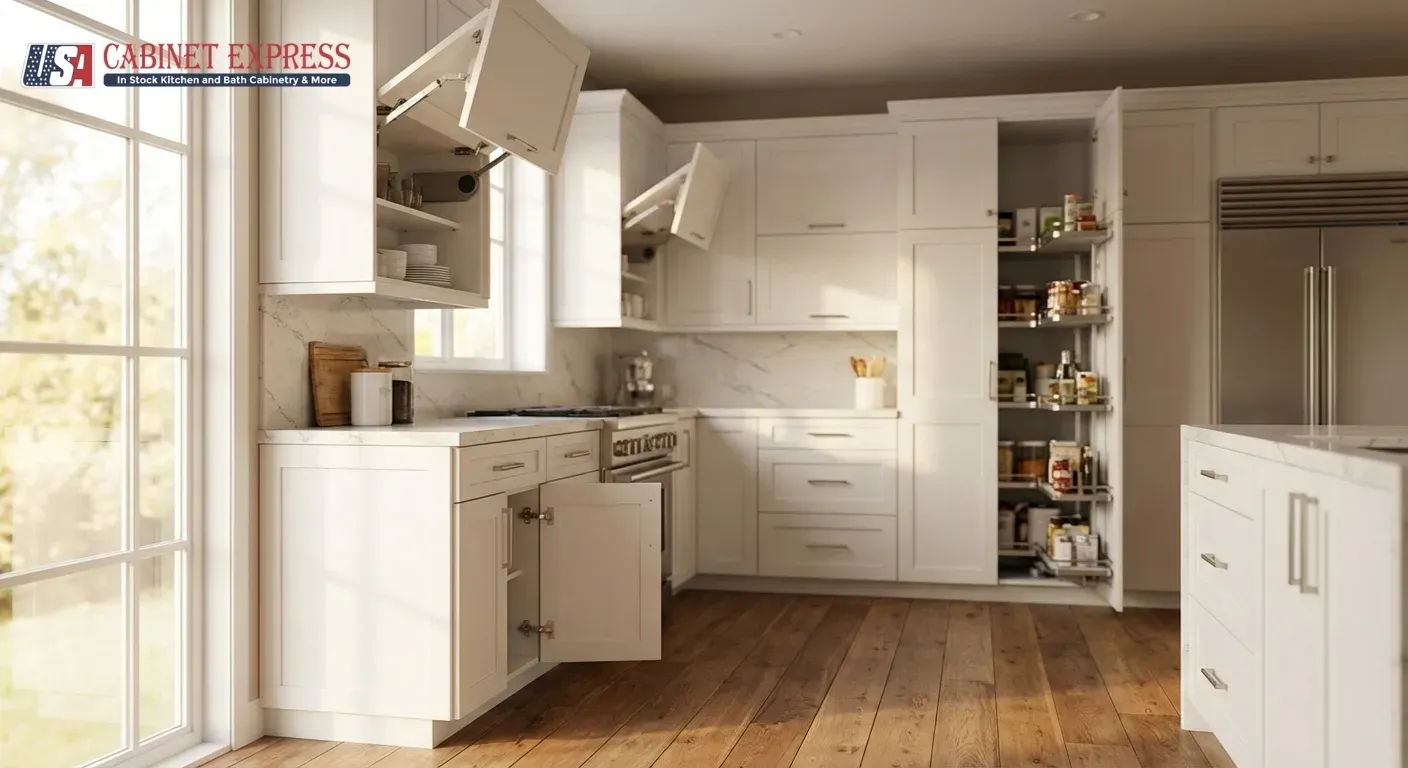
USA Cabinet Express operates showrooms nationwide. Visit us to see Fabuwood, Wolf, and Mantra cabinets with premium hardware in action.
Section 8: Application-Specific Selection Guide
Wall/Upper Cabinets
Default Recommendation: Lift-up systems (AVENTOS HK top for standard heights)
Why Lift Systems Beat Swing Doors:
- Doors stay up and out of the user’s trajectory
- Full interior visibility when open
- No head-level hazard during food preparation
- Handles remain accessible
Sizing Guide:
| Cabinet Height | Recommended System |
|---|---|
| 7⅜” – 15¾” | AVENTOS HK-S |
| 10″ – 24″ | AVENTOS HK top |
| 18⅞” – 48″ | AVENTOS HF top (bi-fold) |
| Appliance garage | AVENTOS HL (parallel) |
Base Cabinets
Industry Insight: Full-extension drawers outperform doors for base cabinet accessibility in nearly every application.
Why Drawers Win:
- Contents come TO you (no reaching into dark cavities)
- Handle heavy items more safely
- Better organization visibility
- Easier ADA compliance
Reserve Doors For:
- Sink bases (plumbing access)
- Trash/recycling with SERVO-DRIVE
- Under-counter appliance installations
Tall Pantry Cabinets
Doors 60-84″ tall require careful hinge planning:
| Door Height | Minimum Hinges | Notes |
|---|---|---|
| Under 40″ | 2 hinges | Standard |
| 40″ – 60″ | 2–3 hinges | Verify load |
| 60″ – 80″ | 4 hinges | Consider 1⅛” thick doors for stability |
| 80″ – 85″ | 5 hinges | — |
Alternatives: AVENTOS HF bi-fold, REVEGO pocket systems, multi-swing door configurations
Corner Cabinets
| Corner Type | Best Solution | Notes |
|---|---|---|
| Diagonal corner | Lazy Susan | General storage, lighter items |
| 45″ blind corner | Magic Corner / 5PSP | Pots, pans, heavy items |
| 48″ blind corner | LeMans II | Maximum accessibility |
| Budget-conscious | Basic blind pull-out | Compromised access but functional |
Section 9: ADA Compliance and Accessibility
Official ADA Requirements (2010 Standards)
Reach Ranges:
- Forward reach maximum: 48″ above floor (44″ if reaching over countertop)
- Minimum: 15″ above floor
- Requirement: 50% of storage within accessible range
Clearances:
- Pass-through kitchens: 40″ between opposing cabinets
- U-shaped layouts: 60″ minimum
- Clear floor space: 30″ × 48″ in front of fixtures
- Turning radius: 60″ minimum
Hardware That Improves Accessibility
| Solution | Benefit |
|---|---|
| SERVO-DRIVE electrical systems | Hands-free operation via touch activation (knee, hip, elbow) |
| D-shaped handles / lever hardware | Operation without tight pinching or twisting |
| Full-extension drawers with soft-close | Contents come to user; no reaching |
| Magic Corner pull-outs | Items present automatically when door opens |
| Pull-down wall cabinet shelves | Bring upper storage into accessible range |
Section 10: Professional Specification Checklist
Use this checklist for every kitchen project:
Pre-Design Assessment
- Cabinet construction type identified (frameless vs. face-frame)
- Overlay configuration determined (full, partial, inset)
- Door weights calculated (include material density + handle weight)
- All door dimensions documented (height, width, thickness)
- Ceiling heights and clearances measured
- Client accessibility needs assessed (current AND future)
- Budget parameters established
Mechanism Selection by Cabinet Type
- Wall cabinets: Lift system type specified based on Power Factor
- Base cabinets: Door vs. drawer strategy determined; soft-close throughout
- Tall pantries: Hinge count calculated; pocket/bi-fold considered
- Corners: Lazy susan, magic corner, or LeMans selected based on budget/use
- Appliance garages: Parallel lift, tambour, or pocket specified
- Islands: Heavy-duty hinges; push-to-open for clean appearance
Technical Verification
- Weight capacities exceed calculated loads
- Clearances confirmed for lift systems
- Opening angles appropriate for adjacent obstructions
- Electrical requirements planned (SERVO-DRIVE needs 110V)
- Temperature ranges considered (garage/outdoor kitchens)
- Hardware systems standardized for parts compatibility
Quality Assurance
- Minimum 80,000-cycle testing required for all hinges
- EN 15570 Level 3 or ANSI/BHMA Grade 1 specified for premium projects
- Integrated soft-close required (not add-on dampers)
- Warranty terms verified: Lifetime mechanical, 5+ years electrical
- 3D adjustability required on all concealed hinges

Common Mistakes to Avoid
❌ Undersizing hinge count for door weight—add extra hinges rather than risk sagging
❌ Forgetting handle weight in Power Factor calculations—multiply handle weight by 2 for safety margin
❌ Specifying lift systems without verifying clearances—insufficient ceiling space ruins installations
❌ Planning tambour doors as a retrofit—they must be designed from the start
❌ Specifying wider-than-tall doors—creates stability and sagging problems
❌ Mixing incompatible hardware brands—stick to single brand families where possible
❌ Skipping soft-close on high-use cabinets—callbacks from slamming doors are expensive
Frequently Asked Questions (FAQs) for Kitchen Cabinet Door Opening Mechanisms
What’s the difference between soft-close hinges and regular hinges?
Soft-close hinges contain an integrated hydraulic damper that catches the door approximately 2″ before closing, then guides it silently to the frame regardless of closing force. Regular hinges allow the door to slam shut. Modern soft-close mechanisms (like Blum BLUMOTION) adapt to closing speed—slam the door, and they provide maximum resistance; push gently, and they yield easily.
How many hinges do I need per cabinet door?
The general rule is one hinge per 10-15 lbs of door weight:
- Doors under 40″ tall: 2 hinges
- Doors 40-60″ tall: 2-3 hinges
- Doors 60-90″ tall: 3 hinges
- Doors over 90″ tall: 4+ hinges
Always exceed minimum counts for heavy solid-wood or glass doors.
Are Blum hinges worth the extra cost?
Yes, for most applications. Blum hinges are tested to 200,000 cycles (vs. 25,000-50,000 for budget options), include superior 3D adjustability, and come with lifetime warranty on mechanical components. The price difference per door ($5-15 more) is insignificant compared to the callback cost of replacing failed budget hardware within 2-3 years.
Can I add soft-close to my existing cabinets?
Yes, through several methods:
- Hinge-mounted adapters (Blum 973A) clip onto existing concealed hinges ($6-10 each)
- Cabinet-corner dampers mount inside the cabinet ($2-8 each)
- Full hinge replacement with integrated soft-close ($9-20 per hinge)
Add-on solutions work best with self-closing hinges. For optimal performance, full replacement is recommended.
What are push-to-open cabinets, and should I get them?
Push-to-open mechanisms allow handleless cabinet doors to be opened by pressing anywhere on the door face. A spring-loaded mechanism releases the door with about 2mm of pressure. They’re ideal for:
- Sleek, contemporary designs without visible hardware
- Accessibility applications (easier than grasping handles)
- Areas where handles would interfere with workflow
Modern systems (TIP-ON BLUMOTION) combine push-to-open with soft-close. For premium applications, electrical SERVO-DRIVE provides the smoothest operation.
Why do my cabinet doors sag after a few years?
Door sagging typically results from:
- Insufficient hinge count for door weight
- Low-quality hinges with excessive pivot tolerance
- Improper installation (screws not fully seated, wrong mounting plates)
- Substrate failure (particleboard screw holes stripping)
Quality hinges with proper installation should maintain alignment for 20+ years. If sagging occurs, the solution is usually upgrading to premium hinges with proper mounting plate systems.
What’s the best corner cabinet solution?
It depends on your budget and priorities:
- Best accessibility: Magic Corner II or Rev-A-Shelf 5PSP ($300-800)—provides 100% access to contents
- Best value: Lazy Susan ($50-200)—simple, familiar, adequate for lighter items
- Premium option: LeMans II ($400-700)—55 lb capacity per shelf, ideal for heavy cookware
- Budget minimum: Basic blind corner pull-out—better than fixed shelves
Do I need wide-angle hinges (155°+)?
Yes, if your cabinet contains ANY internal organizer that extends past the door frame:
- Roll-out shelves or trays
- Trash/recycling pull-outs
- Spice racks
- Wire baskets
Standard 110° hinges will block these organizers from fully extending. Specify 155° or 170° “zero protrusion” hinges for these applications.
How do lift-up cabinet doors work?
Lift systems use counterbalanced spring mechanisms to support door weight while allowing smooth upward motion. The Power Factor (Cabinet Height × Door Weight) determines which mechanism strength you need. Premium systems like Blum AVENTOS include soft-close and can be combined with push-to-open (TIP-ON) or electrical assist (SERVO-DRIVE).
What’s the 32mm system I keep hearing about?
The “System 32” (also called “32mm system” or “European system”) is a cabinet construction standard where mounting holes are drilled in a 32mm grid pattern, with a common 37mm setback from edges for hardware plates. This standardization allows interchangeability between manufacturers and simplifies CNC programming for production. Most European concealed hinges are designed around this system.
Are motorized cabinet systems reliable?
Modern electrical systems like Blum SERVO-DRIVE are highly reliable:
- Touch sensors detect pressure anywhere on door front
- Include collision detection (stops if obstruction hit)
- Manual override available during power outages
- 5-year warranty on electrical components
- Low-voltage (24V) operation for safety
They’re particularly valuable for accessibility applications, heavy lift systems, and hands-free operation (ideal for trash drawers when your hands are dirty).
Conclusion: Strategic Hardware Selection Delivers Lasting Value
Cabinet door mechanisms represent a relatively small portion of kitchen project budgets but disproportionately affect daily user experience over the 20+ year lifespan of quality cabinetry. Investing in premium mechanisms from established manufacturers prevents the most common sources of customer dissatisfaction—sagging doors, failed soft-close, and worn hinges.
The most significant shift in cabinet design is the recognition that lift systems and full-extension drawers fundamentally outperform traditional swing doors for both wall and base cabinet applications. While these mechanisms add $100-400 per cabinet, they transform daily kitchen ergonomics and support aging-in-place needs.
Three factors deserve particular attention in 2025 specifications:
- Handleless push-to-open designs continue gaining market share, requiring TIP-ON or SERVO-DRIVE specification
- Accessibility considerations should be addressed proactively—universal design features benefit all users
- SERVO-DRIVE electrical systems have matured for mainstream consideration in premium projects
Professionals who master mechanism selection—matching system type to application, calculating Power Factors accurately, and specifying appropriate quality tiers—deliver kitchens that function beautifully for decades.
Ready to Transform Your Kitchen?
At USA Cabinet Express, we combine premium Fabuwood, Wolf, and Mantra cabinetry with industry-leading hardware. Our design team understands the technical details that make kitchens function beautifully for decades.
Why Choose USA Cabinet Express?
✅ Expert Design Consultation — We help you specify the right mechanisms for every cabinet
✅ Premium Hardware Included — Soft-close hinges and quality drawer slides standard
✅ In-Stock Cabinets — No waiting, no back-orders
✅ Best Price Guaranteed — Quality without breaking the bank
✅ FREE 3D Design Service — Visualize your dream kitchen before committing
📞 Schedule Your Free Kitchen Design Consultation
Visit usacabinetexpress.com or contact your nearest showroom:
Texas Locations
| Location | Address | Phone |
|---|---|---|
| Austin | 2112 Rutland Dr #185, Austin, TX 78758 | (469) 336-9201 |
| Dallas | 2650 Lombardy Ln Ste S, Dallas, TX 75220 | (469) 990-2200 |
| Houston | 27718 Interstate 45 N, Oak Ridge North, TX 77385 | (281) 306-6060 |
Missouri Location
| Location | Address | Phone |
|---|---|---|
| St. Louis | 2605 S Hanley Rd, Saint Louis, MO 63144 | (314) 900-0440 |
Quality cabinets. Expert guidance. Hardware that lasts.
This guide was prepared by the design team at USA Cabinet Express, drawing on decades of combined experience installing kitchens across the country. For project-specific recommendations, contact your nearest showroom.
Related Articles: