

Every cabinet seller claims sustainability. FSC logos, green leaf icons, phrases like “eco-friendly materials” scattered across product pages. But strip away the marketing, and most buyers have no framework for comparing one door style’s environmental footprint against another.
That’s a problem. Over 9.8 million tons of old cabinets reach U.S. landfills each year, and 61% of homeowners now rank sustainability among their top three renovation priorities, according to the National Association of Home Builders. Demand is there. The measurement tools are not.
This article gives you the tools. We break down the specific, measurable criteria that separate a durable, low-impact cabinet door from one destined for a dumpster in seven years. If you’re comparing cabinet door styles with sustainability in mind, these metrics should be your starting point.
9.8M
tons of cabinets landfilled yearly
61%
homeowners rank sustainability top 3
$16.5B
sustainable cabinet market by 2030
The 5 metrics that matter
Material efficiency
% of raw substrate that becomes usable door vs. scrap waste. Slab: 5–10% waste. Shaker: 15–25%.
VOC emissions profile
Certification tier from CARB 2 → NAUF → GREENGUARD Gold. Finish target: under 50 g/L VOCs.
Trend resilience
How many years this style has stayed relevant. The door you don’t replace is the greenest door.
Repairability
Count of independently repairable parts. Shaker = 5 components. Slab = 1 (whole door).
Lifecycle cost / year
Total door cost ÷ realistic lifespan. Below $5/yr = competitive. Below $3/yr = excellent.
Door-by-door scorecard
| Door style | Material eff. | VOC profile | Trend score | Repairability | $/year |
|---|---|---|---|---|---|
| Shaker (5-piece) | 3/5 | 4/5 | 5/5 | 5/5 | $3.50–$5.00 |
| Slab / Flat-panel | 5/5 | 3/5 | 4/5 | 2/5 | $3.00–$6.00 |
| Raised panel | 2/5 | 4/5 | 3/5 | 4/5 | $4.00–$5.50 |
| Fluted / Reeded | 4/5 | 3/5 | 3/5 | 2/5 | $4.50–$7.00 |
| Glass-panel accent | 3/5 | 4/5 | 4/5 | 3/5 | $5.00–$8.00 |
Moderate (3)
Weak (1–2)
Certification hierarchy — know what each one actually tests
CARB Phase 2
Formaldehyde limits only. 0.09 ppm plywood / 0.11 ppm MDF. Federal law — every U.S. cabinet should meet this.
NAUF / ULEF
No Added Urea Formaldehyde or Ultra-Low Emitting (<0.05 ppm). Eliminates the primary formaldehyde source entirely.
GREENGUARD Gold
Tests 10,000+ compounds. Formaldehyde ≤7.3 µg/m³. Total VOCs ≤220 µg/m³. Covers what you actually breathe.
KCMA ESP
Audits the entire factory: waste, energy, emissions, community impact. Annual renewal required. Only cert that checks the operation, not just the product.
FSC (Forest Stewardship Council)
Verifies timber origin from responsibly managed forests. Covers raw materials only — does not test emissions or manufacturing.
30-year cost comparison — 30-cabinet kitchen
Option A — Budget
Thermofoil slab on particleboard
Per door
$55
Lifespan
8–10 yr
Cost/yr
$5.50+
30-yr total
$4,950
3 replacement cycles · CARB 2 only · Non-refinishable
Option B — Sustainable
FSC plywood Shaker, low-VOC finish
Per door
$115
Lifespan
25–30 yr
Cost/yr
$3.83
30-yr total
$4,200
1 cycle + 1 refinish · GREENGUARD Gold · Saves $750
Ready to compare? Bring these metrics to your next consultation.
Download the full buyer’s checklist in the article above or schedule a free design consultation.
usacabinetexpress.com
Putting the Metrics to Work: A Buyer’s Checklist
Bring these questions to your next design consultation or supplier conversation. They’ll separate credible sustainability claims from surface-level marketing in under ten minutes.
- What percentage of substrate becomes scrap during door production? (Target: below 15%)
- Does the finished product hold CARB Phase 2 compliance? If so, does it also carry GREENGUARD Gold?
- What adhesive system does the core material use—urea-formaldehyde, phenol-formaldehyde, or soy-based?
- Is the finish water-based or solvent-based? Can the supplier provide a VOC emissions data sheet?
- What is the manufacturer’s realistic lifespan estimate under normal residential use?
- Can individual door components (panels, rails, stiles) be repaired or refinished without full replacement?
- For slab or MDF doors: is the edge banding solvent-free PUR or 1–2mm ABS plastic? (Thin 0.4mm iron-on tape chips and admits moisture, shortening door life.)
- Is the wood FSC-certified? Is the manufacturer KCMA ESP certified?
- What is the total cost per door (including hardware) divided by expected lifespan?
If a supplier can’t answer most of these, that tells you something. The ones who build genuinely sustainable products know their numbers and share them willingly.
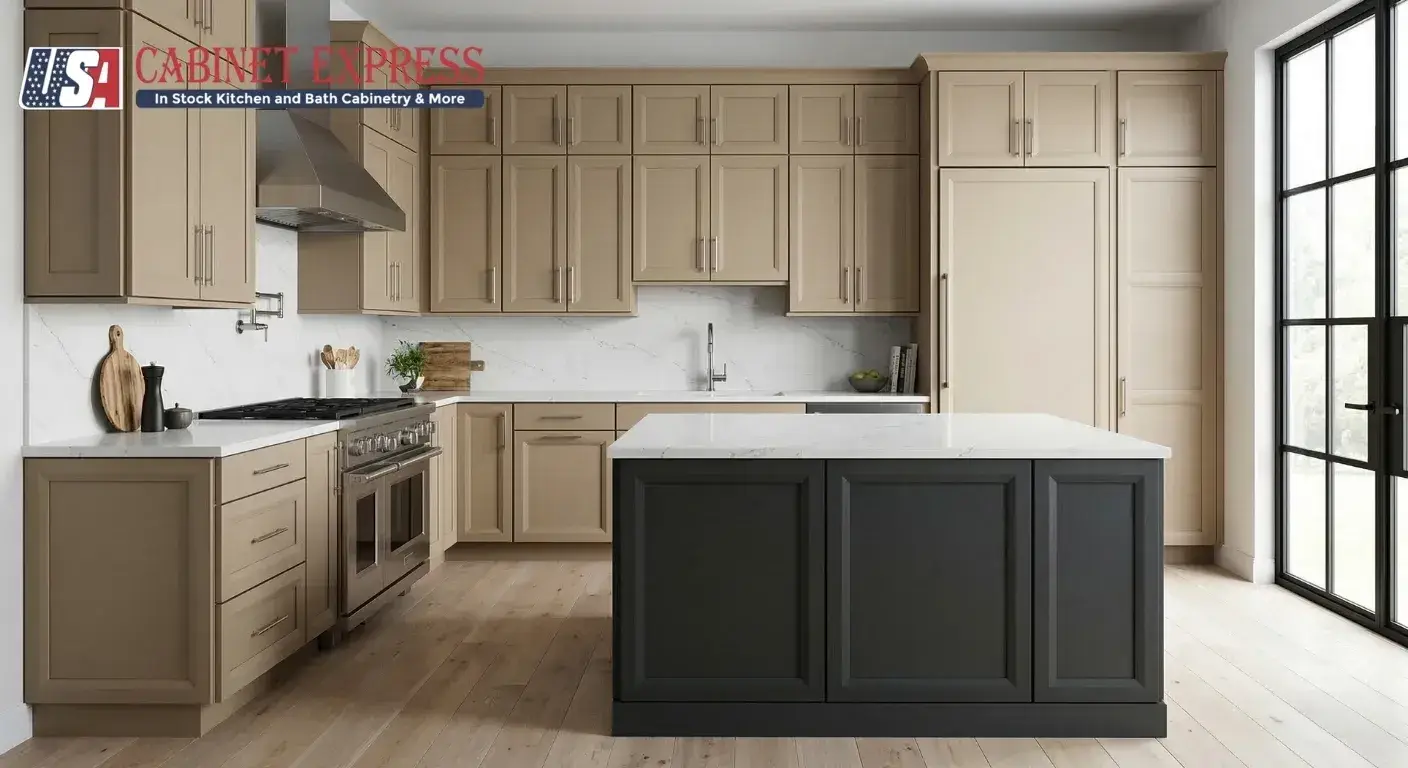
The Five-Metric Framework for Door Style Sustainability
Sustainability in cabinetry isn’t one thing. It’s at least five. Each can be scored, compared, and verified—no green-leaf icon required.
1. Material Efficiency Ratio
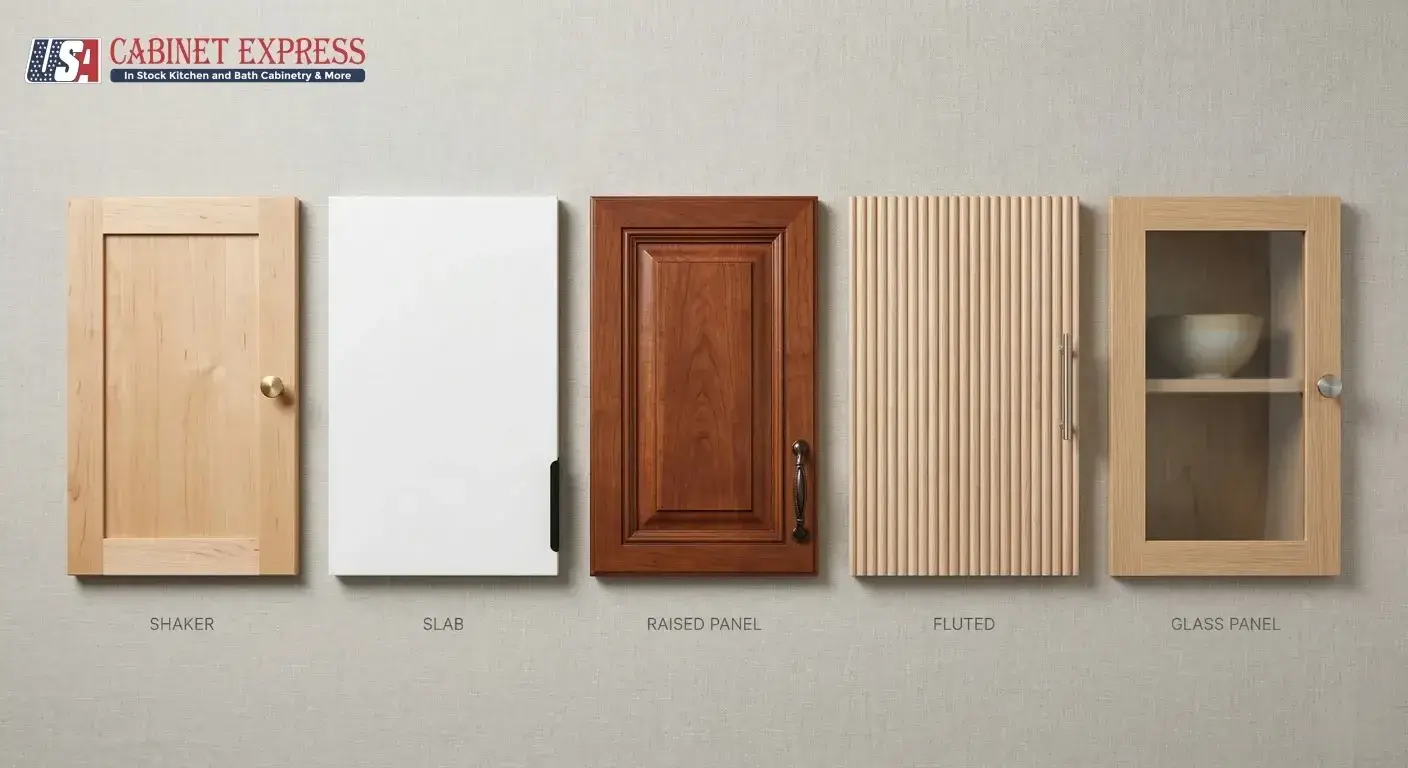
How much raw material goes in versus how much usable door comes out. A slab (flat-panel) door cut from a single engineered sheet wastes 5–10% of the substrate. A five-piece Shaker door, with its separate frame rails, stiles, and floating center panel, generates 15–25% waste during milling and joinery. Raised panel doors sit even higher—the routing process for the beveled center panel alone adds another 8–12% in offcuts.
Does that make slab doors automatically greener? Not necessarily. The waste number is just one input. A Shaker door made from FSC-certified maple that lasts 30 years may beat a slab door made from imported MDF that warps in 10. But if two doors use identical materials, the one generating less manufacturing waste carries a lower embedded environmental cost. Period.
How to score it: Ask your supplier what percentage of substrate becomes scrap during production. Anything below 12% is strong. Above 20% should come with a good reason—like exceptional durability or repairability.
2. VOC and Chemical Emissions Profile
Volatile organic compounds off-gas from adhesives, finishes, and core materials. They contribute to indoor air pollution, and in a room where you cook and eat, exposure adds up fast. The numbers are stark: solvent-based lacquers emit 380–450 grams of VOCs per liter. Water-based and UV-cured finishes come in under 50 g/L—a reduction of roughly 90%.
The baseline standard is CARB Phase 2 compliance, which caps formaldehyde emissions at 0.09 ppm for hardwood plywood and 0.11 ppm for MDF. Every cabinet sold in the U.S. should meet this—it’s federal law—but it’s a floor, not a ceiling. Two stricter tiers exist above it: NAUF (No Added Urea Formaldehyde) eliminates the primary formaldehyde source entirely, and ULEF (Ultra-Low Emitting Formaldehyde) certifies emissions below 0.05 ppm. If a supplier offers NAUF or ULEF cores at a reasonable upcharge, that’s worth the investment.
GREENGUARD Gold certification, issued by UL Environment, is the most rigorous indoor air quality test available for cabinetry. It tests finished products for over 10,000 individual VOCs and sets strict thresholds: formaldehyde must fall below 7.3 µg/m³, and total VOCs below 220 µg/m³. The KCMA Environmental Stewardship Program (ESP) goes further still, auditing supply chain practices, waste reduction, and energy use—not just what the finished product emits.
Door style matters here. Slab doors with thermofoil wraps rely on heat-activated adhesives that can off-gas at higher rates than a clear-coated natural wood-grain door. Painted Shaker doors depend entirely on the finish. And a third option is gaining ground: UV-cured finishes, which harden instantly under ultraviolet light rather than slow chemical evaporation. UV-cured coatings trap micro-emissions during the curing process and produce exceptionally scratch-resistant surfaces—a durability-plus-air-quality combination that solvent-based finishes can’t match.
How to score it: Rank by certification tier. No certification = red flag. CARB 2 only = baseline. NAUF/ULEF = strong. GREENGUARD Gold = best for IAQ. KCMA ESP = best for full supply chain. Then check the finish: demand the VOC content in grams per liter. Anything under 50 g/L is the target.
3. Trend Resilience Index
The greenest cabinet door is the one you keep. A style that feels dated five years after installation drives premature replacement—more material, more labor, more landfill waste—regardless of how sustainably it was built.
Shaker-style doors have survived over a century of design trends and still command roughly 50% of the residential market. That track record is itself a sustainability metric. Slab doors are gaining ground (69% of design professionals call flat-panel styles “growing” in 2026), but they don’t have the multi-generational data yet. Raised panel doors, once the standard in traditional kitchens, now trend downward in specifications—a risk factor for anyone building a kitchen they plan to keep for 15+ years.
Fluted and reeded door profiles fall in between. They’re trending in 2026, but the texture helps hide scuffs and fingerprints, which may give them practical staying power beyond the trend cycle.
How to score it: Rate each style on a 1–5 scale based on historical longevity and current trajectory. A Shaker door earns a 5. A raised panel earns a 3. A novelty profile with no track record earns a 1. Multiply by intended kitchen lifespan to weight appropriately.
4. Repairability and Component Replacement
When part of a door gets damaged, can you fix just that part? Or does the entire door need replacing?
Five-piece doors (Shaker and raised panel) have an advantage here. A scratched center panel can be refinished without touching the frame. A cracked rail can be replaced individually by a skilled carpenter. The modular construction means partial repairs are possible.
Slab doors are the opposite. Damage to any part of the surface—a deep gouge, a chip in a thermofoil wrap, a burn mark—typically means replacing the whole door. There’s no seam, no separate component to swap. For a solid-wood slab, sanding and refinishing works. For an MDF slab with a laminate or thermofoil finish, the repair options narrow sharply.
Glass-panel accent doors create a mixed picture. The glass insert is replaceable. But the frame holding it is often a specialty piece—harder to source and more expensive to match if it cracks.
How to score it: Count the number of independently repairable components. Shaker = 5 components (2 rails, 2 stiles, 1 panel). Slab = 1 component (the whole door). More repairable parts = higher sustainability score, because each repair avoids a full replacement cycle.
5. Lifecycle Cost Per Year
Upfront price is misleading. A $45 thermofoil slab door that peels in 8 years costs $5.63 per year. A $120 FSC-certified solid maple Shaker door that lasts 30 years costs $4.00 per year. The “cheap” option is actually 41% more expensive in real terms—and that’s before counting the environmental cost of manufacturing and disposing of 2.75 extra doors over the same period.
This metric collapses material quality, construction method, and finish durability into a single comparable number. It rewards doors built to last and penalizes disposable construction that looks sustainable on a spec sheet.
How to score it: Divide total door cost (including hardware and installation labor) by the manufacturer’s realistic lifespan estimate. Compare across styles at the per-year figure. Below $5/year per door is competitive. Below $3/year is excellent.
Door-by-Door Sustainability Scorecard
Here’s how five common door profiles stack up across all five metrics, using a 1–5 scale where 5 is the most sustainable rating.
| Door Style | Material Eff. | VOC Profile | Trend Score | Repairability | Lifecycle $/yr |
| Shaker (5-piece) | 3 / 5 | 4 / 5 | 5 / 5 | 5 / 5 | $3.50–$5.00 |
| Slab / Flat-panel | 5 / 5 | 3 / 5 | 4 / 5 | 2 / 5 | $3.00–$6.00 |
| Raised Panel | 2 / 5 | 4 / 5 | 3 / 5 | 4 / 5 | $4.00–$5.50 |
| Fluted / Reeded | 4 / 5 | 3 / 5 | 3 / 5 | 2 / 5 | $4.50–$7.00 |
| Glass-panel Accent | 3 / 5 | 4 / 5 | 4 / 5 | 3 / 5 | $5.00–$8.00 |
Note: VOC scores assume best-in-class finish for each style. A Shaker door with a high-VOC lacquer would drop to a 2. Finish selection swings this metric more than door geometry does.
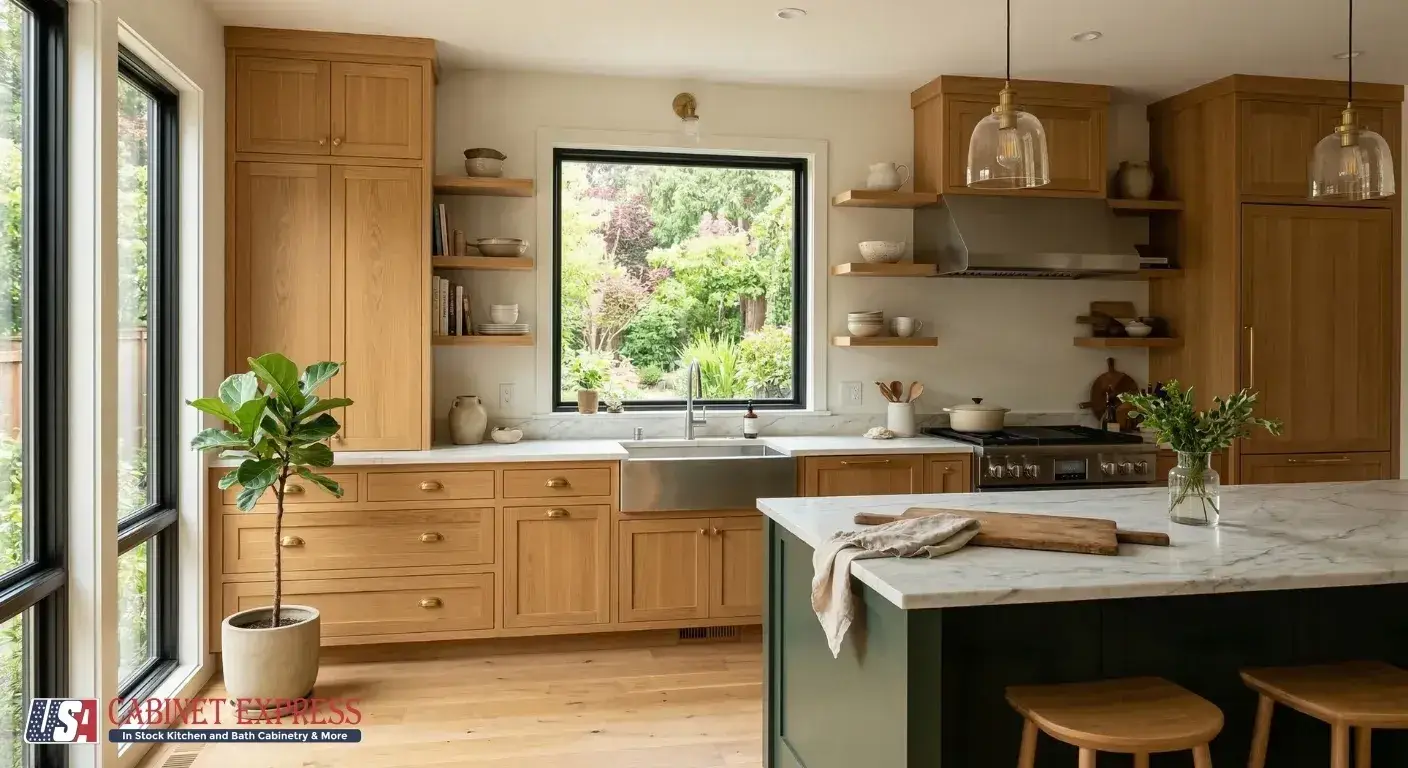
The Certification Decoder: What Each Label Actually Tests
Sustainability certifications are not interchangeable. Each one tests different things, covers different stages of the product lifecycle, and carries different weight with informed buyers.
| Certification | What It Tests | Scope | Why It Matters |
| FSC | Timber sourcing and forest management practices | Raw material origin only | Confirms wood came from responsibly managed forests; does not test final product emissions |
| CARB Phase 2 | Formaldehyde emissions from composite wood products | Manufacturing output | U.S. legal baseline; caps at 0.09 ppm (plywood) and 0.11 ppm (MDF) |
| NAUF / ULEF | No Added Urea Formaldehyde (NAUF) or Ultra-Low Emitting (<0.05 ppm) | Core substrate adhesives | Stricter than CARB 2; eliminates primary formaldehyde source entirely |
| GREENGUARD Gold | 10,000+ VOCs tested; formaldehyde ≤7.3 µg/m³, total VOCs ≤220 µg/m³ | Finished product as installed | Most rigorous IAQ test; covers what you actually breathe at home |
| KCMA ESP | Supply chain, waste reduction, energy use, emissions, and community impact | Manufacturer operations end-to-end | Only cert that audits the factory, not just the product; requires annual renewal |
The strongest sustainability claim stacks two or more: FSC-certified wood processed in a KCMA ESP facility and finished to GREENGUARD Gold standards. That combination covers sourcing, manufacturing, and the product you live with. One certification alone always leaves a gap. Brands like Fabuwood stack multiple certifications by design—eco-friendly manufacturing paired with their Q12 quality standard across 12 performance categories.
How Substrate Choice Affects Door Sustainability Scores
The material behind the door face drives three of the five metrics: material efficiency, VOC profile, and lifecycle cost. Here’s what each common substrate brings to the table.
Solid Hardwood (Oak, Maple, Cherry)
Expected lifespan: 30–50 years with proper care. Refinishable multiple times, which resets the appearance without replacing the door. FSC-certified options carry a 20–40% price premium over conventional lumber, but amortized over three decades, the annual cost difference is negligible. Solid wood also has the lowest formaldehyde risk since it contains no composite adhesives—though the finish still matters.
Plywood Core
Cross-laminated veneer layers make plywood more dimensionally stable than solid wood in humid kitchens. Manufacturing uses nearly the entire log, reducing raw material waste. Most plywood cores meet CARB Phase 2 by default, and low-VOC adhesive options are widely available. Lifespan: 20–35 years depending on veneer quality and finish. Budget-conscious options like Mantra cabinets offer plywood construction with a five-year warranty at an accessible price point.
MDF (Medium-Density Fiberboard)
Excellent for painted finishes—the surface is void-free and machines cleanly for Shaker profiles, raised panels, and fluted textures. The catch: standard MDF uses urea-formaldehyde resin, which off-gasses at higher rates than plywood. Moisture-resistant MDF performs better but costs 15–25% more. Lifespan: 12–20 years, shorter in high-humidity areas.
Bamboo
Reaches harvest maturity in 3–5 years versus 50+ for most hardwoods. Harder than red oak on the Janka scale. Sounds ideal, but sourcing matters enormously. Bamboo grown with heavy pesticide use and bonded with formaldehyde-based adhesives undercuts the sustainability story. Look for FSC-certified bamboo with documented low-VOC binders. Lifespan: 20–30 years.
Thermally Fused Laminate (TFL)
Laminate fused directly to a particleboard core without separate adhesive layers. Low cost, low waste, and low VOC emissions when the core meets CARB 2 standards. The trade-off: TFL doors are not refinishable. Damage means replacement. Lifespan: 8–15 years, which pushes the lifecycle cost-per-year higher than the sticker price suggests.
Reading the Trend Data: Where Sustainability Is Headed
The sustainable furniture market, including eco-friendly cabinetry, is projected to reach $16.48 billion by 2030, growing at 5.32% annually. That trajectory is changing what manufacturers prioritize. FSC-certified wood, low-VOC finishes, and plywood construction are moving from premium upsells to baseline expectations.
White oak—projected to capture 40% of the cabinet market by late 2026 according to the NKBA—is accelerating this shift. Its natural grain looks best with minimal finish: a clear oil or water-based topcoat that produces the lowest VOC emissions of any finishing approach. When the most popular aesthetic also happens to be the most chemically restrained option, the market takes notice.
Frameless (full-access) cabinet construction is gaining share for similar reasons. By eliminating the face frame, frameless boxes use 10–15% less material while delivering more interior storage. Paired with a low-waste slab door, the combined system pushes material efficiency higher than any framed configuration. These shifts align with the broader 2026 kitchen trend movement toward organic grounding and tactile luxury.
For dealers, contractors, and homeowners: these trends mean that sustainability metrics aren’t just ethical preferences. They’re becoming selection filters that affect resale value, insurance ratings, and code compliance. Measuring now positions you ahead of requirements that are clearly coming.
Seven Greenwashing Red Flags in Cabinet Marketing
Not every sustainability claim holds up. Watch for these patterns when evaluating cabinet suppliers and product listings.
“Eco-friendly” with no certification named. The phrase itself means nothing without a verifiable standard behind it. If the only evidence is a green logo the company designed itself, keep asking questions.
Single-attribute claims presented as total sustainability. A door made from reclaimed wood but finished with high-VOC lacquer isn’t comprehensively sustainable. It scores well on sourcing and poorly on emissions. Real sustainability requires multiple metrics passing simultaneously.
Expired or inherited certifications. KCMA ESP certification requires annual renewal and third-party audits. FSC chain-of-custody applies to specific product lines, not entire companies. Ask when the certification was last renewed and whether it covers the specific door model you’re evaluating.
“All-natural” materials with no emissions data. Solid wood is natural. It can also be coated with finishes that release harmful compounds for years. The material origin is one data point. The finished product’s emissions test is a different, equally important one. Formaldehyde occurs naturally in wood itself—what matters is the total off-gassing rate of the assembled door.
Durability claims without warranty backing. If a manufacturer claims a 25-year lifespan but offers a 1-year warranty, the numbers don’t align. The warranty tells you what the company actually stands behind. Use warranty length as a credibility check against lifespan marketing.
Sustainability messaging that ignores door construction. A company might promote its FSC sourcing while using stapled butt joints that fail in 5 years. Construction method determines durability, and durability is a core sustainability metric. Dovetail joints and dowel construction outlast stapled assembly by a factor of three or more. If the marketing doesn’t mention how the door is built, the omission is telling.
The hidden chemical risk in colored finishes. Research from the University of Iowa identified a hazard most buyers have never heard of: modern cabinet finishes—particularly those using yellow pigments in stains and paints—can emit polychlorinated biphenyls (PCBs) as manufacturing byproducts. PCBs are persistent, bioaccumulative toxins linked to cancer and immune suppression. The study found that PCB emissions from brand-new finished cabinetry were comparable to levels from pre-1970s electrical equipment. This is another reason to demand full emissions testing documentation, not just a material safety data sheet. If a supplier can’t tell you what’s in their pigments, consider that a red flag.
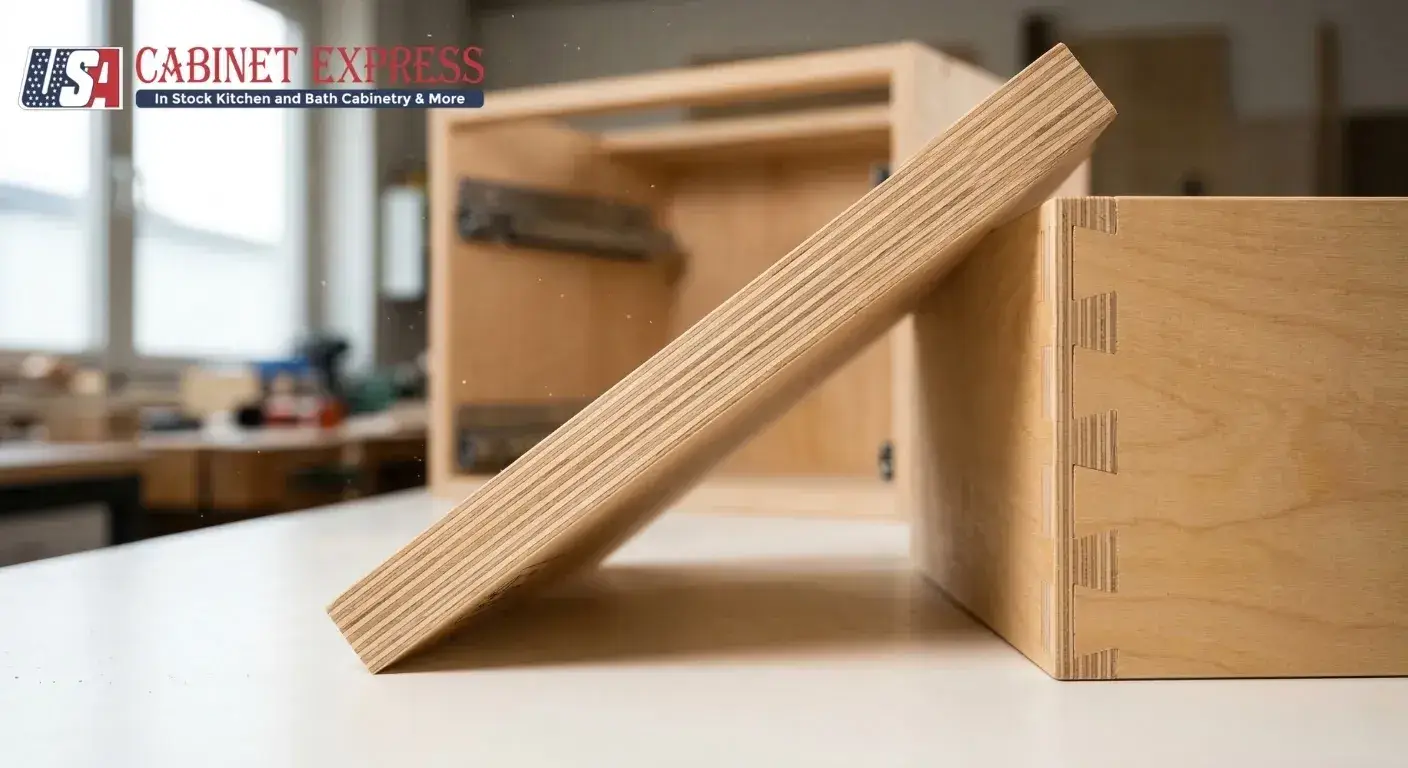
Running the Numbers: A Side-by-Side Example
To show how the framework works in practice, here’s a comparison between two real-world options for a standard 30-cabinet kitchen.
Option A: Thermofoil slab door on particleboard core. Cost per door (installed): $55. Realistic lifespan: 8–10 years. CARB 2 compliant. No additional certifications. Non-refinishable. Lifecycle cost per door per year: $5.50–$6.88. Total kitchen replacement cost over 30 years (assuming 3 cycles): $4,950.
Option B: Painted Shaker door on FSC-certified plywood core, water-based low-VOC finish. Cost per door (installed): $115. Realistic lifespan: 25–30 years. CARB 2 + GREENGUARD Gold certified. Refinishable twice. Lifecycle cost per door per year: $3.83–$4.60. Total kitchen cost over 30 years (1 cycle + 1 refinish at $25/door): $4,200.
Option B costs $750 less over 30 years, generates one-third the landfill waste, and exposes the household to measurably fewer chemical emissions. The upfront price difference of $1,800 is real, but it’s a down payment on 30 years of lower cost and lower environmental impact.
To put the carbon dimension in perspective: a Life Cycle Assessment of a complete circular kitchen by the Netherlands-based company Chainable measured a total carbon footprint of 1,330–1,590 kg of CO₂ equivalents. The primary emissions drivers were chipboard panel production and replacement cycles, followed by transportation for ongoing maintenance. That study found that transport alone accounted for roughly 32% of total greenhouse gas emissions—which means a locally sourced cabinet from a regional manufacturer carries a meaningfully smaller carbon footprint than an identical product shipped from overseas.
This is what metric-based evaluation does. It turns subjective “which is greener?” debates into math you can verify. For options that balance quality and budget, explore our affordable kitchen cabinets collection—many meet CARB 2 standards at prices that work for real renovation budgets.
Frequently Asked Questions
What is the best material for kitchen cabinet doors?
It depends on how you define “best.” For longevity and refinishability, FSC-certified solid hardwood (maple, cherry, white oak) leads with a 30–50 year lifespan. For dimensional stability in humid kitchens, plywood cores outperform solid wood. For budget-conscious projects that still meet sustainability standards, moisture-resistant MDF with a low-VOC painted finish hits a practical middle ground. The real answer: match the material to your climate, your maintenance tolerance, and how many years you plan to keep the kitchen.
How do I tell if kitchen cabinets are good quality?
Check five things. First, open a drawer and look at the joints—dovetail joints signal quality, stapled butt joints signal cost-cutting. Second, knock on the cabinet box—plywood sounds solid, thin particleboard sounds hollow. Third, test the drawer slides—full-extension, soft-close slides last 2–3 times longer than partial-extension hardware. Fourth, ask about the finish—multi-step catalyzed finishes resist chipping far better than single-coat spray jobs. Fifth, check for KCMA certification, which tests cabinets against five structural performance standards before granting a quality seal.
What does CARB Phase 2 certification mean for kitchen cabinets?
CARB Phase 2 is a California Air Resources Board regulation that limits formaldehyde emissions from composite wood products like MDF, particleboard, and hardwood plywood. Any cabinet sold in the United States using these materials must comply. It sets a maximum emission level of 0.09 ppm for plywood and 0.11 ppm for MDF. Think of it as the legal minimum for air quality safety—necessary but not sufficient. For stricter protection, look for GREENGUARD Gold, which tests over 360 chemicals beyond just formaldehyde.
Are eco-friendly kitchen cabinets more expensive?
Upfront, yes—typically 15–30% more than conventional options. An FSC-certified plywood Shaker door runs roughly $110–$130 installed versus $45–$65 for a thermofoil slab on particleboard. But lifecycle cost flips that equation. The sustainable option lasts 25–30 years; the budget option lasts 8–10 years. Over 30 years, the eco-friendly door actually costs $750 less for a 30-cabinet kitchen when you factor in replacement cycles. The cheaper door is only cheaper if you plan to move before it fails.
What is the most durable kitchen cabinet material?
Solid hardwood—particularly hard maple and white oak—ranks highest for raw durability, with Janka hardness ratings of 1,450 and 1,360 respectively. Bamboo surprises many people at 1,380—1,500, rivaling maple while growing to harvest maturity 10 times faster. For cabinet boxes (rather than doors), marine-grade plywood offers the best combination of moisture resistance and structural strength. The critical distinction: material hardness determines scratch and dent resistance, while construction method (dovetail vs. staple) determines how long the assembled cabinet holds together under daily use.
How long do kitchen cabinets last before needing replacement?
It varies enormously by material and construction. Solid hardwood cabinets with quality joinery: 30–50 years. Plywood-core cabinets with dovetail drawers: 20–35 years. MDF-core cabinets in dry climates: 15–20 years. Thermofoil on particleboard: 8–12 years. Laminate on particleboard: 8–15 years. These ranges assume normal residential use. High-humidity environments (near dishwashers, under sinks) shorten every material’s lifespan by 20–30%. The finish matters too—a cabinet refinished at year 15 can reset its appearance clock without replacing the structure underneath.
What is the difference between FSC, GREENGUARD, and KCMA ESP certifications?
Each certification tests a different part of the supply chain. FSC (Forest Stewardship Council) verifies that the raw wood was harvested from responsibly managed forests—it says nothing about what happens to the wood after it leaves the forest. GREENGUARD Gold, issued by UL Environment, tests the finished product as installed in your home: it measures emissions of 10,000+ individual chemicals and sets hard limits at 7.3 µg/m³ for formaldehyde and 220 µg/m³ for total VOCs. KCMA ESP (Kitchen Cabinet Manufacturers Association Environmental Stewardship Program) audits the manufacturer’s entire operation: energy use, waste reduction, emissions, and community impact—with required annual renewal. A fourth standard worth knowing is NAUF (No Added Urea Formaldehyde), which eliminates the primary formaldehyde source in composite cores entirely—stricter than the CARB 2 legal baseline. The strongest sustainability claim stacks at least two: FSC-certified material processed in a KCMA ESP facility, finished to GREENGUARD Gold standards, with NAUF composite cores.
Which cabinet door style is most sustainable: Shaker, slab, or raised panel?
No single style wins across every metric. Slab doors lead on material efficiency—they generate 5–10% waste versus 15–25% for Shaker and 20–30% for raised panel. Shaker doors lead on repairability (five separate components can be individually replaced) and trend resilience (over 100 years of continuous market presence). Raised panel doors offer strong repairability but carry a declining trend trajectory. Our scorecard approach rates Shaker highest overall because trend resilience is the most powerful sustainability lever—the door you never replace has the smallest environmental footprint regardless of how it was made.
Will low-VOC finishes compromise the look of my cabinets?
Not anymore. Five years ago, water-based finishes couldn’t match the depth and hardness of solvent-based lacquers. That gap has closed. Modern water-based catalyzed topcoats now deliver scratch resistance, sheen consistency, and color depth comparable to traditional conversion varnishes—while emitting under 50 grams of VOCs per liter versus 380–450 g/L for solvent-based alternatives. UV-cured finishes go a step further: they harden instantly under ultraviolet light, trapping micro-emissions during the curing process and creating surfaces that pass rigorous European DIN 68861 durability testing. The visual trade-off that once existed between eco-friendly and high-performance finishes is effectively gone.
Are RTA cabinets more sustainable than pre-assembled?
In two measurable ways, yes. First, flat-pack RTA (ready-to-assemble) cabinets require significantly less shipping volume than pre-assembled units. A single delivery truck can carry 3–4 times more RTA kitchens than assembled ones, cutting transportation emissions per kitchen by roughly 60–70%. Second, precision factory cutting for RTA components generates less waste than field-assembled construction—every panel is CNC-cut to exact dimensions with optimized nesting layouts. The trade-off is construction quality variance: a well-assembled RTA cabinet from a reputable manufacturer performs identically to a factory-assembled equivalent, but a poorly assembled one (wrong fastener torque, skipped glue steps) won’t. At USA Cabinet Express, our RTA lines ship flat-packed for lower emissions and arrive with pre-drilled precision joinery that simplifies assembly without sacrificing structural integrity.
Is cabinet refacing more eco-friendly than full replacement?
Substantially. Cabinet refacing preserves the existing cabinet boxes—which required an estimated 8–12 mature trees to produce for a standard kitchen—and replaces only the doors, drawer fronts, and hardware. Industry data suggests refacing eliminates roughly 2.3 tons of CO₂ per kitchen renovation compared to full tear-out and replacement. It also avoids the landfill impact: over 9.8 million tons of old cabinets reach U.S. landfills annually, and a full replacement kitchen contributes 500–800 pounds to that number. Refacing cuts material waste by 70–80%, costs 40–50% less, and finishes in 3–5 days rather than 3–5 weeks. If your cabinet boxes are structurally sound—plywood in good condition, no water damage, frames still square—refacing is the most sustainable renovation path available. It’s the lifecycle-cost-per-year metric in action: extending the useful life of existing materials beats replacing them with new ones, even if the new ones carry green certifications.
How long do new kitchen cabinets take to off-gas?
Covers the up-to-2-year formaldehyde timeline, explains why urea-formaldehyde resins are the worst offenders, and recommends NAUF/GREENGUARD Gold as the solution. This is one of the most emotionally charged questions in the forum research — parents and chemically sensitive buyers search this constantly.
Are standard cabinets from major brands truly eco-friendly?
Directly addresses the skepticism we found across every forum thread. The “CARB 2 is like passing a health inspection” analogy makes the compliance-floor vs. genuine-sustainability distinction instantly clear. No competitor article draws this line this sharply.
What is the most eco-friendly way to update kitchen cabinets?
Gives the sustainability hierarchy (repaint → reface → replace) that community consensus supports. This subtly reinforces your business model since USA Cabinet Express sells both new cabinets and serves the reface/upgrade market.
Final Thought
A green label on a cabinet door tells you someone paid for a certification. A set of measured metrics tells you whether the door actually earned it. Material efficiency, emissions profile, trend resilience, repairability, and lifecycle cost—these five numbers do more to predict real-world environmental impact than any single logo or claim.
Use them. Compare with them. Demand them from suppliers. When sustainability moves from a marketing message to a measured standard, everybody’s kitchen benefits.
Related: How to Choose Sustainable Kitchen Cabinet Door Styles for 2026 — Our companion buyer’s guide covering door profiles, materials, and finishes ranked by sustainability.
Ready to compare? Schedule a free consultation with a USA Cabinet Express expert and bring your sustainability checklist along.
USA Cabinet Express Showroom Locations
Austin, Texas • (469) 336-9201 • 2112 Rutland Dr #185, Austin, TX 78758
Chesapeake, Virginia • (757) 296-6669 • 1543 Sams Cir, Chesapeake, VA 23320
St. Louis, Missouri • (314) 900-0440 • 2605 S Hanley Rd, Saint Louis, MO 63144
Dallas, Texas • (469) 990-2200
Houston, Texas • (281) 306-6060
Fredericksburg, Virginia • (540) 515-1500
Hours: Mon–Fri 8AM–6PM, Sat 9AM–5PM, Sun Closed
Online: usacabinetexpress.com