

A $2 hinge doesn’t save you $4. It costs you $580. That’s the 10-year Total Cost of Ownership gap between budget and premium cabinet hardware — a number that accounts for extra installation labor, inevitable replacement parts, service calls, and cabinet carcass repairs. The price on the box is the smallest number in the equation. It’s also the only one contractors see before it’s too late.
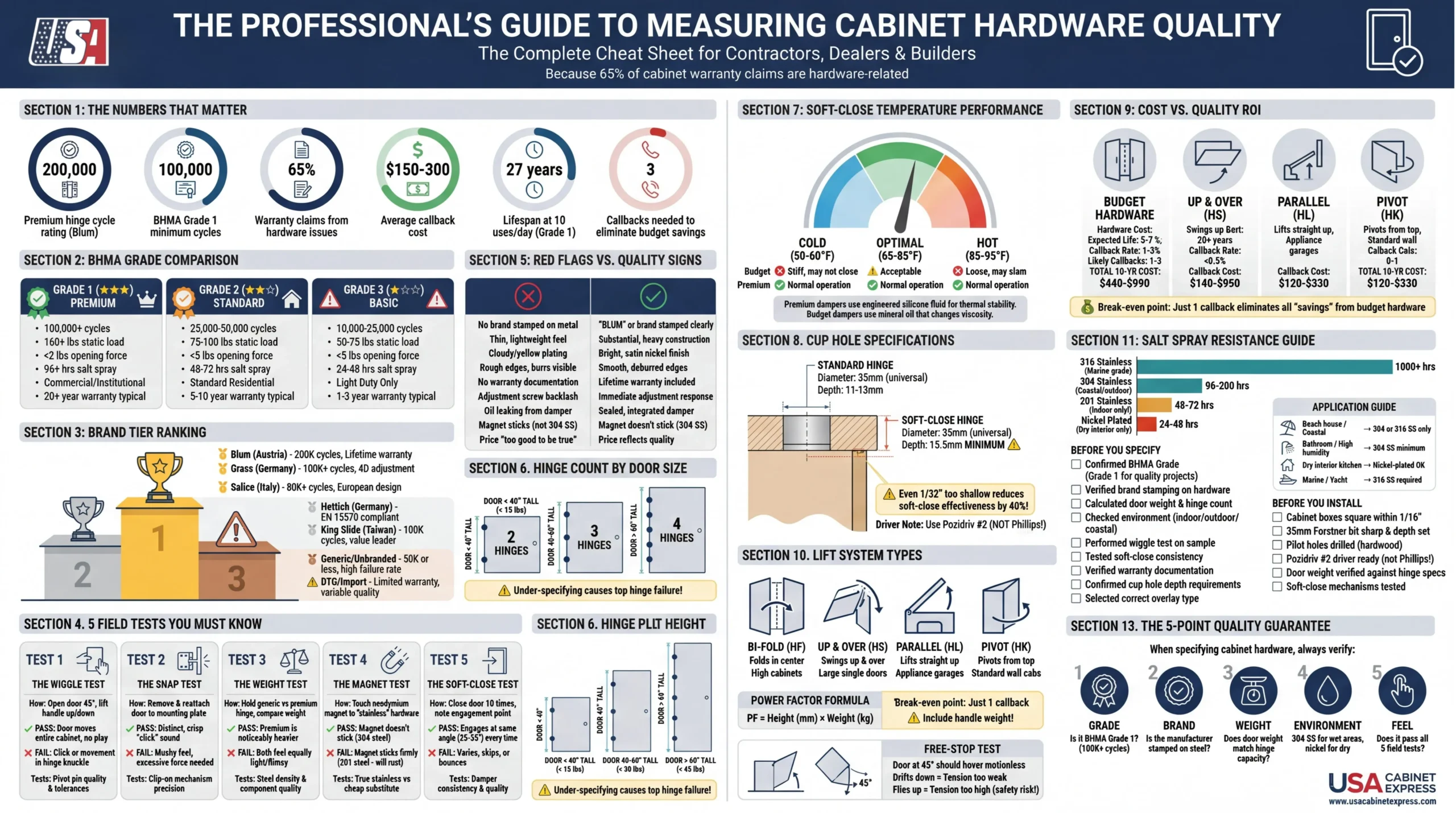
This article isn’t a spec guide. If you want brand-by-brand comparisons, cycle-test ratings, and field evaluation checklists, our Complete Guide to Measuring Cabinet Hardware Quality covers that ground. What follows is about what goes wrong — why the failures cascade far beyond the mechanism itself, and exactly how much they cost in dollars, time, and reputation.
10 Things Every Contractor Should Know About Cheap Cabinet Hardware
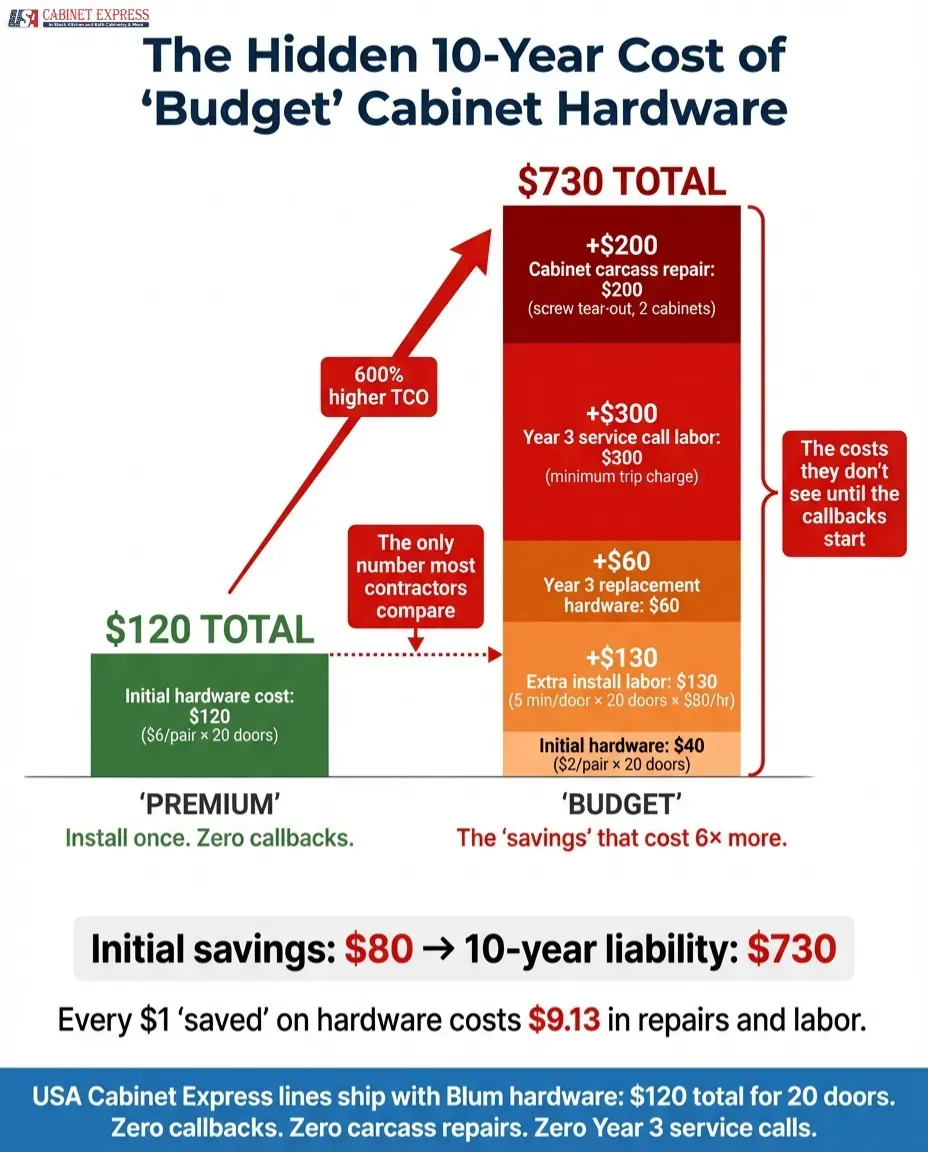
1. The 10-year cost gap is 600%. A 20-door kitchen with premium hardware totals $120 over a decade. The same kitchen with budget hardware accumulates $730 — in replacement parts, service calls, and cabinet repairs.
2. Kitchens destroy cheap hardware 3–5× faster than any other room. Thermal cycling (60°F to 100°F+), corrosive kitchen acids, and 100,000+ door cycles over 10 years create an environment budget hardware was never built to survive.
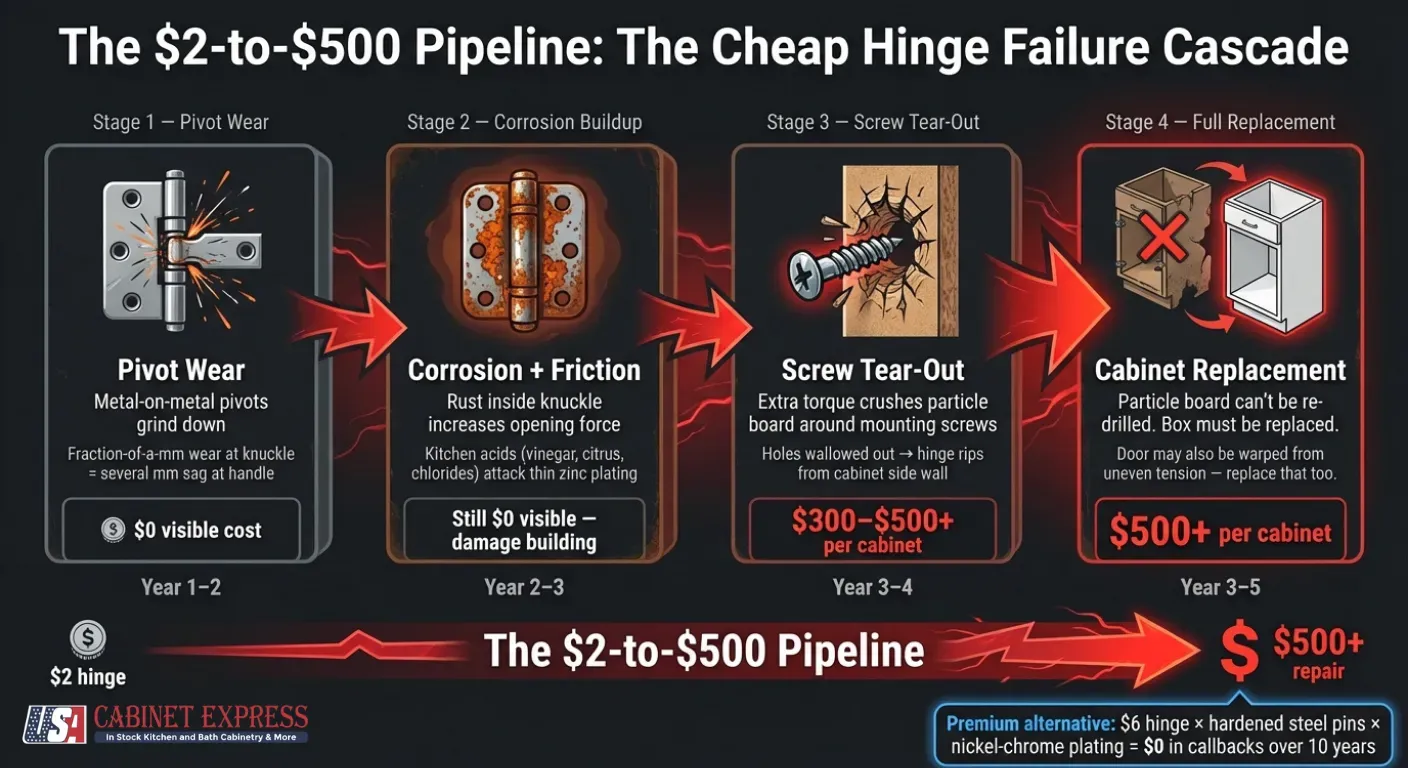
3. Cheap hinges don’t just fail — they rip the cabinet apart. Corroded knuckles increase friction, which amplifies torque on mounting screws, which tears out particle board. A $2 hinge becomes a $500+ cabinet box replacement.
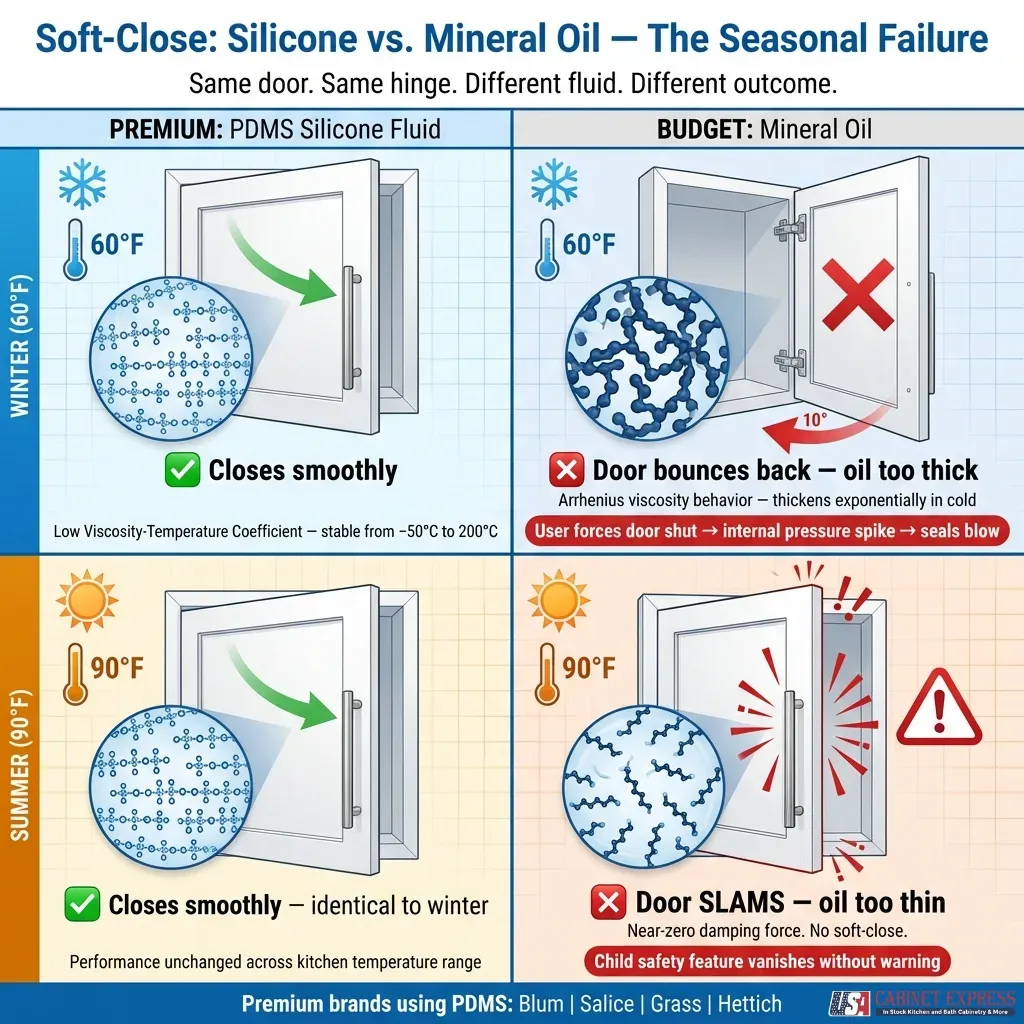
4. Soft-close failure is seasonal and instant. Budget dampers use mineral oil that thickens in winter (door bounces open) and thins in summer (door slams shut). Premium PDMS silicone fluid performs identically from −50°C to 200°C. No gradual decline — one season it works, the next it doesn’t.
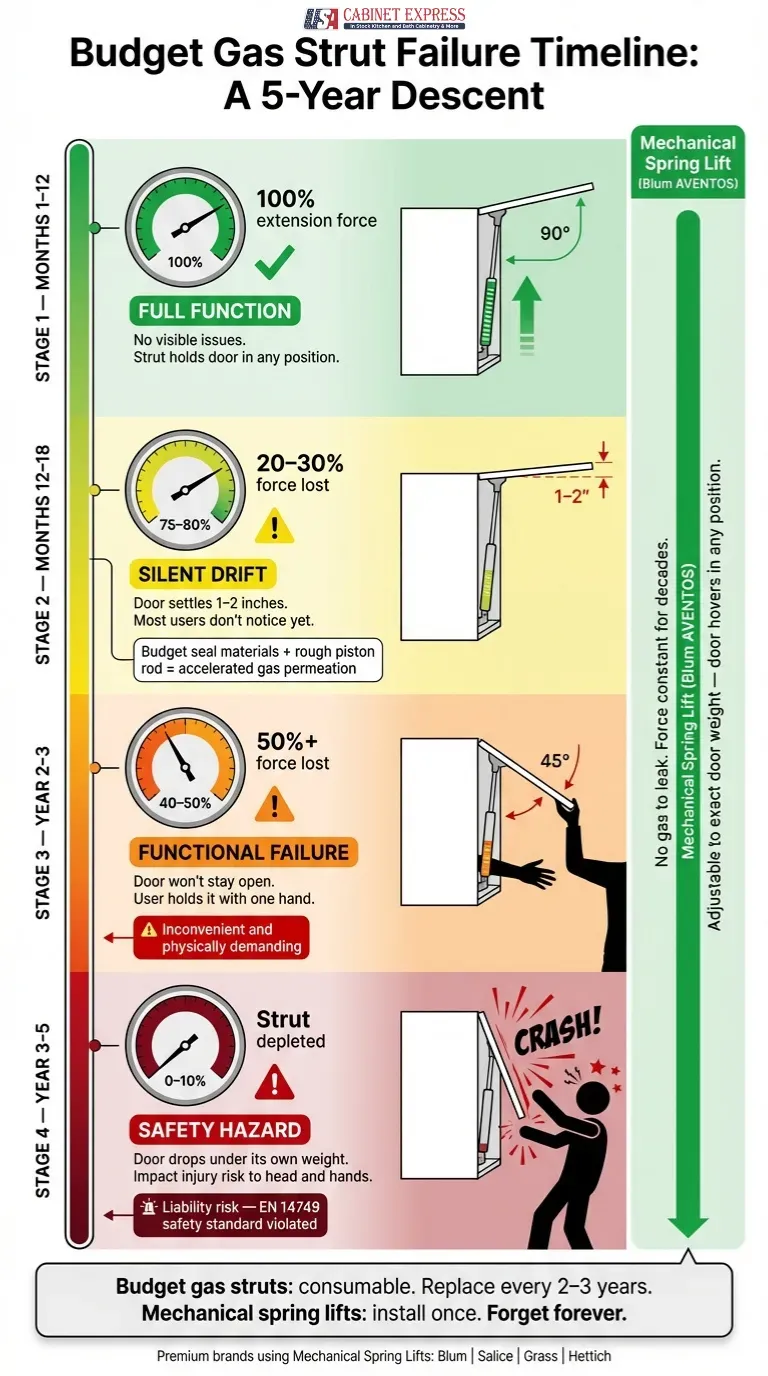
5. Gas struts lose 20–30% of their force within 12–18 months. By year 3–5, the door drops under its own weight. That’s a head-injury hazard on overhead cabinets and a liability for the contractor who installed them.
6. Budget hardware burns $130 in extra labor on Day 1. Slotted-hole adjustment takes 5 extra minutes per door. Across 20 doors at $80/hour, that wipes out every dollar “saved” on hardware before the first callback.
7. Die-cast zinc fractures without warning. Budget hinges use Zamak for complex shapes because it’s cheap to mold. Under load, it doesn’t bend like steel — it snaps, and the door detaches instantly.
8. Push-to-open plus self-closing hinges equals the “bounce” problem. The two spring systems fight each other. The door releases and immediately re-latches. The only fix is a purpose-built integrated system.
9. Drawer slides generate more callbacks than any other mechanism. Side-mount soft-close fails roughly 30% of the time out of the box. Undermount slides with integrated soft-close report zero callbacks across hundreds of installations.
10. If the spec sheet won’t name the hardware brand, walk. Named, traceable hardware from Blum, Grass, Hettich, or Salice — backed by BHMA or KCMA certification — is the single highest-ROI line item in any cabinet spec.
The Kitchen Is a Hostile Environment for Hardware
Before getting into specific failure modes, contractors need to understand why cabinet hardware fails faster in kitchens than anywhere else in the home. A kitchen isn’t a living room. It’s an environment that actively attacks mechanical components on three fronts.
Thermal cycling hits hardest. Cabinets near ovens, dishwashers, and cooktops swing from 60°F on a cold morning to over 100°F during heavy cooking. For mechanisms relying on fluid damping (soft-close hinges) or gas pressure (lift struts), those temperature swings change how the hardware behaves — budget hardware can’t compensate.
Chemical exposure runs second. The kitchen atmosphere carries corrosive agents that eat metal finishes: acetic acid from vinegar, citric acid from citrus, and chlorides from salt and cleaning sprays. Premium hardware mitigates this with nickel-chrome or zinc-nickel alloy plating and passivation layers. Budget hardware relies on thin, porous zinc coatings that corrode fast. And that corrosion isn’t cosmetic. Rust forming inside the hinge knuckle increases friction, stiffens operation, creates noise, and eventually destroys the hinge arm or pulls mounting screws out of the cabinet.
Cycle frequency finishes the job. A waste bin cabinet or cutlery drawer may open 20–30 times a day. Over 10 years, that’s over 100,000 cycles — the BHMA Grade 1 (Heavy Duty) threshold. Budget hardware, often untested or rated well below, experiences fatigue failure long before the decade mark.
Every failure mode described below is accelerated by this environment. Hardware that might last 5 years in a bedroom closet can fail in 18 months next to a dishwasher.
5 Red Flags That Scream “Cheap Hardware”
Before the engineering deep-dive, here are the instant warning signs every contractor should watch for during a cabinet evaluation:
- No named hardware brand on the spec sheet — If the manufacturer won’t tell you who made the hinges and slides, there’s a reason. Ask directly. Vague answers are their own answer.
- Cycle-test ratings under 50,000 — or no rating at all — A typical kitchen door cycles 3,650 times per year. At 20,000 cycles, the hinge is done in 5 years. At 50,000, borderline. At 80,000+, you’re covered for the kitchen’s useful life.
- Phillips-head adjustment screws — Quality European hinges use cam or worm-screw adjustment mechanisms with immediate, precise response. Phillips screws strip after minimal adjustment and introduce backlash — you can turn them 2–3 times before the door moves at all.
- Add-on soft-close dampers instead of integrated systems — Bolt-on plastic pucks in the cabinet corners are a compromise. They create variable closing behavior from door to door, and the plastic cylinders crack under repeated use.
- Die-cast zinc structural components — Most contractors miss this one. Budget hinges often use zinc die-cast (Zamak) for the hinge cup or mounting plate — cheap to mold into complex shapes. But Zamak is brittle. Under stress from a heavy door or an overtightened screw, die-cast zinc doesn’t bend. It fractures suddenly, and the door detaches.
How Cheap Hinges Fail: The 4 Mechanisms
The concealed European hinge is a four-bar linkage — a system that moves the door out and away from the cabinet before swinging it open. The precision of that motion depends on tight manufacturing tolerances and quality materials. Compromise either one and failure follows a predictable sequence.
Mechanism 1: Pivot Wear → Door Sag
The pivot points in a hinge are bearings. Premium hinges use hardened steel pins in burnished holes, sometimes with nylon bushings, to keep friction low. Budget hinges run metal-on-metal with rough surface finishes.
After thousands of cycles, abrasive wear opens up the clearance at the pivot. A fraction of a millimeter of wear at the knuckle translates to several millimeters of sag at the handle side — the door’s width acts as a lever arm. The door starts dragging on the frame below it. Both surfaces get scratched. By the time the homeowner notices, the finish damage is done.
Mechanism 2: Spring Fatigue → “Drafty” Doors
A properly engineered hinge pulls the door tight against the cabinet face when closed, compressing bumper pads to create a seal. Budget hinges use standard drawn-wire springs instead of high-fatigue spring steel. These springs relax. The hinge loses closing force. The door rests 1–2mm off the frame.
That gap seems trivial, but in a kitchen it lets in dust, cooking grease, and insects. It also makes the whole kitchen look cheap to anyone paying attention — including your clients.
Mechanism 3: Corrosion → Friction → Screw Tear-Out
Here’s where a hinge failure becomes a cabinet failure. Rust forms inside the hinge knuckle. Friction goes up. The force needed to open and close the door increases, and that extra torque transfers directly to the mounting plate screws.
In particle board or MDF cabinets — the vast majority of modern cabinet boxes — those screws are held by resin-bonded wood fibers with poor shear strength. Under amplified cyclic load from a corroded hinge, the screw holes get wallowed out. Crushed and enlarged. The hinge rips out of the side wall.
The repair cost: Epoxy and dowel fills, or metal repair plates. Often the entire cabinet box has to go. A $2 hinge failure becomes a $500+ cabinet repair.
Mechanism 4: Tolerance Stacking → Door Warping
Large doors — pantry cabinets, fridge panels — need 3, 4, or 5 hinges sharing the load equally. Budget hinges with sloppy adjustment screws make equal loading nearly impossible.
If the top hinge sits deeper than the bottom by even a small margin, the door twists under constant stress. Over months, the wooden or MDF panel warps permanently — it cups or bows and can’t be straightened. The door must be replaced. On paper, nobody calls that a “hinge failure.” In practice, that’s exactly what it is.
Soft-Close Failures: The One Nobody Sees Coming
The soft-close mechanism is a miniature hydraulic shock absorber — a sealed piston moving through damping fluid. The quality difference comes down to three things: the fluid, the seals, and how they respond to temperature.
The Fluid Problem: Silicone vs. Mineral Oil
Premium dampers (Blum, Salice, Grass, Hettich) use Polydimethylsiloxane (PDMS) silicone fluid — a synthetic with an exceptionally low Viscosity-Temperature Coefficient. Its molecular structure keeps damping stable from −50°C to 200°C. A Blum hinge with PDMS performs the same whether the kitchen is 60°F or 90°F.
Budget dampers cut costs with mineral oil or low-grade hydrocarbon fluids. These obey standard Arrhenius viscosity behavior: viscosity increases exponentially as temperature drops.
The failure is seasonal and binary:
- Winter (50°F–60°F): The oil thickens until the hinge spring can’t push through it. The door stops 10 degrees short of closing and bounces back. The homeowner forces it shut, spiking internal pressure. Seals blow.
- Summer (85°F–95°F): The oil thins to nothing. Damping force drops to near zero. The door slams like there’s no damper at all.
No gradual degradation. One season the door closes quietly. Next season, it doesn’t.
The Seal Problem: Blown Dampers
Once the seal fails — pressure spike, temperature cycling, or simple breakdown of generic rubber O-rings versus the NBR or Viton elastomers in premium dampers — the damage cascades:
- Fluid leaks out. You’ll see an oily stain on the hinge cup or a drip on the shelf below.
- The empty cylinder may jam the hinge mechanism entirely.
- Leaked oil attracts dust and grit, grinding the pivot pins down.
- Zero damping. The door free-swings.
The safety angle contractors miss: Soft-close is marketed as child safety. When a budget damper fails silently, a child conditioned to slow-closing doors may leave fingers in the gap. A free-swinging door can slam with enough force at the hinge side to cause severe pinch injuries. EN 14749 and US CPSC classify this as a recognized hazard category — not a theoretical one.
Need the full spec comparison between integrated and add-on soft-close systems? See the side-by-side cost and performance table in our Complete Hardware Quality Guide.
Drawer Slides: The Highest-Callback Mechanism
Drawer slides generate more contractor callbacks than any other mechanism. The professional consensus from cabinetmaker forums is consistent: contractors running Blum TANDEM undermount slides report zero callbacks across hundreds of installations. Those running cheap side-mount soft-close slides report roughly 30% don’t function correctly out of the box.
Why Side-Mount Soft-Close Fails
The problem is mechanical. Side-mount soft-close requires pushing force from the exact center of the drawer face. Any off-center push — which is how people actually close drawers — causes binding, incomplete closure, or early failure. Undermount slides with integrated soft-close remove that variable.
4 Non-Negotiable Drawer Slide Specs
- Full extension — Three-quarter extension slides hide 25% of drawer contents. That’s one in four drawers’ worth of accessible storage, gone.
- Integrated soft-close — Built into the slide mechanism. Not bolted on.
- 75 lb minimum dynamic load — Kitchen drawers hold cast iron, stoneware, and canned goods. A 50 lb rating is marginal. 25 lbs guarantees failure.
- Independent cycle testing — If the spec sheet says “50,000 cycles,” ask: tested by whom? No answer means the number is marketing copy.
Get a Free Project Quote →
Every cabinet line carried by USA Cabinet Express — Fabuwood, Wolf, and Mantra — ships with named, traceable hardware from Blum. No anonymous components, no guesswork. Browse our cabinet lines or request a quote to spec your next project with hardware that won’t generate callbacks.
Gas Struts: The “Time Bomb” in Overhead Cabinets
Lift-up mechanisms for wall cabinets carry the sharpest quality divide and the highest safety stakes. A failed mechanism drops a heavy door onto the user. That’s a liability issue, not a cosmetic one.
Why Gas Struts Are Fundamentally Consumable
A gas strut is a sealed cylinder of compressed nitrogen. Even high-quality struts lose a small percentage of pressure every year — gas permeates through the seals regardless of quality. But budget struts use inferior seal materials and rougher piston rod finishes that accelerate leakage dramatically.
Budget struts can lose 20–30% of their extension force within 12–18 months. Mechanical spring lifts (Blum AVENTOS) use coiled metal springs. Springs don’t leak gas. Their force stays constant for decades and barely responds to temperature.
The Failure Timeline
- Months 1–12: Full function. No issues visible.
- Months 12–18: Door drifts down 1–2 inches from fully open. Most users don’t notice.
- Year 2–3: Door won’t hold open. User holds it with one hand while reaching in.
- Year 3–5: Strut fails completely. Door drops under its own weight — head and hand injury risk.
Temperature compounds the problem. Gas pressure follows Gay-Lussac’s Law — pressure drops proportionally with temperature. A strut that barely holds the door in summer will fail in winter. Budget struts lack the reserve force engineering to handle that seasonal swing.
The Safety Standard Most Budget Struts Skip
EN 14749 (Domestic Storage Furniture Safety) tests exactly this: durability of vertical moving parts to prevent door-drop injuries. Budget hardware rarely carries independent EN 14749 or BHMA certification. The homeowner becomes the test subject. The contractor becomes the liable party.
For the full gas strut vs. mechanical spring lift comparison, including the AVENTOS product range (HK-XS, HK-S, HK, HF), see the lift system section of our Complete Hardware Quality Guide.
Push-to-Open: The Alignment Trap and the Bounce Problem
Push-to-open (PTO) mechanisms are growing popular with handleless slab-door designs. They’re also the most alignment-sensitive and failure-prone mechanism in the cabinet — especially at the budget tier.
How the Mechanism Wears Out
A PTO latch uses a “heart curve” cam track molded into plastic. A spring-loaded pin follows the heart-shaped track to lock; a second push guides it out to release.
Material selection determines lifespan:
- Premium (POM/Acetal): Polyoxymethylene — an engineering thermoplastic with high stiffness, low friction, and excellent dimensional stability. Resists abrasive wear from the steel pin riding the track.
- Budget (ABS): Acrylonitrile Butadiene Styrene — softer, higher friction. Over repeated cycles, the steel pin rounds off the sharp edges of the heart curve notch. Eventually the pin slips out on its own (door pops open) or won’t catch (door won’t stay closed).
The “Bounce” Problem Nobody Warns About
A system-level failure, not a component failure. Standard self-closing hinges pull the door shut. PTO latches push the door open. Combine standard self-closing hinges with a PTO latch and the two springs fight each other.
The user pushes the door. The latch releases. The hinge spring immediately drags the door back onto the catch. The door “bounces” and stays closed. The user tries to catch it mid-bounce — frustrating and guaranteed to generate calls.
The fix: Blum’s TIP-ON BLUMOTION integrates the push-to-open trigger with soft-close damping in a single system. You can’t retrofit PTO onto existing soft-close hinges and expect it to work. If you’re specifying push-to-open, plan for it at the design stage.
3 More Push-to-Open Pitfalls
- Accidental activation: Lower cabinets with PTO open when hips or knees bump them in tight galley kitchens. Not a defect — a design consideration. But it surprises homeowners and generates calls.
- Finish damage: No handles means users push directly on the door face. Hand oils accumulate, damaging painted, lacquered, and thermofoil finishes. PTO works best on melamine and high-pressure laminate.
- Spring hysteresis: Budget latch springs lose ejection force over time. The latch can’t pop the door open effectively. Users end up prying at the edge.
The Callback Math: Why Cheap Hardware Costs 6× More
Installation Labor: The Hidden First Cost
Labor is the largest cost in any cabinet project. Budget hardware quietly eats more of it than contractors realize.
Premium hinges use cam-driven 3-way adjustments — one screw turn moves the door 1mm. Precise. Repeatable. Budget hinges use slotted holes. The installer loosens the screw, holds the door’s weight, slides it into position, and retightens. Slow, imprecise, and physically demanding across 20+ doors.
The math: 5 extra minutes per door × 20 doors = 100 minutes of lost labor. At $80/hour, that’s $130+ in labor burned before the first callback — more than the initial hardware “savings.”
Total Cost of Ownership: 10-Year Comparison (20-Door Kitchen)
| Cost Component | Premium Hardware | Budget Hardware |
|---|---|---|
| Initial hardware cost | $120 ($6/pair) | $40 ($2/pair) |
| Extra installation labor | $0 | +$130 (adjustment time) |
| Year 3 replacement hardware | $0 (warranty/durability) | $60 (new hardware) |
| Year 3 replacement labor | $0 | $300 (minimum service call) |
| Cabinet carcass repair (screw tear-out, 2 cabinets) | $0 | $200 |
| 10-Year Total Cost | $120 | $730 |
The budget option runs roughly 600% higher over 10 years. The initial $80 in savings turns into a $730 liability — and that number doesn’t touch reputational damage from callbacks, negative reviews, or lost referrals.
The Damage That Extends Beyond the Mechanism
- Finish damage: Worn hinges and sagging doors rub against cabinet fronts and floors, scratching surfaces that cost far more to repair than the hardware
- Door replacement: Warped doors from uneven hinge tension can’t be straightened — full replacement required
- Customer perception: A $50,000 kitchen with hinges that creak, sag, or slam feels like a $5,000 kitchen. Professionals on cabinetry forums are nearly unanimous: they won’t risk their name on $2 hardware
- Warranty exposure: The homeowner calls you — not the hinge manufacturer
Schedule a Showroom Visit →
See and feel the difference. Our showrooms in Austin, Chesapeake, St. Louis, Dallas, Houston, and Fredericksburg have working cabinet displays with Blum hardware you can cycle, adjust, and compare against budget alternatives.
The Contractor’s Quick-Reference Checklist
Use this when evaluating any cabinet line. Every box should check before you commit:
✅ Hinges
- Named brand on spec sheet (Blum, Grass, Hettich, Salice, or equivalent)
- Cycle rating: 80,000 minimum
- Material: Cold-rolled steel or 304 stainless — not die-cast zinc structural components
- 3-way adjustment: Cam or worm-screw (not Phillips)
- Opening angle: 110° minimum standard
- Soft-close: Integrated (not add-on)
- Mounting: Tool-free clip-on
✅ Drawer Slides
- Dynamic load: 75 lbs minimum
- Extension: Full (not ¾)
- Soft-close: Integrated into slide mechanism
- Type: Undermount (not side-mount for soft-close)
- Cycle testing: Independently verified
✅ Lift-Up Mechanisms
- Mechanism type: Spring-based for critical applications (not gas strut)
- Variable position hold (not just open/closed)
- EN 14749 or BHMA Grade 1 certification
✅ Push-to-Open (if specified)
- Compatible system (not retrofitted onto existing soft-close)
- POM/Acetal cam track (not ABS)
- Integrated soft-close pairing (e.g., TIP-ON BLUMOTION)
Want the printable version? Download the complete hardware evaluation checklist with scoring criteria and brand benchmarks.
What USA Cabinet Express Gets Right
Hardware specification is what separates a cabinet supplier who protects your reputation from one who doesn’t. The Fabuwood and Wolf/Mantra lines from USA Cabinet Express ship with named, traceable hardware from Blum — not anonymous components from unnamed factories.
Fabuwood’s Illume frameless line holds KCMA certification and ships with Blum CLIP top hinges and TANDEM Plus BLUMOTION slides. Integrated soft-close with PDMS silicone fluid. Cold-rolled steel construction. Cam-driven 3-way adjustability. The cycle ratings that eliminate callbacks.
When a manufacturer names their hardware supplier and backs it with third-party certification, the transparency itself is a quality signal. When they won’t name either, that tells you everything.
Frequently Asked Questions for How Cheap Cabinet Hardware Fails
1. What materials inside a soft-close damper determine whether it will fail seasonally?
The damping fluid matters most. Premium dampers use Polydimethylsiloxane (PDMS) silicone fluid — engineered for a low Viscosity-Temperature Coefficient, stable from −50°C to 200°C. Budget dampers substitute mineral oil or low-grade hydrocarbons that thicken in cold kitchens (door bounces back open) and thin in warm kitchens (door slams). Seal material runs a close second. Premium dampers use NBR or Viton elastomers with double-lip geometries; budget units use generic rubber O-rings that break down faster under temperature cycling.
2. How can I test soft-close consistency before committing to a bulk order?
Get a sample pack of 6–10 hinges. Mount each on a door of identical weight, open to 90°, and release. Every hinge should close at the same speed and produce the same sound. Then repeat in both warm and cool conditions if the project involves an outdoor kitchen or unheated space. Variation between units — one faster, another hesitating, a third not latching — signals poor manufacturing tolerance that will multiply across a full kitchen. Integrated soft-close from Blum or Hettich will be virtually identical unit-to-unit.
3. What are the progressive warning signs of gas strut failure?
Four stages, in order:
- Stage 1: Door drifts down 1–2 inches from fully open (strut has lost 10–15% force)
- Stage 2: Door closes noticeably slower — the strut can’t push with full force
- Stage 3: Door won’t hold open at all — user holds it with one hand
- Stage 4: Visible oil residue around the piston seal — complete seal failure
Budget struts can hit Stage 2 within 12–18 months from accelerated gas permeation through inferior seals. Stages 1 or 2 mean schedule proactive replacement. Stage 3 on an overhead cabinet is an active safety hazard.
4. Why does my cabinet door feel wobbly when opening but solid when closed?
Worn pivot points — the pin-and-socket joints that let the hinge arm rotate. Budget hinges use soft steel with rough finishes that wear fast. After several thousand cycles, the pivot hole elongates and creates play. Closed, the door feels solid because the soft-close mechanism holds it under compression. During the opening swing, nothing masks the slop. Premium hinges use hardened steel pins in burnished or nylon-bushed holes that maintain tight tolerances past 80,000 cycles.
5. How does cheap hinge failure damage the cabinet box itself?
Through screw tear-out. The door acts as a lever — a 60cm wide door puts significant torque on the hinge mounting plate. When a budget hinge seizes or corrodes and friction climbs, the opening force increases. That extra torque transfers to the mounting screws. In particle board or MDF, the screws crush the resin matrix around the holes, the holes enlarge, and the hinge rips free of the side wall. Repair means epoxy fills, dowels, or metal plates — and often complete box replacement. A $2 hinge failure turns into a $500+ cabinet repair.
6. What are the tell-tale signs of a counterfeit Blum or Grass hinge?
Six checks:
- Logo quality: Genuine Blum hinges have crisp, laser-etched “BLUM” on the hinge arm. Counterfeits show shallow, stamped, or misaligned logos.
- Weight: Cold-rolled steel hinges weigh noticeably more than stamped copies.
- Packaging: Branded packaging with part numbers, batch codes, and QR verification. Bulk bags with no markings are suspect.
- Damping consistency: Test 5–6 from the batch. Genuine units close at identical speeds.
- Price floor: A “Blum CLIP top BLUMOTION” under $4/hinge is not genuine.
- Distribution: Buy from authorized distributors only. Both Blum and Grass publish dealer lists.
7. How much adjustment range should a quality 3-way hinge provide?
| Direction | Minimum Acceptable | Premium Range (Blum/Hettich/Grass) |
|---|---|---|
| Lateral (side-to-side) | ±1.5mm | ±2.0mm |
| Vertical (up-down) | ±1.5mm | ±2.0mm |
| Depth (in-out) | +2/−1mm | +3/−2mm |
Budget hinges with Phillips screws usually deliver less than ±1mm of effective range — and the screws strip before precise adjustment is possible. Cam-driven mechanisms in premium hinges respond immediately without backlash and hold their setting permanently.
8. Should I worry about chemical safety in budget cabinet hardware?
Yes — especially with unbranded imports. Budget zinc alloys and platings from unregulated sources may exceed lead or cadmium limits set by REACH (EU) or California Prop 65. Some cheap corrosion-resistant coatings still use hexavalent chromium — a known carcinogen — instead of the safer trivalent chromium from reputable manufacturers. For any project where chemical compliance matters (schools, healthcare, childcare), specify hardware with documented REACH/RoHS compliance and don’t accept vague “meets all standards” claims without documentation.
What This Means for Your Next Bid
The gap between budget and premium cabinet hardware isn’t polish or brand prestige. It’s structural, chemical, and economic. Budget mechanisms use unstable damping fluids that fail with the seasons, corrosion-prone metals that destroy the cabinets they’re mounted to, and brittle die-cast components that fracture without warning. Over a 10-year kitchen lifespan, the Total Cost of Ownership runs roughly 6× higher for budget hardware — and that math doesn’t account for the reputational cost of callbacks.
Roughly $80 separates budget from premium hardware on a 20-door kitchen. That’s the highest-ROI line item in any cabinet spec. Not a cost. Insurance.
Ready to spec cabinets with hardware that won’t call you back? Get a free project estimate from USA Cabinet Express — in-stock Fabuwood and Wolf/Mantra cabinets with Blum hardware, available for same-day pickup at showrooms in Austin, Dallas, Houston, Chesapeake, St. Louis, and Fredericksburg.
Companion article: The Complete Guide to Measuring Cabinet Hardware Quality — brand-by-brand spec comparisons, field evaluation tests, and quality inspection scorecards. Printable tool: Cabinet Hardware Checklist.