

Kitchen cabinet door failures are rarely mysteries. Most problems—doors that collide, bind, sag, chip, warp, or start to look tired within a few years—trace back to a handful of preventable decisions made early in the design process. Choosing an overlay style without planning clearances. Selecting materials that cannot tolerate the humidity and heat exposure of a working kitchen. Under-specifying hardware tolerances. Approving finishes under showroom lighting that bears no resemblance to the home’s actual environment.
The most robust approach treats a cabinet door as a small system: door geometry + construction + finish + hardware + installation + maintenance. When any single element is specified in isolation—chosen by how it looks in a photo rather than how it performs in a kitchen—the entire system is compromised.
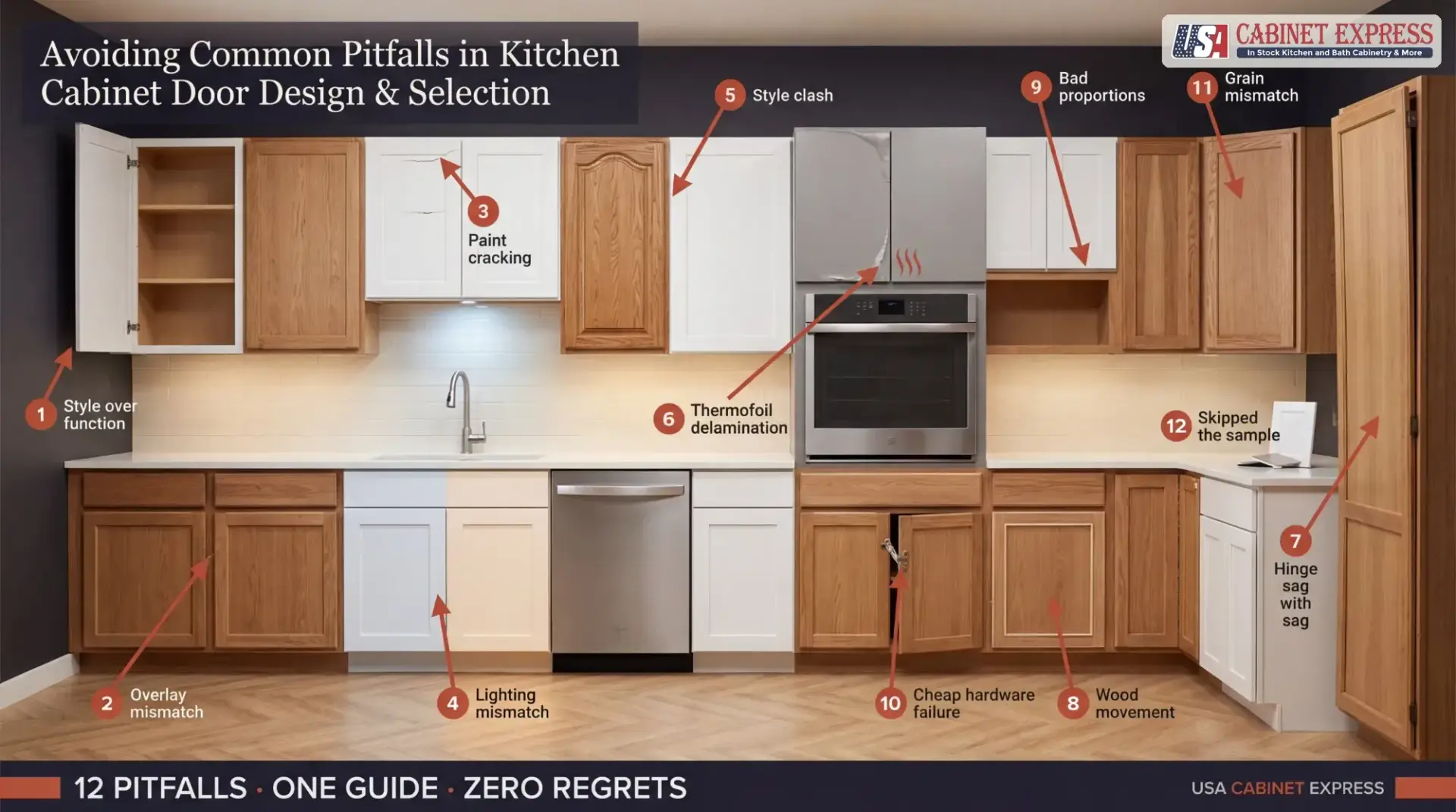
This guide documents 12 common and costly pitfalls in cabinet door design and selection. Each section identifies the mistake, explains its root cause, quantifies the consequence, and provides the specific corrective action. Whether you are a dealer building inventory, a contractor specifying for a client, or a homeowner investing in a kitchen that must last 15–20 years, these are the failures you can prevent before the first order is placed.
⭐ 10 Key Takeaways for Common Pitfalls in Kitchen Cabinet Door Design
1. Spec before you select. Choosing a door by photo without verifying rail width, overlay type, and panel material is the #1 source of cabinet regret—always request a spec sheet and physical sample before ordering.
2. Painted wood cracks. Painting solid wood doors without understanding differential expansion leads to hairline fractures within 12–24 months. HDF center panels eliminate this problem entirely.
3. Overlay type drives budget. Mismatching overlay type to cabinet construction creates uneven reveals. Upgrading from partial to full overlay mid-project adds 15–25%; to inset, 30–40%.
4. Heavy doors sag. Ignoring door weight-to-hinge capacity ratios causes sagging within 2–3 years, especially on tall pantry doors and wide slab panels.
5. Showroom light lies. Finishes approved under 5000K showroom lighting look dramatically different under a home’s 3000K kitchen bulbs. Always take samples home.
6. Two styles maximum. Mixing more than two door styles in a single kitchen creates visual chaos. The 60/30/10 rule applies to door profiles just as it does to color.
7. Swing geometry is non-negotiable. Every door is a moving part. Failing to model door swing envelopes, filler needs, and appliance clearances guarantees collision failures.
8. Thermofoil has a kill zone. Doors adjacent to ovens, dishwashers, and ranges face heat and steam that delaminate thermofoil finishes. Material zoning prevents catastrophic peeling.
9. Proportions matter more than style. A 24″ wall cabinet looks squat; a 28″ opening sits in an “awkward zone” between single and double doors. Getting proportions wrong undermines any style.
10. Samples are your cheapest insurance. Skipping the $15–$25 sample step to save time costs 3–6 weeks in reorder delays and restocking fees when the delivered product misses expectations.
Pitfall 1: Prioritizing Style Over Spatial Function
The Mistake
Selecting cabinet doors based entirely on visual appeal—from a magazine photo, Pinterest board, or showroom display—without mapping how the doors physically operate within the kitchen’s spatial constraints.
Why It Happens
A beautifully finished cabinet door is rendered functionally obsolete if its operational arc obstructs a walkway, impedes an adjacent appliance, or collides with opposing hardware. Yet most selection conversations begin and end with aesthetics. The NKBA specifies that a single-cook work aisle must be a minimum of 42 inches wide, expanding to 48 inches for multi-cook environments. When these clearance requirements are not checked against door swing arcs, the result is a kitchen where doors cannot fully open, drawers block each other, and the daily cooking workflow is a series of frustrating compromises.
The problem compounds at blind corners and appliance adjacencies. French door refrigerators need doors to pivot beyond 90° for crisper drawer extraction—placing one flush against a perpendicular wall renders the interior partially inaccessible. Dishwasher drop-down doors can trap users in dead-end corners. Two full-overlay doors at a 90° interior corner will bind against each other if no filler strip is specified.
The Consequence
Doors that cannot fully open, blocking access to interior storage and pull-out systems. Hardware pulls that gouge adjacent walls, appliance faces, or opposing door panels. Dishwasher and oven doors that lock out adjacent cabinet access during use. Project rework requiring filler strips, repositioned hinges, or substituted drawer banks—all at change-order cost.
The Fix
- Model every door as a moving part. Before finalizing any layout, verify that every door and pull-out clears three zones: adjacent fronts (door-to-door, door-to-drawer), appliance interactions (dishwasher drop-down, oven door, fridge doors), and human flow (aisles, pinch points, island clearances).
- Require filler strips at corners and walls. Filler strips of 1.5″ to 3″ at all inside corners and wherever cabinetry abuts walls prevent door-to-wall collision and allow full 90°–110° swing.
- Substitute drawers for doors in tight bases. In narrow kitchens, drawers reduce swing conflicts and require only a single motion to access contents versus the two-motion door-plus-rollout combination.
- Specify hinge opening angles by location: 90°–95° restricted hinges where doors face walls or appliance panels; 110° standard for unobstructed runs; 165°–170° wide-angle for blind corners with internal pull-outs.
➤ Deep dive: How to Choose Kitchen Cabinet Door Opening Mechanisms: A Complete Checklist
Pitfall 2: Overlay Confusion — Full vs. Partial vs. Inset
The Mistake
Failing to specify overlay type before ordering, or assuming all overlay types work with all cabinet constructions and budgets.
Why It Happens
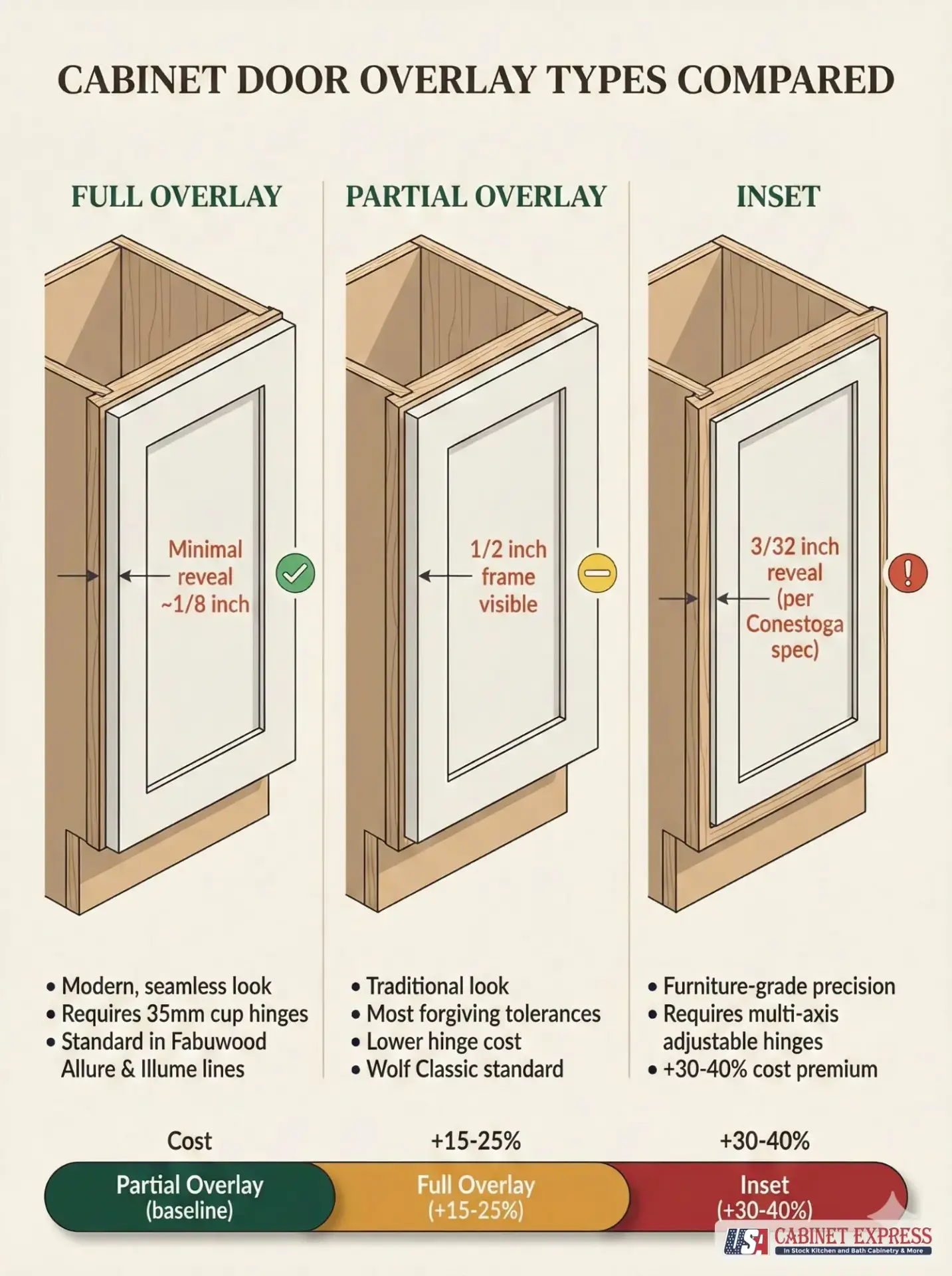
The terms “full overlay,” “partial overlay,” and “inset” are often used loosely in sales settings. A homeowner says “I want the doors to cover the frame” (full overlay), but framed cabinets ship with standard partial overlay hinges. Or the client wants the premium inset look without understanding the 30–40% cost premium and precision installation requirements. Each overlay type carries fundamentally different aesthetics, tolerances, costs, and failure modes—yet the decision is frequently made casually, without documenting the cascading implications.
Full overlay covers nearly the entire cabinet face, leaving minimal reveals between adjacent doors. It creates a sleek, modern appearance and maximizes visual continuity—but requires precise filler planning at corners and walls to prevent collision.
Partial overlay leaves more face frame visible, is the most budget-friendly and forgiving of installation imperfections, but creates strong visual “grid lines” that expose any misalignment.
Inset sits flush within the frame opening with a typical 3/32″ reveal on all sides (per the Conestoga Wood Specialties Systems Manual). It delivers a furniture-grade look but demands multi-axis adjustable hinges, tolerances tight enough that seasonal wood movement can cause binding, and labor-intensive installation. It also reduces usable interior cabinet depth by the door’s thickness.
The Consequence
- Full overlay on framed cabinets with wrong hinges = doors that will not close flush.
- Inset specified without accounting for seasonal wood movement = doors that stick in summer and gap in winter.
- Budget cascade: upgrading from partial to full overlay mid-project typically adds 15–25% to the door/hinge cost. Partial-to-inset adds 30–40%, because the change requires different hinges, different filler strategies, tighter installation tolerances, and often different cabinet boxes entirely.
The Fix
- Confirm overlay type with both the cabinet manufacturer AND the hinge manufacturer before ordering.
- For inset: budget the premium from day one. Define the reveal target (3/32″ typical) and acceptable variance in writing before installation begins.
- Price all three overlay options at the quoting stage—even if the client says “just standard.” Present the cost cascade transparently: door cost + hinge cost + labor differential + filler/trim changes.
- USA Cabinet Express staff can provide accurate comparisons across Fabuwood Cabinetry and Wolf Home Products lines for all overlay configurations, including hinge compatibility.
➤ Deep dive: Inset vs Overlay Cabinets: Which Style Is Right for You?
Pitfall 3: The Painted Solid Wood Fracture Trap
The Mistake
Specifying painted finishes on doors with solid wood center panels, expecting a flawless factory finish that will remain pristine indefinitely.
Why It Happens
Wood is hygroscopic—it constantly exchanges moisture with surrounding air, expanding across its grain when humidity rises and contracting when the environment dries. In a five-piece door, the stiles, rails, and center panel all move at different rates and in different directions relative to their grain orientation. This differential movement stresses the paint film at the joints—creating visible hairline fractures typically within 12–24 months of installation.
Major cabinet manufacturers’ care guides—including Wolf and Fabuwood—explicitly classify painted-joint separation as a “normal characteristic of wood” rather than a defect. Consumers seeing these cracks for the first time, however, universally perceive them as a quality failure.
The Consequence
Hairline fractures at every panel-to-frame joint across the kitchen. Structurally harmless but aesthetically devastating. Manufacturers typically offer no warranty coverage because wood movement is classified as expected behavior. The homeowner blames the contractor, the contractor blames the paint, and no one identified the real culprit: a predictable, preventable material science failure.
The Fix
- For painted finishes: specify doors with HDF (High Density Fiberboard) center panels. HDF exceeds 50 lbs/ft³ density and is dimensionally isotropic—no grain direction means minimal expansion, which virtually eliminates joint fractures.
- The industry gold standard: solid wood frames (for screw-holding power and hinge rigidity) paired with MDF/HDF center panels (for finish stability). The Fabuwood Allure lines and Wolf Classic use this hybrid construction as standard.
- Reserve solid wood construction for stained finishes, where the grain is a design feature and minor seasonal movement is expected and visually acceptable.
- Set expectations with clients: if they insist on painted solid wood, document in writing that hairline joint fractures are a normal characteristic of the material and are not covered under warranty.
➤ Deep dive: Transitional Kitchen Cabinet Door Styles: A Metrics-Based Checklist (Material Science Section)
Pitfall 4: Ignoring Material Zoning — The Thermofoil Kill Zone
The Mistake
Specifying thermofoil (vinyl film over MDF core) uniformly across the entire kitchen without accounting for the heat and steam exposure zones that destroy this material.
Why It Happens
Thermofoil delivers a seamless, consistent, easy-to-clean surface at a lower price point than painted wood—making it an attractive specification for budget-conscious projects. However, thermofoil exhibits fatal vulnerabilities to the thermodynamic realities of active kitchens.
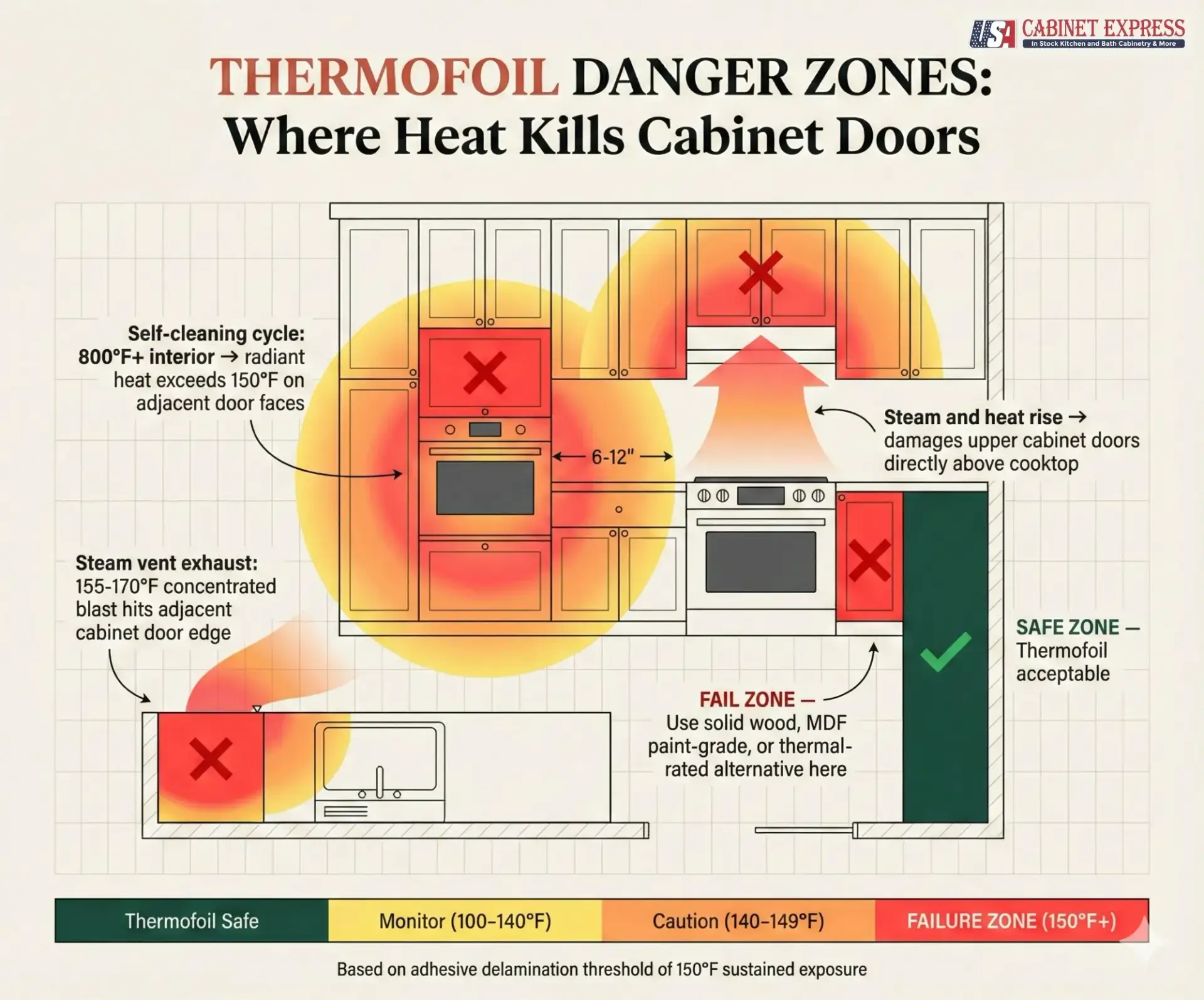
The adhesive bonding vinyl to MDF softens and fails when exposed to sustained temperatures above 150°F. This routinely occurs on doors flanking self-cleaning ovens, above stovetops, and adjacent to dishwasher steam vents. Once steam penetrates the vinyl edge seams, it attacks the adhesive bond while simultaneously causing the MDF core to swell—an irreversible process that results in bubbling, peeling, and delamination. The structural damage to the swollen MDF substrate cannot be repaired; full door replacement is the only remedy.
The Consequence
Catastrophic delamination on the 4–6 doors in the kitchen’s highest-heat zones. Peeling typically begins at edges and corners, spreads rapidly, and turns a “like-new” kitchen into a “needs-replacement” kitchen within 3–5 years—well before the rest of the cabinetry shows any wear. The fix (replacing individual thermofoil doors) is complicated by color-matching challenges as thermofoil colors shift with age and UV exposure.
The Fix
- Zone your materials. Identify the four highest-risk locations in every kitchen: sink base and adjacent cabinets (splash, cleaning chemicals); dishwasher-adjacent doors and panels (steam cycling); range run and oven tower surrounds (heat and grease); and waste bin pull-out doors (impact and repeated contact).
- Reserve thermofoil for low-exposure zones (pantry interiors, above-refrigerator cabinets, laundry rooms) where heat and steam are minimal.
- For high-heat zones: specify painted HDF/MDF, laminate, or solid wood doors—materials that tolerate the thermal and moisture loads of active cooking environments.
- If thermofoil must be used near heat: install metal heat-shield strips between the appliance and adjacent cabinetry, and ensure a high-CFM range hood is actively vented to the exterior to reduce steam condensation.
Pitfall 5: Showroom Lighting Deception
The Mistake
Approving a door finish under showroom lighting conditions that bear no resemblance to the home’s actual lighting environment.
Why It Happens
Cabinet showrooms typically use high-CRI LED lighting at 4000K–5000K (cool white to daylight) to make finishes appear crisp, clean, and color-accurate. Most kitchens use 2700K–3000K (warm white) ambient lighting, with 3500K task lighting under cabinets. The shift from cool to warm dramatically changes how paint colors and wood stains appear—particularly whites, grays, and light wood tones.
The challenge is compounded by the Light Reflectance Value (LRV) shift that defines the 2026 market: stark whites (LRV 90+) are being replaced by warm whites (LRV 82–85) and mushroom/taupe neutrals (LRV 45–60). These warmer tones are far more sensitive to lighting temperature changes than the high-contrast whites they’re replacing.
The Consequence
The “perfect warm gray” selected in the showroom reads blue or purple under 3000K kitchen lighting. The “warm white” reads yellow. The dissatisfaction often does not surface until after full installation—when remediation means repainting or replacing every door in the kitchen. A $15,000+ mistake that started with a $0 decision: not taking a sample home.
The Fix
- Always take sample doors home and evaluate under your actual lighting conditions for at least 48 hours. Evaluate at three times of day: morning daylight, midday mixed light, and evening artificial light only.
- Match cabinet finish to planned bulb temperature: 3000K for stained wood and warm whites; 3500K–4000K for neutral whites and gray tones.
- Request physical samples from USA Cabinet Express ($15–$25 per sample door from Fabuwood and Wolf)—this is the cheapest insurance against the most expensive mistake in kitchen design.
- Photograph samples next to fixed elements (countertop, flooring, backsplash) under each lighting condition and review critically before placing the full order.
Pitfall 6: Getting Proportions and Sizing Wrong
The Mistake
Specifying cabinet doors at widths and heights that produce visually unbalanced proportions, regardless of the style or finish quality.
Why It Happens
Proportion is one of the most overlooked aspects of cabinet door design, yet it controls how the entire kitchen “feels.” Oversized doors overwhelm small kitchens; undersized doors look awkward in large spaces. The issue is compounded by specific sizing traps that catch even experienced designers.
The 24-inch wall cabinet trap: a 24″ wide single-door wall cabinet looks “wide and squat” on the wall, sacrificing elegance regardless of finish quality or price. The 28-inch awkward zone: at 28″ wide, you are too wide for a single door but barely wide enough for a double door, resulting in roughly 12″ doors that look poorly proportioned and limit interior access. Any base cabinet opening wider than 24″ typically requires two doors to prevent warping of a single oversized panel.
The Consequence
A kitchen where every element—style, finish, hardware—is individually excellent, but the overall impression is “something is off.” Clients cannot articulate the problem because proportion failures register subconsciously. The result: dissatisfaction that no hardware swap or paint touch-up can resolve.
The Fix
- Work with standard cabinet widths that produce well-proportioned doors. Base cabinets: 12″–24″ wide per door panel. Wall cabinets: avoid the 24″ squat zone for single doors and the 28″ awkward zone.
- If your layout requires non-standard widths, verify the resulting door proportions with a kitchen designer before ordering.
- For Slim Shaker profiles (2″ rails), proportional sensitivity increases—the narrower frame means the center panel dominates visually, making width-to-height ratios even more critical.
- Visit a USA Cabinet Express showroom to see actual door proportions installed on real cabinet runs—catalogs and screens flatten the three-dimensional proportional relationships that determine how a kitchen feels in person.
Pitfall 7: Mismatching Door Weight and Hinge Capacity
The Mistake
Selecting heavy slab doors, tall pantry doors, or wide cabinet doors without verifying that the hinge is rated for the door’s actual weight.
Why It Happens
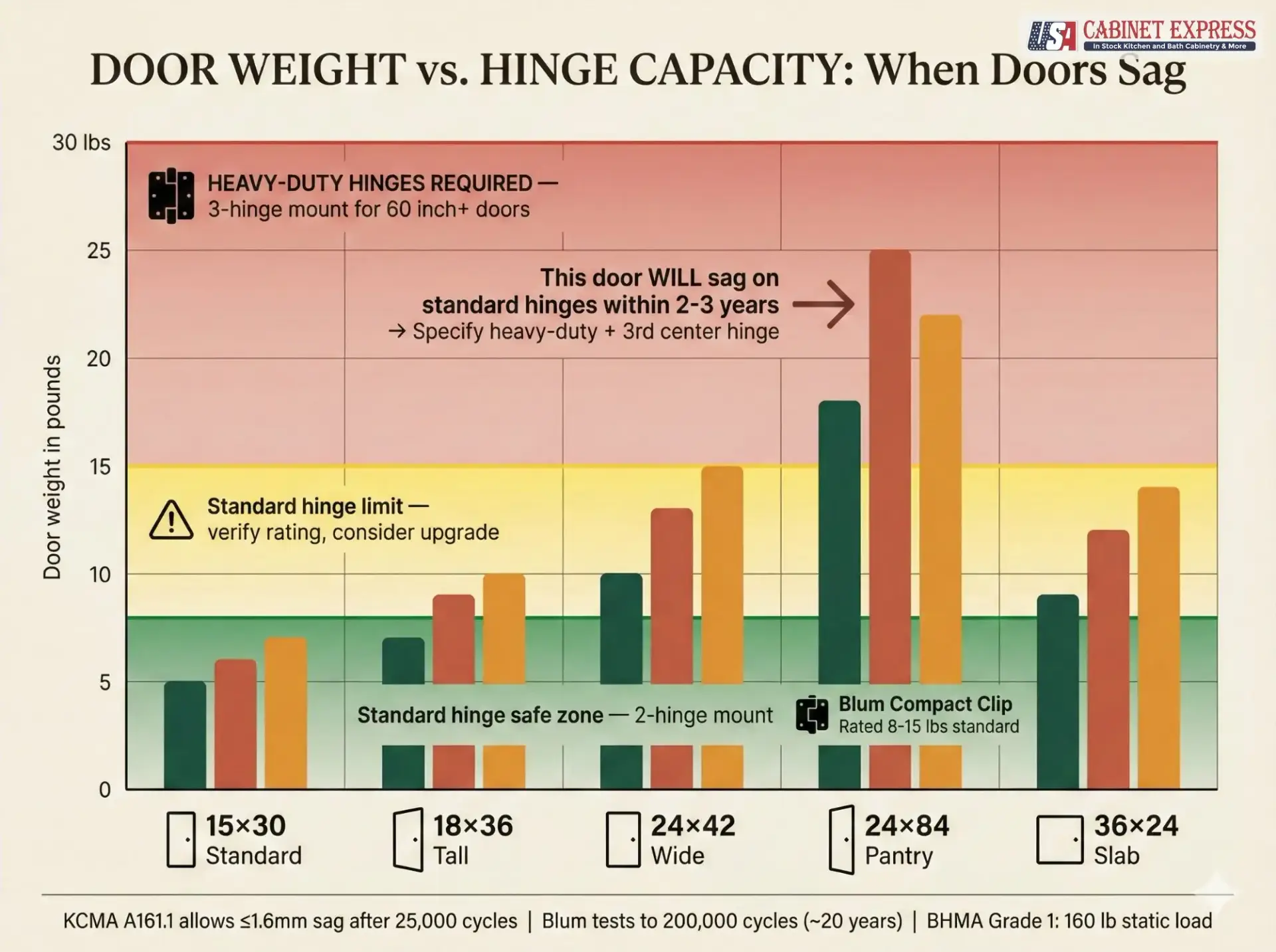
Standard European concealed hinges (35mm cup) are rated for specific weight ranges—typically 8–15 lbs per door for standard residential models. A standard 15″×30″ Shaker door in MDF weighs roughly 6–8 lbs and sits comfortably within range. But a 24″×90″ pantry door in solid wood can exceed 25 lbs. A wide slab door in MDF with high-gloss lacquer can hit 18–20 lbs.
Premium hinges are engineered for dramatically longer service. Blum, Inc. (the Austrian hardware manufacturer) states its hinges are tested to 200,000 opening and closing cycles—approximately 20 years of standard residential use, and eight times the 25,000-cycle baseline required by the KCMA A161.1 performance standard. The Builders Hardware Manufacturers Association (BHMA) Grade 1 certification independently requires hinges to endure 100,000–200,000 open-close cycles and support a 160-pound static load. Hettich Group (Germany) documents 200,000-cycle LGA-certified testing for its Sensys line. Budget hinges, by contrast, may fail at 25,000 cycles or fewer.
The Consequence
Doors sag on their hinges within 2–3 years. The top of the door tilts outward, creating an uneven gap. The soft-close mechanism strains and fails. The homeowner adjusts hinge screws repeatedly until screw holes strip out—at which point the door must be replaced or the cabinet side re-drilled and patched. Industry lifecycle analyses estimate that a $2 hinge saving can create a total cost-of-ownership gap of several hundred dollars per door over a ten-year period, once you factor in replacement hardware, labor, screw-hole repair, and potential door replacement.
The Fix
- Calculate door weight before specifying hinges. Estimate: MDF ≈ 1 lb/sq ft for 3/4″ thickness; solid wood varies by species but typically 1.2–1.5 lb/sq ft.
- For doors exceeding 15 lbs: specify heavy-duty hinges rated for the actual load with a 20% safety margin.
- For tall pantry doors (60″+): use three hinges instead of two—the middle hinge prevents bowing and distributes weight evenly.
- Fabuwood Allure and Illume lines ship with Blum Compact Clip BLUMOTION soft-close hinges as standard—tested to 200,000 cycles and properly matched to door weight specifications.
- For coastal and high-humidity installations (relevant for USA Cabinet Express’s Chesapeake and Fredericksburg locations): specify hardware with documented corrosion testing. Hettich Group tests Sensys hinges against neutral salt spray per EN ISO 9227; Blum documents corrosion resistance through heat, water, and salt exposure testing regimes. Standard plated hinges in uncontrolled coastal environments can seize within 3–5 years.
➤ Deep dive: How Cheap Cabinet Hardware Fails: The Failure Timeline, Hidden Costs, and Safety Risks
Pitfall 8: Ignoring Seasonal Wood Movement in Stained Doors
The Mistake
Selecting stained solid wood doors without understanding or planning for seasonal panel movement—then interpreting normal movement as a defect.
Why It Happens
In a properly constructed five-piece door, the solid wood center panel “floats” in a groove within the frame, allowing it to expand and contract with humidity changes without stressing the frame joints. This floating panel design is not a defect—it is intentional, precision engineering. As documented by the USDA Forest Products Laboratory’s Wood Handbook (General Technical Report FPL-GTR-282, Chapter 4), wood’s equilibrium moisture content shifts continuously with ambient relative humidity, causing measurable dimensional change primarily across the grain.
During dry winter months, the panel shrinks and may reveal a thin line of unfinished wood at the panel edge where it retracts from the frame groove. Consumers and inexperienced contractors frequently panic at this sight. Conversely, during humid summer months, the panel expands and can push tightly against the frame. If the panel was improperly glued into the groove during construction, or if the finish seals the panel unevenly (thin coat on the back, thick on the front), the panel can warp, causing the door to twist and refuse to close flat.
The Consequence
Unnecessary warranty claims and project disputes when seasonal panel lines appear. In cases of improper construction (glued panels, uneven finishing), actual structural warping that forces the door to be replaced. Homeowner dissatisfaction rooted in unset expectations about how natural wood performs in a kitchen environment.
The Fix
- Verify that the manufacturer uses proper floating panel construction—the panel should NOT be glued to the frame.
- Confirm the finish is applied uniformly to all surfaces of the panel (front, back, edges) to equalize moisture absorption.
- Maintain indoor relative humidity between 35–50% and temperature between 60–80°F year-round. This is the single most effective protection against wood movement problems.
- For high-humidity environments (coastal homes, non-climate-controlled spaces): consider engineered cores with veneer faces for dimensional stability, or specify paint-grade HDF/MDF doors.
- Set expectations proactively: inform homeowners that seasonal panel line visibility in stained wood doors is normal behavior, not a defect.
Pitfall 9: Mixing Too Many Door Styles
The Mistake
Combining three or more door styles in a single kitchen, or mixing styles from conflicting design languages (ornate raised panel uppers with stark slab lowers).
Why It Happens
The desire for personalization and “collected over time” aesthetics—fueled by design media showing eclectic interiors—leads to over-specification. What works in a curated magazine photoshoot with professional styling does not translate to a real kitchen where 30–42 doors must create a unified visual field.
The problem extends beyond aesthetics into procurement and maintenance complexity. Multiple door profiles mean multiple manufacturer spec sheets, multiple hardware placement templates, multiple hinge configurations, and multiple spare-door SKUs for future repairs.
The Consequence
Visual chaos. The kitchen reads as indecisive rather than intentional. Ordering complexity increases error rates. Inconsistent hardware placement across different profiles creates subtle but persistent visual discord. Future door replacements become more difficult and expensive when multiple profiles must be sourced and matched.
The Fix
- Maximum two door styles in any single kitchen.
- Apply the 60/30/10 rule: 60% primary style (perimeter), 30% secondary style (island or accent area), 10% differentiation through hardware and finish—not additional door profiles.
- Successful two-style combinations: Slab uppers + Shaker lowers. Shaker perimeter + glass-front display cabinets flanking the range. Flat-panel island + transitional perimeter.
- Avoid: multiple Shaker rail widths in the same sightline (a 2″ Slim Shaker next to a 2.5″ Traditional Shaker reads as a mistake, not a design choice). Styles from opposing design languages in direct adjacency. More than two door profiles in a single sightline.
➤ Deep dive: Kitchen Cabinet Door Styles in 2026: Strategic Outlook for Dealers, Contractors and Homeowners
Pitfall 10: Measurement Errors and the Non-Returnable Order
The Mistake
Ordering custom or semi-custom cabinet doors based on inaccurate measurements, then discovering that custom-made doors are typically non-returnable.
Why It Happens
Measurement errors are among the most frustrating and expensive cabinet door pitfalls because the consequences are absolute: a door cut to the wrong size cannot be adjusted. Common errors include not measuring each opening individually (cabinet openings vary even on the same wall), forgetting overlay allowances (for standard 1/2″ overlay with concealed hinges, add 1″ to both width and height of the opening), using worn tape measures with bent or loose metal tabs that produce consistently inaccurate readings, and measuring from the front of a beveled door rather than the back.
In frameless full-overlay systems, the margin for error is particularly unforgiving. Deviations as small as 1/16″ can cascade into visible reveal inconsistencies across an entire cabinet run.
The Consequence
Doors that are too large to fit or too small to cover properly. Restocking fees on non-returnable custom orders (when accepted at all). Reorder delays of 3–6 weeks while the kitchen sits partially assembled. Contractor credibility damage and client relationship strain.
The Fix
- Create a numbered diagram of every cabinet in the kitchen before measuring anything.
- Measure each opening individually—never assume two cabinets of the same nominal size have identical openings.
- Measure twice with two different tools. Cross-check at multiple points (top, middle, bottom for width; left, center, right for height).
- Note the overlay type and hinge allowances on the measurement sheet before transmitting the order.
- For USA Cabinet Express in-stock RTA cabinets, door sizes are pre-matched to cabinet specifications—eliminating this risk entirely when ordering complete cabinet-and-door sets.
Pitfall 11: Veneer Mismatch and Grain Chaos
The Mistake
Failing to specify grain direction, veneer matching method, and sequence continuity when ordering natural wood, wood veneer, or engineered woodgrain doors.
Why It Happens
When utilizing natural wood or veneer finishes, the orientation and matching of the grain dictates the visual coherence of the entire space. Vertical grain draws the eye upward, elevating perceived ceiling height. Horizontal grain expands perceived width and grounds the design. Mixing these orientations without deliberate architectural intent—such as inadvertently placing vertical-grain uppers directly over horizontal-grain lowers—creates immediate visual chaos.
Veneer matching adds another layer of complexity. Book matching (mirroring consecutive leaves) creates symmetry but introduces “barber pole effect” risk—because alternating veneer leaves are flipped face-up then face-down, each leaf reflects light at a slightly different angle and absorbs stain at a different rate, creating a subtle but noticeable stripe pattern across adjacent doors. Slip matching (sliding leaves side-by-side without flipping) eliminates the barber pole effect but can make slanted grain appear to lean uniformly across a cabinet run. Sequence matching ensures adjacent doors share similar color and pattern family.
The Consequence
Random grain directions across a cabinet run that destroy visual coherence. Color inconsistency between adjacent doors caused by the barber pole effect in book-matched veneers. Customer complaints and “this looks wrong” callbacks that cannot be resolved without replacing doors from a new, properly matched flitch.
The Fix
- Specify grain direction (vertical or horizontal) on the order. Do not assume the manufacturer will default to your preference.
- For premium stained installations: specify the veneer matching method (book, slip, or sequence) and request that doors be cut from the same flitch for color consistency.
- Order all doors for a single kitchen at the same time to ensure batch consistency in color, grain, and stain absorption.
- If using engineered woodgrain finishes (as available in Fabuwood and Wolf lines), confirm that the grain embossing pattern is consistent in direction across all doors—even engineered finishes require orientation specification.
Pitfall 12: Skipping the Sample Step to Save Time
The Mistake
Ordering a full kitchen’s worth of doors without first ordering and evaluating physical samples—because the project timeline feels “too tight” to wait.
Why It Happens
Renovation timelines create pressure. The cabinet order feels like the long pole in the schedule, and adding 1–2 weeks for sample evaluation seems like an unaffordable delay. So the client or contractor orders based on a catalog swatch, a digital rendering, or a showroom memory.
A cabinet door is a tactile object that will be touched 10,000+ times over its lifetime. The sound it makes when closing, the weight in the hand when opening, the texture of the finish under fingertips—these are experience metrics that no photograph, digital rendering, or catalog swatch can convey. The color accuracy of screens varies widely. Catalog swatches fade. Showroom memories are colored by the showroom’s lighting, not the home’s.
The Consequence
The delivered product does not match expectations. The “white” is too yellow. The “gray” is too blue. The grain pattern is more pronounced than expected. The door feels lighter or hollower than the showroom sample (which was a different product line). The project now faces a 3–6 week reorder delay, restocking fees of 15–25% of order value, and a damaged client relationship.
The Fix
- Build sample evaluation into every project timeline as a non-negotiable step. 1–2 weeks invested now saves 3–6 weeks of potential reorder delays.
- Order samples of the top 2–3 contenders ($15–$25 each through USA Cabinet Express from Fabuwood and Wolf).
- Evaluate samples in the actual space, under actual lighting, for at least 48 hours. Perform the touch test: close the door and listen (solid vs. hollow?), lift it (substantial vs. flimsy?), run your hand across the surface (smooth vs. rough? fingerprint-resistant?).
- Take photos of samples next to existing fixed elements (countertops, flooring, backsplash) and review critically before placing the full order.
- USA Cabinet Express advantage: once samples are approved, the full order ships from in-stock inventory immediately—no 8–12 week factory wait. The sample step does not extend the project timeline when using an in-stock supplier.
⚠️ Pro Tip: Crown Molding on Frameless Cabinetry
A common and costly installation mistake—especially relevant for the USA Cabinet Express Illume line (Threespine® frameless construction)—is attempting to attach crown molding directly to the top edge of the cabinet box. Without a face frame providing a nailing surface, the molding either blocks the operational swing of the full-overlay door or pulls away under its own weight.
The fix: Install a hidden sub-frame (nailer strip) mounted to the top of the cabinet boxes using a pneumatic brad nailer and heavy-duty wood glue. This sub-frame must sit behind the door’s plane so it accepts the crown molding’s brad nails without interfering with the door’s 110-degree operational swing. Fabuwood publishes a detailed installation guide for crown molding on their frameless lines at fabuwood.com/blog.
Understanding Cabinet Performance Standards
When evaluating cabinet doors, anchoring expectations to recognized performance standards prevents both under-specification and over-promising. The KCMA A161.1 standard sets a meaningful durability baseline for the kitchen and bath cabinet industry. The Builders Hardware Manufacturers Association (BHMA) independently certifies hinge and slide hardware to Grade 1 through Grade 3 performance tiers. The Architectural Woodwork Institute (AWI) establishes material and craftsmanship grades for premium architectural casework. Premium hardware from manufacturers like Blum and Hettich is designed and tested far beyond these baselines.
Understanding Cabinet Performance Standards
KCMA A161.1 baseline vs. premium hardware — what the numbers actually mean for your kitchen.
| Performance Metric | KCMA A161.1 Baseline | Premium Hardware | Practical Meaning |
|---|---|---|---|
| Door cycling | 25,000 cycles | 200,000 cycles Blum Hettich |
≈7 yrs vs. ≈20 yrs of residential use (per Blum) |
| Door sag tolerance | ≤1.6mm after testing | Engineered to maintain alignment through full cycle life | Premium hinges stay aligned; budget hinges visibly droop |
| Drawer cycling | 25,000 cycles at 15 lb/ft² load | 100,000 cycles Blum MOVENTO / TANDEM |
4× longer service in high-frequency drawers |
| Finish durability | Heat, chemical, water resistance tests on production doors | Factory-applied multi-coat systems with edge sealing | Resists kitchen chemicals, water spotting, heat marking |
USA CABINET EXPRESS
Material Selection Quick Reference
Every material excels somewhere and fails somewhere. The key is matching materials to their environment—not applying a single material uniformly across zones with dramatically different exposure profiles.
Material Selection Quick Reference
Choose the right door material for every zone in your kitchen — stability, lifespan, and vulnerabilities at a glance.
| Material | Best For | Stability | Key Vulnerability | Service Life | Kitchen Zones to Avoid |
|---|---|---|---|---|---|
| Solid Wood (frame & panel) |
Stained finishes; authentic grain | Medium Moves with humidity |
Paint joint fractures; seasonal expansion | Decades with controlled environment |
✓ None if properly maintained |
| Paint-Grade HDF/MDF | Painted finishes; smooth surface | High Engineered |
Standing water; edge damage | Long-life with edge sealing |
⚠ Caution Direct water contact zones without edge protection |
| Veneered MDF / Plywood | Natural wood appearance; modern slabs | High Stable substrate |
Veneer edge damage; abrasives | Long-life when sealed |
⚠ Caution High-abrasion zones without protection |
| Thermofoil (vinyl / MDF) |
Budget projects; easy-clean surface | Medium–High Core stable; film sensitive |
Heat >150°F; steam; edge delamination | ≈10–15 years typical |
✕ AVOID Oven-adjacent · Dishwasher-adjacent · Above-range |
USA CABINET EXPRESS
Decision Flow: From Design to Installation
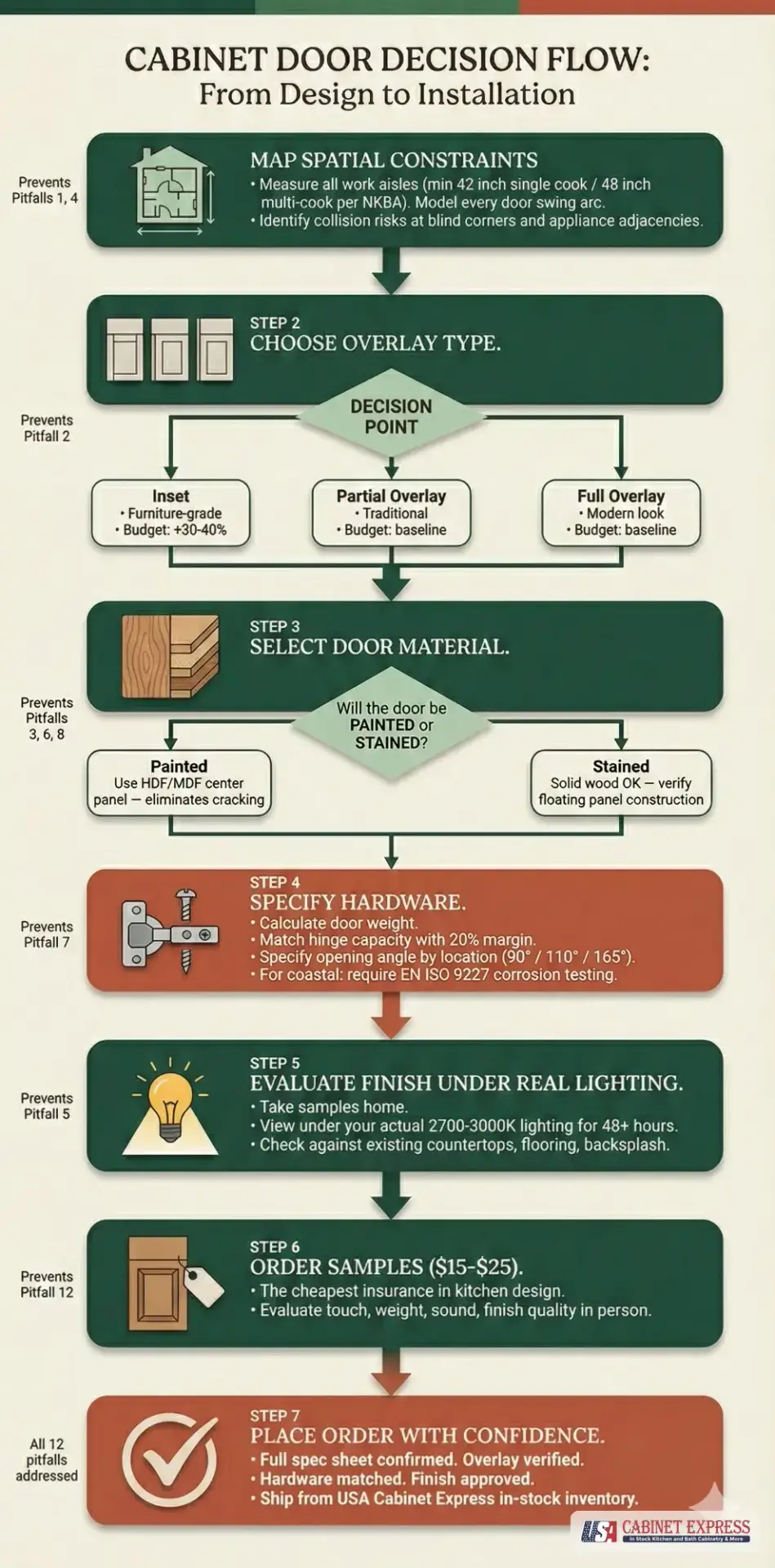
The sequence below ensures that each decision is made before its downstream dependencies are locked in. Overlay style and swing planning happen before finish and hardware. Tolerances are defined before purchase orders.
Step 1: Measure and document constraints — Aisles, appliance doors, corners, ceiling height, wall irregularities
Step 2: Choose cabinet construction — Framed vs. frameless; confirm with supplier
Step 3: Select door style and overlay type — Full overlay / partial overlay / inset; document cost cascade
Step 4: Model swing envelopes and filler needs — Verify every door clears walls, appliances, and adjacent fronts
Step 5: Select material and finish system — Paint vs. stain; zone materials to heat/steam/moisture exposure
Step 6: Specify hardware performance — Hinge type, capacity, cycle rating; drawer slides; soft-close; corrosion resistance
Step 7: Write tolerances and QC criteria — Reveal targets, flatness, acceptable variation—all in writing
Step 8: Order samples and approve in-situ — Color, sheen, texture, weight under actual home lighting
Step 9: Install boxes level and plumb — Then hang and adjust doors and drawers
Step 10: Commission and brief homeowner — Fine adjustment + care guide + schedule 30–90 day follow-up
How USA Cabinet Express Prevents These Pitfalls
Every pitfall in this guide shares a common root cause: the gap between expectation and specification. USA Cabinet Express exists to close that gap.
- In-stock inventory, no 8–12 week wait. Once samples are approved, the full order ships immediately from stocked warehouses across Austin TX, Chesapeake VA, St. Louis MO, Dallas TX, Houston TX, and Fredericksburg VA. The sample evaluation step does not extend your project timeline.
- Premium construction as standard. Fabuwood Allure lines feature solid wood frames with MDF/HDF center panels (the hybrid gold standard for painted finishes) and Blum BLUMOTION soft-close hinges tested to 200,000 cycles. The Illume line uses Threespine® frameless construction with 3/4″ EFB panels for maximum interior access.
- Every overlay configuration available. Fabuwood and Wolf lines cover partial overlay, full overlay, and specialty configurations—with hinge compatibility confirmed at the specification stage, not discovered at installation.
- Sample door lending program. $15–$25 per sample door from both Fabuwood and Wolf, shipped or available at any showroom for at-home evaluation under your actual lighting conditions.
- Seven showroom locations. See, touch, and compare actual door profiles, finishes, and hardware combinations before ordering. Handle the doors. Listen to the close. Feel the weight. No catalog can replace this.
- Design staff who speak specifications. USA Cabinet Express staff provide complete specification sheets for every Fabuwood, Wolf, and Mantra line—including rail widths, panel materials, hinge ratings, overlay dimensions, and finish system details.
Frequently Asked Questions forCommon Pitfalls in Kitchen Cabinet Door Design
What is the single most common cabinet door mistake?
Choosing a door style from a photo without verifying the actual rail width, panel material, and overlay type. The visual difference between a 2″ Slim Shaker and a 2.5″ Traditional Shaker is dramatic across a 30–42 door kitchen, but nearly invisible in a catalog photo. Always request a spec sheet and a physical sample before committing.
How do I prevent paint cracking on cabinet doors?
Specify doors with HDF (High Density Fiberboard) center panels for painted finishes. HDF is dimensionally stable and will not expand or contract like solid wood, eliminating the joint stress that causes paint fractures. Reserve solid wood panels for stained finishes only, where grain texture is a design feature. The Fabuwood Allure lines use this hybrid construction as standard.
Is it worth ordering sample doors before committing?
Always. Sample doors cost $15–$25 each through USA Cabinet Express and can be evaluated in your home’s actual lighting. This is the cheapest insurance against a color, texture, or style mismatch that would cost thousands to correct after full installation. With USA Cabinet Express’s in-stock model, the sample step does not extend your overall project timeline.
What is the real cost difference between partial overlay and full overlay?
The doors themselves may be similar in price, but full overlay triggers a cost cascade: different hinges, different filler strip requirements, tighter installation tolerances, and potentially different cabinet construction (frameless). Plan for 15–25% more than partial overlay when calculating the total installed cost. Always price both options at the quoting stage.
Can thermofoil doors be used near ovens and dishwashers?
This is the highest-risk zone for thermofoil failure. Sustained heat above 150°F and steam exposure cause the vinyl-to-MDF adhesive to soften and fail, resulting in irreversible bubbling and peeling. If thermofoil must be used near appliances, install metal heat-shield strips and ensure an exterior-vented range hood is actively used during cooking. Better strategy: zone a different material (painted HDF/MDF or solid wood) for these 4–6 high-exposure doors.
How many door styles can I mix in one kitchen?
Two is the practical maximum. Use the 60/30/10 rule: 60% primary style on perimeter, 30% secondary style on island or accent areas, 10% differentiation through hardware and finish variation—not additional door profiles. Successful combinations include slab uppers with Shaker lowers, or a flat-panel island with a transitional perimeter.
My stained wood doors show a light line at the panel edge in winter. Is this a defect?
No. In properly constructed five-piece doors, the center panel “floats” in the frame groove and contracts during dry winter months, which can reveal a thin line of unfinished wood. This is intentional engineering—not a manufacturing defect. Maintaining indoor humidity between 35–50% minimizes the visible movement. If the panel is bowing or the frame is twisting, that indicates a construction defect and should be addressed under warranty.
What KCMA A161.1 certification tells me—and what it does not?
KCMA certification means the cabinet has passed standardized durability testing: 25,000 door and drawer operation cycles, finish resistance tests (heat, chemical, water), and construction quality checks. It sets a meaningful floor for mainstream cabinetry. The BHMA (Builders Hardware Manufacturers Association) separately certifies hinge and slide hardware—a BHMA Grade 1 hinge is rated for 100,000–200,000 cycles and must support a 160-pound static load. The Architectural Woodwork Institute (AWI) establishes additional material and craftsmanship grades for premium architectural casework. Premium hardware from Blum, Inc. (200,000 cycles) and Hettich Group (200,000 cycles) exceeds all of these baselines.
Do I need special hardware for coastal or high-humidity kitchens?
Yes. Standard plated hinges in uncontrolled coastal environments can corrode and seize within 3–5 years. For homes near saltwater or in consistently humid climates, specify hardware with documented corrosion testing. Hettich tests Sensys hinges against neutral salt spray per EN ISO 9227; Blum documents corrosion resistance through heat, water, and salt exposure testing. USA Cabinet Express’s Chesapeake and Fredericksburg VA locations can advise on the right hardware specifications for coastal Virginia installations.
What hinge opening angle should I specify?
Match the angle to the cabinet’s location: 90°–95° restricted for doors adjacent to walls or appliance panels (prevents handle damage); 110° standard for unobstructed parallel runs (the default for Blum hinges in Fabuwood and Wolf lines); 165°–170° wide-angle for blind corner cabinets with internal roll-outs (allows full access to interior mechanisms).
Where can I evaluate cabinet doors in person before ordering?
USA Cabinet Express operates seven showroom locations: Austin TX, Chesapeake VA, St. Louis MO, Dallas TX, Houston TX, and Fredericksburg VA. Each showroom features complete kitchen vignettes displaying door styles, finishes, and hardware combinations from Fabuwood, Wolf, and Mantra lines. Walk in with this guide and your kitchen dimensions for a consultation.
| Your Next Step: Prevent the Pitfalls Before They Cost You
Visit your nearest USA Cabinet Express showroom with this guide in hand. Handle the doors. Test the finishes under your lighting. Verify the specs. The best time to prevent a pitfall is before the first order is placed. ➤ Schedule a Free Design Consultation |
USA Cabinet Express Showroom Locations
Austin, Texas • (469) 336-9201 • 2112 Rutland Dr #185, Austin, TX 78758
Chesapeake, Virginia • (757) 296-6669 • 1543 Sams Cir, Chesapeake, VA 23320
St. Louis, Missouri • (314) 900-0440 • 2605 S Hanley Rd, Saint Louis, MO 63144
Dallas, Texas • (469) 990-2200
Houston, Texas • (281) 306-6060
Fredericksburg, Virginia • (540) 515-1500
Hours: Mon–Fri 8AM–6PM, Sat 9AM–5PM, Sun Closed
Online: usacabinetexpress.com